Beyond the Perimeter: Understanding Dynamic Threats and the Flawed “Secure Before Care” Mentality
Introduction
In contemporary high-threat incidents, the most dangerous assumption responders can make is that a fully “secure” environment will ever exist before care is required. Active shooter events, complex assaults, and coordinated acts of violence do not unfold within fixed boundaries or predictable timelines. They evolve, migrate, fragment, and terminate rapidly—often before traditional response models can complete even their initial phases. Yet many operational doctrines continue to rely on a perimeter-based mindset that treats safety as a condition to be achieved before medical action begins. This assumption is no longer compatible with reality.
The central argument of this analysis is direct and evidence-based: the “secure before care” mentality is operationally flawed in dynamic threat environments and directly contributes to preventable death. Modern response requires abandoning static perimeter thinking and adopting integrated, TECC-aligned medical operations that function inside hot and warm zones while threats are still being managed. Care delivered early, under protection, saves lives; care delayed in pursuit of certainty costs them.
Why Perimeter-Based Safety Frameworks Fail in Fluid Threat Events
Perimeter-based safety frameworks assume that threats can be geographically contained and temporally stabilized. The scene is cordoned, the perimeter expands or contracts, and once control is achieved, additional assets are permitted to enter. This model emerged from fireground operations, hazardous materials incidents, and large-scale disasters where hazards were largely environmental and predictable.
Dynamic threat events violate every one of these assumptions. Active attackers move. They change locations, alter tactics, and exploit response delays. Threats may fragment into multiple nodes or terminate suddenly without external intervention. In these conditions, perimeters are descriptive at best and misleading at worst.
When medical response is tied to perimeter status, care becomes hostage to an abstraction rather than guided by physiology. Responders wait not because care cannot be delivered, but because a line on a map has not yet been redrawn. The perimeter becomes a proxy for safety—one that fails to reflect real-time threat dynamics.
The Illusion of a Fully “Secure” Environment
At the heart of the “secure before care” mentality is an implicit promise: that if responders wait long enough, a moment of total safety will arrive. In high-threat events, this promise is false. There is no point at which risk is eliminated—only moments when it is managed to an acceptable level for specific actions.
Assuming that full security precedes care creates a binary decision model: unsafe equals no action; safe equals action. This model collapses under ambiguity. When safety cannot be confirmed, responders default to delay. Meanwhile, hemorrhage continues, airways obstruct, and shock progresses.
This illusion of eventual safety also distorts responsibility. Risk is shifted from responders to patients without explicit acknowledgment. The system implicitly decides that responder protection outweighs patient survivability, even when early intervention could dramatically alter outcomes. This is not a clinical decision; it is a doctrinal artifact.
Mobile and Expanding Threats: The End of Static Thinking
Dynamic threats invalidate static thinking in three critical ways.
First, threat location is transient. Attackers move faster than perimeters can adapt. A scene declared “secure” moments ago may become contested again without warning. Waiting for static security in a mobile threat environment ensures perpetual lag.
Second, threat scope is uncertain. Secondary attackers, devices, or delayed assaults may exist beyond the initial area of focus. Expanding perimeters in response to uncertainty only increases distance between casualties and care.
Third, incident duration is compressed. Empirical data consistently demonstrates that most active shooter incidents conclude within minutes. By the time traditional security benchmarks are achieved, the incident has often already ended—leaving casualties untreated during the most survivable window.
These realities demand a shift from location-based safety decisions to time- and threat-informed action.
The Physiological Cost of Waiting
Trauma physiology does not negotiate with doctrine. The leading causes of preventable death in violent incidents—uncontrolled hemorrhage, airway compromise, and traumatic shock—progress rapidly and predictably. The effectiveness of simple interventions declines sharply with time.
Tourniquets, wound packing, airway positioning, and rapid movement are most effective when applied early, often within the first few minutes after injury. Delays measured in minutes, not hours, correlate strongly with mortality. When medical care is withheld until an area is deemed secure, the survivable window closes.
This is the irreducible truth anchoring modern tactical medicine: time without care equals irreversible loss. Any framework that prioritizes spatial certainty over temporal urgency is misaligned with human physiology.
Operational Benefits of Care Inside Hot and Warm Zones
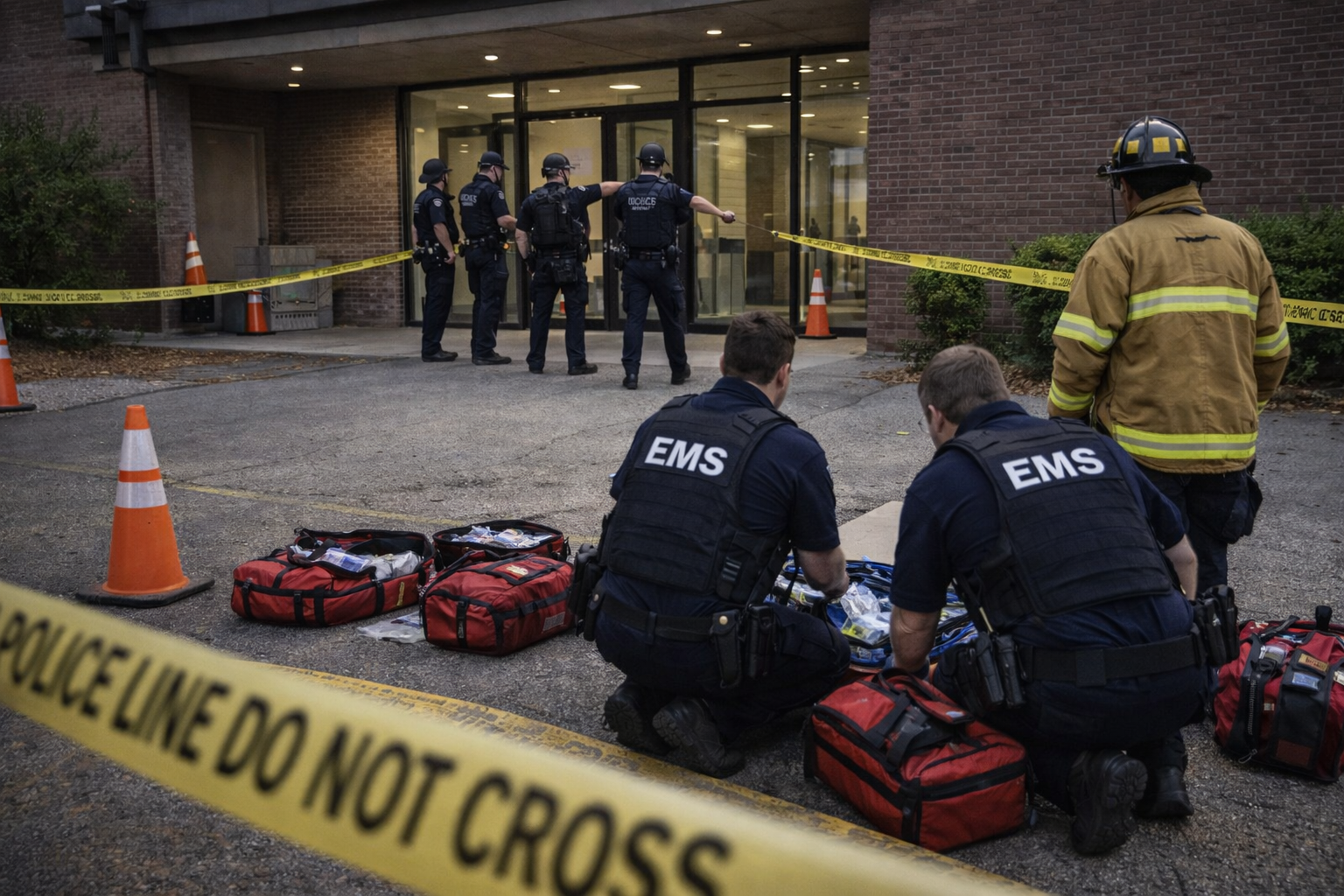
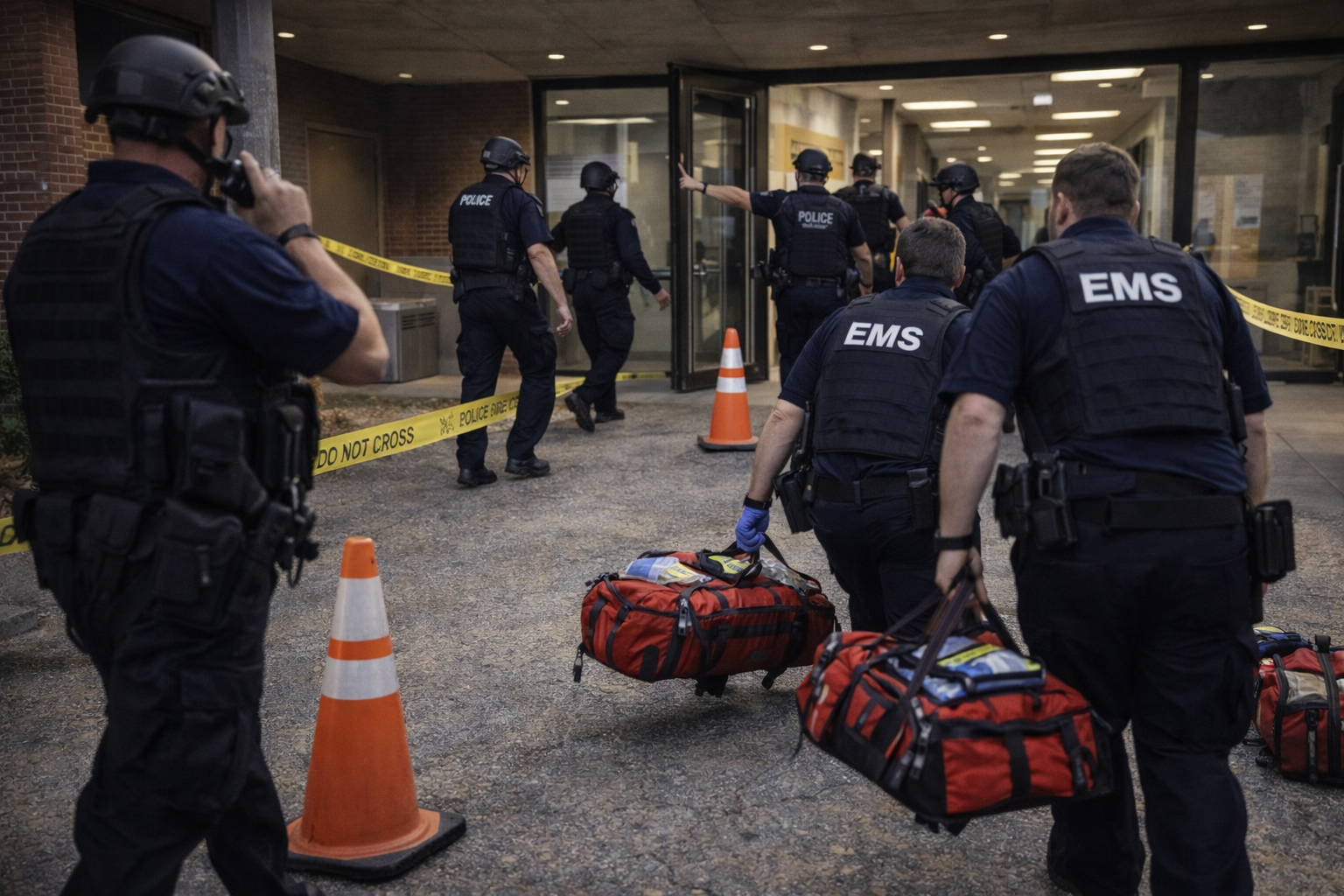
Delivering care inside hot and warm zones fundamentally alters outcomes. Early access enables immediate hemorrhage control, faster triage, and accelerated casualty movement away from danger. It reduces the distance—both physical and temporal—between injury and intervention.
Critically, hot and warm zone care does not imply uncontrolled exposure. It is predicated on integrated movement, law enforcement protection, and continuous threat assessment. This is managed risk, not reckless entry.
Operational benefits include:
Earlier hemorrhage control, reducing preventable death
Improved casualty flow, preventing bottlenecks
Shortened extraction timelines, reducing secondary injury
Enhanced situational awareness, as medical teams contribute real-time observations
These benefits compound. Each minute saved increases the probability of survival and reduces downstream resource strain.
Medical Rescue Teams and TECC-Based Dynamic Care
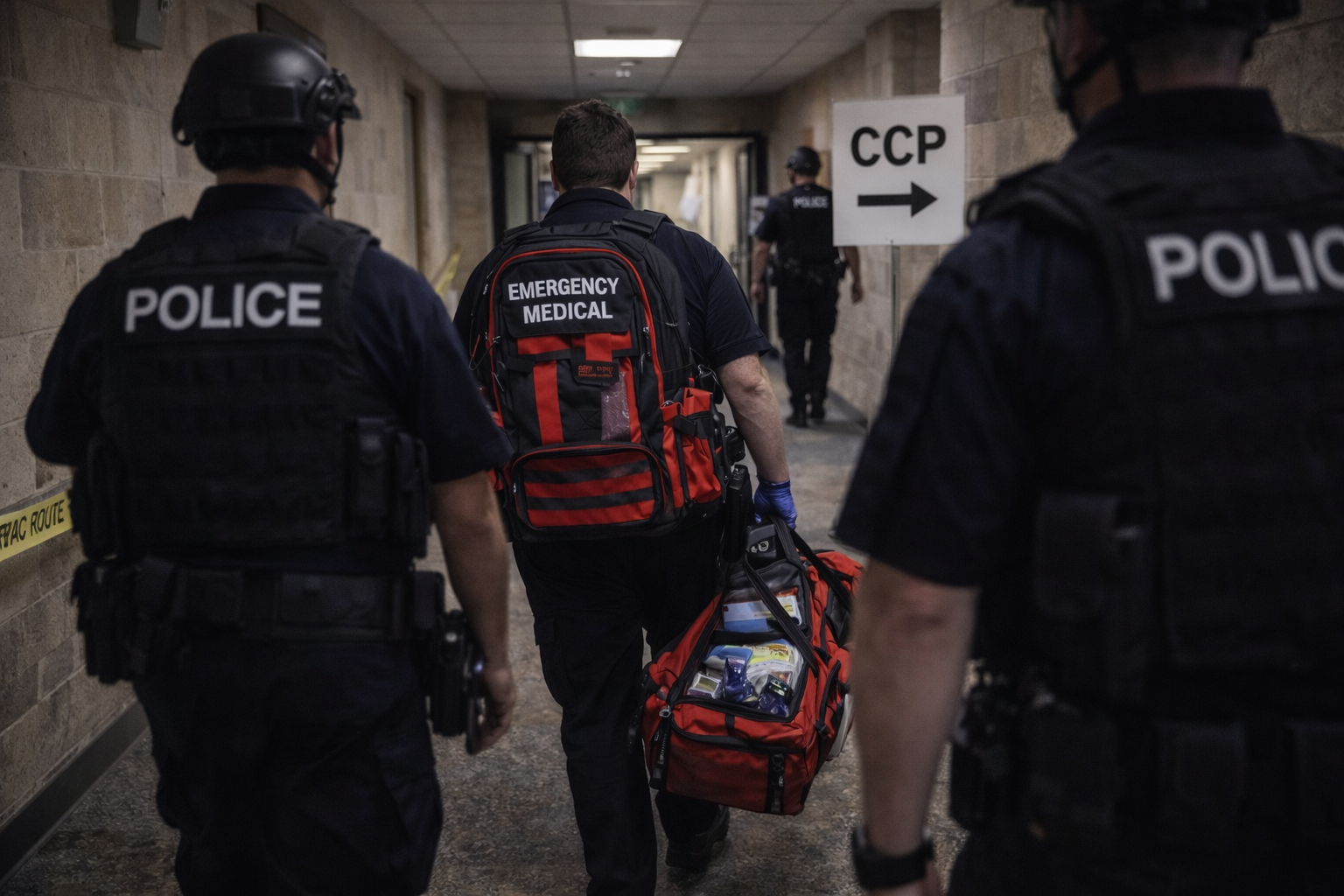
Medical Rescue Teams (MRTs) operationalize dynamic care under threat. By embedding medical providers with armed protection, MRTs enable threat-mitigated access to casualties in environments that are not—and may never be—fully secure.
Within Tactical Emergency Casualty Care (TECC), MRTs are not anomalies; they are expected capabilities. TECC recognizes that care must occur during threat management, not after it. Zones are fluid, risk is continuous, and intervention must be synchronized with tactical operations.
MRTs collapse the false dichotomy between “tactical” and “medical” phases. Law enforcement manages the threat while medical providers manage physiology. These efforts are parallel, not sequential.
When MRTs are integrated into planning, training, and command structures, early care becomes routine rather than controversial.
Cognitive Anchoring and the Persistence of the Perimeter Myth
The persistence of the “secure before care” mentality is not primarily a knowledge problem; it is a cognitive anchoring problem. What responders learn first—and repeat most often—becomes their default under stress.
If training frames safety as a prerequisite rather than a continuum, responders hesitate when certainty is absent. Under cognitive load, ambiguity triggers inaction. This is not fear; it is conditioned behavior.
Listener attention science emphasizes primacy and repetition. When early instruction centers on static safety concepts without equal emphasis on dynamic risk management, those concepts dominate decision-making. Correcting this requires deliberate repetition with variation—training that forces responders to operate in ambiguous, evolving threat environments.
From Perimeters to Purpose: A New Safety Paradigm
Safety in dynamic threat events must be reframed from avoidance to purpose-driven action. The relevant question is no longer “Is the scene secure?” but “What action is necessary now, and what level of risk is acceptable to achieve it?”
This reframing aligns safety with outcomes rather than distance. It acknowledges that some exposure is inherent in life-saving operations and that delaying action carries its own, often greater, risk.
Fire services have long accepted this logic in structural firefighting. Law enforcement accepts it in dynamic entries. Tactical medicine must do the same.
Training, Policy, and Command Alignment
Abandoning the “secure before care” mentality requires alignment across training, policy, and command.
Training must integrate medical providers into contested-environment scenarios alongside law enforcement. Policies must explicitly authorize early medical access under defined protections. Command structures must prioritize parallel operations over sequential clearance.
Most importantly, leadership must endorse managed risk in pursuit of survivability. When responders know they will be supported for acting within doctrine, hesitation decreases and performance improves.
Progressive Emphasis: Returning to What Matters Most
Throughout this discussion, one principle recurs with variation: time matters more than territory. Whether viewed through physiology, psychology, or operations, the conclusion is the same. Waiting for spatial certainty delays temporal necessity.
By progressively returning to this anchor—early care saves lives—doctrine can be reshaped to reflect reality rather than nostalgia.
Conclusion
The “secure before care” mentality is a relic of a response environment that no longer exists. In dynamic, high-threat events, perimeters are fluid, threats are mobile, and certainty is fleeting. Waiting for full security delays care beyond the most survivable window and shifts risk onto those least able to bear it.
Modern response demands a new paradigm—one that recognizes safety as dynamic, integrates medical operations into hot and warm zones, and leverages MRTs and TECC-based frameworks to deliver care under threat. This is not a call for recklessness. It is a call for relevance.
Beyond the perimeter lies the truth responders must confront: lives are saved not when danger disappears, but when action begins despite it.