
Breakdown in Translation to Civilian Public Safety
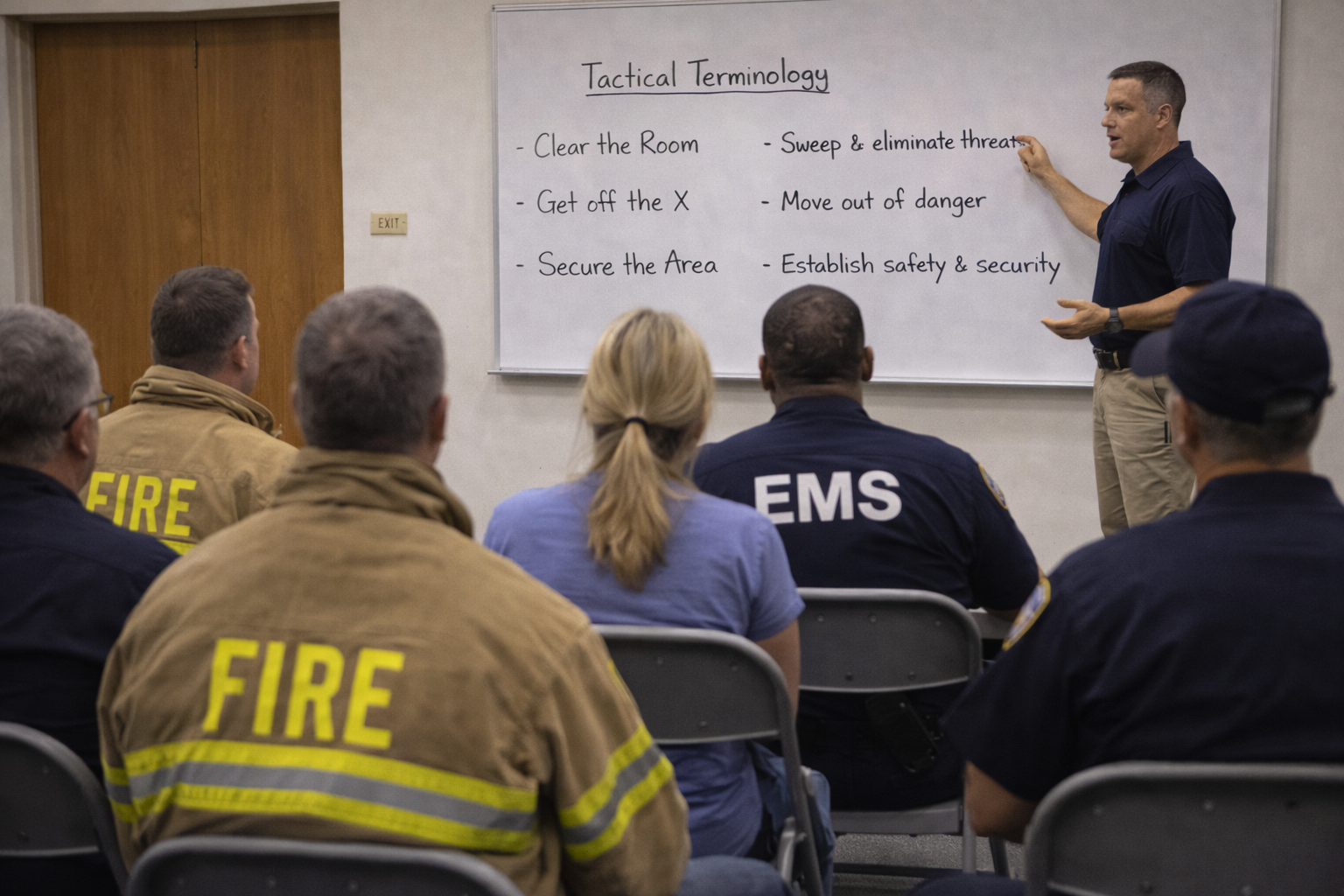
Breakdown in Translation to Civilian Public Safety: When Borrowed Language Fractures Unified Action
In high-risk civilian incidents, especially active shooter and complex threat events, language is not decorative—it is directive. The words used in briefings, policies, and training become the cues that drive action under stress. When those words are imported from military contexts without translation, they often carry authority without clarity. The result is a subtle but dangerous breakdown: responders believe they are aligned because they are using the same terms, while in reality they are operating from different assumptions, constraints, and expectations.
The central argument of this analysis is straightforward: military terminology, when introduced into civilian public safety without doctrinal alignment, becomes distorted and operationally ambiguous. Civilian EMS, fire, and law enforcement operate under distinct legal frameworks, command structures, and risk tolerances. When military terms are oversimplified or inconsistently applied across these disciplines, coordination degrades precisely when it is most needed. Using the science of listener attention—front-loaded relevance (primacy), structured cognitive chunking, progressive emphasis, repetition with variation, and continuous relevance anchoring—this article explains why translation fails, how ambiguity emerges, and what must change to restore shared understanding.
Why Translation Failure Is an Operational Problem
Front-loading relevance is essential: misunderstood language creates real-world risk. In moments of urgency, responders do not pause to debate definitions; they act on what they believe words authorize. If those beliefs differ across agencies, actions diverge. Divergence under stress produces friction, delay, and exposure.
Translation failure is not a semantic issue. It is an operational one. The same term—spoken with confidence—can trigger incompatible actions among EMS, fire, and law enforcement. In high-threat incidents, that incompatibility can delay care, compromise security, or fracture command.
Different Systems, Different Assumptions
Civilian public safety agencies are not modular components of a single system; they are distinct systems required to collaborate. Each operates under different constraints:
Legal authority varies by discipline and jurisdiction.
Command structures differ, with Incident Command System (ICS) and Unified Command replacing military hierarchy.
Training depth and mission scope are not uniform.
Risk tolerance is shaped by policy, liability, and public accountability.
Military terminology assumes a unified chain of command, standardized training, and rules of engagement that permit rapid, coercive action. Civilian responders rarely share these assumptions simultaneously. When military terms are used without acknowledging these differences, responders fill gaps with their own interpretations.
Repetition with variation reinforces the point: shared words do not guarantee shared meaning.
How Oversimplification Distorts Meaning
Military terms are often introduced into civilian training environments as slogans rather than procedures. Phrases are appealing because they sound decisive and concise. However, concision without context strips away the very information that makes the term safe to use.
Oversimplification occurs when:
Terms are taught without explaining their doctrinal prerequisites.
Language is used aspirationally rather than operationally.
Training emphasizes memorization over application.
As a result, words become symbols of intent rather than instructions for action. This distortion is particularly pronounced in mixed-discipline settings where each group maps the same term onto its own operational reality.
Inconsistent Application Across Agencies
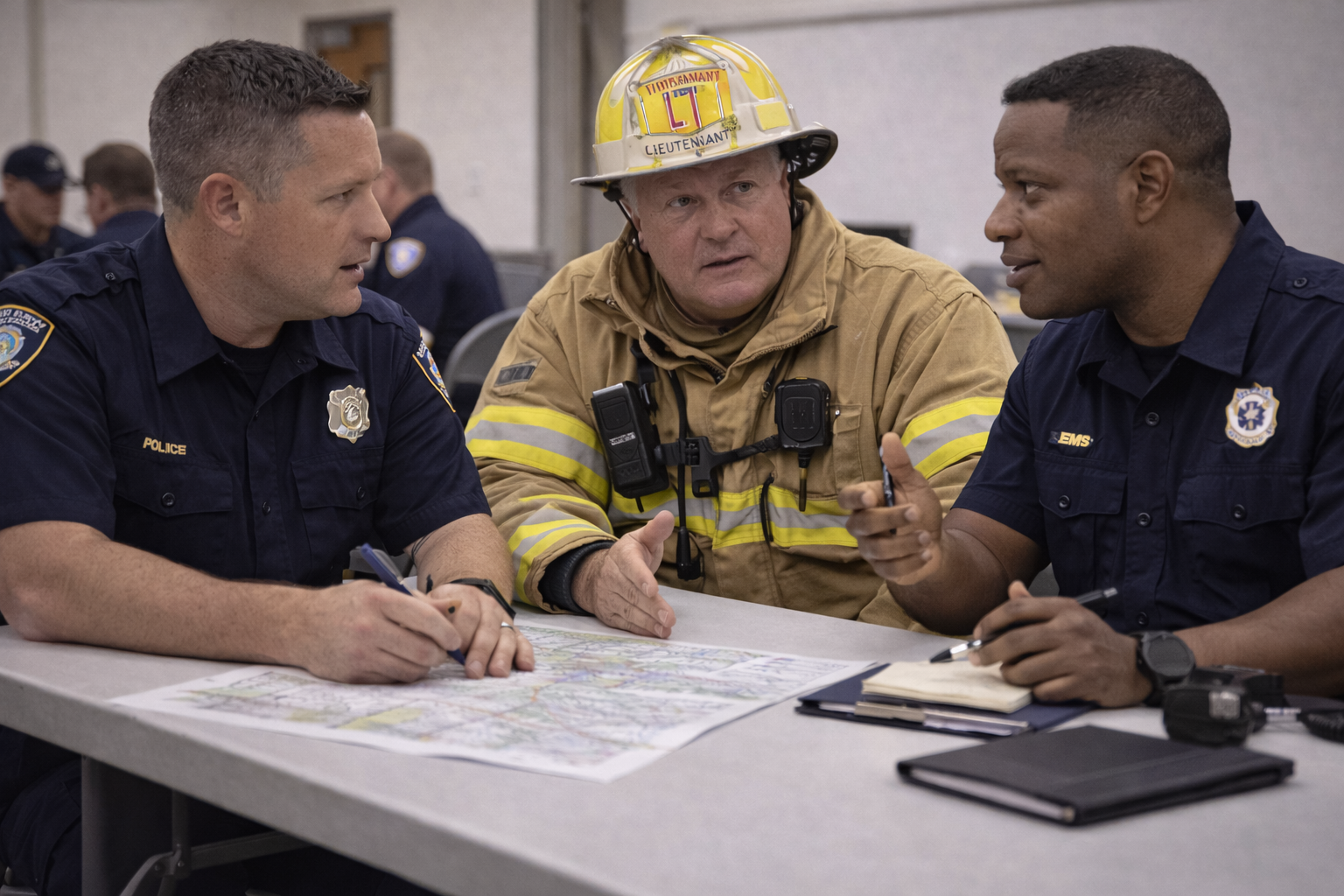
Without doctrinal alignment, agencies apply the same terms differently. Law enforcement may interpret a directive as authorization for movement or control. Fire services may interpret it as confirmation of environmental safety. EMS may interpret it as permission to enter and treat.
These differences are rarely articulated explicitly. They surface only when actions conflict. By then, correction costs time—and time is often the one resource that cannot be replenished.
Progressive emphasis highlights the consequence: inconsistency in language produces inconsistency in action.
Active Shooter Events: Where Ambiguity Becomes Acute
Active shooter incidents magnify translation failures. The tempo is high, information is incomplete, and stakes are immediate. Language must compress complexity into actionable guidance—yet compression without shared doctrine increases error.
Common failure patterns include:
Premature assumptions of safety based on ambiguous terms.
Delayed medical access because “clear” or “secure” meant different things to different agencies.
Command friction when agencies act in parallel rather than in concert.
These are not failures of courage or commitment. They are failures of shared understanding.
Cognitive Load and Default Behavior
Listener attention science explains why ambiguity persists. Under stress, cognitive load narrows attention. Responders fall to the lowest mastered level of training, relying on familiar language cues to guide action. If training normalized ambiguous terms, those ambiguities become embedded.
Repetition with variation matters here. Hearing a term repeatedly increases confidence—even when comprehension remains shallow. The mind substitutes familiarity for accuracy.
This is how translation failure becomes systemic: language feels right, so it goes unchallenged.
The Illusion of Alignment
One of the most dangerous effects of distorted terminology is the illusion of alignment. Meetings sound productive because everyone nods at the same words. Plans appear cohesive because they use common phrases. In execution, however, actions diverge.
The illusion persists because problems are attributed to execution rather than language. After-action reviews may note delays or confusion without tracing them back to terminological mismatch.
Continuous relevance anchoring keeps attention on the root cause: alignment requires shared definitions, not shared vocabulary.
Doctrinal Mismatch: Words Without Authority
Military terms often imply authority that civilian responders do not possess. When used casually, they suggest permissions that policies do not grant. This creates risk for responders who act in good faith but beyond their mandate.
Doctrinal mismatch manifests when:
Terms imply detention, control, or movement without legal basis.
Language suggests risk acceptance not supported by policy.
Commands are interpreted as orders rather than coordination cues.
This mismatch exposes agencies to legal and ethical consequences while undermining trust between disciplines.
Rebuilding Meaning Through Translation
The solution is not to abandon military terminology entirely, but to translate it into civilian-operational language. Translation preserves intent while aligning execution with authority, training, and policy.
Effective translation includes:
Explicit definitions tied to civilian roles and constraints.
Task-based language that describes actions rather than slogans.
Interagency agreement on what terms authorize—and what they do not.
Scenario-based training that tests understanding under stress.
For example, replacing a vague directive with a description of specific actions, responsible parties, and conditions restores clarity.
Training as the Primary Corrective Mechanism
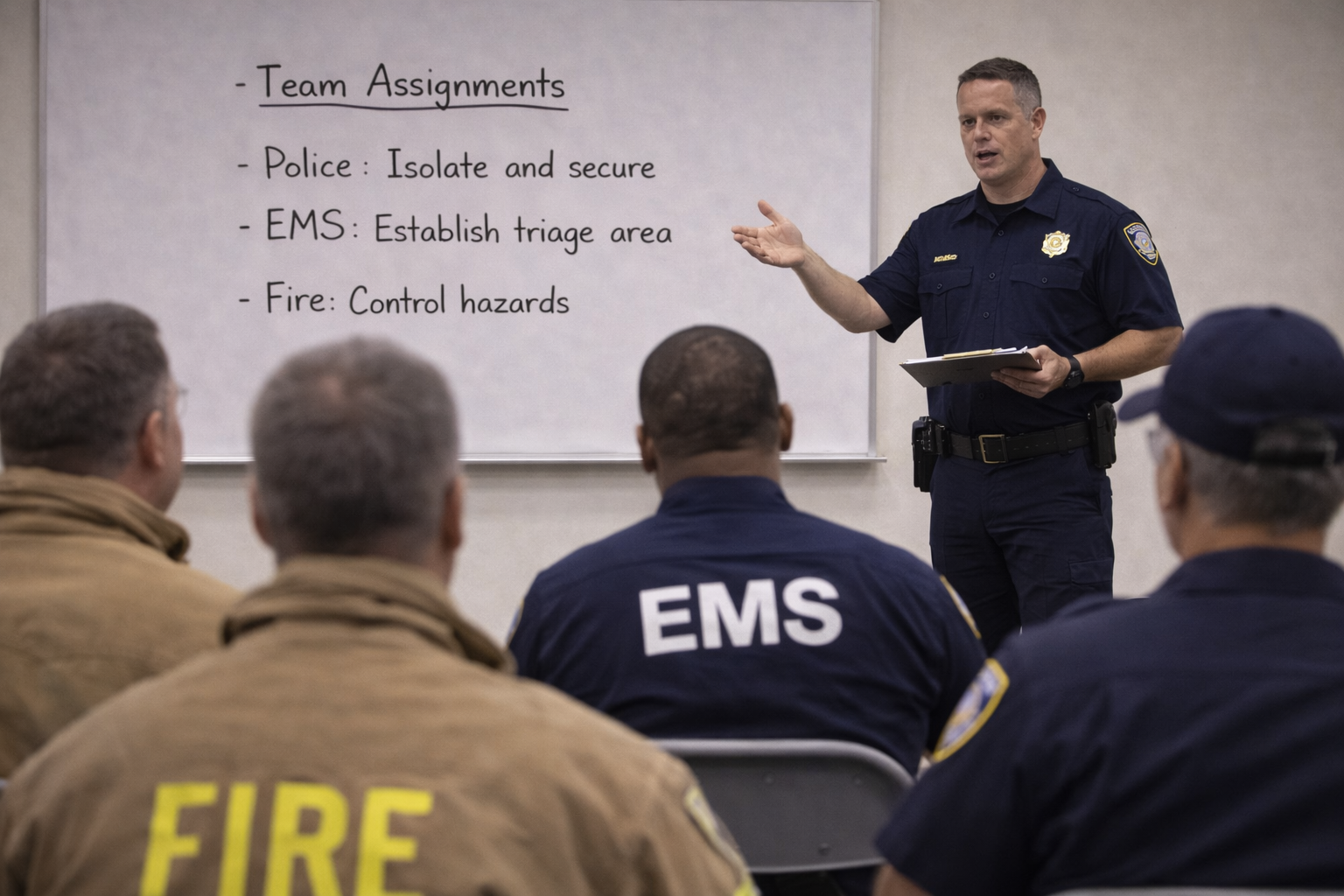
Translation must be trained deliberately. Cross-disciplinary training environments are the ideal venue to surface and correct differences in interpretation. When agencies explain how they understand a term—and why—misalignment becomes visible.
Effective training practices include:
Pre-briefing terminology with shared definitions.
Injecting ambiguity into scenarios to test communication.
Conducting after-action reviews focused explicitly on language use.
Repetition with variation ensures that translation is internalized rather than memorized.
Leadership and Language Discipline
Leaders play a decisive role in preventing translation failure. When leaders use precise, context-aware language, it sets expectations. When leaders use borrowed terms casually, distortion spreads.
Language discipline includes:
Challenging ambiguous terms during planning.
Insisting on definitions during briefings.
Modeling task-oriented communication under pressure.
This discipline signals that clarity is a professional standard, not an academic preference.
Interagency Doctrine: The Missing Link
Ultimately, translation failure persists because interagency doctrine lags behind practice. Agencies train together tactically but often lack shared language frameworks. Developing interagency glossaries, standard operating language, and agreed-upon definitions bridges this gap.
Doctrine does not need to be exhaustive. It needs to be shared, accessible, and reinforced. When language is codified, it becomes stable. When it is informal, it drifts.
Progressive Emphasis: Precision Enables Speed
A recurring myth is that precise language slows action. In reality, precision accelerates coordination. When everyone knows what a term authorizes, less time is spent clarifying or correcting.
Across high-risk operations, the same principle holds: clarity reduces friction; reduced friction saves time; saved time saves lives.
Conclusion
The breakdown in translation of military terminology into civilian public safety is a predictable—and preventable—source of operational risk. Civilian EMS, fire, and law enforcement operate under different constraints and command structures. When military terms are oversimplified or imported without doctrinal alignment, responders apply them inconsistently, creating ambiguity at the worst possible moments.
By translating rather than transplanting language, training terminology as a skill, and codifying shared definitions across agencies, public safety systems can restore clarity and cohesion. In high-threat incidents, what responders believe words mean determines what they do.
Precision in language is not pedantic. It is protective.