Civilian vs. Military Triage Models
Civilian vs. Military Triage Models
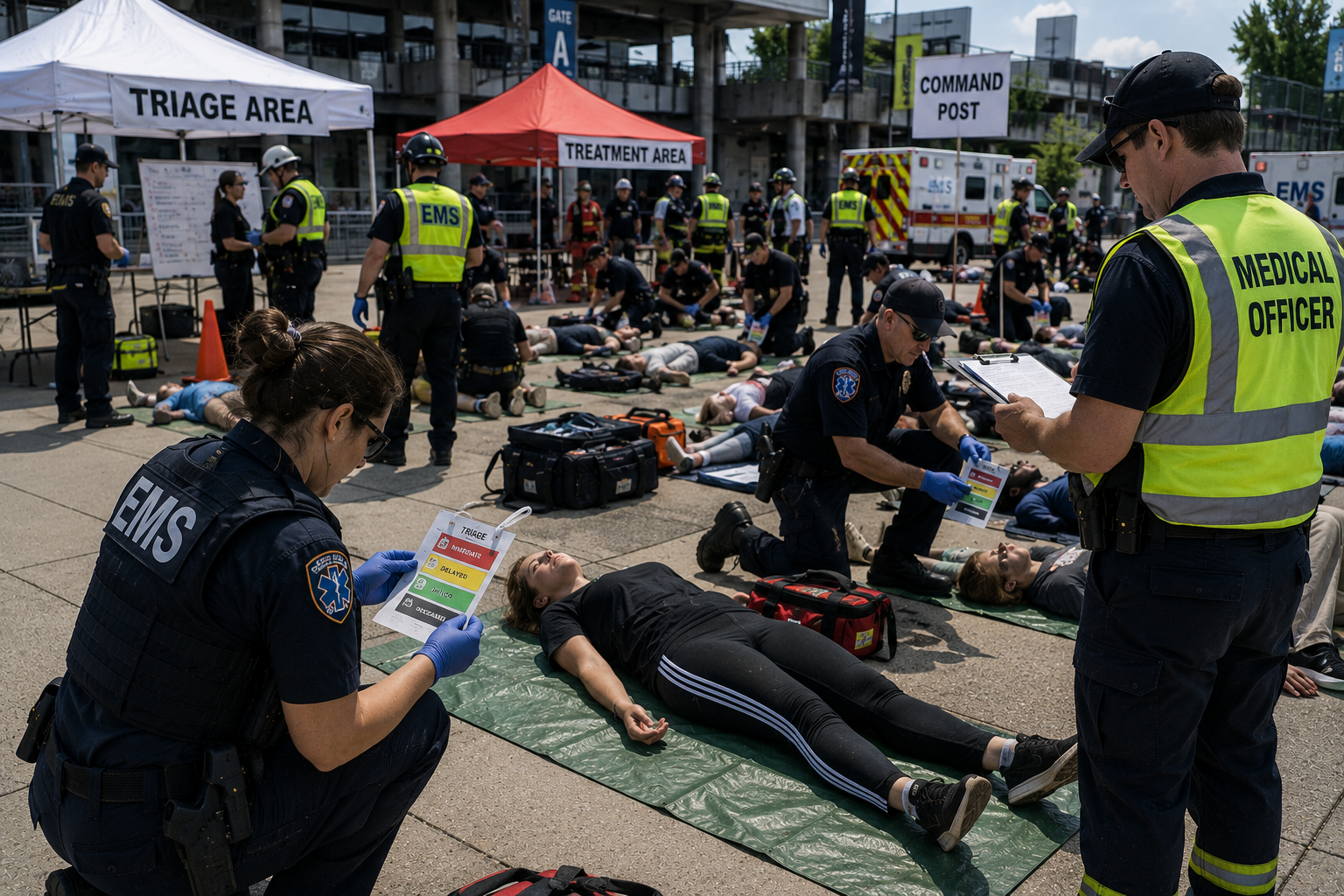
Triage is the fulcrum on which survival balances during mass-casualty and high-threat incidents. In theory, triage is a sorting exercise—an orderly method to categorize patients based on urgency and available resources. In reality, particularly during active shooter events and other violent incidents, triage is not a clerical function but a time-compressed, consequence-laden decision process carried out under fire, noise, fear, and uncertainty. The difference between civilian and military triage models is not merely procedural; it is philosophical. One model prioritizes categorization and system order, while the other prioritizes immediate physiological survival. In high-threat environments, that difference matters profoundly.
This analysis examines why traditional civilian triage systems such as START and JumpSTART often fail under violent, chaotic conditions, and why military-derived, MARCH-based triage consistently aligns better with the realities of ballistic trauma. The argument is not that civilian systems are inherently flawed, but that they were designed for environments that no longer represent the dominant threat profile. As threats evolve, triage models must evolve with them—or accept preventable loss of life as the cost of doctrinal inertia.
The Original Intent of Civilian Triage Systems
Civilian mass-casualty triage systems emerged from disasters defined by predictability of environment but unpredictability of volume—transportation accidents, natural disasters, industrial incidents, and structural collapses. START and JumpSTART were built to help overwhelmed responders rapidly classify large numbers of patients when scenes were relatively secure, hazards were static, and responder movement was unrestricted.
In this context, the emphasis on color categories, respiratory rate thresholds, capillary refill, and mental status made sense. These systems prioritized rapid sorting to enable downstream resource management, assuming that once tagged, patients could be moved to treatment areas and reassessed in relative safety.
However, these assumptions collapse in high-threat incidents. Active shooter scenes are not static. They are fluid, adversarial, and dangerous. Responders must move with purpose, often under protection, and cannot afford prolonged patient assessments or repeated physical contact. Civilian triage systems were never designed for this operational reality.
Why START and JumpSTART Falter Under Threat
START and JumpSTART struggle in high-threat environments for several interconnected reasons. First, they are assessment-heavy relative to the time available. Counting respirations, evaluating perfusion markers, and assigning categories requires cognitive bandwidth that is scarce under stress.
Second, these systems emphasize classification over correction. A patient may be accurately tagged as “immediate,” yet receive no life-saving intervention before evacuation. In ballistic trauma, classification without intervention is often meaningless. A patient with uncontrolled hemorrhage does not benefit from accurate tagging if bleeding continues unabated.
Third, civilian triage assumes relative scene stability. START functions best when responders can stand over patients, make deliberate assessments, and move freely. In a hallway under threat or a warm zone corridor, this posture is unrealistic and unsafe.
Finally, these systems tend to degrade under chaos. As noise, fear, and competing priorities increase, responders either abandon formal triage altogether or apply it inconsistently. The result is neither effective sorting nor effective care.
Ballistic Trauma Demands a Different Logic
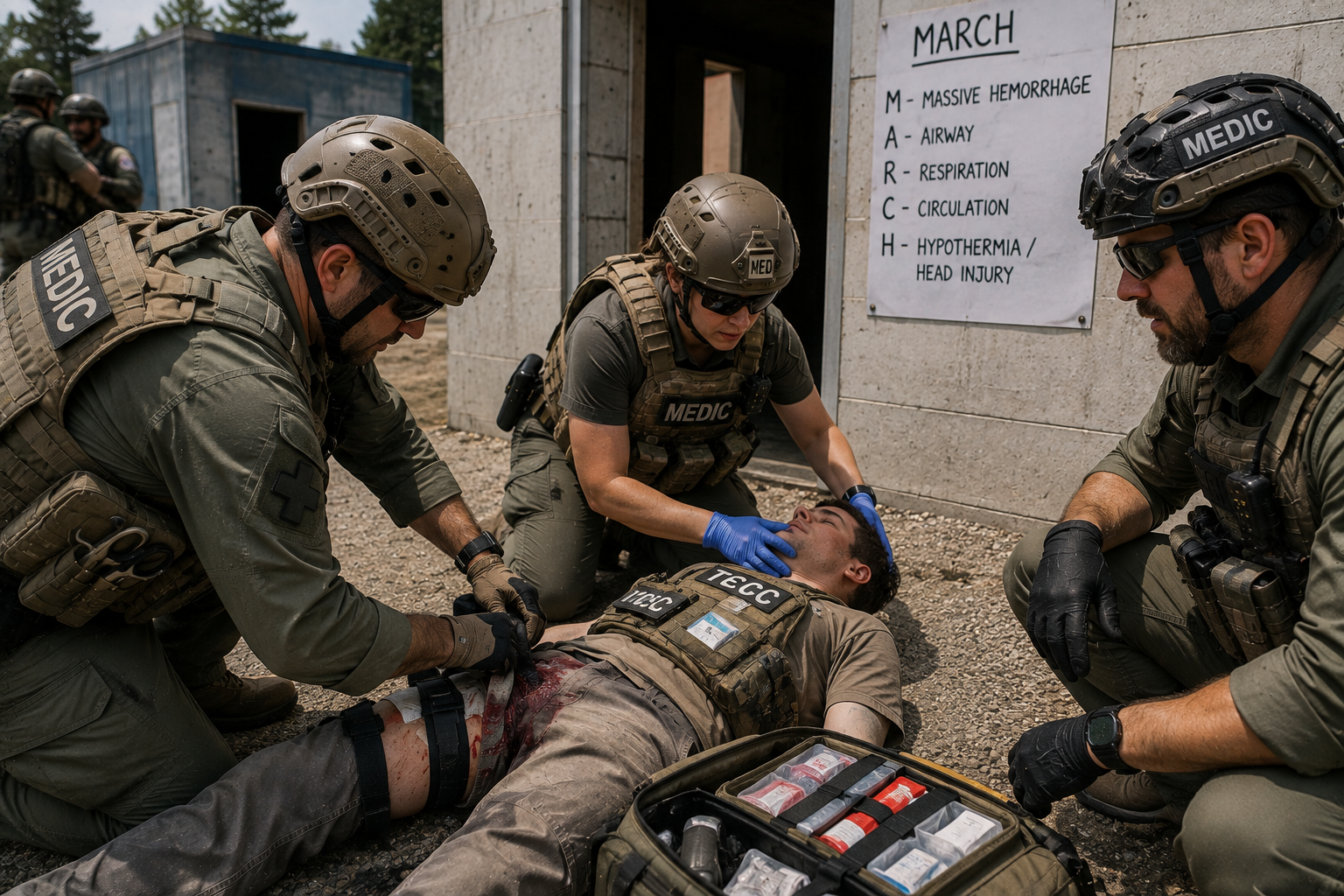
High-threat incidents produce a distinct injury pattern. Ballistic trauma is characterized by rapid blood loss, complex wound tracks, blast effects, and concurrent psychological stress. Death is often preventable, but only if intervention occurs within minutes.
In this context, the most important triage question is not “What category does this patient belong in?” but rather “What will kill this patient first, and can I stop it now?” Military triage models are built around this exact question.
The MARCH framework—Massive hemorrhage, Airway, Respiration, Circulation, Hypothermia/Head injury—reflects decades of battlefield data. It is not a sorting tool in the traditional sense; it is a prioritized intervention sequence. Patients are triaged by action, not by label.
Military Triage: Intervention Before Classification
Military triage prioritizes doing over documenting. On the battlefield, time spent assigning categories is time not spent stopping bleeding. As a result, military triage models collapse assessment and treatment into a single cognitive flow.
If a patient has massive hemorrhage, that hemorrhage is controlled immediately. If airway compromise is suspected, it is addressed on the spot. Only after immediate threats to life are mitigated does broader categorization occur—often multiple times as the casualty moves through care echelons.
This approach is well suited to chaotic environments because it is simple, repeatable, and physiologically grounded. It reduces cognitive load by focusing attention on a short list of priorities that directly influence survival. Under stress, responders do not need to remember color codes; they need to remember what kills first.
Cognitive Load and Triage Performance
Human performance research consistently shows that under extreme stress, working memory narrows and decision-making becomes simplified. Triage systems that rely on multiple branching criteria are vulnerable to error in these conditions.
MARCH-based triage aligns with how humans actually perform under stress. It uses ordered priorities rather than conditional logic. This makes it more resilient to noise, fear, fatigue, and incomplete information.
Civilian triage systems, by contrast, demand that responders toggle between observation, counting, categorization, and documentation—tasks that compete with situational awareness and self-protection. In high-threat environments, this competition degrades both safety and care.
The Problem of Paperwork in a Gunfight
One of the most profound differences between civilian and military triage is the role of documentation. Civilian systems often embed documentation into the triage act itself. Tags are applied, categories assigned, and data recorded early.
Military systems defer documentation until the tactical situation allows. This is not a dismissal of accountability; it is a recognition that paperwork does not stop bleeding. Documentation occurs when it no longer competes with survival.
In civilian high-threat incidents, insisting on early documentation can inadvertently delay care. Hybrid models that allow documentation to follow intervention—rather than precede it—better align with survivability imperatives.
Civilian System Strain in Chaotic Scenarios
Civilian EMS systems are optimized for orderly progression: scene control, triage, treatment, transport. Active shooter incidents invert this sequence. Care must begin before order exists, and order must be built while care is ongoing.
This inversion exposes the limitations of civilian triage doctrine. When systems assume order that does not yet exist, responders are forced to improvise—often abandoning formal triage altogether. The absence of a threat-adapted triage model creates variability, not flexibility.
Military-derived approaches provide structure that tolerates chaos. They offer a common language of priorities that can be applied consistently even when conditions are deteriorating.
Hybrid Models: Bridging Doctrine and Reality
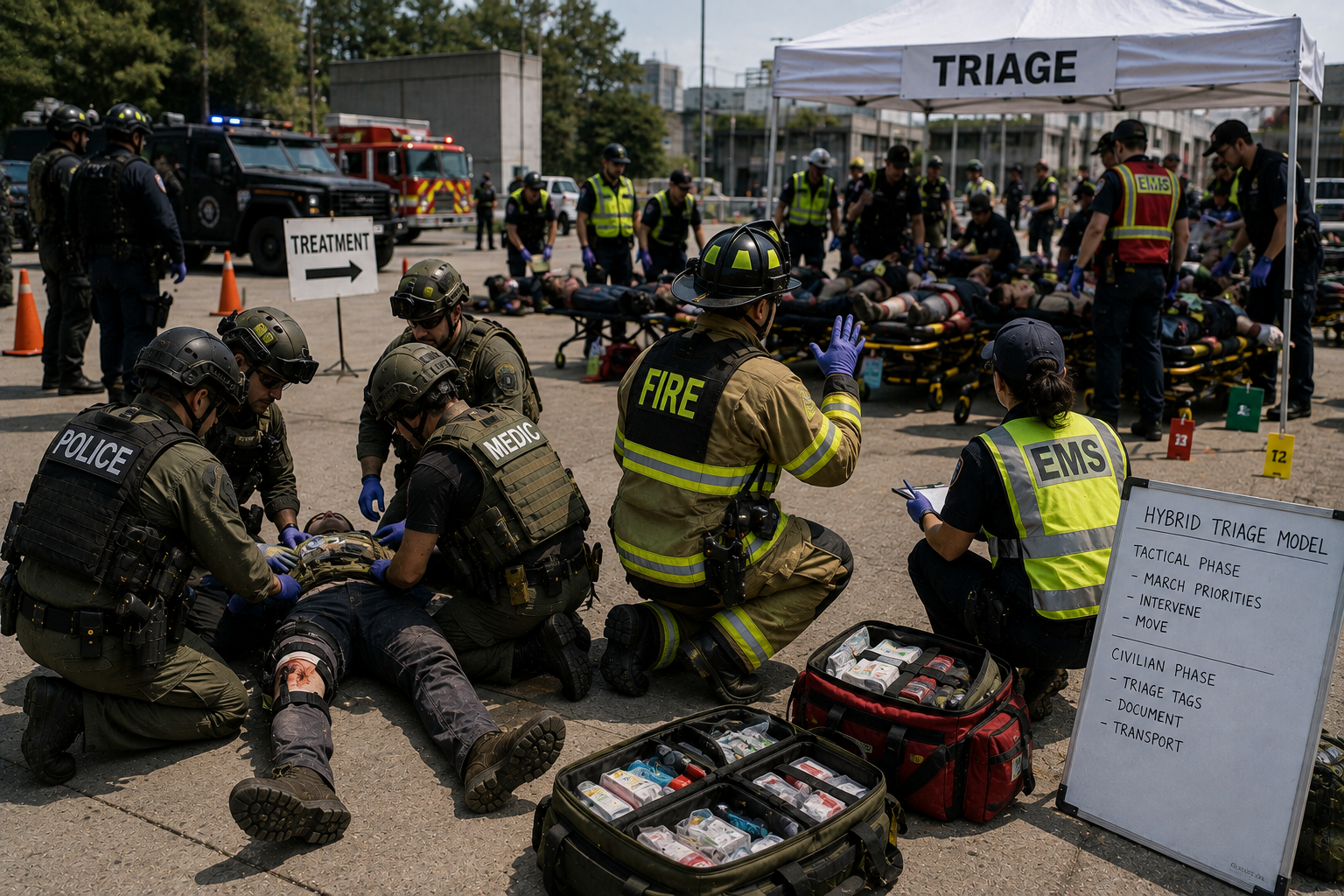
Recognizing the limitations of purely civilian or purely military approaches, many agencies have begun adopting hybrid triage models. These models typically apply MARCH priorities during the direct and indirect threat phases, then transition to more traditional civilian triage once stabilization occurs.
Hybrid models preserve the strengths of both systems. They deliver early, life-saving intervention when it matters most, while still supporting downstream resource management and accountability once the environment allows.
Evidence from after-action reviews and training evaluations consistently shows improved performance when responders are trained to triage by physiology first, category second.
Training Implications and Doctrine Alignment
The success of any triage model depends on training. Responders will default to what they have practiced most often. If training emphasizes color tags and checklists, those tools will be applied—even when inappropriate. If training emphasizes hemorrhage control and rapid reassessment, those behaviors will emerge under stress.
Doctrine must therefore align with operational reality. Teaching START as the default triage system for active shooter response sends a contradictory message when responders are later expected to function under TECC or tactical medical principles.
Clear doctrinal guidance that differentiates environmental context—secure versus high-threat—is essential. Triage models should be matched to threat conditions, not applied universally.
Relevance to Modern Response Systems
As active shooter incidents increase in frequency and complexity, triage models that delay intervention in favor of categorization will continue to produce preventable deaths. The data are consistent: early hemorrhage control saves lives. Any triage system that does not prioritize this fact is misaligned with modern threats.
Military triage models are not superior because they are military; they are superior because they are evidence-driven and consequence-focused. When adapted thoughtfully to civilian legal and ethical frameworks, they offer a path forward.
Conclusion
The contrast between civilian and military triage models reveals a deeper truth about emergency response: systems succeed or fail based on how well they reflect reality. START and JumpSTART were built for environments that assumed safety, time, and order. High-threat incidents offer none of these.
MARCH-based triage aligns with the physiology of ballistic trauma, the psychology of stress, and the operational constraints of violent scenes. By prioritizing life-saving intervention over early categorization, it delivers what matters most when seconds determine survival.
Hybrid models that integrate military priorities into civilian response offer the most promising path forward. They respect the strengths of existing systems while correcting their shortcomings in chaos. In modern high-threat environments, triage must save lives first and sort later—or risk sorting casualties that could have survived.