
Community Communication, Trust-Building, and Resilience
Community Communication, Trust-Building, and Resilience: Completing Recovery Through Transparent Engagement
When a high-threat incident ends, the operational problem does not disappear—it transforms into a social one. Long after tactical success and medical stabilization, communities continue to ask fundamental questions: Is it truly over? Are we safe? Can we trust the system that responded? The answers to these questions are not delivered through force or speed, but through communication. In the Recovery Phase of the Chaos–Stabilization–Recovery (CSR) framework, community communication is not a public-relations function—it is a core operational task that determines whether recovery consolidates or fractures.
The central argument of this analysis is clear: transparent, timely, and coordinated communication is essential to restoring trust and building long-term community resilience after high-threat incidents. Applying the science of listener attention—front-loaded relevance (primacy), structured cognitive chunking, progressive emphasis, repetition with variation, and continuous relevance anchoring—this article explains why communication must be treated as a life-cycle function of emergency management, not an after-action courtesy.
Why Communication Is the Decisive Recovery Variable
Front-loading relevance matters because silence creates narratives—and those narratives rarely favor institutions. In the absence of clear information, communities fill gaps with speculation, fear, and misinformation. These dynamics amplify emotional harm, erode trust, and can destabilize otherwise successful operations.
Communication during recovery serves three simultaneous purposes:
Reassurance that the threat has been addressed
Orientation about what is happening next
Meaning-making that allows communities to process what occurred
If any of these functions fail, recovery stalls. Communication, therefore, is not ancillary—it is decisive.
The Role of Public Information Officers as Operational Leaders
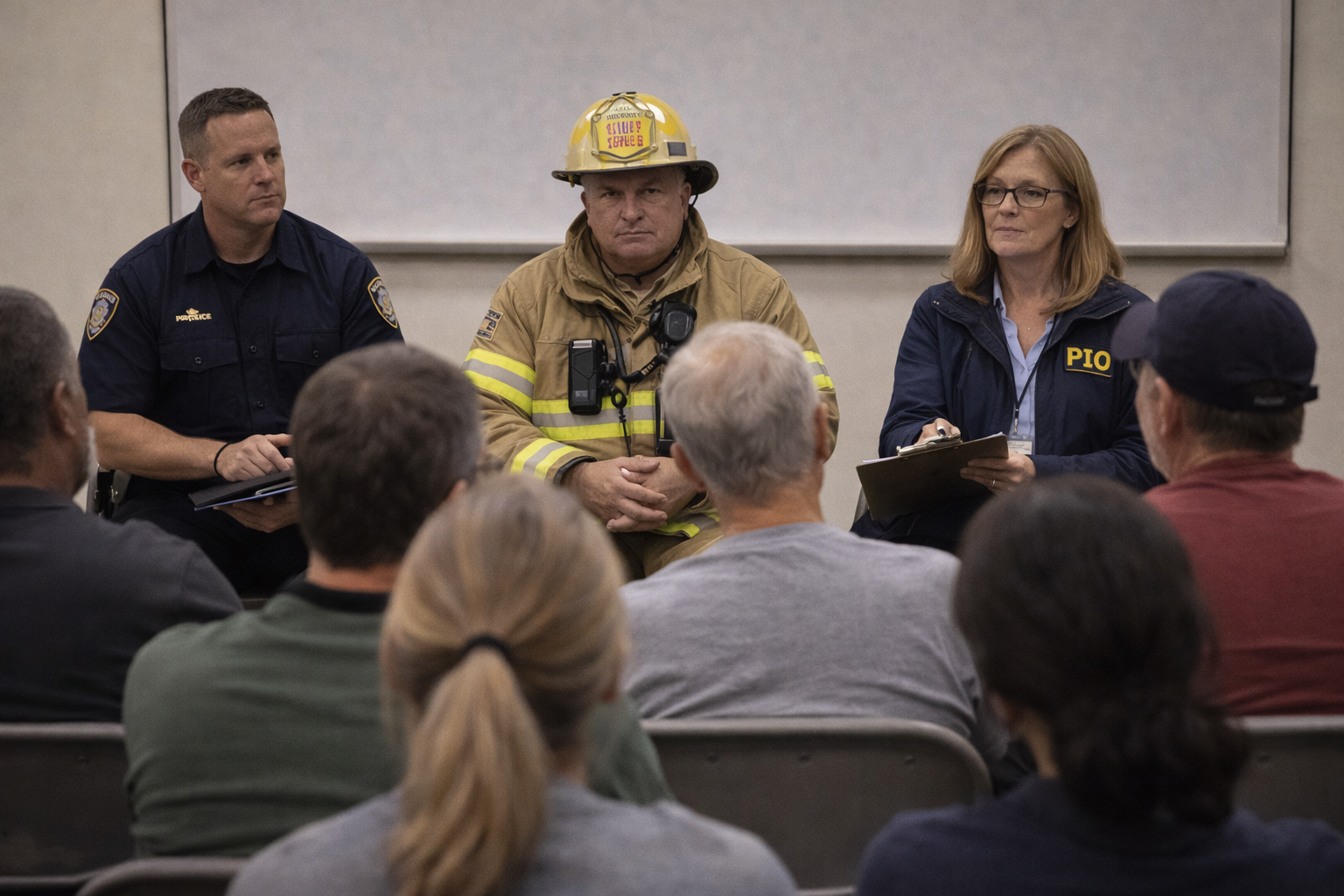
Public Information Officers (PIOs) are often mischaracterized as messengers who speak after decisions are made. In effective recovery operations, PIOs function as operational leaders embedded within Unified Command. Their role is not simply to relay facts, but to translate operational reality into public understanding.
Transparent updates during recovery include:
Confirmation of incident resolution and safety verification
Clear explanations of ongoing investigative or restoration activities
Honest acknowledgment of uncertainty where it exists
Guidance on public access, services, and support resources
Repetition with variation reinforces credibility. Messages evolve as conditions change, but core themes—safety, accountability, and care—remain consistent. This consistency signals control.
Transparency as a Trust-Preservation Mechanism
Trust is not rebuilt through reassurance alone; it is rebuilt through transparency. Communities can tolerate bad news more readily than unclear news. Transparent communication acknowledges what is known, what is not yet known, and what is being done to close those gaps.
Operational transparency achieves several effects:
Reduces rumor propagation
Aligns public expectations with operational reality
Demonstrates institutional competence and integrity
Importantly, transparency does not require disclosing sensitive details that compromise investigations or security. It requires honest framing of constraints and priorities.
Anchoring attention here is critical: trust is preserved by process, not perfection.
Countering Misinformation During the Recovery Window
The recovery period is particularly vulnerable to misinformation. Social media accelerates speculation, and emotionally charged narratives spread rapidly. Left unaddressed, misinformation can undermine compliance with safety measures, inflame tensions, and retraumatize survivors.
Effective counter-misinformation strategies include:
Rapid, authoritative updates from a single coordinated source
Proactive myth-busting that addresses circulating falsehoods
Consistent messaging across agencies to avoid contradiction
Repetition with variation strengthens impact. Communities must hear accurate information often and in multiple formats to counter emotionally salient false narratives.
Communication as Emotional Regulation
Beyond facts, communication performs a psychological regulation function. Clear, calm messaging helps communities modulate fear and grief. Uncertainty amplifies stress; clarity contains it.
Messages that acknowledge emotional impact—without sensationalizing—validate lived experience. They signal empathy and shared concern. This validation is a prerequisite for trust.
Effective communication therefore balances precision and compassion. It informs without alarming, reassures without minimizing, and acknowledges harm without assigning premature blame.

Sharing Lessons Learned: From Closure to Preparedness
Recovery communication should not end with reassurance. As incidents move toward closure, agencies have an opportunity to convert experience into preparedness. Sharing high-level lessons learned demonstrates accountability and forward momentum.
This may include:
Explaining changes being implemented based on the incident
Reinforcing community preparedness actions (e.g., Stop the Bleed, situational awareness)
Clarifying how interagency coordination functioned and will improve
These messages reframe the incident from a singular tragedy to a learning event—not to diminish harm, but to strengthen future resilience.
Progressive emphasis reinforces the point: resilience grows when communities see that systems learn.
Community Outreach as a Bridge to Healing
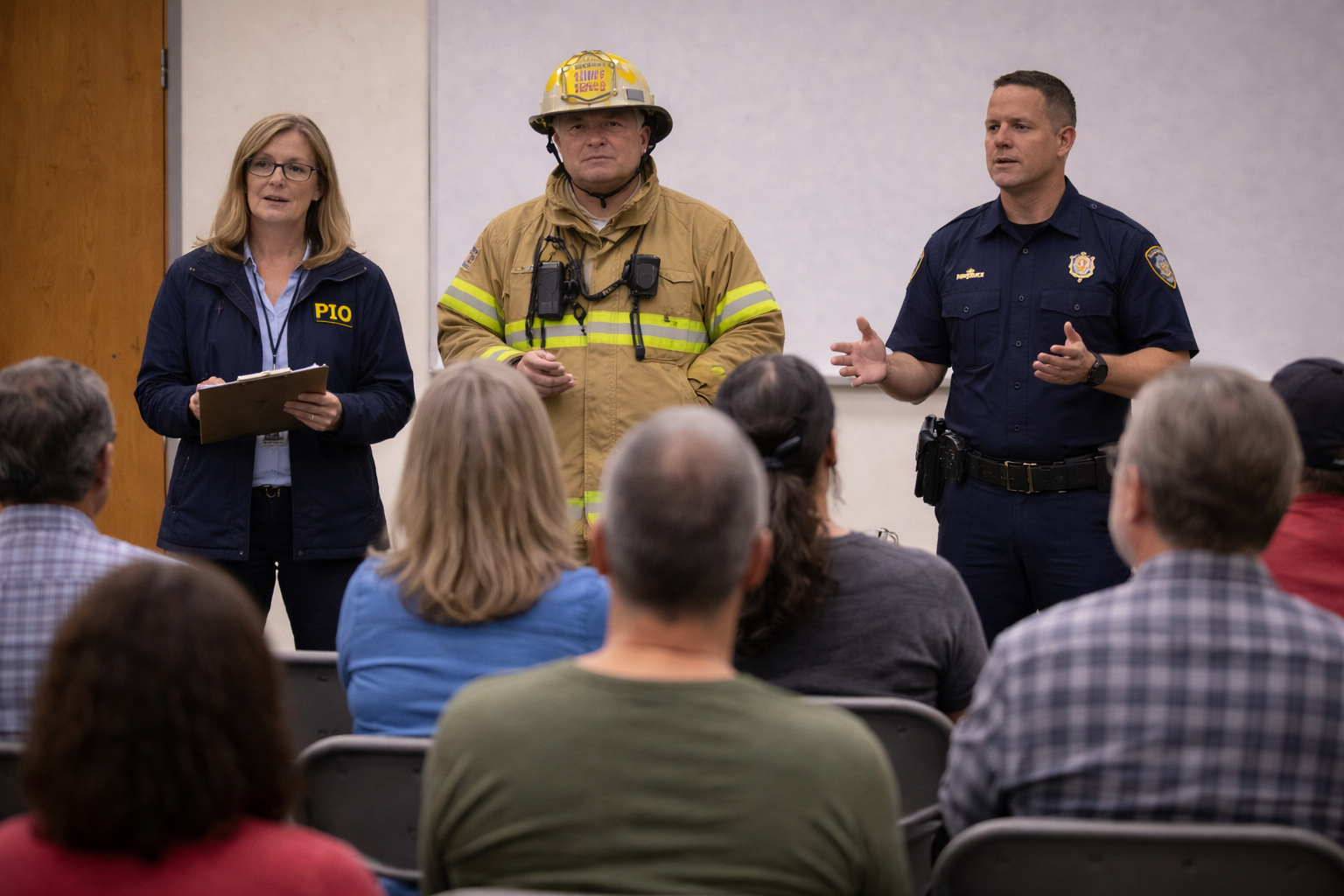
Formal press briefings alone are insufficient. Community outreach—town halls, listening sessions, meetings with faith and civic leaders—creates space for dialogue rather than broadcast.
These engagements serve multiple purposes:
Allowing communities to ask questions directly
Providing platforms for survivor and family support resources
Giving agencies feedback on perceived gaps or concerns
Outreach humanizes institutions. It transforms agencies from abstract systems into visible partners in recovery.
Repetition with variation matters here as well. Different segments of the community require different forums and messengers. Effective outreach meets people where they are.
Building Confidence in Emergency Response Systems
Confidence is distinct from trust. Trust is belief in intent; confidence is belief in capability. Recovery communication must reinforce both.
Agencies build confidence by clearly articulating:
What worked during the response
How coordination was achieved
What safeguards are now in place
When communities understand how systems function—and see those systems acting coherently—confidence grows. This confidence directly influences future compliance, reporting, and cooperation.
Continuous Relevance Anchoring: Safety, Accountability, Care
Across all recovery messaging, three anchors should recur—safety, accountability, and care.
Safety: What has been done to ensure no remaining threats exist
Accountability: How agencies are accounting for actions and outcomes
Care: What support is available for those affected
These anchors maintain focus amid evolving details. They help communities organize information cognitively and emotionally.
Listener attention science supports this approach: repeated anchors stabilize understanding under stress.
Interagency Alignment: One Voice, Many Roles
Disjointed messaging erodes trust rapidly. Recovery communication must be coordinated across agencies, even when roles differ. Unified Command messaging ensures consistency in facts, tone, and intent.
This does not require identical language, but it does require alignment. Conflicting statements—however minor—invite doubt. Aligned communication reinforces unity and control.
Cultural Competence and Equity in Messaging
Communities are not monolithic. Language access, cultural norms, and historical experiences with institutions shape how messages are received. Recovery communication must therefore be culturally competent and inclusive.
Providing translations, engaging trusted community intermediaries, and acknowledging historical context improves reach and credibility. Equity in communication is equity in recovery.
Training Communication as an Operational Skill
Just as tactical and medical skills are trained, communication must be trained. PIOs, command staff, and agency leaders should rehearse recovery messaging, misinformation response, and community engagement.
Scenario-based training that includes press pressure, social media dynamics, and emotionally charged questions prepares leaders for reality. Repetition with variation builds adaptability.
Progressive Emphasis: Communication Creates Resilience
Across every function—information sharing, outreach, education, and trust-building—the same principle emerges: communication creates resilience. Resilience is not simply the ability to absorb shock; it is the capacity to recover with cohesion and confidence.
When communication is transparent, consistent, and compassionate, communities move from fear to function more quickly. They engage with preparedness rather than withdraw from it.
Conclusion
Community communication during the Recovery Phase of the CSR framework is not a closing gesture—it is a foundational operation. Transparent updates, proactive misinformation management, shared lessons learned, and meaningful outreach rebuild trust and strengthen resilience.
High-threat incidents test emergency response systems in moments of chaos. Recovery tests whether those systems can explain themselves, learn publicly, and care visibly. When communication is treated as an operational priority, recovery consolidates. When it is neglected, harm lingers.
In the end, resilience is built not only by how agencies respond—but by how they speak, listen, and engage once the crisis has passed.