
Coordinated Threat Mitigation and Medical Response: Synchronizing Action When Seconds Decide Survival
Introduction
In high-threat incidents, lives are not saved by excellence in a single discipline. They are saved when threat mitigation and medical response occur together, deliberately and without delay. The earliest moments of an active shooter or complex assault are defined by uncertainty, violence, and compressed time. In those moments, separating “tactical” and “medical” action into sequential steps is not caution—it is dysfunction. Coordination is the intervention.
This analysis advances a central thesis: coordinated threat mitigation and medical response—enabled by Medical Rescue Teams (MRTs) and synchronized through the Incident Command Post (ICP)—reduces preventable mortality, stabilizes operations, and accelerates the transition from chaos to control. By front-loading relevance, structuring the discussion into cognitive chunks, and reinforcing principles through repetition with variation, this article demonstrates how unified action outperforms siloed excellence in modern response.
The Imperative for Parallel Action
Traditional response doctrine often implies a handoff: law enforcement suppresses the threat; medicine follows. This sequencing assumes time exists to wait. In dynamic threats, it does not. Hemorrhage progresses, airways fail, and shock deepens while responders negotiate access. Parallel action—suppression and care advancing together—compresses time-to-intervention, the single strongest predictor of survival.
Parallel action does not dilute tactical focus; it sharpens it. When medical capability moves with security, law enforcement can sustain momentum without accumulating untreated casualties behind the line of advance. The system acts as one organism rather than a relay team.
Law Enforcement’s Dual Role During the Chaos Phase
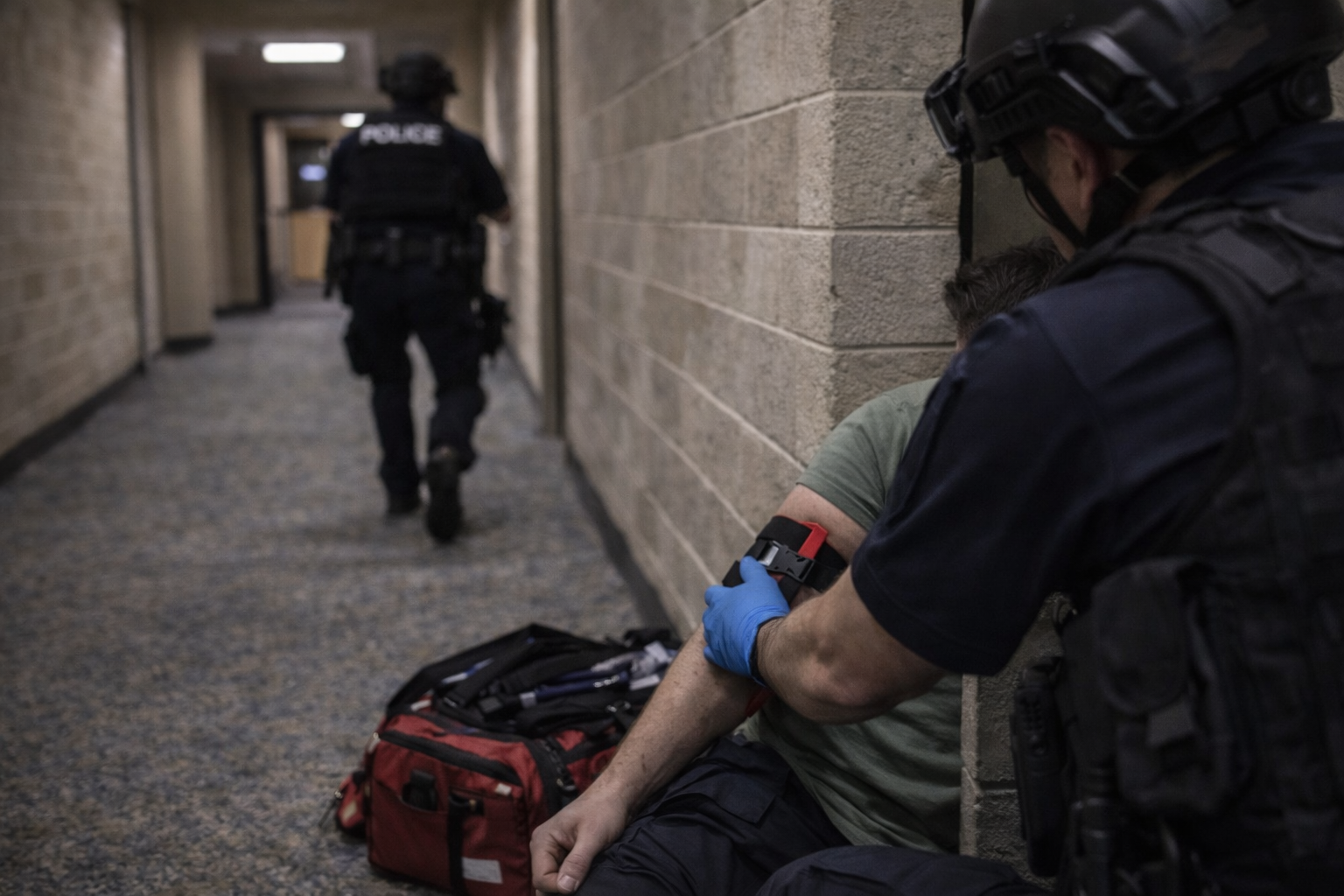
During early operations, law enforcement’s primary objective remains clear: stop the killing. Rapid entry, isolation, and deliberate clearing are essential. Yet in the same space, officers inevitably encounter the injured—civilians and teammates alike. In a coordinated model, officers do not choose between suppression and humanity; they integrate immediate, limited aid until MRTs arrive.
This assistance is focused and disciplined: direct pressure, tourniquet application, simple airway positioning, and movement to relative cover when feasible. It is not prolonged care. It is bridging care—the minimum necessary to interrupt death while preserving operational momentum. This dual role reflects reality: the first responder at the point of injury is often a law enforcement officer.
Critically, bridging care is enabled by training and policy that authorize action under managed risk. When officers are trained to provide limited, high-yield interventions without stalling movement, casualties stabilize sooner and operations continue decisively.
MRTs: Purpose-Built for Preventable Death
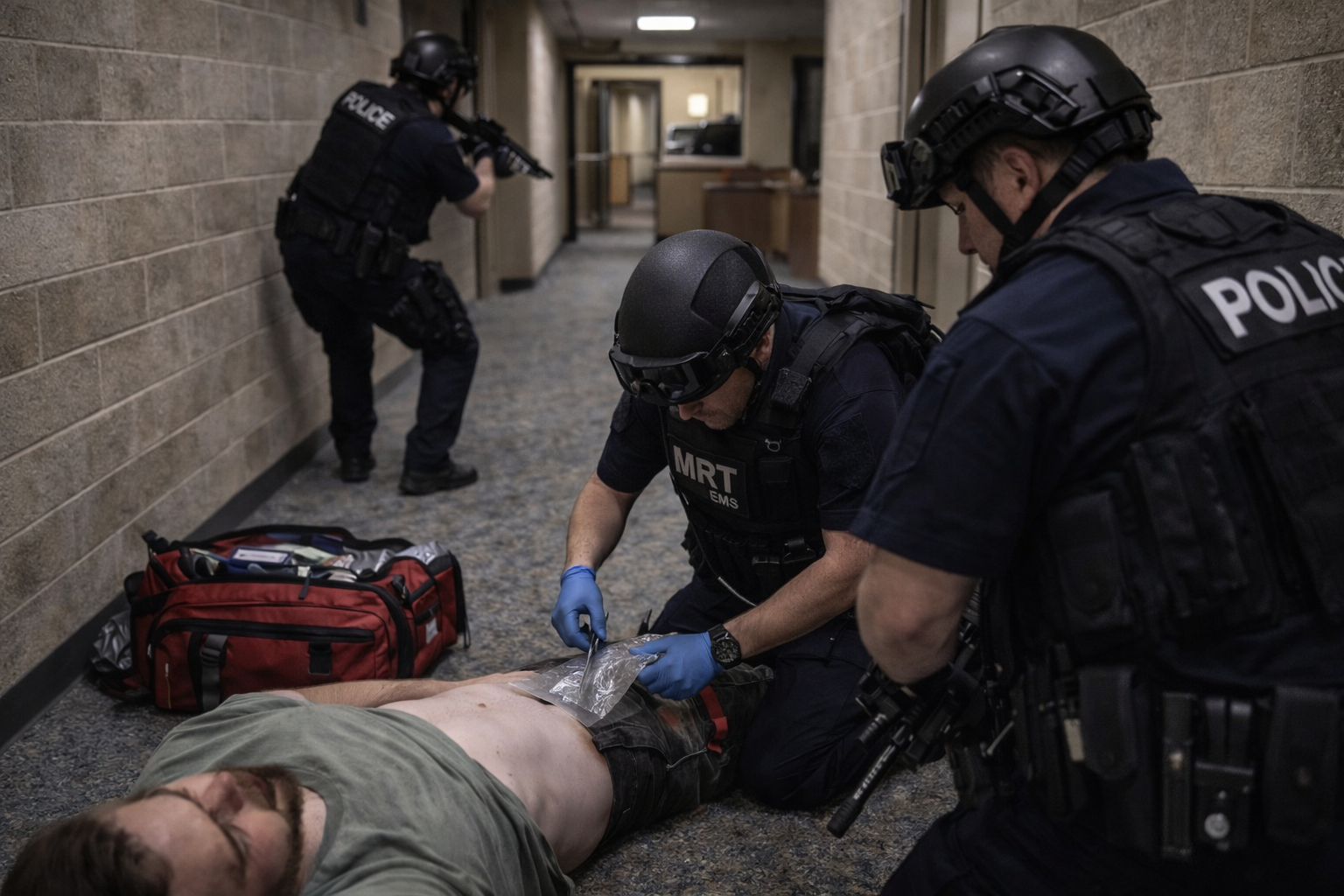
Medical Rescue Teams exist to finish what bridging care begins. Their mission is narrow, time-critical, and outcome-focused: address the preventable causes of death—massive hemorrhage, tension pneumothorax, and airway compromise—at or near the point of injury.
MRTs are tactically trained to operate under protection, communicate in contested environments, and move with purpose. They do not attempt definitive care in the Hot Zone; they interrupt fatal physiology so that movement becomes survivable. By concentrating on a small set of interventions with outsized impact, MRTs reduce cognitive load and increase speed.
This focus matters. In high stress, complexity kills time. MRT doctrine that prioritizes a few decisive actions ensures that care is delivered when it still changes outcomes.
The ICP as a Synchronization Engine, Not a Gatekeeper
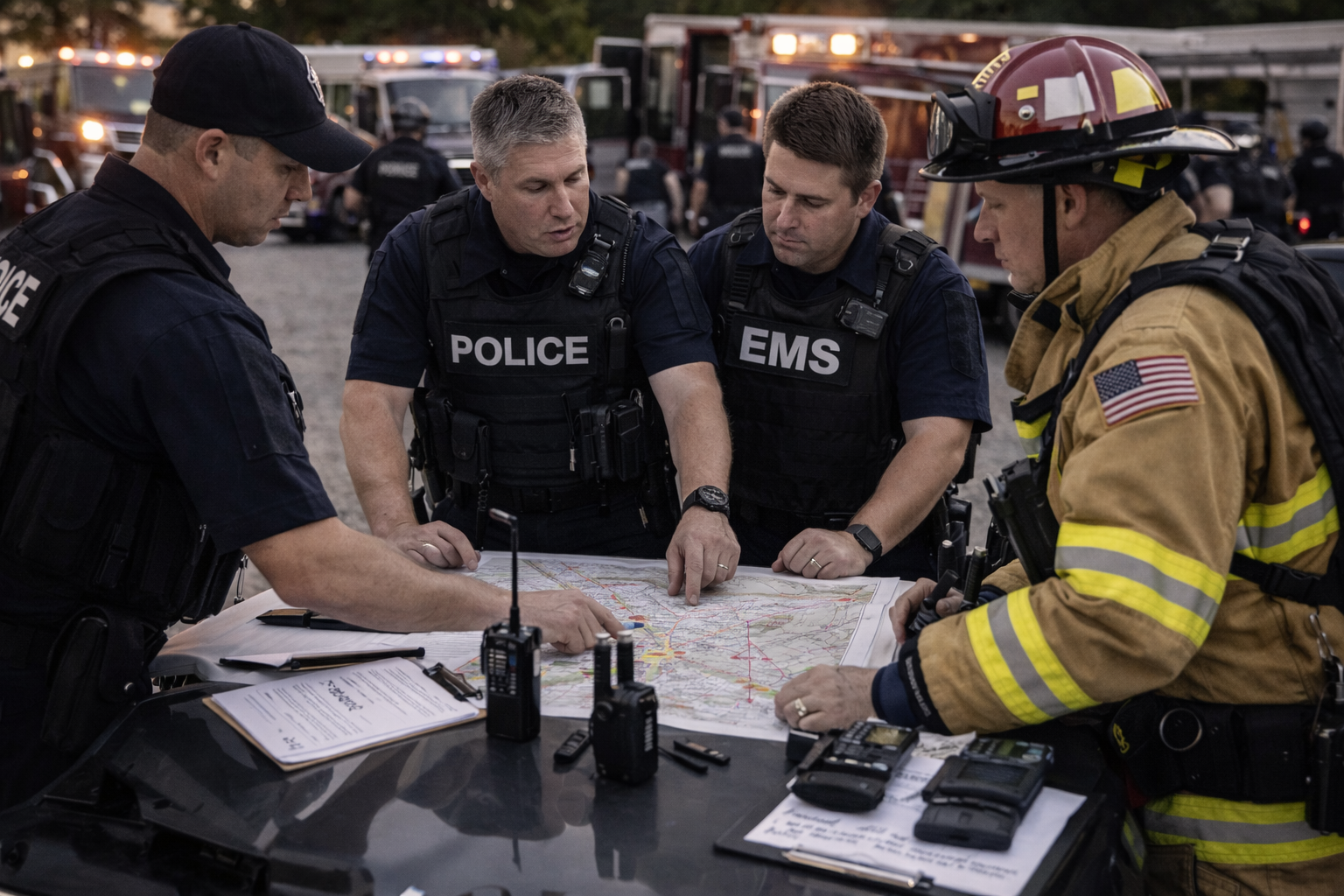
Coordination fails when command becomes a bottleneck. In dynamic incidents, the Incident Command Post must function as a synchronization engine, aligning movement, information, and resources without delaying action.
Effective ICPs do five things during coordinated threat mitigation and medical response:
Authorize parallel operations by articulating acceptable risk thresholds.
Manage MRT deployment—where teams stage, when they move, and with whom.
Maintain communication pathways that connect tactical elements with medical assets in real time.
Allocate resources dynamically, preventing redundancy and closing gaps.
Preserve tempo by prioritizing intent over permission.
When the ICP enables rather than restrains, coordination becomes habitual. When it requires sequential approvals, delays multiply.
Interagency Collaboration: From Presence to Performance
Collaboration is not the co-location of agencies; it is shared intent executed at the same tempo. Coordinated threat mitigation and medical response demands that law enforcement, MRTs, EMS, fire, and support elements operate from a common mental model.
That model includes shared language (Hot/Warm Zones, point-of-injury care), shared priorities (time-to-intervention), and shared expectations (parallel movement). Joint training builds this alignment. Without it, agencies arrive with different assumptions about risk, access, and timing—and coordination degrades into negotiation.
Research on high-reliability organizations underscores this point: teams perform best under stress when they anticipate each other’s actions. Anticipation is built through repetition together, not policy statements alone.
Why Coordination Reduces Chaos
Chaos thrives on uncertainty and delay. Coordination reduces both. When suppression and care advance together, uncertainty narrows faster: casualties are identified, triaged, and moved; threat geometry clarifies; operational space opens. Each early intervention compounds the next.
Consider the alternative. If medical action waits, casualties accumulate, movement slows, and attention fragments. Law enforcement must choose between advancing and managing untreated victims. The environment becomes noisier, riskier, and less controllable. Coordination is not an administrative virtue; it is a control mechanism.
Combined Action and Casualty Minimization
The outcome measure that matters is not the elegance of the plan but casualties minimized. Combined suppression and medical action achieves this by shortening the interval between injury and intervention.
Hemorrhage control applied early prevents exsanguination.
Airway management prevents hypoxic injury.
Chest interventions prevent rapid decompensation.
Early movement reduces secondary exposure.
Each intervention is simple. Their power lies in timing. Coordinated action makes early timing routine rather than heroic.
Cognitive Load, Primacy, and Default Behavior
Under stress, responders default to what they learned first and practiced most. If training presents medical response as downstream, responders wait. If it presents coordination as the norm, responders move.
Listener attention science highlights primacy and repetition with variation. Introducing coordination early in training anchors it. Repeating it across scenarios with different threats, venues, and casualty profiles builds adaptability. Variation prevents rote behavior while reinforcing the same core principles.
This is why doctrine must be taught as a sequence of why → what → when, not just how. When responders understand why coordination saves lives, they sustain it under pressure.
Managing Risk Without Freezing Action
A persistent objection to early coordination is risk. The answer is not denial; it is risk management. Coordinated models define acceptable risk for specific actions—bridging care by officers, MRT movement under protection, limited interventions at point of injury.
Fire services accept managed risk to rescue victims from unstable structures. Law enforcement accepts it during dynamic entries. Tactical medicine must be afforded the same operational logic. Waiting for zero risk guarantees loss; managing risk enables survival.
Policy must protect responders who act within defined parameters. Confidence follows clarity.
Operational Tempo and the Transition to Stabilization
Coordination accelerates the transition from chaos to stabilization. As casualties are treated and moved, law enforcement can consolidate gains. The ICP gains clarity. Resources reallocate from urgent to deliberate tasks. Tempo stabilizes because pressure is relieved.
This transition is not a switch; it is a slope. Coordinated action steepens the slope toward control.
Training Implications: Practicing the Hard Part
Training must practice what reality demands. Scenarios should deny early evacuation, inject uncertainty, and force parallel action. MRTs should train with entry teams. Commanders should practice enabling movement under incomplete information.
Repetition with variation builds trust. Trust sustains coordination when radios fail and plans fray. The goal is not perfection; it is shared momentum.
Progressive Emphasis: Returning to the Core Truth
Across every layer—tactics, medicine, command—the same truth returns with variation: time matters most. Coordinated threat mitigation and medical response exist to buy time for physiology and space for operations.
Parallel action shortens time-to-intervention.
Shorter time-to-intervention saves lives.
Saved lives stabilize operations.
This progression anchors attention where it belongs.
Conclusion
Coordinated threat mitigation and medical response is not an enhancement to modern operations; it is the standard that matches reality. When law enforcement continues clearing while providing bridging care, when MRTs focus decisively on preventable death, and when the ICP synchronizes movement and resources, the system stabilizes faster and saves more lives.
The lesson is simple and demanding: separate excellence is not enough. Only coordinated action—suppression and care advancing together—minimizes casualties and accelerates control in high-threat incidents. In the moments when seconds decide survival, coordination is the most powerful tool we have.