
The Chaos Phase in the CSR Framework: Immediate Law Enforcement Action and Hot Zone Operations
Introduction
In the opening minutes of a high-threat incident, outcomes are shaped before structure exists, before clarity emerges, and often before coordination is fully established. These moments—defined by uncertainty, violence, and compressed time—constitute the Chaos Phase of the Chaos–Stabilization–Recovery (CSR) framework. This phase is not an aberration to be endured; it is the decisive window in which threat trajectory, casualty burden, and operational momentum are established.
The Chaos Phase is characterized by immediate law enforcement action in the Hot Zone, where rapid entry, threat suppression, and deliberate clearing occur under extreme stress and incomplete information. Decisions made here reverberate across every subsequent phase. This analysis brings together the operational, cognitive, and doctrinal elements of the Chaos Phase, demonstrating why early law enforcement action is not merely tactical necessity, but the organizing force that enables later stabilization and recovery.
Defining the Chaos Phase: Reality Before Order
The Chaos Phase begins the moment credible threat indicators emerge and ends only when enough control exists to enable coordinated operations. It is not defined by command structure or policy compliance, but by conditions: uncertainty, violence, sensory overload, and rapidly evolving hazards.
During this phase, responders operate with fragmented intelligence. Communications are incomplete. Threat location is fluid. Casualties are uncounted. Environmental hazards are unidentified. Yet action cannot wait. The absence of perfect information does not negate the necessity of immediate response.
The CSR framework explicitly acknowledges this reality. Rather than attempting to suppress chaos through delay, it recognizes chaos as an operational environment that must be engaged decisively. The Chaos Phase is where initiative is seized—or lost.
Rapid Entry Teams: Seizing the Initiative
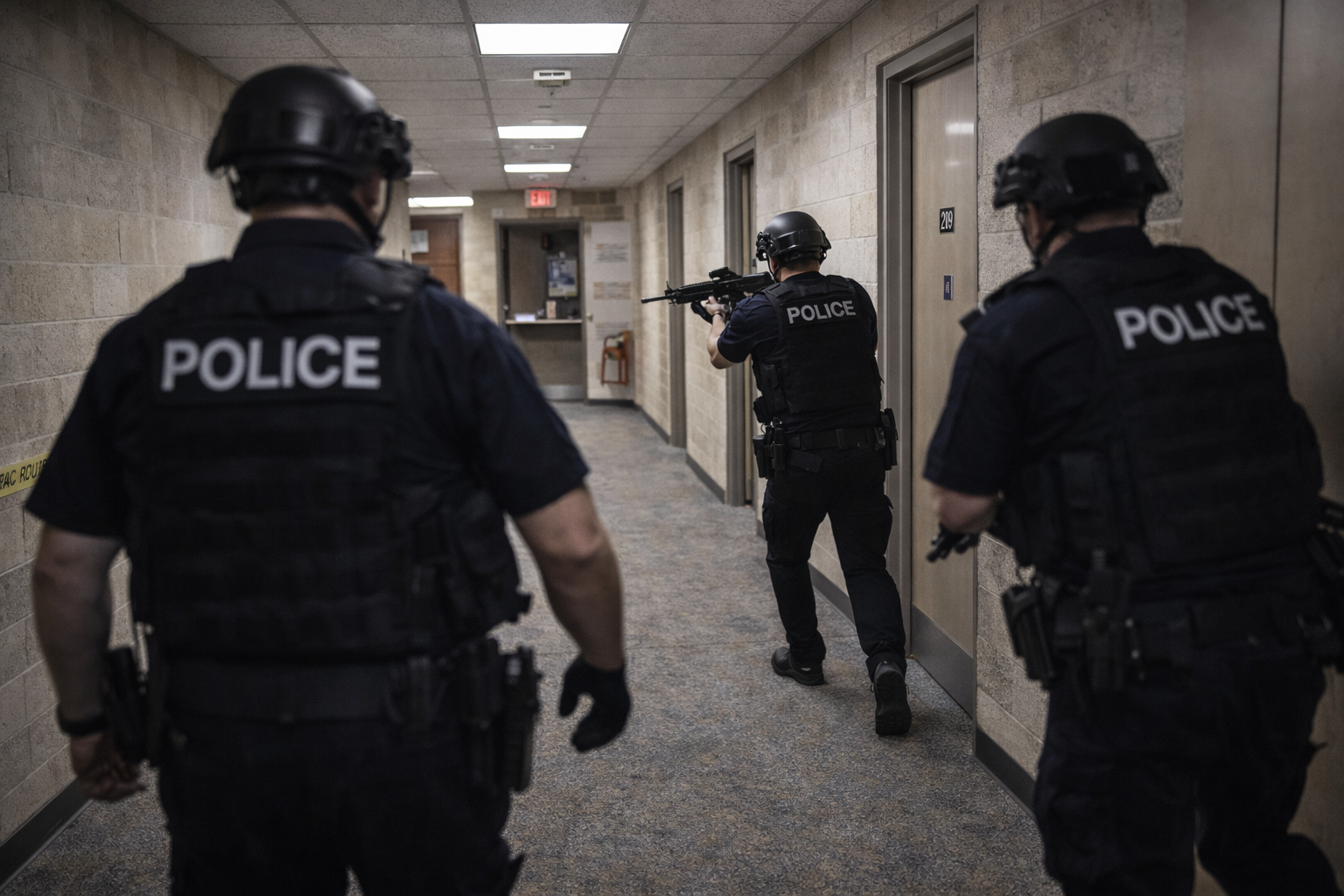
The first decisive action in the Chaos Phase is rapid law enforcement entry into the Hot Zone. Rapid entry teams move toward the threat with a singular objective: stop the killing. Whether through direct engagement, isolation, or deliberate clearing, these teams act under the understanding that time favors the attacker.
Rapid entry is not reckless movement; it is purpose-driven momentum. Teams accept managed risk to disrupt threat activity, reduce further harm, and establish the first points of control. In doing so, they alter the incident’s trajectory from uncontrolled violence toward containment.
This action carries cognitive weight. Under extreme stress, responders default to their most rehearsed behaviors. Training that emphasizes rapid entry, threat focus, and forward movement ensures that decisive action occurs despite uncertainty. Without this conditioning, hesitation fills the vacuum—and chaos expands.
Deliberate Clearing Under Dynamic Conditions
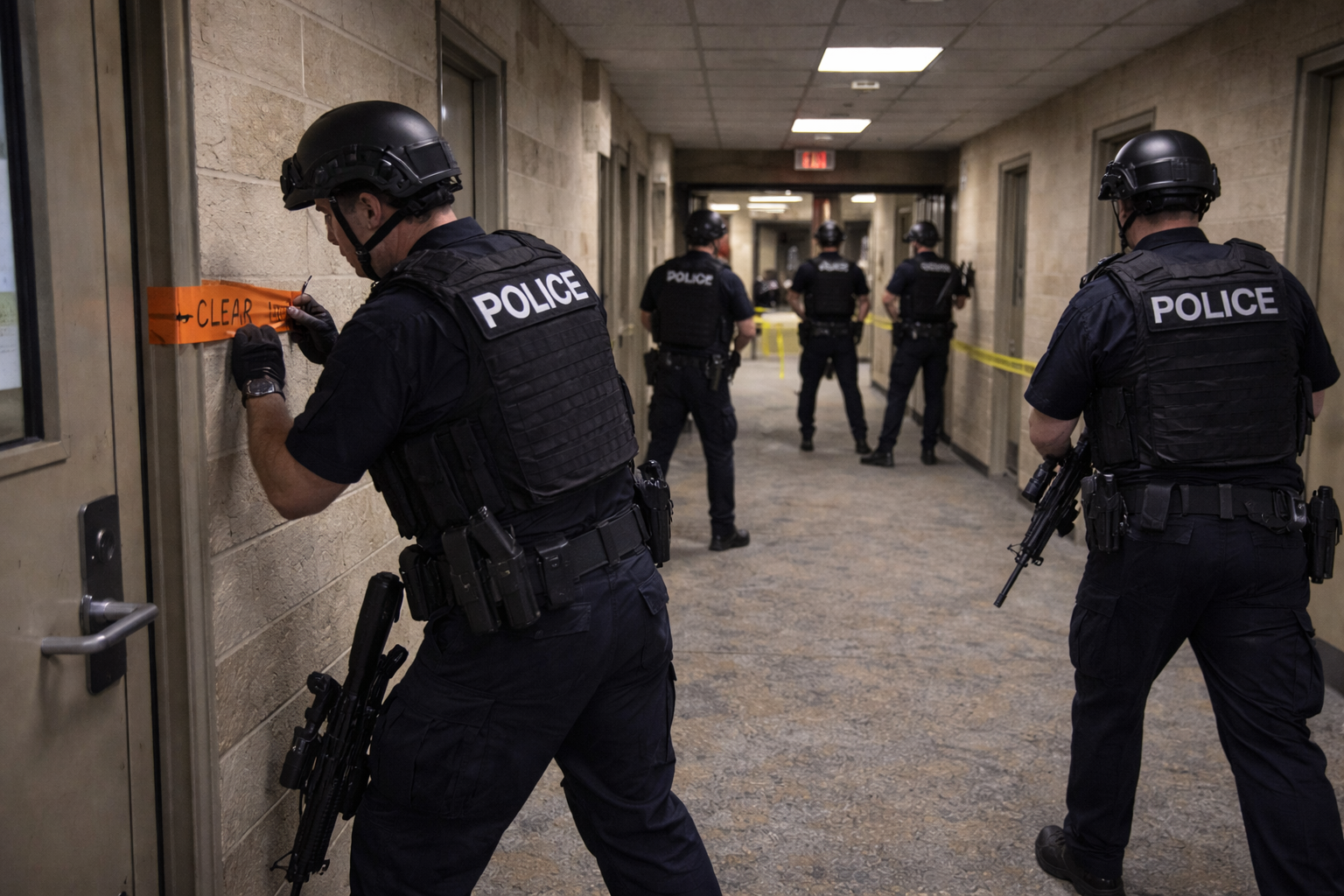
Not all Chaos Phase operations are immediate confrontations. In some incidents, rapid entry transitions into deliberate clearing operations, particularly when threat location is unknown or when attackers have gone static, barricaded, or fled.
Deliberate clearing during the Chaos Phase remains fundamentally different from post-incident searches. It occurs under the assumption that threat contact is imminent and that intelligence is incomplete. Movement, communication, and decision-making must balance speed with survivability.
Importantly, deliberate clearing sustains momentum. Stopping to await additional resources or certainty allows threat reconstitution and increases casualty risk. The Chaos Phase rewards continuous forward pressure, even when operations shift from speed to precision.
Reinforcement Officers: Expanding Hot Zone Control
As initial teams move forward, reinforcement officers play a critical role in expanding Hot Zone control. These officers do not merely backfill positions; they extend operational depth, secure cleared areas, manage secondary threats, and prevent operational fatigue from stalling momentum.
Reinforcement transforms isolated action into sustained operations. It allows initial entry teams to remain threat-focused while additional personnel manage flanks, hallways, stairwells, and access points. This expansion is essential in complex environments such as schools, malls, or multi-structure venues.
Without reinforcement, early gains erode. Chaos reasserts itself through gaps, blind spots, and responder exhaustion. Sustained Hot Zone control is therefore not achieved by the first team alone—it is built progressively through layered action.
Command Emergence: From Tactical Direction to Coordination
During the earliest moments of the Chaos Phase, command is implicit rather than formal. Leadership is exercised at the team level, driven by proximity to the threat and immediate necessity. As personnel and information increase, this implicit command must evolve.
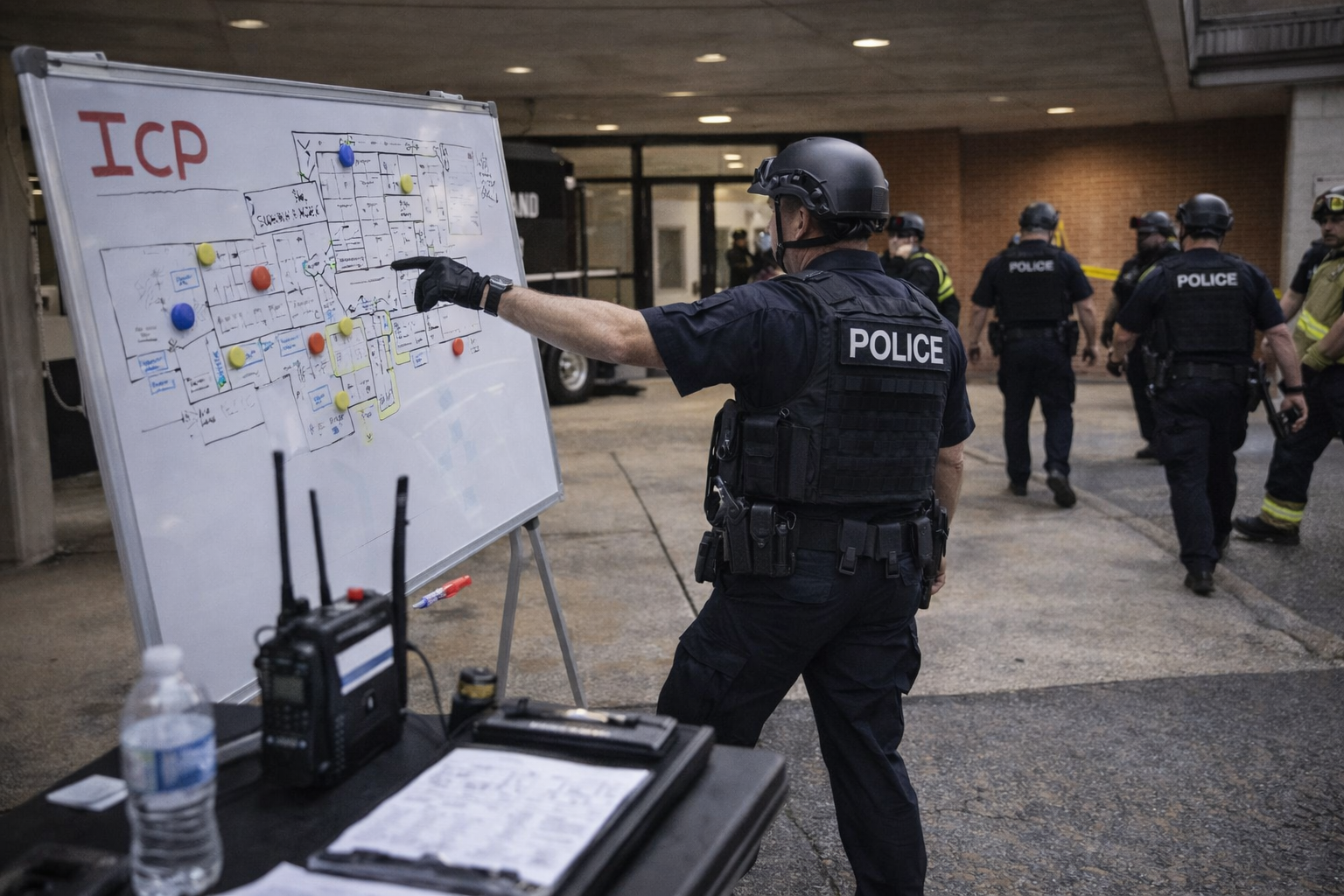
A tactical command post typically emerges near staging, serving as the first coordination node. Its function is not comprehensive control, but resource synchronization: directing incoming units, tracking threat updates, and preventing duplication of effort.
As situational clarity improves—threat location refined, access routes identified, initial casualties reported—tactical command transitions into a formal Incident Command Post (ICP). This evolution is gradual, not instantaneous. During the Chaos Phase, command structures must remain flexible enough to support ongoing Hot Zone operations without constraining them.
Critically, command during chaos must enable action, not inhibit it. Over-centralization or premature bureaucratic control can stall momentum and increase risk.
Operating Under Extreme Stress and Limited Information
The Chaos Phase places responders under maximum cognitive load. Sensory input is overwhelming. Information is contradictory. Time pressure is acute. In this environment, decision-making is simplified by necessity.
Effective Chaos Phase operations rely on principles rather than procedures. Clear priorities—stop the threat, move forward, protect teammates—guide action when detailed plans are unavailable. This principle-based approach aligns with human performance science, which shows that complex decision trees collapse under stress.
Listener attention science reinforces this point: what responders hear first, train most often, and internalize deeply becomes their anchor. If early training emphasizes decisive action despite uncertainty, responders act. If it emphasizes waiting for clarity, they stall.
The Hot Zone as an Operational Reality
The Hot Zone is not merely a geographic label; it is an operational condition defined by active or credible threat. During the Chaos Phase, the Hot Zone is fluid. It expands, contracts, and shifts as intelligence develops and operations progress.
Law enforcement action within the Hot Zone establishes the conditions necessary for everything that follows. Medical access, fire suppression, evacuation corridors, and stabilization efforts all depend on the space created by early Hot Zone operations.
Importantly, Hot Zone operations do not end chaos instantly. They reshape it, channeling disorder into manageable risk. This distinction is critical. Expecting the Hot Zone to disappear before additional action occurs misunderstands the nature of the Chaos Phase.
Momentum as a Life-Saving Variable
Momentum is the most undervalued asset in the Chaos Phase. Forward movement compresses the attacker’s options, reassures trapped civilians, and accelerates the transition to stabilization. Loss of momentum, by contrast, prolongs uncertainty and increases harm.
Momentum is sustained through reinforcement, communication, and leadership that prioritizes action over perfection. It is also sustained by trust—between responders, between teams, and between command and operators.
In the CSR framework, momentum bridges Chaos and Stabilization. Without it, the system oscillates between action and pause, never fully achieving control.
Integration With the CSR Framework
The Chaos Phase is not an isolated chapter; it sets the conditions for the entire response. Effective Hot Zone operations reduce casualty volume, clarify threat status, and establish operational geometry for subsequent phases.
Stabilization depends on the space and time created during chaos. Recovery depends on the decisions made under pressure. Bringing it all together requires recognizing that early law enforcement action is not just tactical—it is foundational.
The CSR framework’s strength lies in its honesty. It does not pretend chaos can be avoided. It teaches responders how to operate within it, transition through it, and ultimately overcome it.
Training Implications: Preparing for Chaos, Not Avoiding It
Training that sanitizes chaos produces responders unprepared for reality. Chaos Phase training must be uncomfortable, ambiguous, and stressful. Scenarios should deny perfect information, compress timelines, and force prioritization.
Repetition with variation builds adaptability. Responders learn not only what to do, but how to think when conditions deteriorate. This prepares them to act decisively rather than wait for ideal circumstances that will never arrive.
Training must also reinforce the linkage between individual action and system outcomes. Early decisions matter. Movement matters. Hesitation has cost.
Progressive Emphasis: Why the First Minutes Matter Most
Across every layer of the Chaos Phase, one truth recurs: the first minutes matter disproportionately. Early law enforcement action determines threat trajectory. Early Hot Zone control enables subsequent access. Early command emergence prevents fragmentation.
By returning repeatedly to this emphasis—from entry to reinforcement to command—the CSR framework sustains attention on what matters most when stakes are highest.
Conclusion
The Chaos Phase is where high-threat incidents are decided, not resolved. It is the environment of uncertainty in which immediate law enforcement action and Hot Zone operations shape everything that follows. Rapid entry, sustained momentum, and adaptive command are not optional—they are essential.
By embracing chaos rather than resisting it, the CSR framework provides responders with a realistic, operationally grounded model for early action. Immediate law enforcement response does more than stop threats; it creates the conditions for stabilization, survivability, and recovery.
In the moments before order emerges, action is the only currency that matters.