Transitioning from Chaos to Structure: Developing a Cohesive Approach for First Responders in Active Shooter Situations Part 7
Part 7: Considerations of the CSR Framework and the Chaos Phase
In the initial moments of an active shooter incident, rapid, coordinated action can mean the difference between life and death. The Chaos, Stabilization, and Recovery (CSR) framework was developed to address the inadequacies of traditional response models by emphasizing integrated tactical and medical interventions at the earliest stages of an event. This final deliverable—the Standard Operating Procedure (SOP) for Active Shooter Events—operationalizes the CSR framework with a specific focus on the Chaos Phase, where responders face rapidly evolving threats and high-stress decision-making environments. The Chaos Phase demands an immediate tactical response, seamless establishment of incident command, and the swift deployment of Medical Rescue Teams (MRTs) to provide on-site life-saving care. By combining real-time threat engagement with point-of-injury medical support, this SOP delivers a modernized, multi-agency approach aligned with the National Response Framework and grounded in evidence-based emergency practices. This section outlines the critical elements, priorities, and considerations necessary for executing the Chaos Phase of the CSR framework effectively.
SOP for Active Shooter Events Using Chaos, Stabilization, and Recovery (CSR) Framework
Scope
Active shooter situations create highly severe and unforeseeable dangers to public protection. Traditional response models have mainly prioritized law enforcement's quick elimination of threats before initiating medical evacuation operations. The traditional response models have frequently resulted in substantial delays between the end of law enforcement operations and the delivery of essential medical treatments, according to research by Pepper et al. (2016). The CSR framework transforms the operational approach by combining tactical medical interventions in response to the early chaos during an event. This SOP combines the specialized skills of law enforcement personnel with Medical Rescue Teams (MRTs) to minimize preventable deaths while enhancing medical results for the injured and helping communities recover quickly after emergencies (Hill, 2022).
Objective
This procedure emerges from an extensive evaluation of best practice standards and active shooter event analysis combined with insights from domestic and international case studies (Graham, 2018). This approach is based on research that demonstrates the advantages of instant medical attention at injury sites, together with swift neutralization of threats and organized response from multiple agencies (Miles & Crook, 2021). This SOP creates an effective emergency response system through defined hierarchical structures and standardized procedures which reduces confusion and speeds up decision-making to protect lives.
Chaos Phase

Tactical Deployments and Threat Neutralization
Responders face the urgent demands of the Chaos Phase right after an active shooter event, which presents rapidly changing threats under high-stress conditions while situational awareness remains limited. Tactically trained Patrol Officers receive immediate deployment to the Hot Zone during this phase (Dailey & Laskey, 2023). The fundamental responsibility of these responders is to confront threats directly through movement-to-contact or systematic clearing actions informed by current intelligence data (Phillip, 2020). The swift tactical confrontation serves as the essential response to eliminate the threat before more people become harmed.
As the initial teams engage the threat, extra reinforcement units arrive to secure entry points while transitioning operations to a controlled state (Hill, 2022). The quick creation of a tactical command post in the nearby Warm Zone assists this mission by establishing a secure place for coordinating reinforcements and sharing critical intelligence. This deployment strategy effectively reduces immediate threats while enabling further support services that protect lives and maintain public safety.
Establishment of Command and Control

Tactical teams entering the Hot Zone must immediately focus on building a strong command and control system. The tactical command post setup in the Warm Zone evolves into a fully operational Incident Command Post (ICP). The ICP is the central control facility for all decision-making activities and operational coordination (FEMA, 2023). The system combines real-time information from different teams with essential support units such as SWAT teams, MRT, and Transport officers who play crucial roles in ongoing and future response phases stationed in the Warm Zone near the Tactical Command Post for immediate activation (Hill, 2022).
The ICP implements a universal operational language and standardized communication protocols for all units, which prove essential in dynamic threat environments with high-stress levels. A centralized command system enables decision-makers to assess threats quickly and deploy resources efficiently, helping prevent communication errors and operational delays. The centralized model becomes essential during active shooter situations because it provides a coordinated and adaptive response throughout all operational sectors (Dailey & Laskey, 2023).
Medical Rescue Team (MRT) Integration

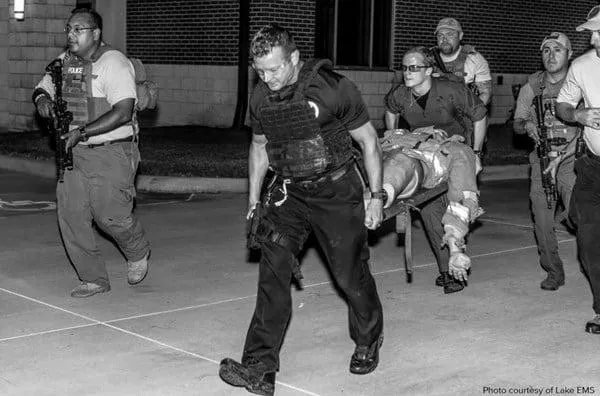
During the Chaos Phase of response operations, the rapid deployment of Medical Rescue Teams (MRTs) proves essential. Establishing a Hasty Casualty Collection Point (CCP) for immediate on-scene medical care occurs after initial tactical operations secure part of the threat environment. Medical Rescue Teams (MRTs) deploy directly into the Hot Zone to perform critical life-saving interventions consisting of personnel from law enforcement, Emergency Medical Services (EMS), and fire services (Graham, 2018).
Specialized training and equipment in Tactical Operations and Tactical Emergency Casualty Care (TECC) protocols prepare these teams to conduct vital medical procedures like hemorrhage control and casualty stabilization while managing airways during extreme situations (NAEMT, 2020). MRTs gaining immediate access to injured areas break away from usual approaches, necessitating speedy transport to distant treatment centers, thus potentially causing fatal holdups. The immediate implementation of critical care at the injury site by MRTs results in substantially improved survival rates because these essential measures are given without delay (Miles & Crook, 2021). Through this integration, law enforcement units experience reduced pressure during tactical responses while highlighting the essential role of multidisciplinary strategies in active shooter event aftermath management.
Operational Priorities and Communication
During the Chaos Phase is built upon two essential actions: neutralizing threats and delivering immediate medical assistance to save lives (NCBRT, 2018). Tactical units execute coordinated assaults to confront threats aggressively and rapidly suppress their dangerous actions. MRTs respond to the scene to deliver essential medical treatment so injured individuals receive quick help for serious injuries (NAEMT, 2020). The successful accomplishment of these two goals depends on all units functioning according to standardized communication protocols. These protocols enable quick information sharing among teams working in the Hot Zone, Warm Zone, and at the ICP.
During active shooter incidents, the effectiveness of communication channels becomes crucial to sustain operational coherence amidst rapidly evolving situations (Dailey & Laskey, 2023). A unified operational language reduces communication errors while informing all units about situational intelligence. Ongoing information exchange enables instantaneous updates to tactical operations and resource deployment, allowing teams to perform threat containment and casualty treatment simultaneously.
Challenges and Considerations
The CSR framework's structured approach cannot eliminate the inherent challenges of the Chaos Phase because operational constraints and limited personnel create significant difficulties at the start. The framework guarantees that tactical and medical teams can effectively handle and reduce chaos during critical events even though they face inherent limitations (Miles & Crook, 2021). Active shooter events move so unpredictably that they decrease situational awareness, leading to flawed threat evaluations (Foster, 2022). During high-stress conditions, responders face additional challenges because they must adapt to fast-changing situations while executing accurate tactical and medical procedures.
Responders operating in this environment must demonstrate advanced technical skills as well as strong psychological endurance. The need to simultaneously neutralize threats and provide urgent medical care generates operational tensions which become particularly severe when resources need to be distributed evenly. Standardized communication protocols remain crucial but face difficulties as responders deal with cognitive overload upon first encountering a situation. Response teams need to undergo thorough pre-event training together with ongoing tactical exercises to improve their ability to adapt to challenging situations.
Successfully handling active shooter situations in the Chaos Phase demands a coordinated multidisciplinary strategy that combines tactical response teams with centralized leadership and direct medical treatment at the scene. The response framework consists of multiple essential elements, including tactical patrol officer teams deploying rapidly in the Hot Zone as well as the creation of a unified Incident Command Post and the direct inclusion of Medical Rescue Teams, all of which contribute significantly to reducing immediate danger and saving lives (NAEMT, 2020). The combined concentration on eliminating threats and delivering medical assistance supported by strict communication procedures enables a coordinated response during intense operational situations. The CSR framework counters unpredictable active shooter incidents through proactive planning, and training, along with real-time adaptability despite ongoing challenges like limited situational awareness and high-stress environments (NCBRT, 2018). The integration of tactical operations with medical response results in improved immediate actions and establishes a solid groundwork for later stabilization and recovery phases, according to research by Dailey & Laskey (2023).
Conclusion – Reinventing the First Response: Operationalizing Chaos Through CSR
The Chaos Phase of the CSR framework presents a transformative approach to managing the most volatile and life-threatening moments of an active shooter incident. By uniting law enforcement and medical personnel into integrated response units, this phase moves beyond outdated sequential models and enables simultaneous threat neutralization and casualty care. The rapid deployment of MRTs, establishment of Incident Command, and strict adherence to standardized communication protocols form the backbone of a coordinated and effective response. While challenges such as limited resources, unpredictable environments, and communication barriers remain, the CSR model provides a robust structure to mitigate chaos through multidisciplinary coordination and real-time adaptability. As this SOP illustrates, operationalizing the Chaos Phase is not just about managing an incident—it is about saving lives, reducing confusion, and setting the stage for a successful stabilization and recovery process. Through continued training, interagency collaboration, and policy integration, the CSR framework offers a scalable, actionable model for modern public safety operations.