
Stabilization Phase in the CSR Framework
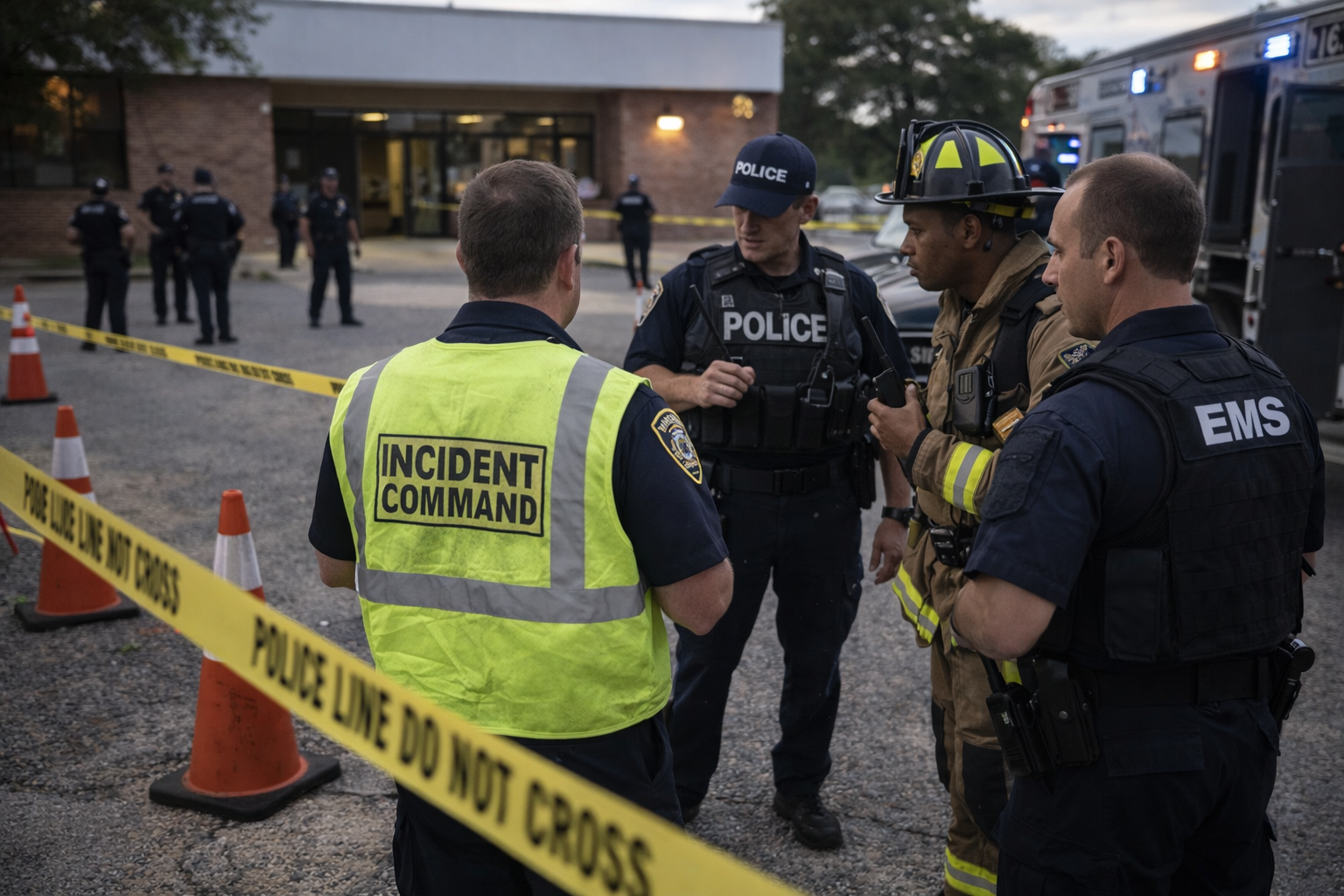
The Stabilization Phase in the CSR Framework: Establishing Control and Coordinated Command
When the immediate violence subsides, the incident does not end—it changes character. The transition from chaos to control marks the beginning of the Stabilization Phase in the Chaos–Stabilization–Recovery (CSR) framework. This phase is decisive not because threats have vanished, but because organizational intent finally catches up to operational reality. The quality of decisions made during stabilization determines whether early gains are preserved, casualties are managed effectively, and secondary harm is prevented.
The central premise of this analysis is straightforward: the Stabilization Phase is where fragmented action becomes coordinated response. Unified Command, cordon control, disciplined MRT deployment, and expanded risk assessment transform a volatile environment into one that can support sustained medical care, investigative operations, and community protection. By applying principles from the science of listener attention—front-loaded relevance, cognitive chunking, progressive emphasis, repetition with variation, and continuous relevance anchoring—this article clarifies why stabilization is not a pause after chaos, but an active phase requiring deliberate leadership and integration.
From Immediate Threat to Managed Risk
The Stabilization Phase begins when immediate threats are neutralized or effectively contained. This does not imply certainty or safety; it signals that the attacker’s ability to inflict additional harm has been sufficiently reduced to permit broader coordination. Threat mitigation transitions from rapid disruption to managed risk.
This distinction matters. Declaring an incident “over” prematurely invites complacency. Stabilization assumes that secondary threats—additional attackers, devices, fires, structural hazards, or fleeing suspects—may still exist. The objective is not comfort, but control.
Front-loading this relevance ensures clarity: stabilization is an operational phase with its own priorities, not merely the absence of chaos.
Establishing Internal and External Cordons
One of the first visible actions of stabilization is the establishment of internal and external cordons. These cordons serve distinct but complementary functions.
Internal cordons secure cleared areas, protect ongoing medical operations, and prevent contamination of investigative spaces. They create predictable movement corridors for MRTs, EMS transport, and command staff. External cordons manage access, control crowds, and regulate the flow of incoming resources and information.
Cordons are not static barriers; they are dynamic control measures that expand or contract based on evolving intelligence. When properly managed, they replace the fluid danger of the Chaos Phase with structured access and accountability.
Repeated emphasis on cordon purpose anchors attention on control rather than exclusion. Cordons are not about keeping people out; they are about enabling safe, efficient operations within.
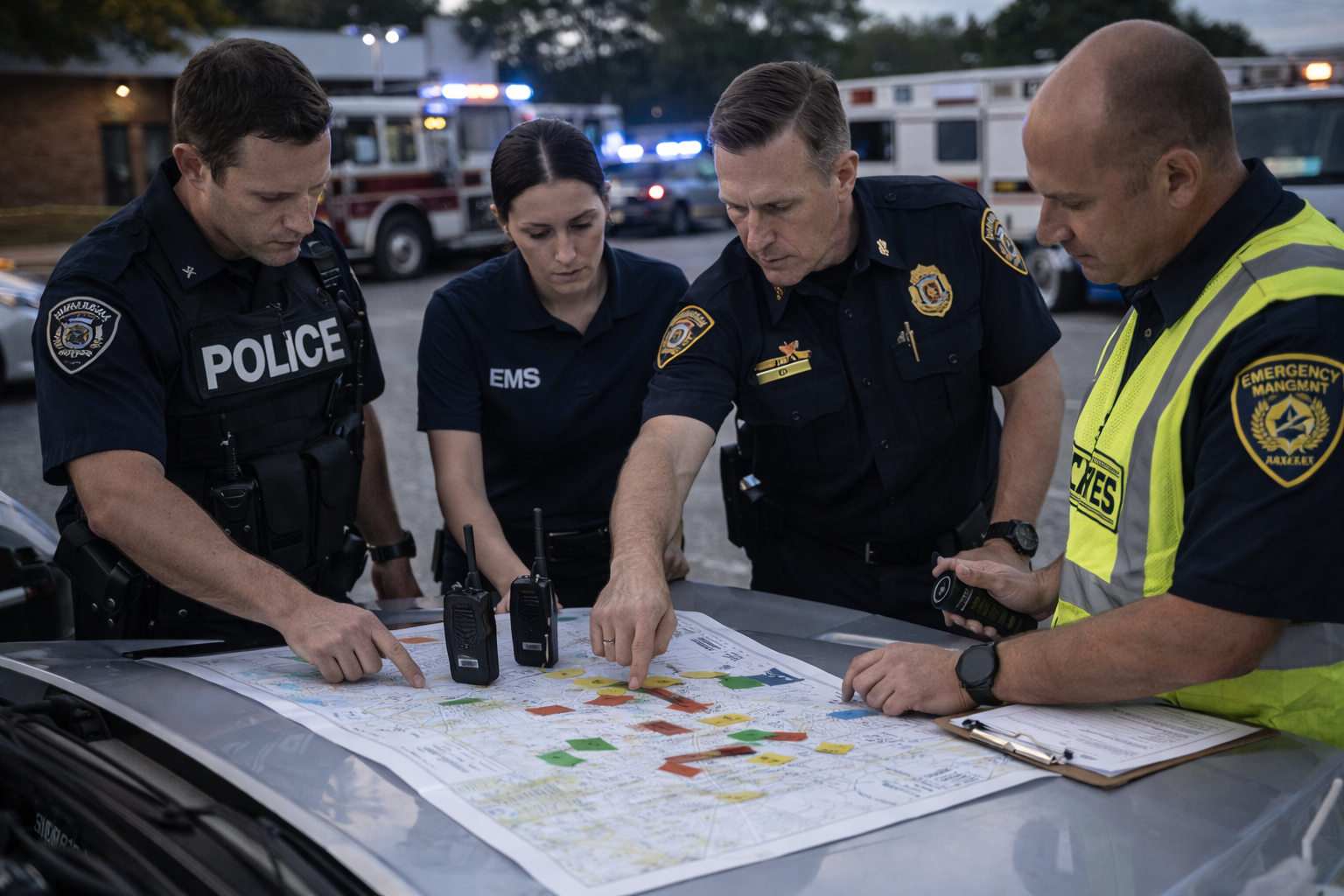
Unified Command: The Architecture of Coordination
As stabilization takes hold, the Incident Command Post (ICP) becomes the operational nucleus. Under Unified Command, law enforcement, EMS, fire services, and Emergency Management Agencies (EMAs) align objectives, share information, and synchronize actions.
Unified Command is not a symbolic gesture; it is an organizational architecture designed to prevent stovepiping. Each discipline retains authority within its domain while committing to shared priorities and common operating pictures.
During stabilization, the ICP shifts from enabling rapid action to orchestrating sustained operations. Resource requests are rationalized. Communication pathways are standardized. Decision-making moves from reactive to anticipatory.
The science of attention reinforces why this matters: when responders see clear command structure early in stabilization, cognitive load decreases and performance improves. Ambiguity fades, and coordinated behavior becomes the default.
Synchronizing EMS, Fire, Law Enforcement, and EMAs
Stabilization succeeds only when agencies move at a shared tempo. EMS focuses on patient distribution, secondary triage, and continuity of care. Fire services address fire suppression, hazard mitigation, and structural safety. Law enforcement consolidates security, conducts systematic searches, and preserves evidence. EMAs manage logistics, public messaging, and intergovernmental coordination.
Synchronization does not require uniformity; it requires alignment. Tasks differ, but timing and intent must converge. The ICP facilitates this convergence by setting priorities, sequencing objectives, and resolving conflicts before they disrupt operations.
Fragmentation at this stage is costly. Disconnected actions create bottlenecks, duplicate effort, and reintroduce risk. Stabilization is therefore as much about discipline as it is about direction.
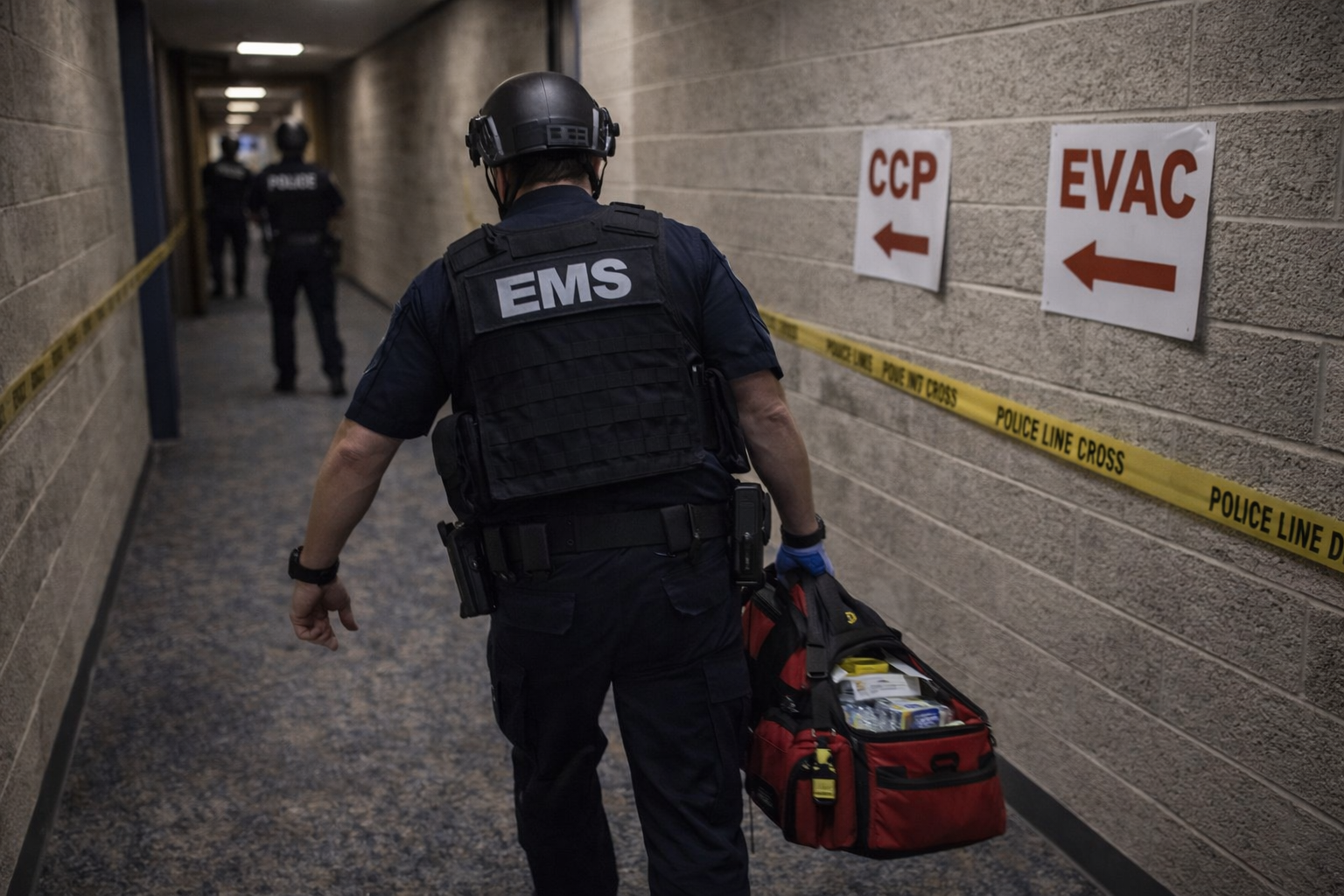
MRT Deployment During Stabilization: Speed With Structure
Medical Rescue Teams remain critical during stabilization, though their role evolves. With immediate threats contained, MRT deployment becomes more deliberate, but no less urgent. Secured Hot and Warm Zones allow MRTs to expand care beyond immediate life-saving interventions into more comprehensive stabilization.
This phase minimizes delays by preserving forward medical access while improving protection and predictability. MRTs operate within cleared corridors, reducing exposure while maintaining proximity to patients. The result is higher-quality care delivered sooner, without reverting to distant staging.
Repetition with variation reinforces the point: early care saved lives during chaos; sustained, coordinated care saves lives during stabilization. The principle remains constant even as tactics adapt.
Managing the Expanded Risk Picture
A defining feature of the Stabilization Phase is the expansion of risk assessment beyond the incident site. Threats do not respect perimeters. Suspects may flee. Devices may be placed off-site. Panic and misinformation can create secondary emergencies.
Unified Command broadens its focus accordingly. Intelligence sharing with regional partners, traffic management, hospital security coordination, and public communication become priorities. This outward-facing posture prevents secondary harm and reassures affected communities.
Anchoring attention here is essential: stabilization is not inward-looking containment; it is system-wide protection.
Cognitive Transition: From Survival to Deliberation
The Stabilization Phase marks a cognitive shift for responders. During chaos, decision-making is fast, intuitive, and principle-driven. Stabilization demands deliberate, analytical thinking. Plans are refined. Assumptions are tested. Resources are allocated with foresight.
This transition is fragile. If responders remain psychologically anchored in chaos, they may overreact or exhaust resources unnecessarily. Conversely, shifting too quickly into routine risks missing residual threats.
Training that explicitly addresses this cognitive transition improves performance. Responders learn to recognize when to slow down—and when not to. Attention science supports this approach: naming the phase change helps teams recalibrate without losing focus.
The Stabilization Phase as a Force Multiplier
Effective stabilization multiplies the benefits of earlier actions. Casualties treated earlier are easier to manage. Secured spaces enable efficient searches. Clear command reduces friction. Each element reinforces the others.
This compounding effect explains why stabilization deserves as much doctrinal emphasis as chaos. It is where early success is consolidated—or squandered.
Repeatedly returning to this idea—success must be preserved—anchors the listener’s understanding of stabilization’s importance.
Avoiding the Trap of Premature Normalization
One of the greatest risks during stabilization is premature normalization—the assumption that because violence has stopped, urgency has passed. This mindset erodes vigilance, disrupts coordination, and invites error.
CSR explicitly guards against this by defining stabilization as an active phase. Control is maintained, not assumed. MRTs remain forward. Cordons remain enforced. Command remains engaged.
Variation in emphasis reinforces the lesson: stabilization is calmer than chaos, but it is not safe by default.
Training and Doctrine Implications
Preparing for stabilization requires training beyond entry tactics. Exercises must include cordon establishment, Unified Command operations, MRT redeployment, and expanded risk assessment. These elements are often undertrained despite their operational importance.
Doctrine must articulate stabilization triggers, roles, and decision thresholds. When responders know what stabilization looks like, they recognize it—and act accordingly.
Repetition with variation ensures that stabilization skills are as reflexive as chaos skills. Both are necessary.
Progressive Emphasis: Control Enables Care
Across the Stabilization Phase, one theme recurs: control enables care. Unified Command enables coordination. Cordons enable movement. MRT deployment enables timely treatment. Expanded risk assessment enables community protection.
Each component supports the others. Control is not an end; it is a means to preserving life and order.
Conclusion
The Stabilization Phase of the CSR framework is where high-threat incidents are shaped into manageable operations. Once immediate threats are neutralized or contained, Unified Command, cordon control, and disciplined MRT deployment establish the structure necessary for coordinated action.
This phase is not passive. It demands leadership, synchronization, and sustained attention. When executed effectively, stabilization preserves the gains of the Chaos Phase, reduces secondary harm, and prepares the system for recovery.
In high-threat incident management, chaos reveals capability—but stabilization proves competence.