Scene Safety Is Dynamic, Not Declarative
Scene Safety Is Dynamic, Not Declarative
In high-threat incidents, few phrases have shaped responder behavior as powerfully—or as problematically—as “scene safe.” Originally intended as a cautionary principle, the concept has gradually hardened into a declarative threshold: a moment when danger is presumed resolved and care is finally permitted. In modern threat environments, this interpretation is no longer merely outdated; it is operationally dangerous. Threats now evolve faster than policy language, and a static declaration of safety cannot keep pace with dynamic, human-driven violence. Scene safety is not a binary condition to be achieved and announced. It is a continuously shifting assessment that must be managed in real time if lives are to be saved.
This distinction matters because time is physiology. Every minute of delay in hemorrhage control, airway management, or rapid extraction increases the likelihood of preventable death. When “scene safe” is treated as a prerequisite for care rather than a condition to be actively mitigated, responders are conditioned to wait for certainty that never truly exists. The result is predictable: delayed intervention, unnecessary mortality, and a widening gap between doctrine and reality.
Threats Evolve Faster Than Policy Language
Modern high-threat incidents are defined by speed, unpredictability, and human agency. Active shooters move, adapt, barricade, flee, or blend into crowds. Secondary devices, accomplices, or copycat actors may emerge without warning. These dynamics unfold in minutes—often seconds—while policy language remains fixed and retrospective.
Most EMS and fire doctrines were written for static hazards: traffic scenes, fires, hazardous materials releases. In those contexts, once a danger is controlled, it remains controlled. Violence does not behave this way. A hallway cleared moments ago may become dangerous again. A suspect believed neutralized may re-engage. A new threat vector may appear beyond the original perimeter.
When policy language treats safety as something that can be conclusively declared, it creates a false expectation of stability. Responders trained under this model wait for an announcement rather than reading conditions. They listen for permission instead of evaluating risk. In doing so, they surrender adaptability—the very skill required to survive and operate in evolving threat environments.
The Illusion of “Scene Safe” and False Certainty
The phrase “scene safe” carries psychological weight. It implies completeness, control, and absence of danger. Once spoken, it reassures responders that the environment has transitioned from threat to routine. In modern incidents, this reassurance is rarely justified.
False certainty is more dangerous than acknowledged risk. When responders believe a scene is safe, they relax vigilance, cluster resources, and move predictably. This behavior increases vulnerability if conditions change—as they often do. Conversely, when responders recognize that safety is provisional, they maintain situational awareness, disperse intelligently, and adapt movement and posture to risk.
From a medical perspective, false certainty also delays care. EMS and fire personnel conditioned to wait for a formal declaration may withhold lifesaving interventions even when risk is manageable and protection is available. The illusion of safety becomes a barrier rather than a safeguard.
Static Assumptions and Delayed Care
Static assumptions about scene safety directly conflict with trauma physiology. Hemorrhage does not pause while a perimeter is expanded. Airway compromise does not wait for investigative clearance. Shock progresses regardless of command milestones. When care is delayed until a scene is declared safe, the most survivable window often closes before intervention begins.
After-action reviews repeatedly show that casualties with potentially survivable injuries deteriorated during these delays. In many cases, responders were physically close but procedurally constrained. The danger was not absolute; it was managed by law enforcement presence, cover, and movement. Yet doctrine discouraged entry because safety had not been formally declared.
This mismatch reveals the core flaw of declarative safety models: they prioritize administrative certainty over biological urgency. In doing so, they invert the very purpose of emergency response.
Risk as a Continuum, Not a Switch
Effective response requires reframing safety as a continuum rather than a switch. Risk is never eliminated; it is managed, mitigated, and balanced against competing priorities. Firefighters accept managed risk when entering unstable structures. Law enforcement accepts it during dynamic entries. Medical responders must be empowered to do the same when lives depend on early intervention.
Continuous risk assessment involves reading threat indicators, understanding protection levels, and adjusting tactics accordingly. It recognizes that different zones—hot, warm, and cold—are not fixed lines but fluid spaces shaped by human behavior. A warm zone today may become hot tomorrow, and vice versa.
This approach does not encourage recklessness. On the contrary, it demands discipline, training, and coordination. Responders must understand what risks are acceptable, under what conditions, and with what protections. Continuous reassessment replaces blind waiting with informed action.
TECC and the Reframing of Safety Decisions
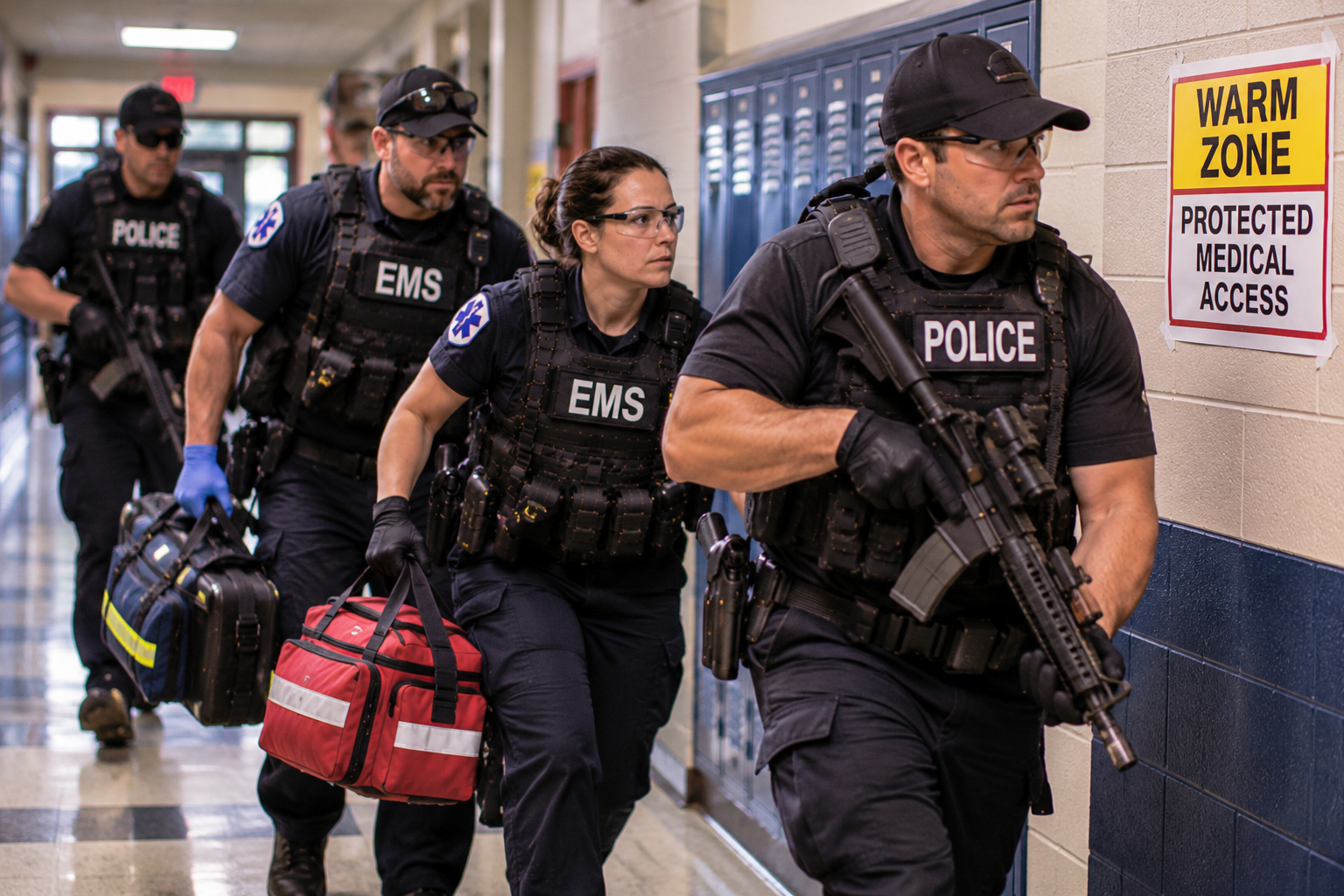
Tactical Emergency Casualty Care (TECC) provides a framework that aligns safety decisions with both threat dynamics and medical urgency. Rather than asking whether a scene is safe, TECC asks how care can be delivered despite ongoing risk. It reframes safety as something created through coordination, movement, and protection—not something discovered after the fact.
TECC’s phases—Direct Threat Care, Indirect Threat Care, and Evacuation Care—explicitly acknowledge that medical intervention often begins before threats are fully resolved. Each phase balances risk and benefit, guiding responders toward actions that save lives while minimizing exposure. Importantly, TECC treats safety as situational and evolving, not declarative.
By integrating medical care into threat management rather than sequencing it afterward, TECC resolves the false dilemma between safety and survival. It recognizes that waiting for absolute safety is itself a hazard.
Cultural and Training Barriers
Despite its evidence base, the shift from declarative to dynamic safety faces cultural resistance. Many responders were trained under rigid interpretations of “scene safe,” reinforced by liability fears and institutional inertia. These beliefs persist even as incident data contradicts them.
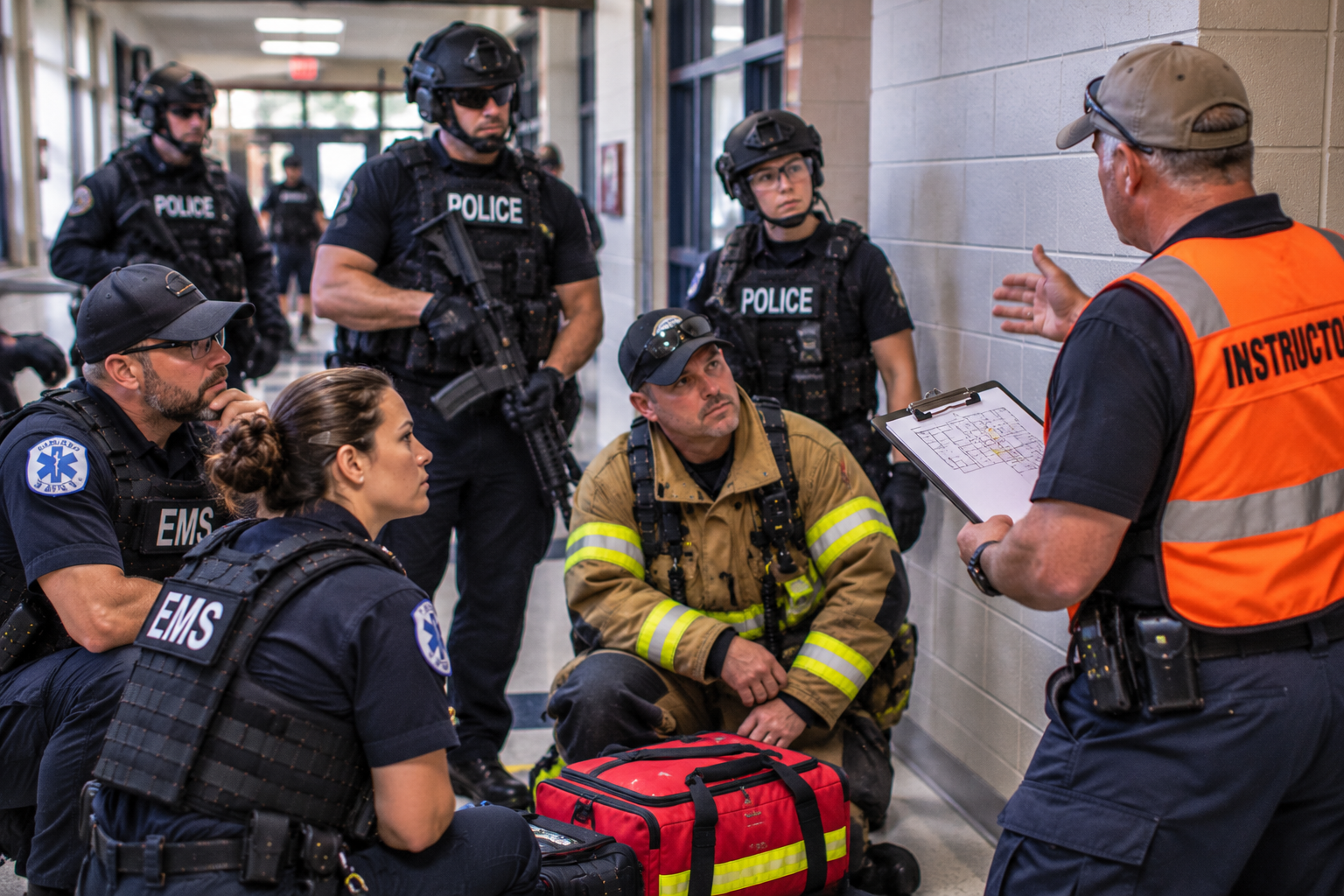
Training often compounds the problem by presenting idealized scenarios where safety transitions cleanly from unsafe to safe. Rarely are responders forced to make decisions in ambiguous environments where partial control exists and risk must be weighed rather than avoided. As a result, responders lack confidence in operating under managed risk and default to delay.
Changing this culture requires deliberate effort. Training must expose responders to realistic ambiguity. Policies must explicitly support early, protected medical access. Leadership must model and defend dynamic decision-making when outcomes justify the risk. Without this alignment, declarative safety will continue to dominate behavior regardless of evidence.
Operational Implications Across Disciplines
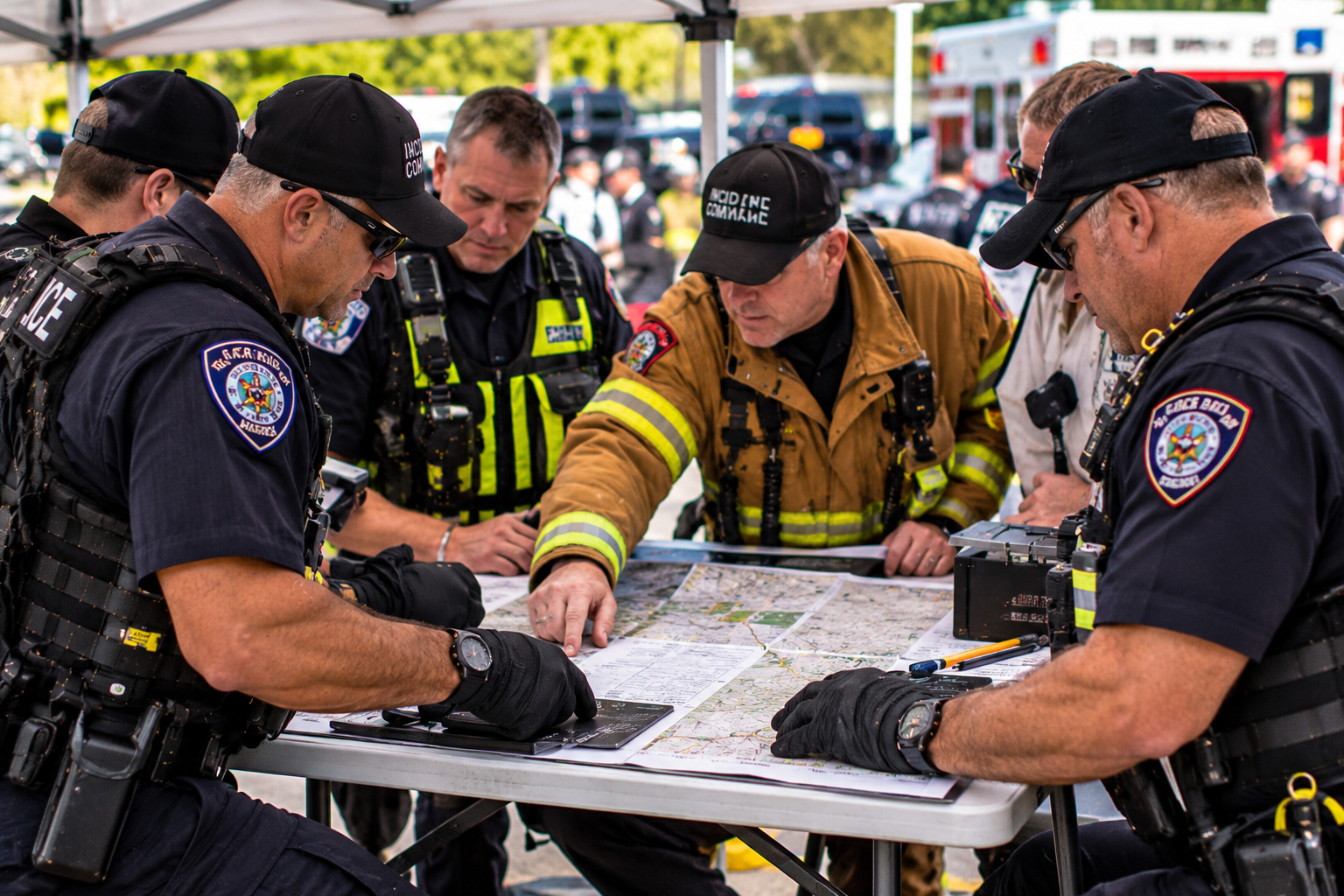
Dynamic scene safety is not solely an EMS issue. Law enforcement, fire, and emergency management all influence how safety is perceived and communicated. A law enforcement declaration intended to convey partial control may be interpreted by EMS as full clearance—or vice versa. Without shared understanding, miscommunication flourishes.
Unified command structures must therefore adopt common language that reflects uncertainty rather than conceals it. Instead of “scene safe,” descriptors such as “threat contained to X area,” “warm zone established,” or “protected access available” provide actionable information. These phrases invite assessment rather than compliance.
When all disciplines operate from a shared, dynamic understanding of risk, coordination improves. Medical access accelerates. Protective movement becomes intentional. Safety is not assumed; it is actively maintained.
Continuous Relevance to Modern Response
The need to abandon declarative safety is not hypothetical. Active shooter events increasingly end within minutes, often before traditional safety declarations occur. If care waits for certainty, it will miss the moment when it matters most. Dynamic safety models align response tempo with incident tempo, ensuring that medical intervention is not perpetually late.
This alignment is essential for responder survival as well. Injured responders cannot wait for declarations; they must act immediately. A doctrine that denies dynamic self-aid and buddy-aid contradicts the realities responders face.
Conclusion
Scene safety is dynamic, not declarative. Treating it as a binary condition creates false certainty, delays care, and increases preventable death. Modern threat environments demand continuous risk assessment, managed exposure, and coordinated action across disciplines.
Frameworks such as TECC demonstrate that safety and early medical intervention are not mutually exclusive. When safety is understood as something responders create through movement, protection, and judgment, rather than something they wait to be granted, outcomes improve.
Abandoning declarative safety does not increase recklessness; it increases realism. In high-threat incidents, certainty is rare, time is unforgiving, and survival depends on action informed by risk—not paralysis justified by policy language.