
Evolution of Active Shooter Tactics and Trends
Evolution of Active Shooter Tactics and Trends
Active shooter incidents are not static phenomena. They evolve in response to social conditions, media exposure, law enforcement countermeasures, and the attackers’ own learning processes. Response doctrine, however, has often lagged behind this evolution—remaining anchored to threat models that no longer reflect operational reality. Understanding how active shooter tactics and trends have changed is therefore not an academic exercise; it is a prerequisite for designing response systems capable of preserving life under modern conditions.
This analysis examines the evolution of active shooter tactics with particular attention to how these changes stress traditional response models. By tracing shifts in offender behavior, weapon selection, planning sophistication, and attack execution, this discussion highlights why legacy assumptions about incident structure, duration, and predictability are increasingly invalid. The central premise is clear: as attacker tactics evolve toward speed, complexity, and coordination, response models must evolve toward integration, adaptability, and simultaneous action. Failure to do so creates a widening gap between threat behavior and responder capability—one measured in preventable loss of life.
From Lone Actors to Coordinated, Multi-Site Attacks
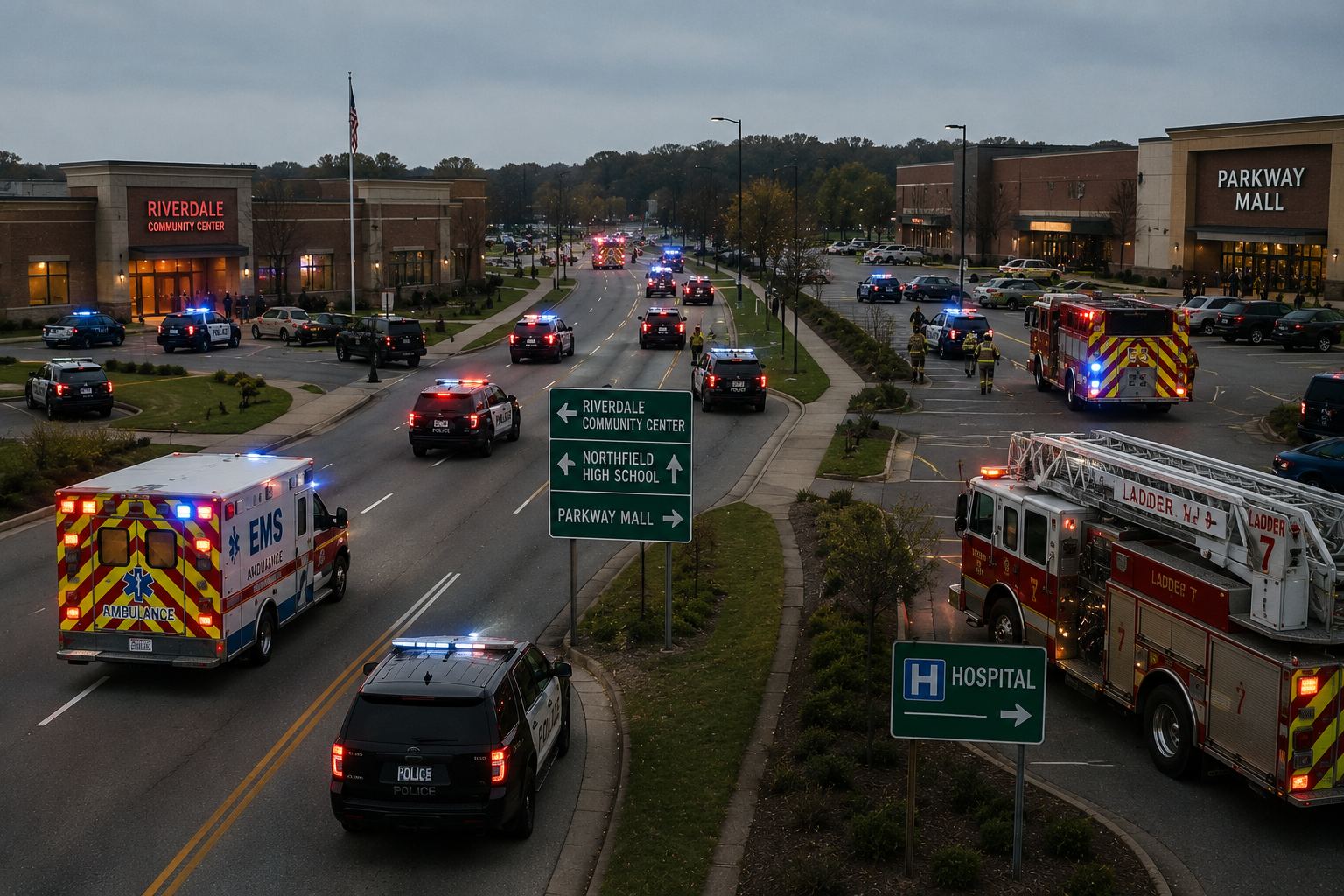
Early active shooter doctrine was shaped largely by incidents involving a single offender operating at a single location. These events, while chaotic, allowed responders to conceptualize the threat as geographically contained and tactically linear. Entry, search, and neutralization could be planned around a relatively fixed problem set.
Recent trends demonstrate a shift away from this model. Increasingly, incidents involve multiple attackers, multiple locations, or rapidly shifting points of violence. Some offenders coordinate actions across campuses, commercial districts, or transportation hubs. Others exploit the delay created by initial response to expand the attack footprint before containment is established.
This shift fundamentally challenges perimeter-based and sequential response models. When violence is distributed rather than centralized, staging assumptions collapse. Responders cannot rely on static boundaries or single-axis movement. Medical access, evacuation routes, and command structures must function across fragmented environments simultaneously.
The evolution toward multi-site attacks exposes the inadequacy of models designed for singular threats.
Hybrid Attacks and the Expansion of Threat Modalities
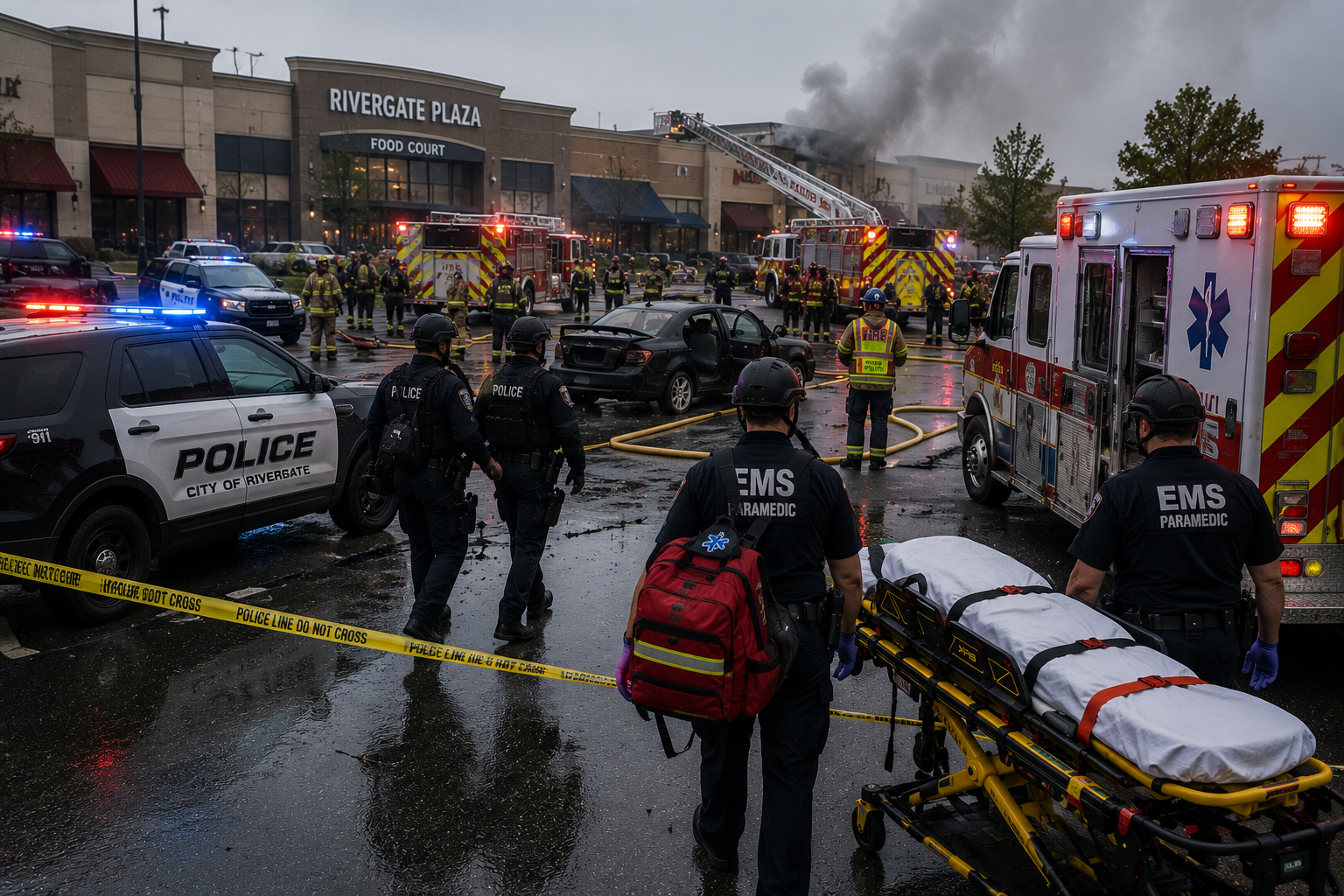
Another defining trend is the increased use of hybrid attack methods, blending firearms with fire-setting, vehicle assaults, improvised explosives, or structural sabotage. These methods serve multiple purposes: increasing casualty potential, overwhelming responders, and creating secondary hazards that delay intervention.
Hybrid attacks complicate response in several ways. Fire and smoke restrict movement and visibility. Explosives create uncertainty about secondary devices. Structural damage limits access to casualties. Each element introduces additional risk layers that interact rather than resolve sequentially.
Traditional response doctrine often treats these hazards as discrete problems to be managed independently. In reality, they unfold concurrently. A shooter setting fires is not transitioning to a new phase; they are amplifying the same attack. Response models that compartmentalize hazards struggle to keep pace with this convergence.
Hybrid tactics demand response systems capable of managing compound risk, not isolated threats.
Increased Pre-Planning, Surveillance, and Target Selection
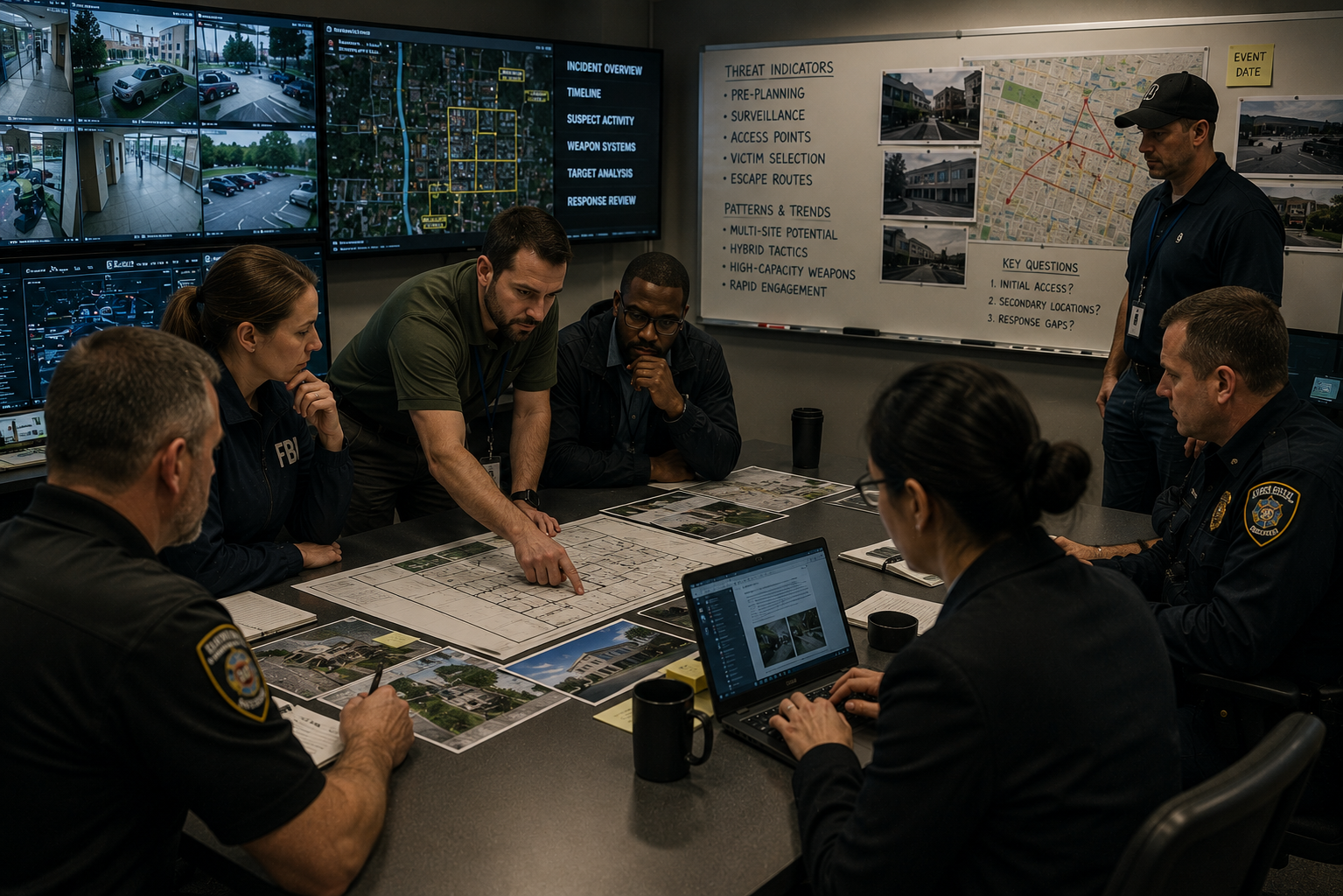
Modern attackers demonstrate a growing level of pre-incident planning. This includes reconnaissance of facilities, analysis of security measures, selection of symbolic or high-density targets, and timing attacks to exploit vulnerabilities such as shift changes, events, or delayed response windows.
This planning is often informed by public reporting on prior incidents and response shortcomings. Attackers learn what works. They adapt accordingly. In doing so, they intentionally target the seams between agencies, the delays created by staging, and the predictability of response patterns.
For responders, this means that many incidents begin with the attacker already inside the decision loop. Initial actions are reactive by necessity. Models that assume time to organize, stage, and sequence operations are immediately disadvantaged.
As attacker planning sophistication increases, response predictability becomes a liability.
Weapon Trends and the Acceleration of Violence
The increasing availability and use of high-capacity firearms significantly compress the timeline of injury and death. High rates of fire, rapid magazine changes, and increased accuracy allow attackers to inflict mass casualties within seconds.
This acceleration has two critical implications. First, casualty generation occurs almost immediately, often before responders arrive. Second, survivable injuries transition to fatal ones rapidly without intervention.
Response models that delay medical access until after threat resolution fail to account for this acceleration. When dozens of casualties are created within minutes, systems designed for orderly progression cannot respond in time.
The evolution of weapons technology amplifies the cost of delay and exposes the inadequacy of response timelines rooted in slower threat assumptions.
Implications for Tactical Movement and Response Design
As attacker tactics evolve, tactical movement must evolve as well. Linear clearing operations designed for contained threats are less effective against mobile, multi-site attackers. Similarly, movement patterns that prioritize methodical progression over access may unintentionally delay both threat mitigation and casualty care.
Modern response requires adaptive movement—prioritizing access to threat corridors, casualty clusters, and survivability-critical locations. This does not mean abandoning tactical discipline; it means aligning movement objectives with both security and medical imperatives.
Rigid adherence to outdated movement doctrine in evolving threat environments creates friction rather than control.
The Mismatch Between Threat Evolution and Response Doctrine
A consistent theme across incident analysis is the mismatch between evolving attacker behavior and static response doctrine. While attackers adapt quickly, response systems often require years to change policy, update training, and secure consensus across agencies.
This lag is not due to lack of effort but to institutional inertia. Large systems favor stability. Unfortunately, stability in doctrine can become fragility in crisis.
When response models fail to account for multi-site violence, hybrid hazards, rapid casualty generation, and attacker pre-planning, they create predictable failure points—ones attackers increasingly exploit.
Casualty Management Under Evolving Threat Conditions
Evolving tactics place extraordinary pressure on casualty management systems. Multiple injury sites, overlapping hazards, and delayed access complicate triage, treatment, and evacuation. Traditional casualty collection point (CCP) models, often located outside threat zones, struggle to function when threats are dispersed or mobile.
In these environments, casualty care must occur closer to the point of injury, often under protection rather than certainty. Models that treat medical care as downstream fail to meet this demand.
Threat evolution thus forces a reexamination of where, when, and how care is delivered.
Command and Control in Complex Attack Scenarios
As incidents become more complex, command and control challenges intensify. Multi-site attacks strain communication, resource allocation, and situational awareness. Hybrid hazards require coordination across law enforcement, fire, EMS, and emergency management simultaneously.
Traditional command models built around single-incident progression often struggle to scale. Information overload, conflicting priorities, and delayed decision-making compound operational stress.
Effective command in evolving threat environments requires flexible frameworks, shared situational understanding, and pre-established integration—not ad hoc coordination.
Why Incremental Adjustments Are Insufficient
Many agencies respond to evolving threats by making incremental adjustments to existing models—adding equipment, revising checklists, or expanding training hours. While beneficial, these changes often fail to address the underlying conceptual mismatch.
When threat evolution fundamentally alters incident structure, response models must adapt structurally as well. Adding capacity to an outdated framework does not resolve its limitations; it amplifies them.
True adaptation requires rethinking assumptions about sequencing, safety, access, and role integration.
Continuous Relevance: Why Evolution Demands Integration
The throughline connecting all modern active shooter trends is compression—of time, space, and decision-making. Violence happens faster, across broader areas, with greater complexity. Response must therefore become faster, more integrated, and more adaptive.
Integrated tactical-medical frameworks acknowledge this reality. They are designed not for certainty, but for chaos. They prioritize early intervention, parallel operations, and continuous reassessment—aligning response behavior with evolving threat characteristics.
As attacker tactics continue to change, relevance demands that response models evolve alongside them.
Preparing for the Next Iteration of Threats
Threat evolution is ongoing. Future incidents may involve new technologies, autonomous weapons, cyber-physical coordination, or further hybridization. Response systems anchored to outdated models will face increasing failure.
Preparing for future threats requires embracing adaptability as a core principle. Training must emphasize decision-making under uncertainty. Doctrine must support integration rather than separation. Success metrics must prioritize survivability alongside threat resolution.
The evolution of attacker tactics is inevitable. The evolution of response doctrine is a choice.
Conclusion
Active shooter tactics and trends have evolved significantly—from single-offender, single-site attacks to coordinated, hybrid, rapidly executed incidents characterized by pre-planning and accelerated violence. These changes expose critical weaknesses in traditional response models built around sequential tasking, static perimeters, and delayed medical access.
As threats become faster, more complex, and less predictable, response systems must evolve toward integration, adaptability, and simultaneous action. Models that fail to do so will continue to lag behind attacker behavior, with consequences measured in preventable deaths.
Understanding the evolution of active shooter tactics is not about predicting the next attack—it is about recognizing that yesterday’s assumptions no longer apply. Only by aligning response doctrine with modern threat realities can public safety agencies hope to preserve life in the face of continually evolving violence.