Force Protection for Medical Personnel
Force Protection for Medical Personnel
Medical care saves lives only when medical personnel can reach patients alive, intact, and operationally capable. In high-threat incidents, this truth becomes unavoidable. Fire and EMS personnel are increasingly expected to operate in warm and hot zones where threats are unresolved, environments are unstable, and traditional assumptions of scene security no longer apply. Yet medical responders are often deployed into these spaces without the training, equipment, or doctrinal support required to survive there. This gap between expectation and preparation places both responders and patients at unacceptable risk.
This section examines force protection for medical personnel as an operational requirement rather than a tactical luxury. The core premise is simple and non-negotiable: medical personnel cannot provide care if they cannot protect themselves. Survivability training, appropriate personal protective equipment (PPE), deliberate movement techniques, and integrated law enforcement coordination are not militarization—they are prerequisites for modern prehospital care in high-threat environments.
Why Force Protection Is No Longer Optional
High-threat incidents have evolved faster than medical doctrine. Active shooter events, hybrid attacks, and complex mass violence now unfold in compressed timelines, often concluding before traditional staging and clearance models allow medical entry. As a result, early care increasingly occurs inside contested or semi-secured spaces.
Despite this shift, many fire and EMS agencies still operate under models that assume protection is external and guaranteed. In practice, this assumption fails. Medical personnel are exposed to unsecured hallways, incomplete threat mitigation, secondary devices, and unpredictable human movement. Without force protection principles, even highly skilled clinicians become liabilities rather than assets.
Force protection does not mean turning medics into law enforcement officers. It means equipping them with the skills and support necessary to function safely in environments that no longer conform to historical norms.
Survivability Training: The Missing Foundation
Under stress, responders do not rise to new levels of performance; they default to their lowest level of training. If medical personnel have never trained to move under threat, they will freeze, misposition, or expose themselves unnecessarily when danger is present. Survivability training is therefore foundational.
Effective survivability training includes:
Threat recognition and orientation
Use of cover and concealment
Movement with purpose rather than speed alone
Maintaining situational awareness while performing care
This training is not about tactics for engagement. It is about understanding risk, reducing exposure, and staying alive long enough to treat patients. When survivability skills are integrated into medical training, confidence improves and hesitation decreases. Medical teams move with intent rather than fear.
PPE Gaps and the Illusion of Protection
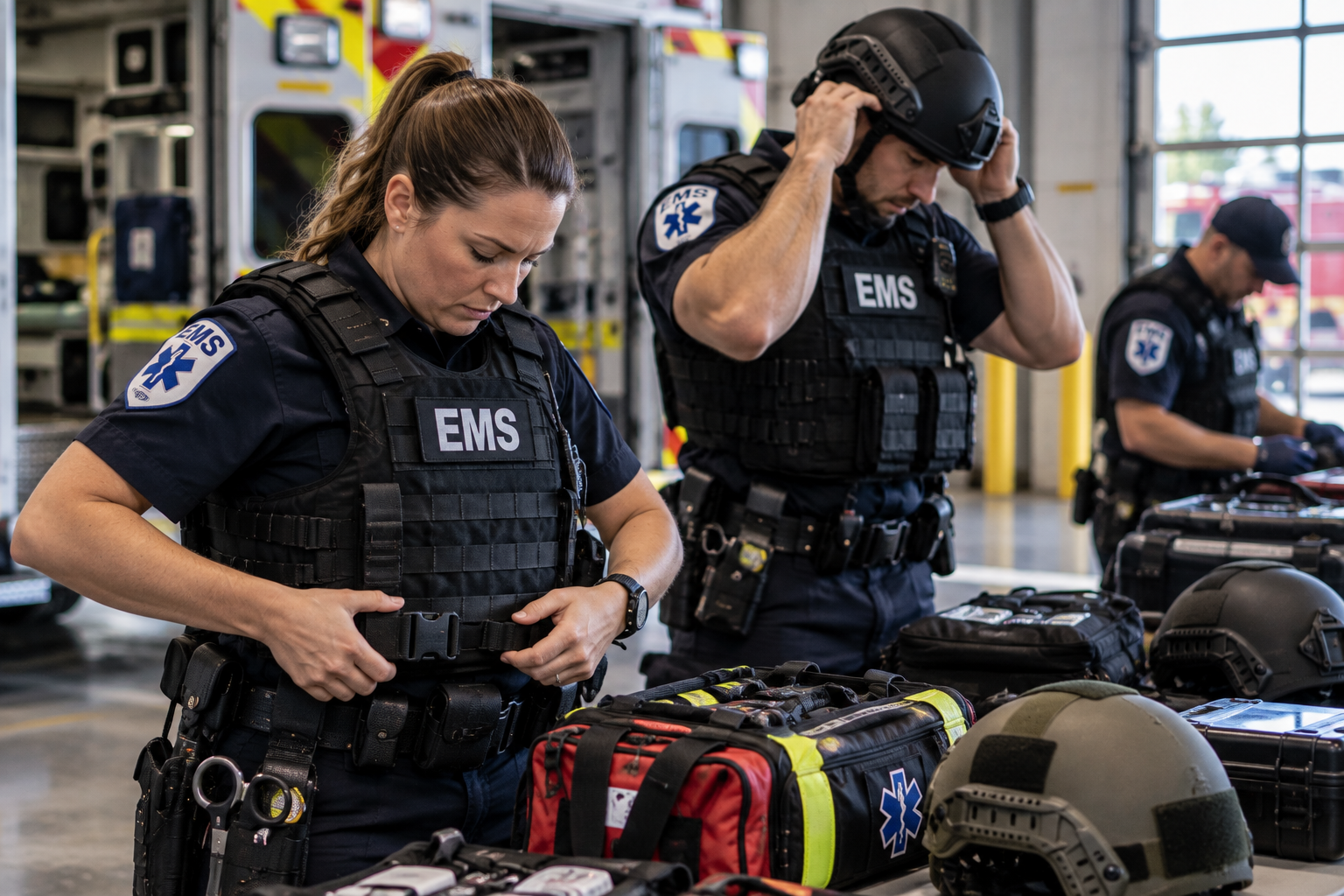
Personal protective equipment represents one of the most visible—and often misunderstood—elements of force protection. In many agencies, PPE for medical personnel remains limited to gloves, eye protection, and turnout gear designed for fire hazards rather than ballistic threats.
Ballistic vests, helmets, and trauma-capable PPE are frequently unavailable, inconsistently issued, or reserved for specialty units. When PPE exists, it may not be worn due to discomfort, lack of training, or cultural resistance. These gaps create an illusion of protection without actual survivability.
Proper PPE selection must be mission-driven. Medical personnel operating in warm or hot zones require ballistic protection appropriate to the threat, balanced against mobility and endurance. Equally important is training in donning, movement, and medical task performance while wearing protective gear. PPE that cannot be used effectively under stress is functionally irrelevant.
Movement Techniques That Reduce Exposure
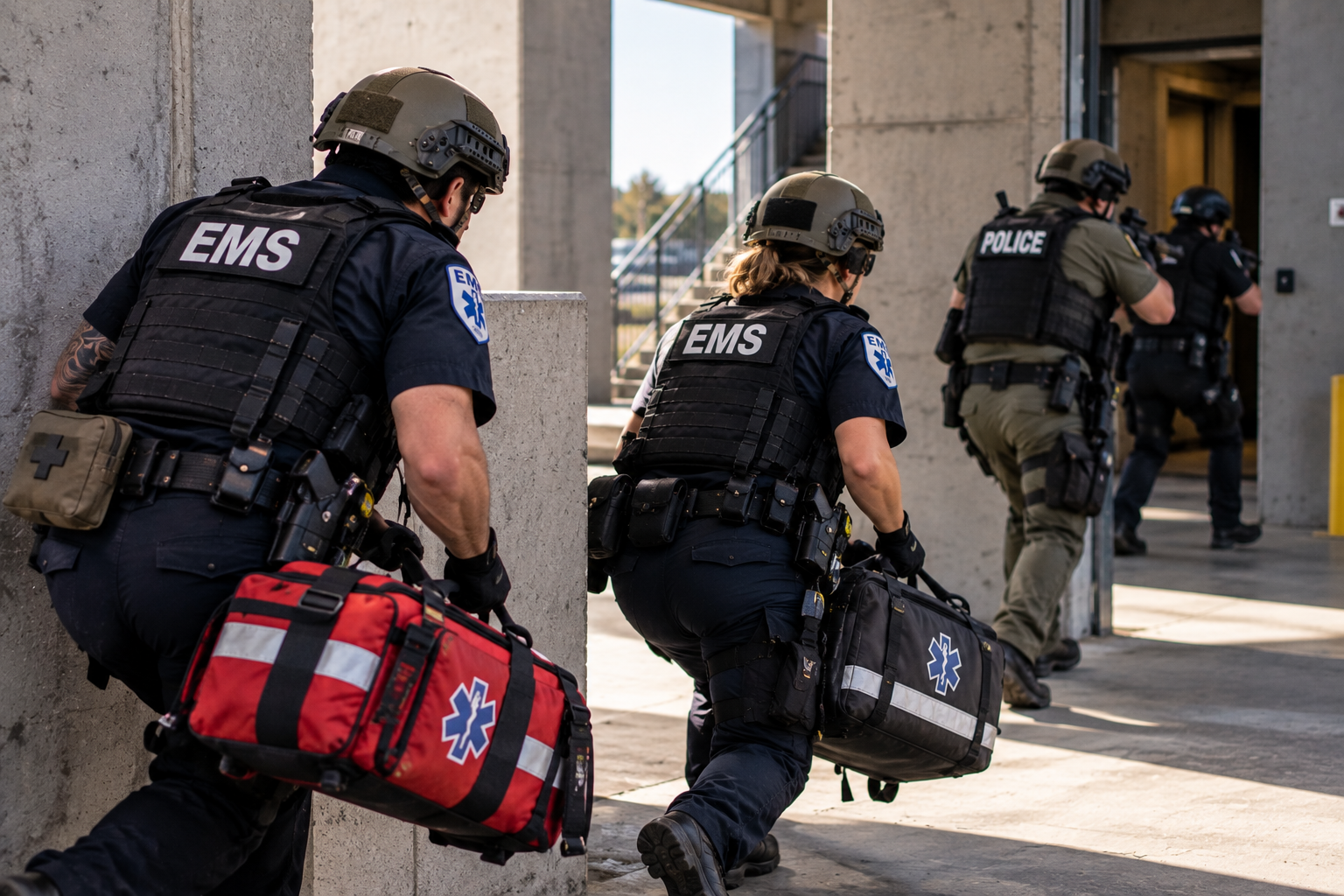
Movement is one of the highest-risk activities in high-threat environments. Untrained movement increases exposure, telegraphs location, and delays care. Survivability-focused movement techniques minimize these risks without requiring tactical complexity.
Key principles include:
Moving deliberately between points of cover
Avoiding predictable pathways
Maintaining spacing to reduce mass casualty risk
Using angles and positioning to limit exposure
These techniques allow medical personnel to reach patients without drawing unnecessary attention or entering danger zones prematurely. Importantly, movement discipline must be practiced repeatedly. Under stress, poorly trained responders revert to instinctive behaviors—often sprinting into open spaces or clustering with others.
Law Enforcement Integration as a Protective Measure
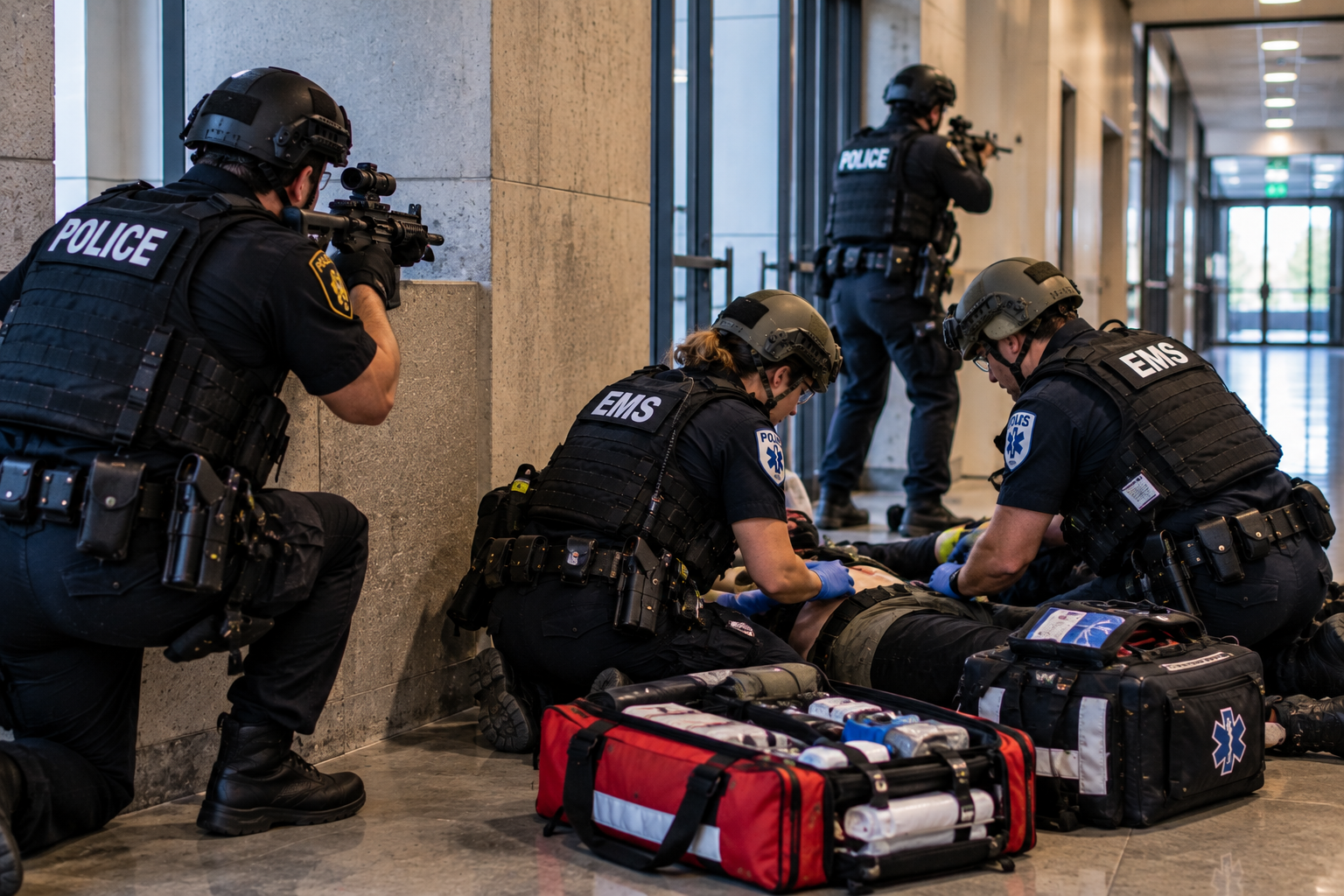
Force protection for medical personnel is not an individual responsibility—it is a coordinated function. Integration with law enforcement provides the most effective protection when medical teams enter contested spaces.
This integration requires shared planning, communication, and expectations. Law enforcement must understand medical objectives, while medical personnel must understand security constraints. When both groups operate from aligned doctrine, protection becomes proactive rather than reactive.
Force-protected movement, overwatch during care, and coordinated extraction all depend on this integration. When medical teams operate independently or without law enforcement awareness, they increase risk for everyone involved.
Cultural Barriers to Force Protection
Resistance to force protection training and equipment often stems from culture rather than evidence. Some medical professionals view ballistic PPE or movement training as incompatible with their role. Others fear that such measures blur professional boundaries.
These concerns are understandable but misplaced. Force protection does not alter the medical mission—it enables it. Refusing protection does not preserve identity; it jeopardizes effectiveness.
Cultural change requires leadership. When agency leaders frame force protection as a safety standard rather than a tactical indulgence, adoption improves. When survivability is normalized as a professional responsibility, resistance fades.
Confidence as an Operational Force Multiplier
Confidence is not bravado; it is competence reinforced through preparation. Medical personnel who understand how to move, where to position themselves, and how they are protected perform better under stress. They make decisions faster, communicate more clearly, and deliver care more effectively.
Conversely, responders who feel exposed or unprotected hesitate. Hesitation delays care, disrupts coordination, and increases psychological stress. Force protection training directly addresses this by replacing uncertainty with practiced response.
Confidence also reduces long-term psychological injury. Responders who believe they had the tools and training to protect themselves experience less moral distress and fewer intrusive memories after incidents.
Force Protection and Operational Tempo
High-threat incidents demand speed, but unprotected speed is reckless. Force protection enables sustained tempo—the ability to operate continuously without excessive risk. Medical teams that feel protected can remain engaged longer, reposition as needed, and support multiple patients.
This capability expands operational options. CCPs can be established closer to the threat. Extraction routes can be adjusted dynamically. Medical access becomes flexible rather than constrained by fear.
In this way, force protection enhances not only safety but overall system performance.
Training Integration and Realism
Force protection training must be integrated into medical education, not treated as a separate specialty. Scenario-based exercises that combine medical tasks with movement, communication, and protection reflect real-world conditions.
Training should involve law enforcement partners whenever possible, reinforcing shared expectations and coordination. Evaluations should focus on survivability outcomes as well as medical proficiency.
Realism matters. Training that avoids discomfort, stress, or complexity fails to prepare responders for actual incidents. Controlled exposure builds resilience and competence.
Continuous Relevance: Protection Enables Care
The relevance of force protection does not end with a single incident type. Any environment where threats are uncertain—active shooters, barricaded suspects, civil unrest, or hybrid attacks—requires medical personnel to operate with awareness and protection.
As response models evolve toward earlier medical access, force protection becomes increasingly central. Without it, expansion of medical roles into warm and hot zones is unsustainable.
Protection enables care. Care justifies protection. These concepts are inseparable.
Conclusion
Force protection for medical personnel is no longer optional in modern emergency response. As fire and EMS increasingly operate in warm and hot zones, survivability training, appropriate PPE, disciplined movement, and law enforcement integration become foundational requirements.
Ignoring these needs places responders at unacceptable risk and undermines patient care. Embracing force protection enhances confidence, operational capability, and long-term resilience. It allows medical professionals to fulfill their mission where it matters most—close to the point of injury, under protection, and without unnecessary delay.
In high-threat environments, the ability to save lives begins with the ability to survive. Force protection is not a tactical add-on; it is the enabler of modern medical response.