
Hasty Casualty Collection Points (CCPs)
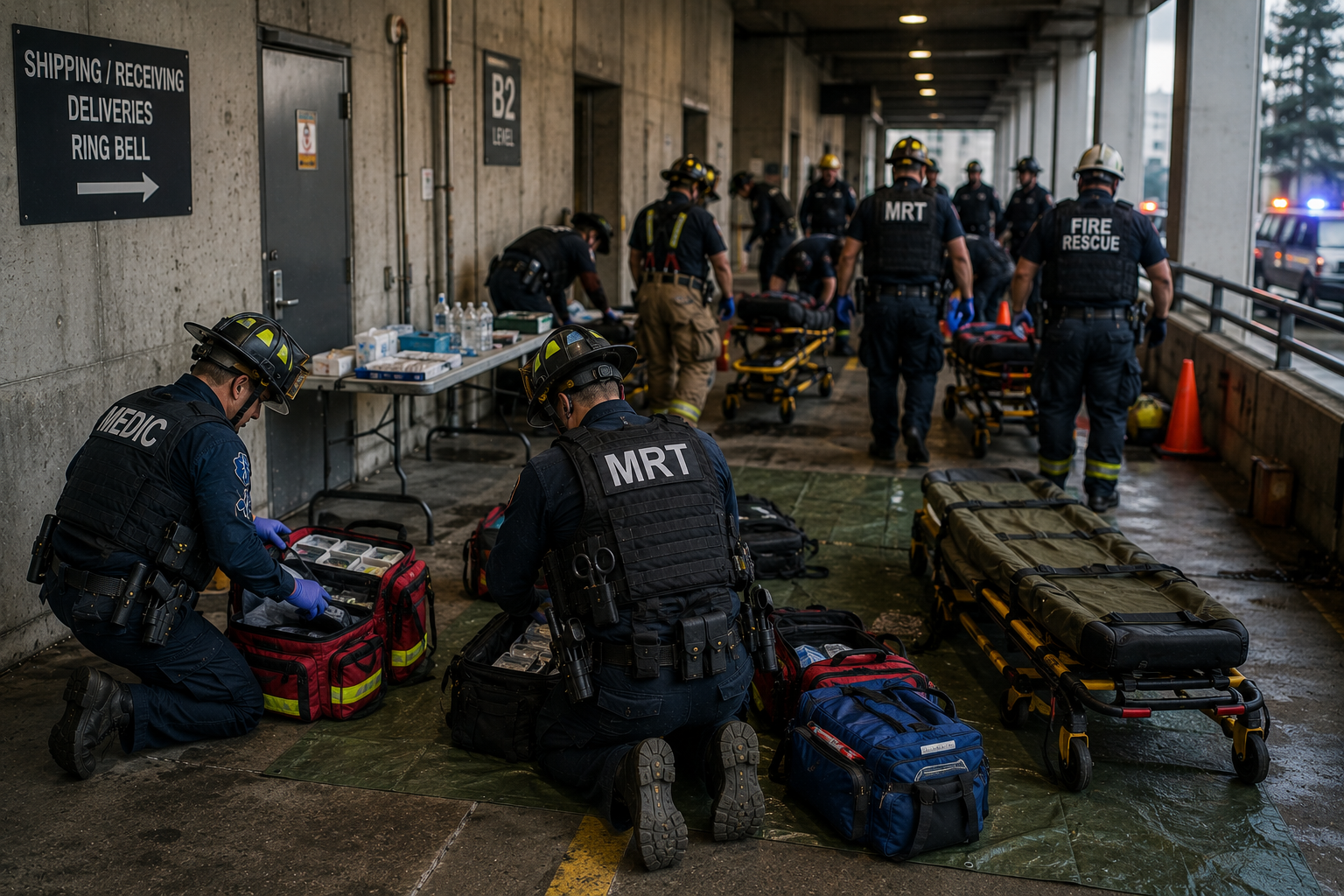
Hasty Casualty Collection Points (CCPs)
In high-threat incidents, survival is decided close to the point of injury and early in the timeline. Every minute between wounding and intervention compounds physiologic deterioration. Hasty Casualty Collection Points (CCPs) exist to compress that timeline—to bring triage, life-saving care, and organized movement as close to the threat as conditions allow. They are not miniature emergency departments, nor are they fixed destinations. They are functional, time-driven nodes designed to interrupt preventable death while maintaining momentum toward evacuation.
This analysis examines hasty CCPs through an operational lens. The central argument is that positioning CCPs near the threat—under protection, with deliberate flow—fundamentally improves survivability. When CCPs are treated as dynamic waypoints rather than static endpoints, responders can deliver MARCH interventions early, avoid bottlenecks, and maintain continuous movement away from danger. Effective hasty CCPs depend on proximity, protection, disciplined flow, and command awareness—each reinforcing the others under pressure.
Why Hasty CCPs Matter Now
Modern active shooter and complex assault incidents unfold faster than traditional medical staging models can accommodate. Casualties are generated early and often in dispersed locations. Waiting to establish distant, fully secured CCPs assumes time that does not exist. Hasty CCPs acknowledge reality: care must begin before certainty, and organization must emerge from action rather than precede it.
Repeated incident reviews demonstrate a consistent pattern. When hemorrhage control and airway interventions occur near the point of injury, survival improves. When care is delayed until casualties are moved long distances untreated, outcomes worsen. Hasty CCPs are the structural answer to this problem—bridging chaos and stabilization by aligning care with survivability timelines.
Proximity to the Threat: A Deliberate Choice
The defining characteristic of a hasty CCP is proximity. These CCPs are positioned as close to the threat as protection and situational awareness allow, typically within warm zones or semi-secured hot zone boundaries. Proximity reduces time-to-care, limits untreated movement, and enables rapid reassessment as conditions evolve.
Proximity does not mean exposure without control. It means managed risk: selecting locations that offer cover, concealment, and egress while remaining accessible to casualties. Hallways, rooms with multiple exits, alcoves behind substantial barriers, and shielded exterior spaces often serve this function. The selection is intentional and temporary, adapting as the threat picture changes.
When proximity is prioritized intelligently, hasty CCPs shorten the interval that matters most—the minutes before irreversible shock.
Triage at Speed: Function Over Formality
Hasty CCPs demand triage that is fast, functional, and iterative. The objective is not comprehensive categorization but immediate identification of life-threatening problems that can be corrected quickly. Static triage systems falter in dynamic environments; hasty CCPs rely on continuous reassessment.
At these CCPs, triage answers a simple question: Who can benefit from immediate intervention right now? That question is revisited repeatedly as patients arrive, conditions change, and resources fluctuate. The focus is on salvageability under current constraints, not ideal conditions.
This approach keeps the CCP fluid. Patients move through it; they do not accumulate within it.
MARCH Interventions: High-Yield, Time-Critical Care
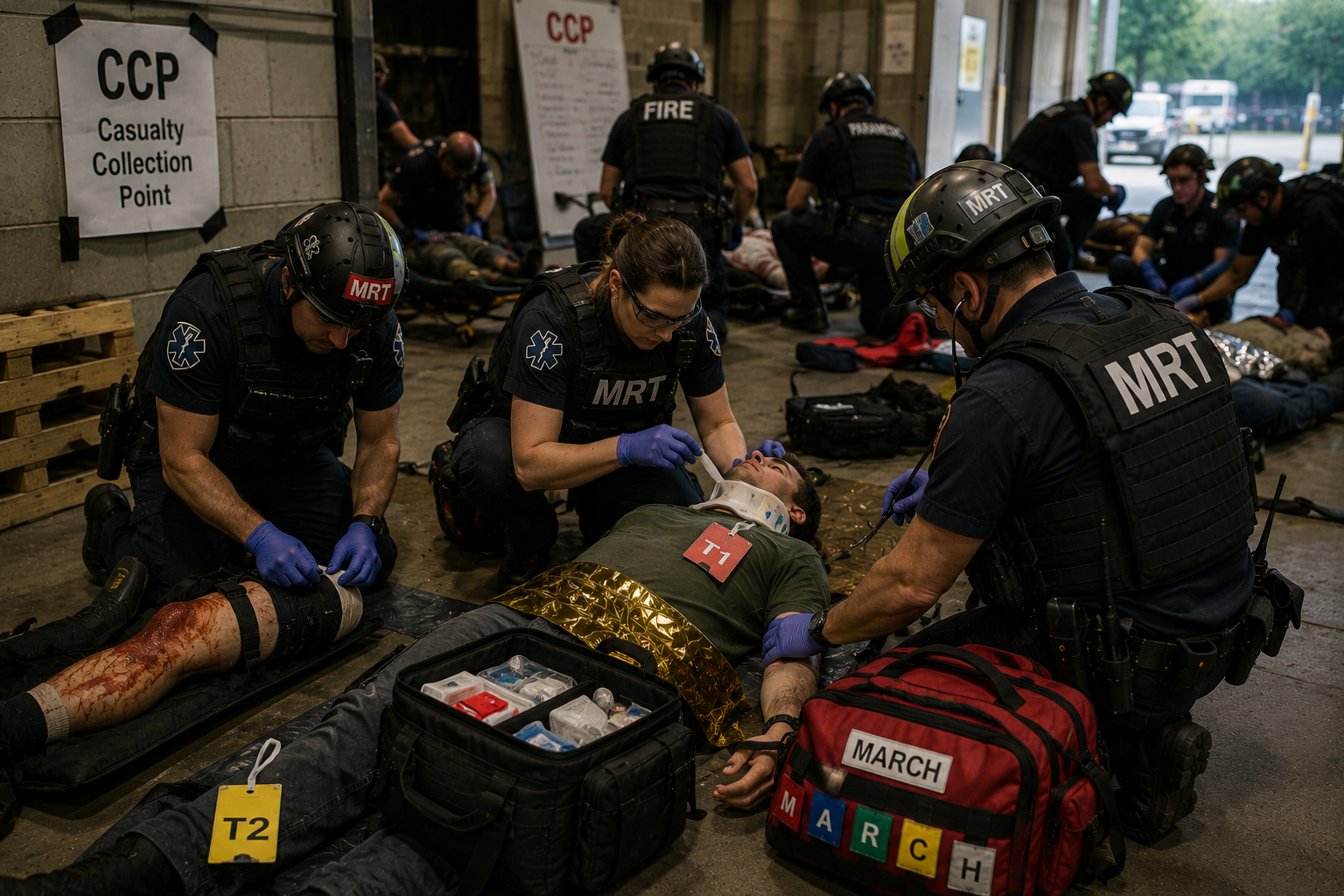
The clinical work of a hasty CCP centers on MARCH interventions—Massive hemorrhage control, Airway management, Respiration, Circulation, and Hypothermia prevention. These priorities are not exhaustive; they are decisive.
Massive hemorrhage is addressed immediately with tourniquets, wound packing, and pressure dressings.
Airway issues are corrected with positioning and simple adjuncts when necessary.
Respiration concerns—particularly penetrating chest trauma—are managed with seals and rapid reassessment.
Circulation focuses on identifying shock and preventing further deterioration.
Hypothermia prevention begins early, even in warm environments.
The discipline of MARCH ensures that care delivered at hasty CCPs is fast, effective, and proportionate to the environment. It prevents the common error of over-treating early and delaying movement.
Casualty Flow: Preventing Bottlenecks and Re-Exposure
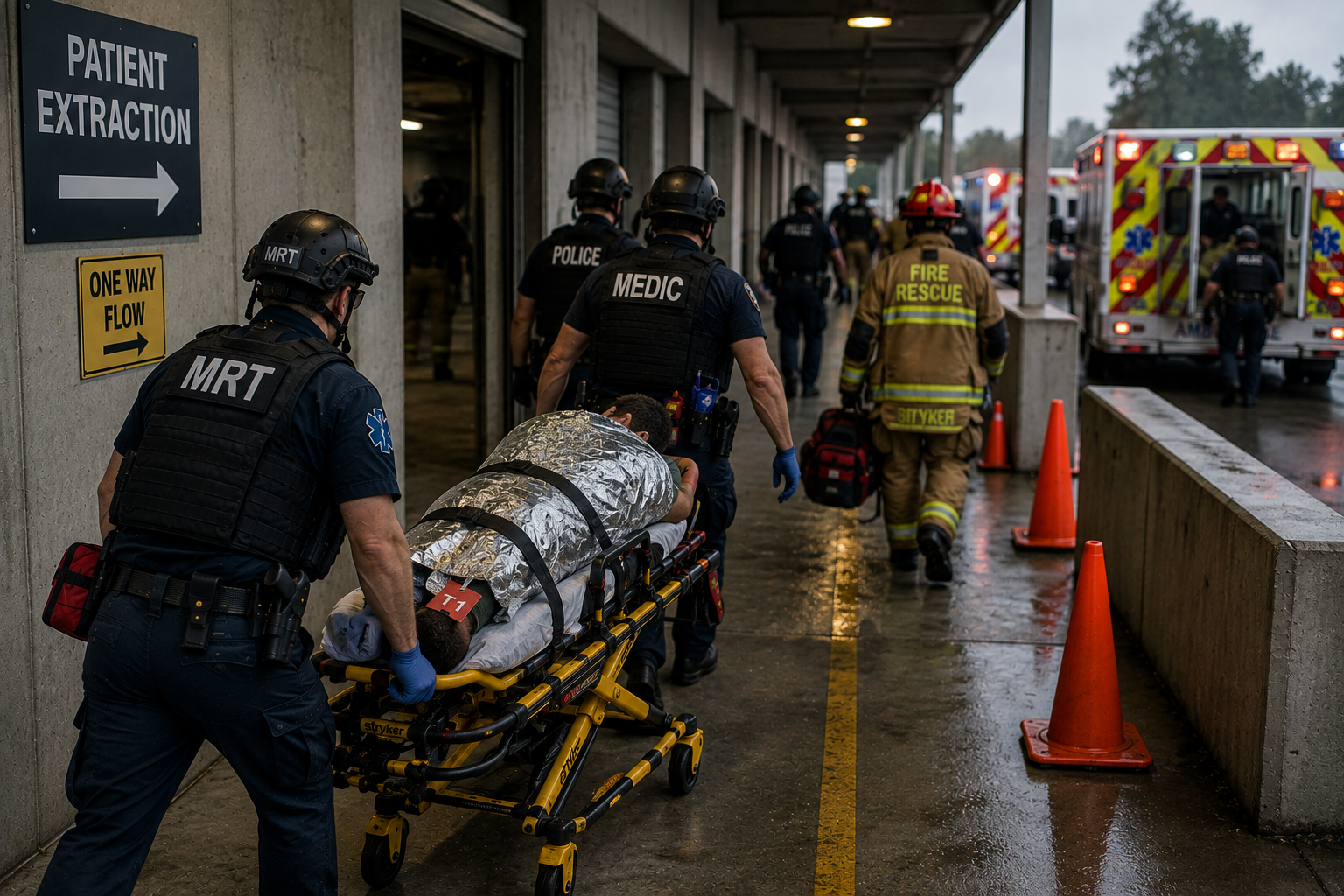
Flow is the operational heartbeat of a hasty CCP. Without disciplined flow, CCPs become bottlenecks—drawing casualties and responders into congestion that increases exposure and delays evacuation. Effective CCPs are designed to move casualties through, not hold them.
Key principles of flow include:
One-way movement whenever possible
Clear entry and exit paths
Minimal stopping time per patient
Immediate preparation for extraction
Flow design must also avoid re-exposure to threats. Routes are selected to minimize crossing unsecured areas and to reduce backtracking. When flow degrades, command must adjust CCP location or extraction routes rather than forcing throughput.
A CCP that stalls becomes a liability. A CCP that flows saves lives.
Operating the CCP: MRTs and RTFs by Protection Level
Hasty CCP operations depend on who is operating them and under what level of protection. Medical Rescue Teams (MRTs) and Rescue Task Forces (RTFs) are commonly employed, each bringing distinct advantages.
MRTs are typically smaller, highly mobile, and medically focused. They excel at establishing CCPs close to the point of injury and adapting rapidly as space is gained or lost.
RTFs combine medical personnel with dedicated law enforcement protection, providing robust security and enabling sustained CCP operations in warm zones.
The choice between MRT and RTF operation is not doctrinal—it is situational. Protection level, staffing, threat stability, and terrain dictate which model is appropriate. What matters is that CCP operations are authorized, protected, and integrated with tactical movement.
Protection as an Enabler, Not a Gatekeeper
Protection enables CCP function; it should not delay it. Law enforcement presence at or near CCPs is not merely defensive—it shapes flow, controls access, and supports extraction. Protection must be dynamic, adjusting as the threat picture changes.
This integration requires shared understanding. Medical leaders must understand protection constraints; law enforcement must understand medical priorities. When protection is treated as a gatekeeper, CCPs form late or not at all. When protection is treated as an enabler, CCPs form early and function effectively.
Extraction Routes: Designing the Path Forward
A hasty CCP without extraction is incomplete. Efficient extraction routes are planned concurrently with CCP establishment, not after. These routes must be known, protected, and flexible, accounting for changing conditions and casualty priority.
Extraction planning considers:
Distance to transport assets
Terrain and obstacles
Threat corridors and blind spots
Redundancy if primary routes are compromised
As stabilization progresses, extraction routes may shorten or multiply. Command awareness is critical to prevent congestion and to ensure transport assets are matched to patient priority. Extraction is not a final step; it is an ongoing process that begins as soon as the first patient reaches the CCP.
Command Awareness: Synchronizing Decisions and Movement
Hasty CCPs function best when command understands where they are, how they are operating, and what they need. Command awareness ensures that tactical clearing, medical flow, and evacuation are synchronized.
Without this awareness, CCPs risk becoming isolated—overloaded with patients, short on supplies, or cut off from extraction. Regular updates on CCP status, patient volume, and protection needs allow command to adjust resources and priorities proactively.
Command does not need to micromanage CCPs. It must enable and sustain them.
Common Failure Modes—and How to Avoid Them
Several predictable failures undermine hasty CCP effectiveness:
Overstaying: treating CCPs as destinations rather than waypoints
Overtreatment: performing prolonged interventions that delay movement
Under-protection: establishing CCPs without adequate security
Poor flow: allowing congestion and backtracking
Avoidance strategies include clear doctrine, repetitive training under stress, and after-action learning focused on flow and timing rather than checklists. CCPs succeed when simplicity and discipline are maintained.
Training for Reality, Not Ideal Conditions
Effective hasty CCP operations cannot be improvised. Training must expose responders to:
Time pressure and ambiguity
Movement with patients under protection
Rapid CCP establishment and relocation
Continuous reassessment and prioritization
Joint training between medical and law enforcement elements is essential. Without shared practice, coordination degrades when stress peaks. Responders will default to what they have rehearsed—making realistic training a prerequisite for effective CCPs.
Relevance Across Incident Types
While often discussed in the context of active shooters, hasty CCPs are relevant across a spectrum of incidents: complex assaults, terrorist attacks, industrial violence, and natural disasters with secondary threats. Any environment where time-to-care is compressed and access is contested benefits from the hasty CCP concept.
Their adaptability is their strength. CCPs move as conditions change, scaling up or down without losing purpose.
From Chaos to Stabilization: The CCP’s Role
Hasty CCPs are the hinge between chaos and stabilization. They translate early action into organized flow, enabling the system to regain control without sacrificing speed. As stabilization progresses, CCPs may formalize, relocate, or dissolve—but their early impact persists in saved minutes and saved lives.
Conclusion
Hasty Casualty Collection Points are not a deviation from good medicine; they are an expression of it under pressure. Positioned close to the threat, focused on MARCH interventions, and governed by disciplined flow, hasty CCPs compress time-to-care and reduce preventable death.
Their effectiveness depends on proximity, protection, extraction planning, and command awareness—each reinforcing the others. Operated by MRTs or RTFs according to protection level, hasty CCPs adapt to reality rather than waiting for it to improve.
In high-threat incidents, care delayed is care denied. Hasty CCPs ensure that lifesaving action occurs where and when it matters most—turning moments of chaos into pathways toward survival.