
Loadout Discipline: Matching IFAK Contents to Real Threats
Loadout Discipline: Matching IFAK Contents to Real Threats
In high-threat operational environments, survivability is not determined by the presence of medical equipment alone, but by the appropriateness, accessibility, and reliability of that equipment under stress. The Individual First Aid Kit (IFAK) represents the most immediate medical capability a responder carries, yet its effectiveness is frequently undermined by poor loadout discipline. Many IFAKs reflect administrative checklists, purchasing contracts, or legacy standards rather than contemporary threat realities. When loadouts fail to match real-world injury patterns, responders are left with equipment that is technically present but operationally insufficient.
Loadout discipline is therefore not a matter of preference or convenience; it is a form of risk management. Matching IFAK contents to actual threats requires an honest assessment of how responders are injured, how quickly interventions must occur, and what constraints exist during high-stress operations. Without this alignment, the IFAK becomes symbolic rather than functional—present on the belt, ineffective at the point of injury.
The Reality of Hemorrhage and the Problem of Redundancy
Trauma research and after-action reporting consistently demonstrate that uncontrolled hemorrhage remains the leading cause of preventable death in both military and civilian high-threat incidents. Despite this, many issued IFAKs lack meaningful hemorrhage-control redundancy. A single tourniquet, one pressure dressing, and limited gauze may satisfy a checklist, but they do not reflect the complexity of real wounds.
Gunshot wounds frequently involve multiple entry and exit points, junctional injuries, or compound trauma involving blast or fragmentation. One tourniquet may be insufficient, either because multiple limbs are involved or because proper placement requires a second device. When responders carry only a single hemorrhage-control option, they are forced into improvised decisions under stress—choices that often cost time and blood.
Redundancy is not excess; it is acknowledgment of uncertainty. A loadout that includes multiple tourniquets and sufficient hemostatic gauze recognizes that responders cannot predict where they will be hit or how severe the injury will be. In this context, redundancy preserves decision-making flexibility and increases the probability of successful self-aid or buddy-aid.
Tourniquet Quantity Versus Tourniquet Placement
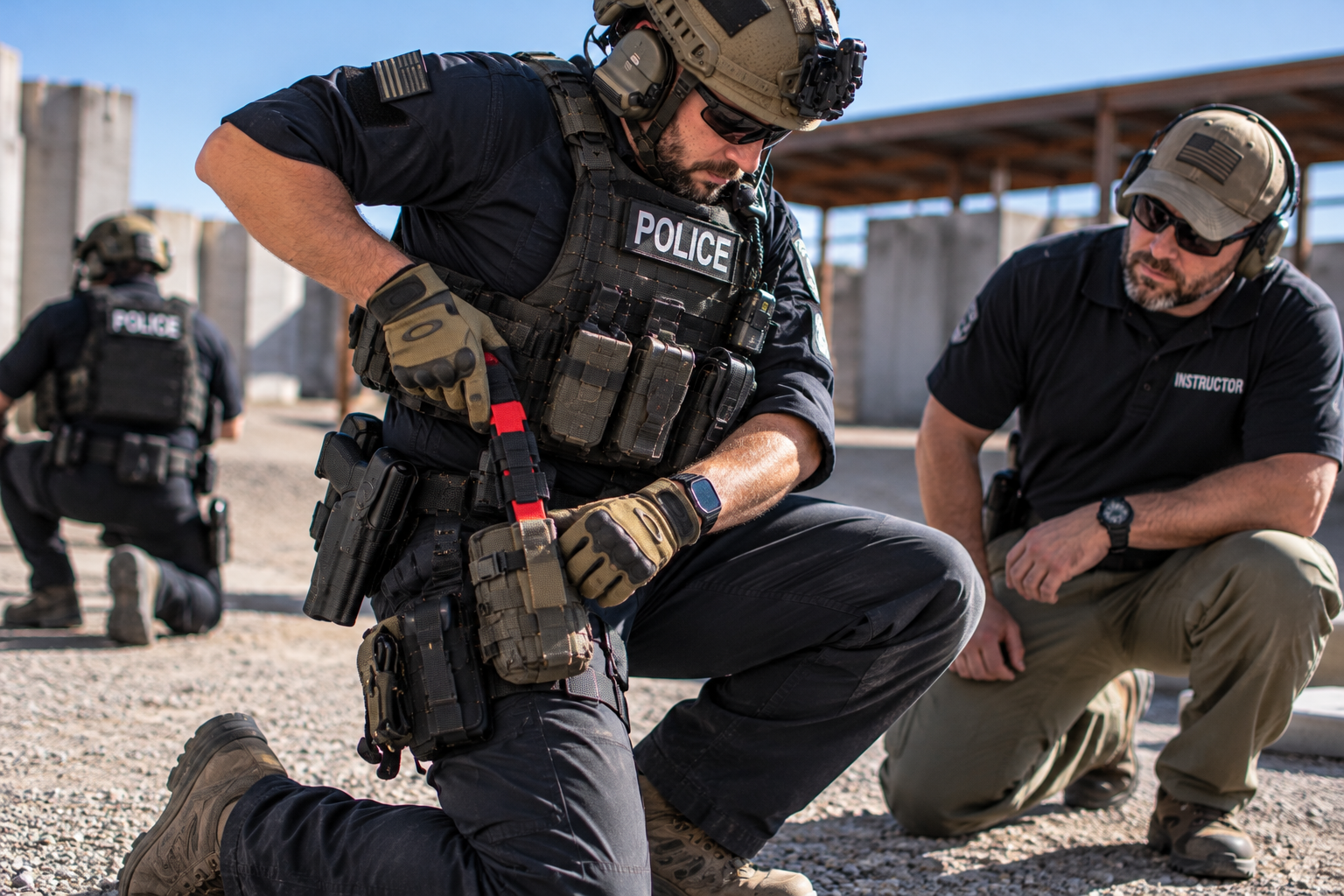
While quantity matters, placement may matter more. A tourniquet that cannot be accessed quickly is functionally equivalent to not having one at all. Numerous after-action reviews reveal a recurring failure pattern: responders possessed tourniquets but could not deploy them in time due to poor placement, retention systems, or access constraints.
High-threat environments impose unique ergonomic challenges. Injuries may occur while moving, prone, supine, or under fire. Fine motor skills degrade rapidly under stress. Tourniquets buried in pouches, secured by complex retention straps, or positioned on non-dominant sides often become inaccessible when seconds matter.
Effective loadout discipline prioritizes ambidextrous access, one-handed deployment, and minimal manipulation. Tourniquets should be staged for immediate use, with consideration given to body armor, duty belts, outer garments, and seasonal clothing. Placement decisions must be tested during movement, shooting, and stress inoculation—not assumed to work because they appear neat during inspection.
Quantity without access is false preparedness. Placement transforms equipment from theoretical capability into practical survivability.
Airway and Chest Injury Considerations
Although hemorrhage dominates preventable death statistics, airway compromise and penetrating chest trauma remain significant contributors to mortality in high-threat incidents. Despite this, many IFAKs either omit airway adjuncts entirely or include items inappropriate for the training level or operational context of the user.
Basic airway positioning, nasopharyngeal airways, and chest seals represent high-yield interventions when properly selected and trained. However, airway tools that require advanced skill, excessive assembly, or fine motor coordination are often unrealistic under fire. Similarly, chest seals that are difficult to deploy on wet, bloody, or moving casualties may fail when needed most.
Loadout discipline requires selecting airway and chest injury tools that balance effectiveness with simplicity. Inclusion must be tied directly to training frequency and demonstrated proficiency. Carrying equipment without the skill to deploy it reliably under stress adds weight without increasing survivability.
Equally important is recognizing what does not belong in an IFAK. Items intended for prolonged care, advanced airway management, or multi-patient treatment dilute the kit’s purpose and increase cognitive load. The IFAK should remain focused on immediate, lifesaving interventions that can be executed quickly and decisively.
PPE Integration as a Medical Loadout Issue
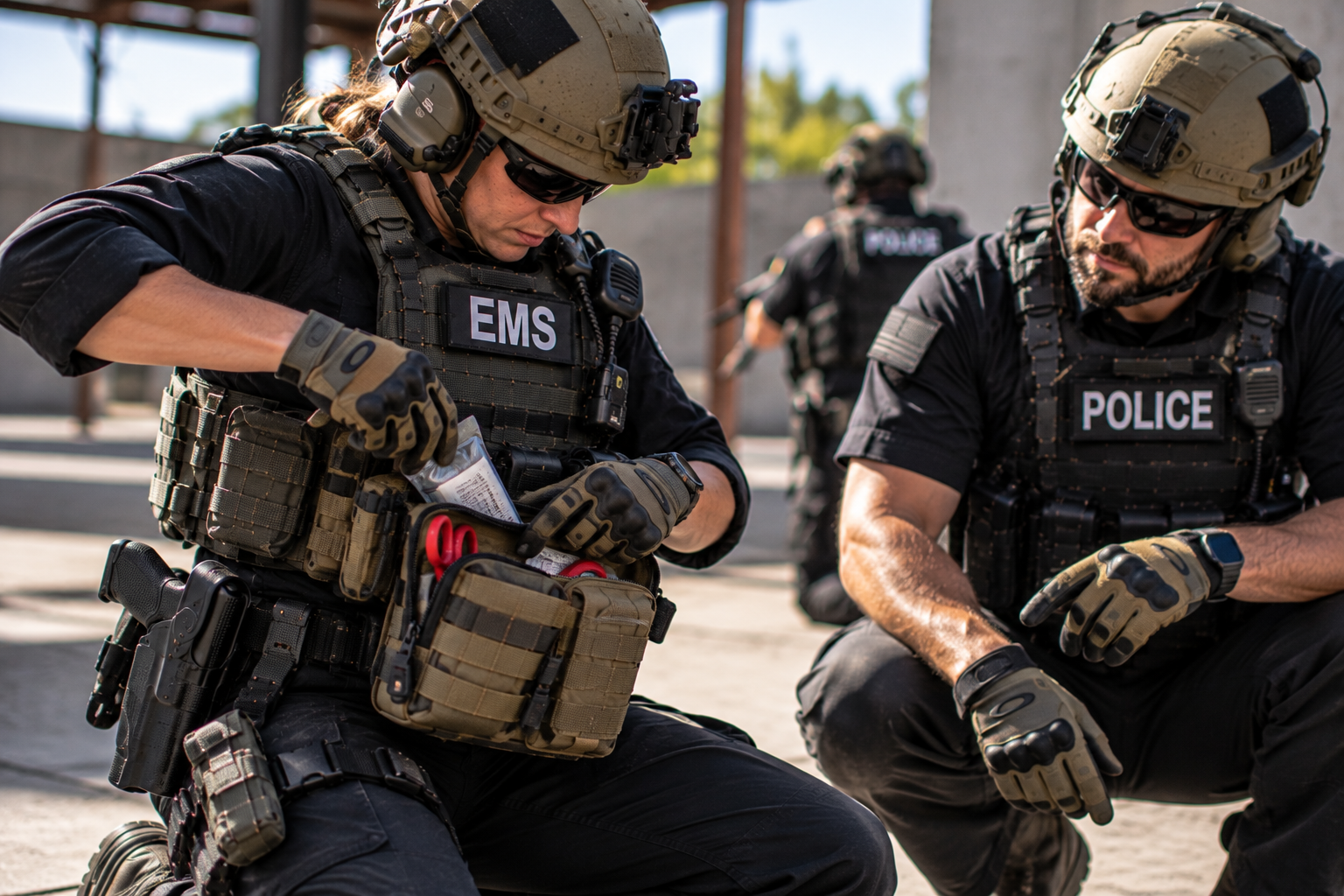
Personal protective equipment (PPE) is often discussed separately from medical loadouts, yet survivability depends on their integration. Ballistic armor, helmets, eye protection, and gloves all influence the responder’s ability to render self-aid. An IFAK that cannot be accessed while wearing armor, or gloves that impede tourniquet application, represent mismatches between protective and medical systems.
Gloves, in particular, are frequently overlooked. Low-quality gloves tear easily, compromise dexterity, or fail under blood saturation. Eye protection may fog or shift, reducing situational awareness during self-aid. Armor placement can obstruct access to medical pouches. These interactions are not theoretical; they emerge during real movement and stress.
Loadout discipline requires holistic evaluation. Medical equipment cannot be optimized in isolation. It must be tested while wearing full duty gear, during physical exertion, and under simulated threat conditions. Only through this integration can responders ensure that protection and care reinforce rather than interfere with one another.
The Case for Standardization
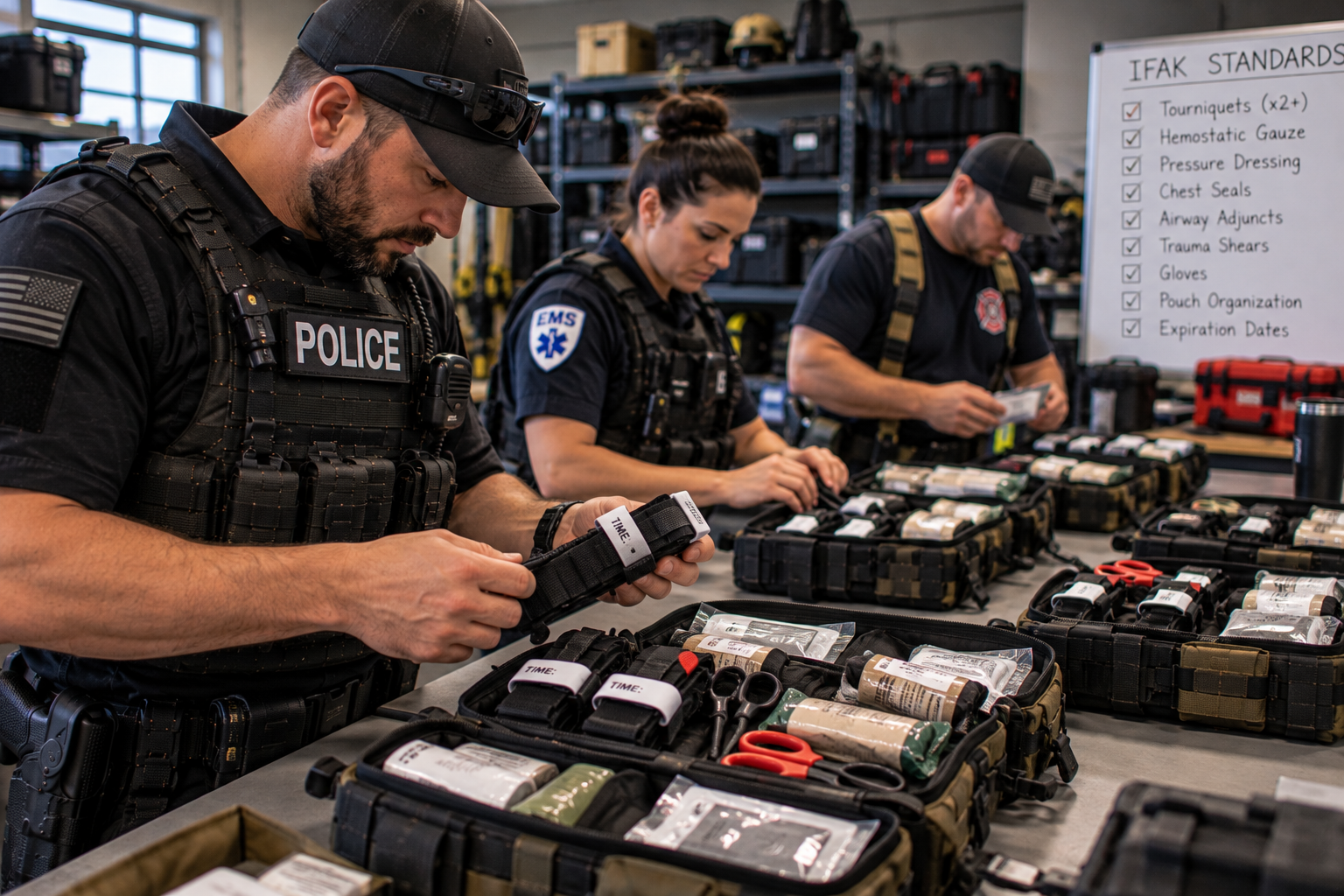
One of the most significant threats to loadout effectiveness is inconsistency. Within the same agency—or even the same unit—responders often carry different tourniquet models, pouch configurations, and contents. This variability complicates buddy-aid, increases cognitive load, and undermines interoperability during multi-casualty incidents.
Standardization does not eliminate individual responsibility; it enhances collective reliability. When responders know what equipment their teammates carry and where it is located, intervention becomes faster and more confident. Standardization also simplifies training, logistics, and quality control. Expired equipment, counterfeit tourniquets, and incompatible components are easier to identify and correct when loadouts are consistent.
Critically, standardization should be threat-driven, not vendor-driven. Agencies must resist the temptation to equate innovation with improvement. New equipment must be evaluated against real injury patterns, training capacity, and deployment conditions. Reliability under stress should outweigh novelty.
Training as the Enforcement Mechanism of Loadout Discipline
Loadout discipline cannot be enforced through policy alone. It must be reinforced through training that exposes mismatches between equipment and reality. Scenario-based training that includes movement, stress, low light, and simulated injury reveals access problems, equipment failures, and decision-making bottlenecks that static inspections never uncover.
Repeated exposure builds muscle memory and confidence. Just as importantly, it identifies what does not work. Equipment that fails during training should not remain in the loadout out of habit or sunk cost. Loadouts must evolve alongside threat analysis and operational experience.
This iterative process—evaluate, test, revise—anchors loadout decisions to evidence rather than assumption. It also reinforces the principle that preparedness is dynamic, not static.
Conclusion
Loadout discipline is a critical but often undervalued component of responder survivability. When IFAK contents fail to reflect real threats, responders pay the price in seconds, blood, and operational capability. Common deficiencies revealed through high-threat incidents include inadequate hemorrhage redundancy, poor tourniquet placement, mismatched airway and chest tools, neglected PPE integration, and inconsistent standardization.
Correcting these deficiencies requires intentional design, rigorous testing, and disciplined training. The IFAK must be treated not as an administrative requirement, but as a precision tool engineered for the worst moments a responder may face. Its contents, placement, and integration must reflect how responders are actually injured—not how planners hope incidents will unfold.
When loadouts are aligned with threat realities, self-aid becomes reliable rather than aspirational. Survivability improves not because responders carry more equipment, but because they carry the right equipment, in the right way, for the right reasons.