The IFAK Is Not a Trauma Bag: Restoring Its Intended Role
The IFAK Is Not a Trauma Bag: Restoring Its Intended Role
In high-threat environments, survivability is rarely determined by the volume of medical equipment available on scene. Instead, it is shaped by whether the right medical capability is available at the right moment—and in the hands of the right person. Few concepts illustrate this more clearly than the widespread misunderstanding of the Individual First Aid Kit (IFAK). Despite decades of tactical medical evolution, the IFAK is still routinely misused as a substitute for a trauma bag, a practice that undermines responder survivability, disrupts medical flow, and creates preventable gaps in care. Restoring the IFAK to its intended role is not a semantic correction; it is an operational imperative.
At its core, the IFAK exists for one reason: to keep the individual carrying it alive long enough to continue fighting, moving, or surviving until higher-level care is available. When that purpose is diluted or ignored, the consequences ripple outward—from individual injury to system-wide failure. Understanding why this occurs, and how doctrine must respond, requires revisiting the IFAK’s design intent, operational limitations, and role within modern high-threat response models.
Design Intent: Self-Aid and Buddy-Aid Under Fire
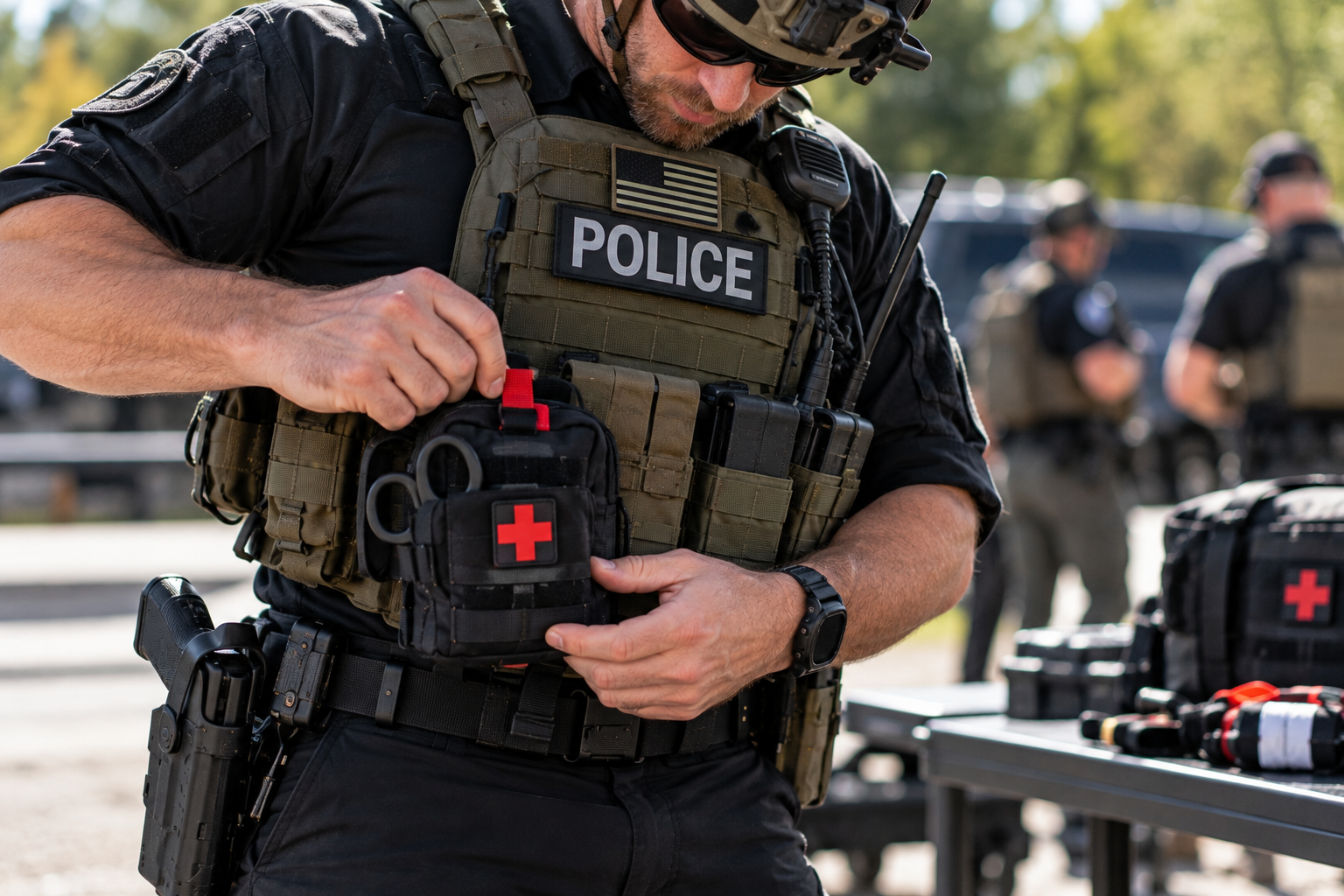
The IFAK originates from military operational medicine, where the assumption of immediate safety does not exist. Its design reflects a harsh reality: the first person injured in a fight is often the only one capable of intervening. As such, the IFAK prioritizes immediate self-aid and buddy-aid at the point of injury, under conditions of extreme stress, limited visibility, and ongoing threat.
This design intent is reflected in both content and configuration. Tourniquets are staged for one-handed application. Hemostatic gauze and pressure dressings address massive hemorrhage—the leading cause of preventable death in combat and high-threat civilian incidents. Chest seals mitigate penetrating thoracic trauma. Every item is selected for speed, simplicity, and reliability rather than versatility. The IFAK is intentionally constrained, not deficient.
Crucially, the IFAK assumes no redundancy. It is built to save one person—the carrier—or, in limited circumstances, a nearby teammate. This assumption is not a flaw; it is the foundation of its effectiveness. The moment the IFAK is treated as a general-purpose trauma resource, its design logic collapses.
Misuse and the Erosion of Responder Survivability
When responders use their IFAKs to treat injured civilians or multiple patients during an ongoing threat, they make an implicit trade: immediate altruism in exchange for personal vulnerability. While this impulse is understandable, it is operationally unsound. An expended IFAK leaves the responder defenseless against their own injury, at precisely the moment risk remains highest.
This practice erodes survivability in two ways. First, it removes the responder’s only immediately accessible life-saving capability. In high-threat environments, delays of even seconds can be fatal, and replacement resources are rarely within reach. Second, it shifts the burden of responder survival onto external systems—EMS entry, casualty collection points, or rescue task forces—that may be delayed, overwhelmed, or unable to access the scene.
Importantly, this misuse is rarely the result of negligence. It is the product of doctrinal ambiguity. When agencies fail to clearly articulate that the IFAK is a self-aid system first and foremost, responders default to treating it as a miniature trauma bag. Under stress, they do not improvise new roles for equipment; they fall back on the mental models reinforced during training. If training normalizes IFAK misuse, that behavior will surface in crisis.
Single-Patient Design and the Myth of Scalability
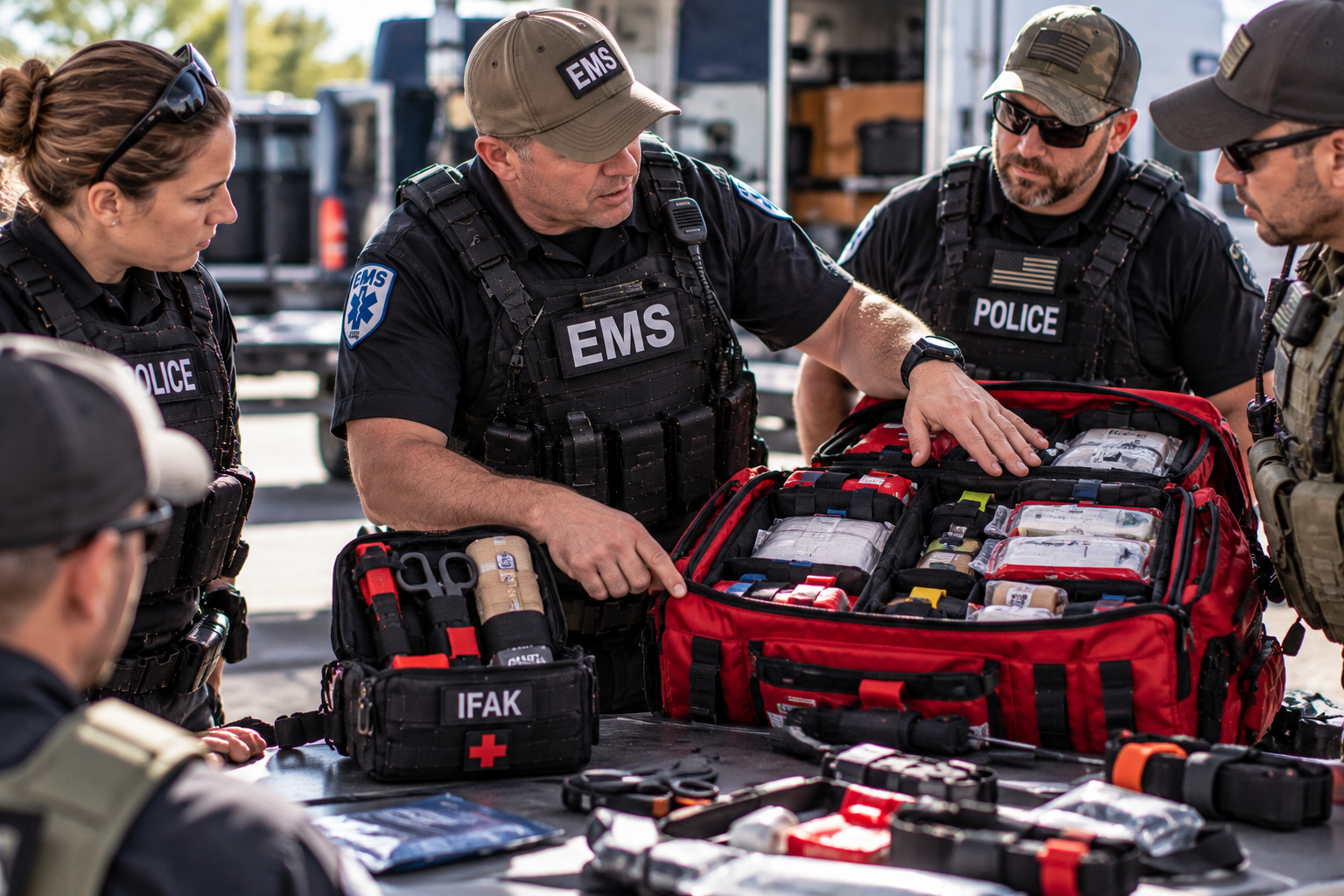
A critical but often overlooked limitation of the IFAK is its single-patient design. Unlike trauma kits or venue bags, IFAKs lack depth, redundancy, and breadth. One tourniquet controls one extremity. One pressure dressing addresses one wound. Once used, the capability is gone.
In multi-casualty environments, this limitation becomes catastrophic. When responders attempt to scale care using IFAKs, they rapidly exhaust resources while achieving only partial coverage. The result is fragmented treatment, inconsistent hemorrhage control, and delayed prioritization. Instead of enabling care, the IFAK becomes a bottleneck.
Trauma kits exist specifically to address this gap. They function as “large IFAKs,” designed to support multiple patients, sustain operations, and integrate into casualty collection points. When responders conflate these tools, they invert the care hierarchy—using personal survivability equipment for scene-level care while leaving dedicated trauma resources underutilized or delayed.
Downstream Medical Gaps and System-Level Consequences
Early IFAK expenditure creates cascading effects beyond the individual responder. When multiple responders deplete their IFAKs early in an incident, the system loses its distributed survivability network. Injured responders can no longer self-treat. Buddy-aid becomes impossible. Early hemorrhage control for secondary injuries is delayed.
These gaps are often invisible until they compound. A responder injured during secondary movement now requires extraction instead of continuing the mission. Law enforcement resources shift from threat mitigation to rescue. Medical personnel face increased risk and workload. What began as a well-intentioned act becomes a force multiplier for chaos.
From a systems perspective, this represents a failure of equipment-role alignment. Tools are being used outside their intended function, not because better options do not exist, but because doctrine has not made their distinctions explicit.
Doctrine, Training, and the Primacy of Self-Aid
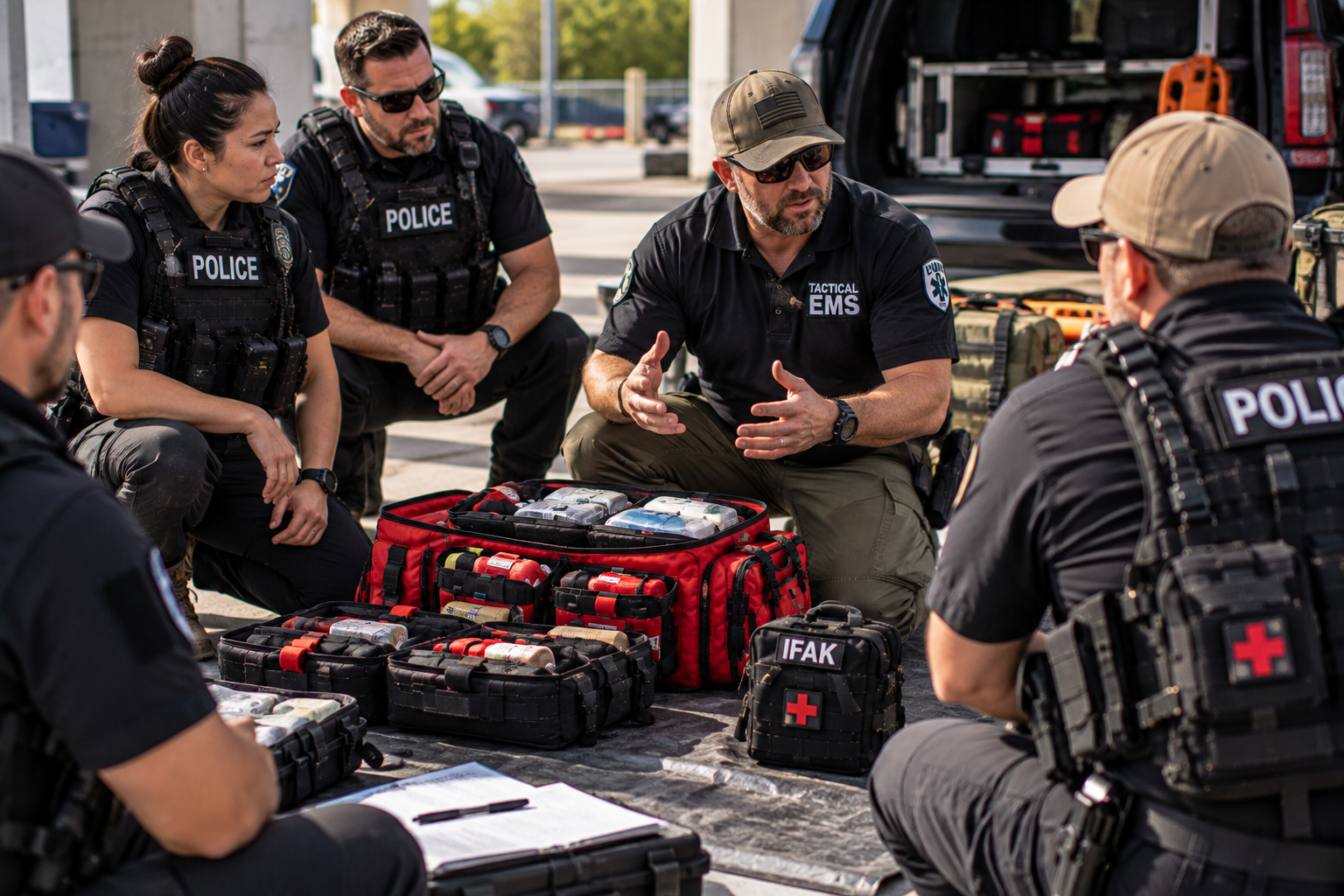
Correcting this problem requires more than issuing new equipment. It demands doctrinal clarity reinforced through training, leadership messaging, and policy. Agencies must state unambiguously that the IFAK exists for self-aid and immediate buddy-aid under fire. Its use for general patient care during ongoing threats must be defined as an exception, not a norm.
Training must reinforce this hierarchy repeatedly and in context. Scenario-based exercises should force responders to experience the consequences of early IFAK depletion—injury without tools, delayed care, increased risk. Through repetition and variation, responders internalize not just what to do, but why it matters.
This approach aligns with well-established principles of human performance under stress. Responders do not rise to a new level of competence in crisis; they default to the lowest level of training they have mastered. If self-aid primacy is not deeply ingrained, it will not appear when it is most needed.
Restoring Alignment Between Tools and Mission
Restoring the IFAK’s intended role also requires aligning equipment distribution with mission requirements. Trauma kits and venue bags must be positioned, accessible, and adequately stocked to support scene care. Rescue Task Forces or Medical Rescue Teams must be equipped to assume multi-patient treatment roles early. When responders trust that scene-care resources exist and will arrive in tempo, the pressure to misuse IFAKs diminishes.
Leadership plays a decisive role in this alignment. Policies must support disciplined equipment use, and supervisors must reinforce correct behavior during training and after-action reviews. Normalizing misuse through silence or tacit approval undermines doctrine just as effectively as explicit mis instruction.
Conclusion
The IFAK is not a trauma bag, and treating it as one carries real, measurable consequences. Designed as a personal survivability tool for self-aid and buddy-aid under fire, the IFAK fulfills its mission only when its role is respected and protected. Misuse depletes responder survivability, fails to scale in multi-casualty environments, and creates downstream medical gaps that compound operational risk.
Restoring the IFAK’s intended role requires doctrinal clarity, disciplined training, and cultural reinforcement. It demands that agencies confront uncomfortable truths about altruism, risk, and survival. In high-threat environments, preserving the responder’s ability to self-treat is not selfish—it is foundational to mission success.
When equipment roles are aligned with operational reality, systems function as designed. When they are not, even the best intentions can lead to preventable failure. Precision in purpose, not abundance of gear, is what ultimately saves lives.