
Initial 911 Caller Intelligence Exploitation

Initial 911 Caller Intelligence Exploitation
In the opening moments of a high-threat incident, the most valuable intelligence does not come from sensors, cameras, or arriving units—it comes from the people who are already inside the event. Before command is established, before responders arrive, and before situational clarity exists, 911 callers provide the only real-time window into what is unfolding. These early minutes shape every downstream decision, yet caller-derived intelligence is often underexploited, inconsistently interpreted, or prematurely dismissed. When this occurs, response systems begin operating with blind spots that persist throughout the incident.
This analysis examines the role of initial 911 callers as critical intelligence sources, explores why their information is frequently undervalued, and argues that deliberate exploitation of caller intelligence significantly enhances situational awareness during the most consequential phase of response. The central thesis is straightforward: caller information is not anecdotal—it is actionable intelligence. When properly elicited, validated, and integrated, it accelerates threat location, improves victim accounting, and informs early tactical and medical decision-making.
Callers as Embedded Observers
Initial callers occupy a position no responder can replicate. They are physically present within or adjacent to the incident environment at the moment violence begins. They hear gunshots, see movement, observe injuries, and experience changes in threat behavior in real time. This makes them embedded observers, not passive informants.
Unlike later intelligence sources, callers provide information uncontaminated by responder movement or tactical assumptions. Their reports capture the raw reality of the incident’s earliest phase—before offenders adapt, before casualties are moved, and before environmental conditions change. This immediacy is what makes caller intelligence uniquely valuable.
However, immediacy also introduces complexity. Caller accounts are emotionally charged, incomplete, and sometimes contradictory. Exploiting their value requires skill, not skepticism.
The Cost of Overlooking Caller Intelligence
Despite its importance, caller-derived intelligence is frequently underutilized. Several factors contribute to this pattern. First, responders and ECCs may discount caller information due to perceived unreliability. Stress, fear, and confusion are assumed to compromise accuracy, leading to cautious or dismissive interpretation.
Second, operational tempo pressures encourage rapid dispatch over deliberate information extraction. Dispatchers may prioritize sending units quickly at the expense of gathering additional details, assuming responders will “figure it out” on arrival.
Third, training gaps leave dispatchers and supervisors uncertain about how to frame, validate, and update caller intelligence. Without structured protocols, valuable information is captured inconsistently or lost altogether.
The result is a recurring failure mode: responders arrive with minimal context, discover conditions that differ from expectations, and lose critical time adjusting. Early uncertainty compounds into delayed access, misallocated resources, and increased risk.
Intelligence Value in the First Minutes
The first minutes of an active shooter or high-threat incident are disproportionately influential. Decisions made during this window shape responder approach, entry points, staging locations, and medical integration. Caller intelligence directly supports these decisions in several ways.
Callers often provide initial threat location, describing where shots are coming from or where a suspect was last seen. Even imprecise descriptions—“near the cafeteria,” “by the front doors,” “second floor hallway”—narrow the operational search space.
They also contribute to victim awareness, reporting injuries, bleeding, or people down. Early recognition of casualty volume informs EMS activation and hospital notification.
Finally, callers may identify threat dynamics, such as movement patterns, pauses in gunfire, or multiple attackers. These details influence whether responders expect a static barricade or a mobile threat.
When aggregated across multiple callers, patterns emerge that are often more accurate than any single account.
Interviewing Under Stress: Skill, Not Intuition
Extracting usable intelligence from distressed callers is not intuitive; it is a trained skill. Effective call interrogation balances empathy with precision, guiding callers to provide actionable information without overwhelming them.
Key elements of effective interviewing include:
Asking closed, directional questions that reduce ambiguity.
Repeating and confirming critical details to improve accuracy.
Encouraging callers to report changes in real time, not just initial observations.
Maintaining caller safety by prioritizing self-preservation.
Training improves dispatcher confidence and performance in this domain. Dispatchers who practice threat-focused interviewing are more likely to extract relevant details quickly and relay them clearly to responders.
Without training, dispatchers may default to generic scripts that fail to capture threat-specific intelligence.
Caller Perspective and Threat Localization
Threat localization is one of the most immediate applications of caller intelligence. Callers describe what they see and hear from specific vantage points—information that, when combined, creates a rough map of the threat environment.
Multiple callers reporting gunfire from the same area increase confidence in location. Divergent reports may indicate movement or multiple threats. Silence after sustained reports may suggest threat displacement or containment.
This information allows responders to choose entry points, avoid unnecessary exposure, and prioritize areas for rapid clearing. Even imperfect localization is superior to none.
Ignoring caller input forces responders to rebuild situational awareness from scratch, often under direct threat.
Supporting Victim Accounting and Triage Expectations
Caller intelligence also shapes early medical expectations. Reports of “people bleeding,” “someone not moving,” or “kids hurt” are not diagnoses, but they signal the likely presence of life-threatening injuries.
Early awareness of victim demographics—such as pediatric involvement—allows EMS to mobilize appropriate resources and equipment. Caller reports of entrapment or inaccessible victims inform extraction planning.
When medical response is delayed or mismatched due to lack of early intelligence, preventable deterioration occurs. Caller information narrows this gap.
Validation Through Pattern Recognition
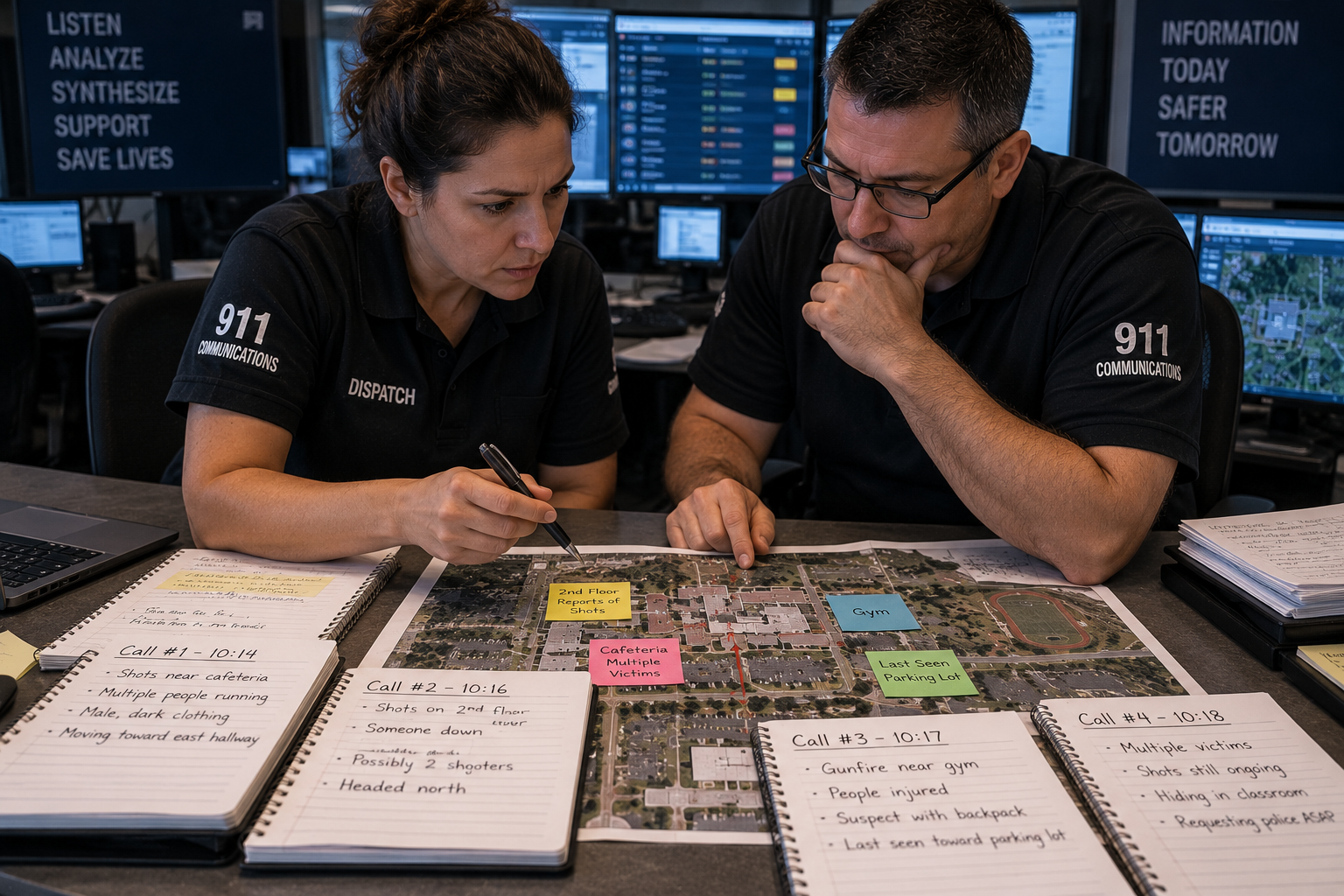
One of the challenges of caller intelligence is validation. Individual reports may be inaccurate, but patterns across multiple calls often reveal truth. ECCs play a critical role in identifying these patterns.
By comparing caller accounts, dispatchers can:
Confirm recurring descriptions of suspects or weapons.
Identify consistent locations or movement paths.
Recognize escalating casualty reports.
This process transforms anecdote into intelligence. It requires ECCs to synthesize information actively rather than passively relaying isolated reports.
Integrating Caller Intelligence Into Operations
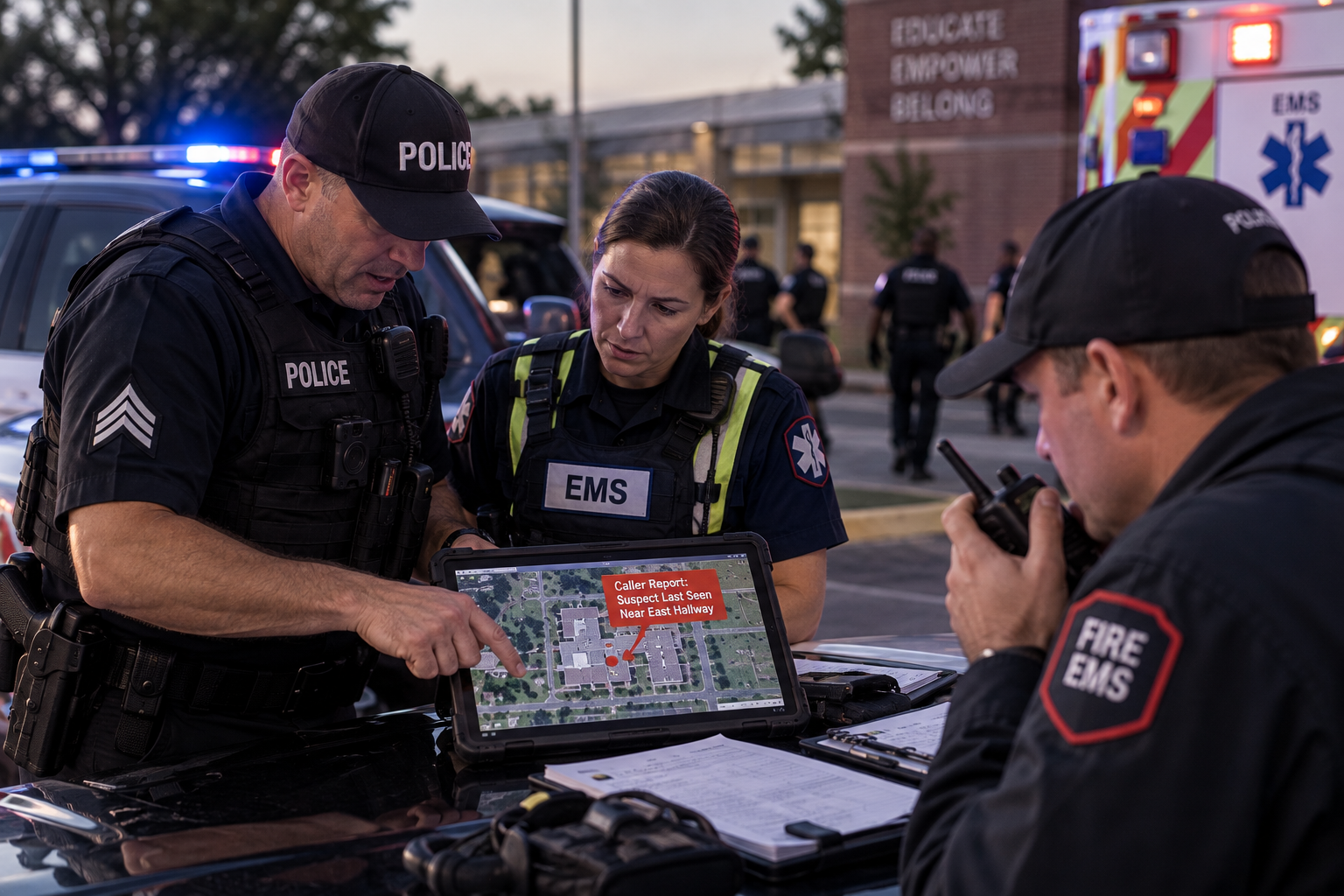
Caller intelligence must be integrated into operational communication to be effective. This means translating raw reports into actionable updates that responders can use.
Effective integration includes:
Time-stamping information to indicate currency.
Distinguishing confirmed details from unverified reports.
Updating responders as conditions change, not just at initial dispatch.
Command elements must also value and request caller-derived intelligence. When commanders ask for updates based on caller input, ECCs are incentivized to prioritize synthesis.
Training Gaps and Organizational Barriers
Many agencies lack formal training on intelligence exploitation at the ECC level. Dispatcher education often emphasizes call processing and customer service rather than threat analysis and information synthesis.
Organizational culture may further marginalize dispatcher input, treating ECCs as support rather than intelligence partners. This discourages proactive analysis and reduces confidence in sharing insights.
Addressing these gaps requires institutional recognition that intelligence collection begins at the first ring of the phone.
Enhancing Situational Awareness in the Earliest Phase
Situational awareness is built incrementally. The earliest layer is often the most fragile—and the most influential. Caller intelligence forms this layer.
When exploited effectively, it accelerates alignment between reality and response. When ignored, misalignment persists, and responders operate reactively rather than proactively.
Early situational awareness does not require perfect information. It requires timely, evolving understanding informed by the best available sources.
Relevance Across Incident Types
While particularly critical in active shooter events, caller intelligence exploitation applies broadly: bomb threats, domestic terrorism, large-scale assaults, and even natural disasters with secondary threats. Any incident where responders arrive after conditions have already changed benefits from early, embedded observation.
The principles remain consistent: listen deliberately, synthesize actively, and update continuously.
Toward a Culture of Intelligence Awareness
Improving caller intelligence exploitation requires cultural change as much as procedural reform. Agencies must view callers as partners in safety, not obstacles to dispatch efficiency.
This culture is reinforced through:
Training that emphasizes intelligence value.
Policies that encourage information synthesis.
Leadership that requests and acts on caller-derived insights.
When responders see caller intelligence reflected in operational decisions, trust in the system grows.
Conclusion
Initial 911 callers provide the first—and often most critical—intelligence during high-threat incidents. Their firsthand observations offer insight into threat location, victim impact, and incident dynamics at a moment when no other source exists.
Yet this intelligence is only as valuable as the system’s ability to exploit it. Training, protocols, and culture determine whether caller information becomes actionable insight or background noise.
By recognizing callers as embedded observers, training dispatchers in threat-focused interviewing, and integrating caller intelligence into operational decision-making, agencies can dramatically improve situational awareness during the earliest and most consequential minutes of response.
In high-threat incidents, the first intelligence shapes every action that follows. Leveraging caller information effectively is not optional—it is foundational to saving lives.