
Integration of Tactical Emergency Casualty Care (TECC)
Integration of Tactical Emergency Casualty Care (TECC)
In high-threat incidents, the difference between survivable injury and fatal outcome is determined less by the sophistication of weapons or tactics than by the speed and coordination of medical intervention. Tactical Emergency Casualty Care (TECC) emerged to address this reality—bridging the gap between civilian prehospital medicine and the operational demands of violent, unstable environments. Its integration across law enforcement, fire, and EMS represents one of the most consequential shifts in modern public safety response. Yet despite broad recognition of its value, TECC adoption remains uneven, fragmented, and frequently misunderstood.
This analysis examines the integration of TECC through the lens of modern threat response, emphasizing why early hemorrhage control, rapid extraction, and coordinated tactical-medical operations are no longer optional enhancements but operational necessities. By exploring how TECC aligns with hot, warm, and cold zone operations—and why barriers such as cost, training gaps, and institutional resistance persist—this discussion demonstrates that TECC is not merely a medical protocol, but a unifying operational framework. Its full integration fundamentally reshapes how agencies act, communicate, and preserve life under extreme pressure.
Why TECC Emerged: A Response to Operational Reality
Traditional civilian EMS models were designed for environments where scenes could be secured, hazards isolated, and care delivered under relative control. Active shooter incidents, terrorist attacks, and complex assaults exposed the limitations of this approach. Casualties were bleeding to death while responders waited for safety guarantees that never fully materialized.
TECC was developed to reconcile trauma science with operational reality. Drawing from military lessons while remaining grounded in civilian legal and ethical frameworks, TECC recognizes that care must occur in imperfect, dangerous conditions. It prioritizes life-saving interventions that can be performed rapidly, with minimal equipment, under threat.
The emergence of TECC reflects a broader shift in public safety thinking: survival cannot wait for certainty.
Cross-Disciplinary Adoption: A Necessary Evolution
One of TECC’s defining strengths is its applicability across disciplines. Law enforcement officers, firefighters, and EMS providers all encounter life-threatening injuries during high-threat incidents. TECC provides a common medical language and operational approach that transcends traditional role boundaries.
Law enforcement officers trained in TECC can apply tourniquets, manage airways, and move casualties while maintaining security. Fire personnel operating in warm zones can integrate suppression, rescue, and care. EMS providers can adapt their clinical skills to contested environments rather than remaining staged and reactive.
This shared framework reduces fragmentation. Instead of separate medical doctrines competing for relevance, TECC establishes a unified standard of care under threat, enabling agencies to function as a coherent system rather than parallel silos.
Early Hemorrhage Control as the Central Priority
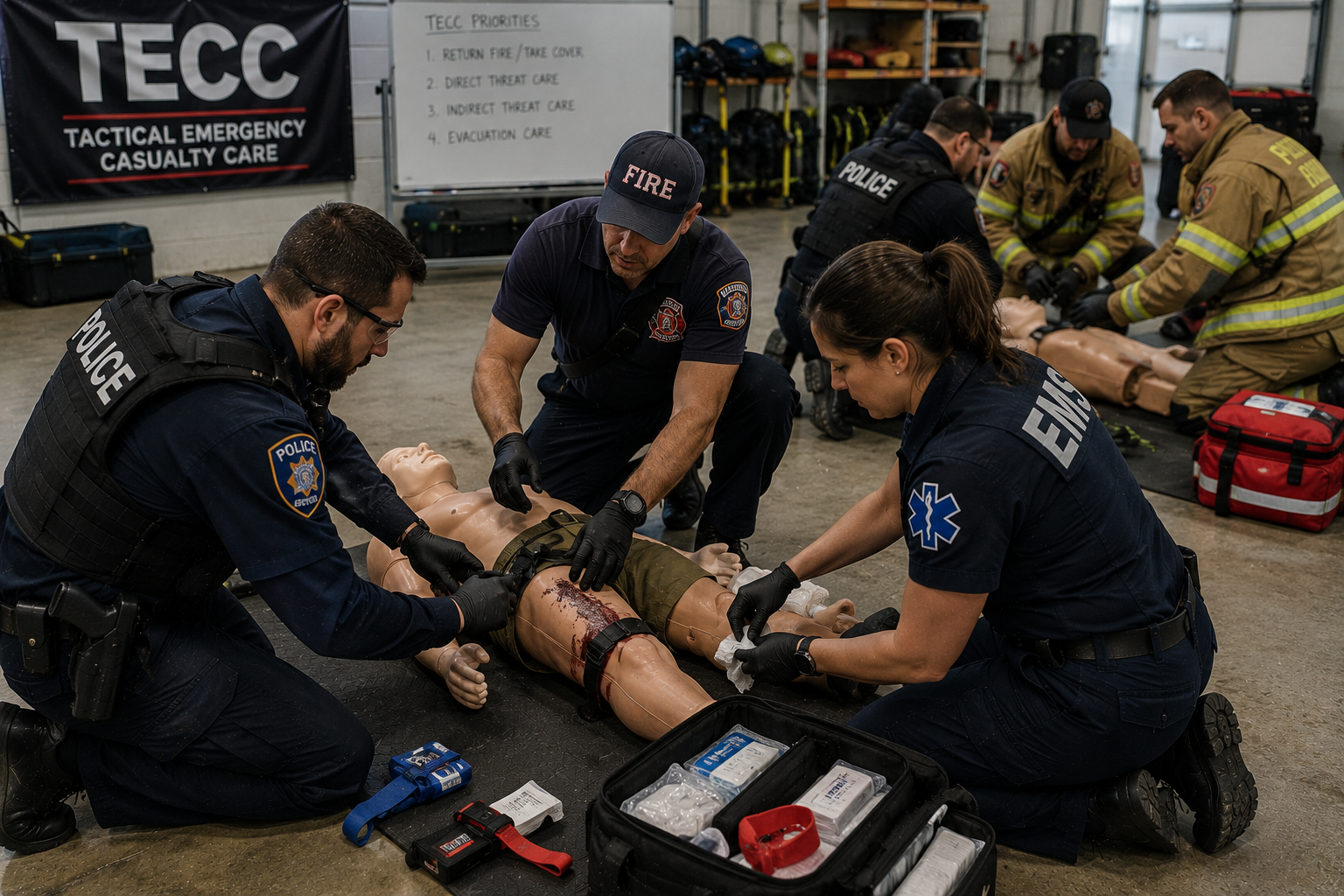
At the core of TECC is an uncompromising emphasis on hemorrhage control. Uncontrolled bleeding remains the leading cause of preventable death in trauma. In high-threat incidents involving firearms, this reality is magnified by injury severity and delayed access.
TECC elevates hemorrhage control to the first priority—regardless of responder discipline. Tourniquets, wound packing, and pressure dressings are not advanced skills; they are essential survival tools. By training all responders to recognize and address life-threatening bleeding immediately, TECC collapses the delay between injury and intervention.
This focus aligns directly with trauma science and counters legacy doctrines that deferred care until scenes were “safe.” TECC reframes bleeding control not as medical care that follows security, but as an action that must occur alongside security.
Rapid Extraction and the Rejection of Static Care Models
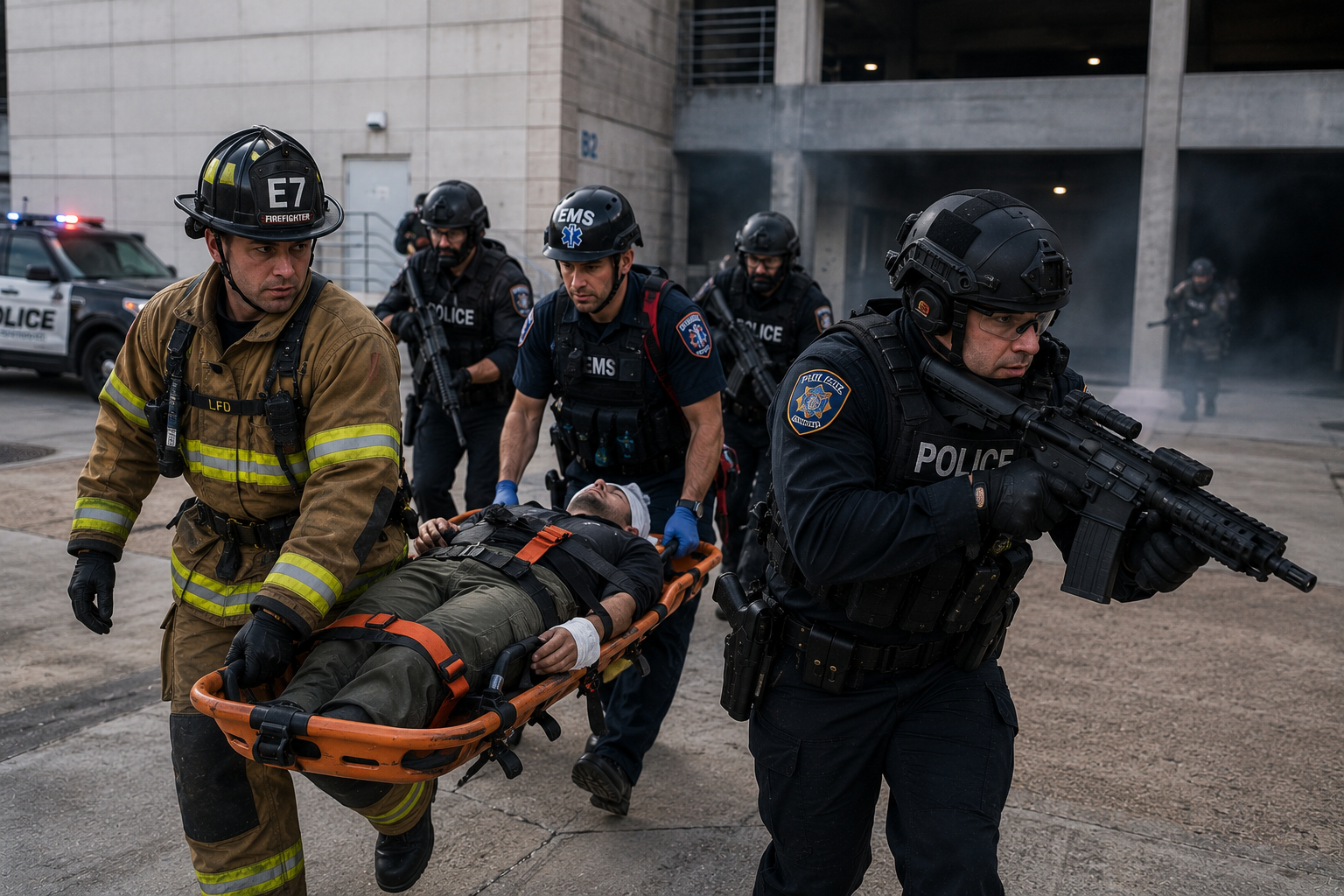
Another defining feature of TECC is its emphasis on movement. In unstable environments, prolonged on-scene treatment increases risk to both patients and responders. TECC prioritizes rapid extraction to safer locations where more definitive care can be delivered.
This approach challenges traditional EMS habits centered on prolonged stabilization at fixed locations. In high-threat incidents, static care is often unsafe and impractical. TECC instead promotes a treat-and-move mindset, balancing immediate intervention with deliberate relocation.
Rapid extraction is not rushed evacuation; it is controlled movement informed by threat awareness and casualty priority. When integrated effectively, it reduces exposure, shortens time to advanced care, and improves overall survivability.
Alignment With Hot, Warm, and Cold Zone Operations
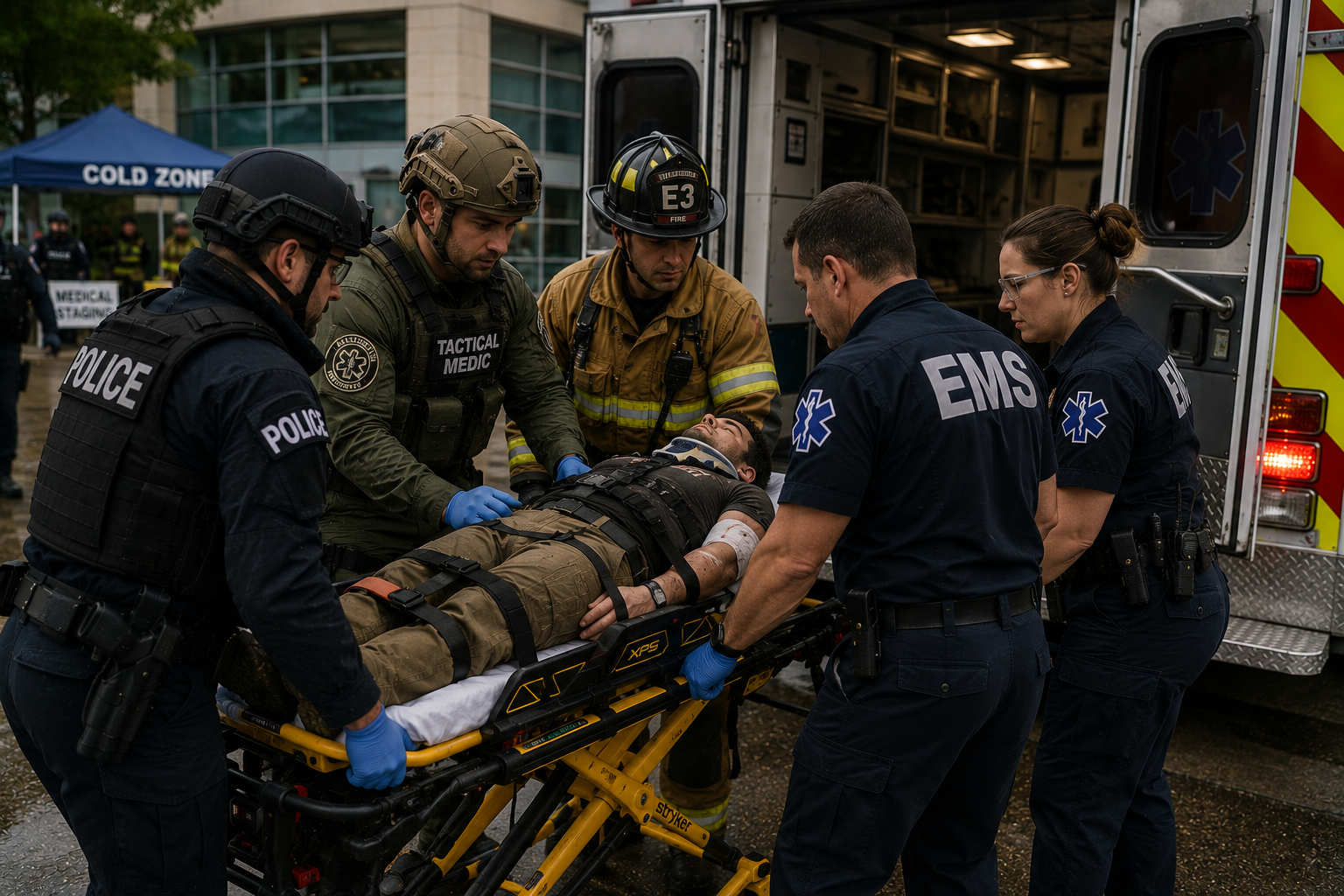
TECC is structured to align with the realities of zone-based operations without becoming constrained by them. Its phases—Direct Threat Care, Indirect Threat Care, and Evacuation Care—map conceptually onto hot, warm, and cold zones while remaining flexible.
In hot zones, TECC emphasizes minimal, high-impact interventions performed under fire or imminent threat. In warm zones, it expands care while maintaining situational awareness and security integration. In cold zones, it transitions seamlessly into conventional EMS operations.
This alignment allows agencies to integrate TECC without abandoning existing operational language. More importantly, it ensures continuity of care as casualties move through changing threat conditions, preventing gaps created by rigid phase transitions.
Coordination as a Force Multiplier
When TECC is integrated across agencies, coordination improves dramatically. Responders share expectations about priorities, capabilities, and limitations. Command decisions are informed by realistic medical timelines rather than optimistic assumptions.
This coordination enhances tactical operations. Law enforcement can plan clearing routes that support casualty movement. Fire and EMS can position resources dynamically rather than waiting passively. Medical information flows upward, improving situational awareness and evacuation planning.
TECC does not compete with tactics; it amplifies tactical effectiveness by ensuring that medical realities inform operational decisions.
Barriers to Integration: Cost, Training, and Resistance
Despite its advantages, TECC integration faces persistent barriers. Cost is frequently cited, particularly for equipment and training. However, these costs are modest compared to the financial and human costs of preventable death and long-term disability.
Training gaps present another challenge. TECC requires realistic, interdisciplinary training that exposes responders to stress, ambiguity, and joint decision-making. Many agencies lack the infrastructure or experience to deliver this effectively.
Institutional resistance may be the most significant barrier. TECC challenges entrenched beliefs about role separation, safety, and authority. Change threatens comfort and predictability. As a result, TECC is sometimes adopted superficially—reduced to tourniquet distribution without doctrinal integration.
Partial adoption yields partial benefit.
The Consequences of Incomplete Implementation
When TECC is implemented unevenly, its effectiveness diminishes. Law enforcement may carry tourniquets without medical context. EMS may understand TECC concepts but remain operationally excluded. Fire may be trained but lack authorization to act.
These inconsistencies recreate the very fragmentation TECC was designed to resolve. Without shared doctrine and mutual trust, early medical intervention remains delayed despite improved individual capability.
True integration requires policy, training, equipment, and authority to align—not just knowledge.
TECC as a Cultural Shift, Not a Checklist
Perhaps the most overlooked aspect of TECC integration is its cultural dimension. TECC redefines what it means to provide care in dangerous environments. It challenges responders to accept managed risk, prioritize life-saving action, and operate beyond traditional comfort zones.
This cultural shift cannot be achieved through policy memos alone. It requires leadership endorsement, repeated joint training, and reinforcement through after-action learning. Responders must see TECC not as an added burden, but as a tool that empowers them to act decisively and ethically.
Culture determines whether doctrine is followed when stress peaks.
Relevance to Modern Threat Environments
Modern high-threat incidents are fast, complex, and unforgiving of delay. TECC’s principles—early hemorrhage control, rapid extraction, and coordinated care—are uniquely suited to these conditions. As threats evolve toward greater speed and lethality, the cost of inaction grows.
TECC remains relevant because it is grounded in physiology rather than convenience. It acknowledges that danger cannot be eliminated before care begins—and that waiting for perfect safety often guarantees failure.
Its integration is therefore not a trend, but a necessity.
Implications for Doctrine and Policy
For TECC to achieve its full potential, agencies must move beyond optional adoption. Doctrine must explicitly support early medical intervention under threat-mitigated conditions. Policies must authorize cross-disciplinary action rather than restrict it. Training must be joint, realistic, and sustained.
Metrics of success should include survivability outcomes, not just tactical resolution. When TECC is embedded at the doctrinal level, it reshapes how agencies plan, train, and respond.
Conclusion
The integration of Tactical Emergency Casualty Care represents a decisive evolution in public safety response. By unifying police, fire, and EMS around shared medical priorities and operational realities, TECC closes the gap between injury and intervention—the gap where preventable deaths occur.
Early hemorrhage control, rapid extraction, and coordinated tactical-medical action are not specialized capabilities; they are baseline requirements in modern high-threat environments. Barriers to TECC integration persist, but they are organizational—not evidentiary.
When fully integrated, TECC transforms fragmented response systems into cohesive, life-preserving operations. In environments where seconds matter and certainty is rare, TECC provides what traditional models cannot: a practical, ethical, and evidence-based framework for saving lives when danger is unavoidable.