
Interagency Training, Exercises, and MOUs
Interagency Training, Exercises, and MOUs
Interagency performance in high-threat incidents is rarely determined by intent. It is determined by preparation. When law enforcement, fire services, EMS, emergency management, and communications centers converge on an active shooter or mass-casualty incident, success depends on whether these organizations have already learned how to think, move, and decide together. No amount of goodwill or improvisation can compensate for a lack of shared training, rehearsed coordination, and clearly articulated agreements.
This analysis examines interagency training, exercises, and memoranda of understanding (MOUs) as foundational mechanisms for operational readiness. The central assertion is straightforward: agencies do not coordinate effectively during crisis unless they have coordinated deliberately before crisis. Joint training builds shared understanding, exercises expose friction points, and MOUs formalize expectations so that responders can act decisively rather than negotiate roles in real time.
Why Interagency Preparedness Fails Without Deliberate Design
High-threat incidents expose the seams between agencies. Each discipline brings its own culture, terminology, priorities, and risk thresholds. Law enforcement focuses on threat mitigation, EMS on patient care, fire services on hazard control and rescue, and emergency management on coordination and continuity. Without structured integration, these priorities compete rather than complement one another.
Historically, many jurisdictions assumed that proximity alone would produce coordination—that agencies arriving at the same scene would naturally align. After-action reviews repeatedly demonstrate the opposite. Absent prior joint preparation, responders default to discipline-specific procedures that may conflict with or delay parallel operations.
Interagency training and formal agreements exist to close this gap. They convert coexistence into collaboration.
Joint Training as the Engine of Coordination
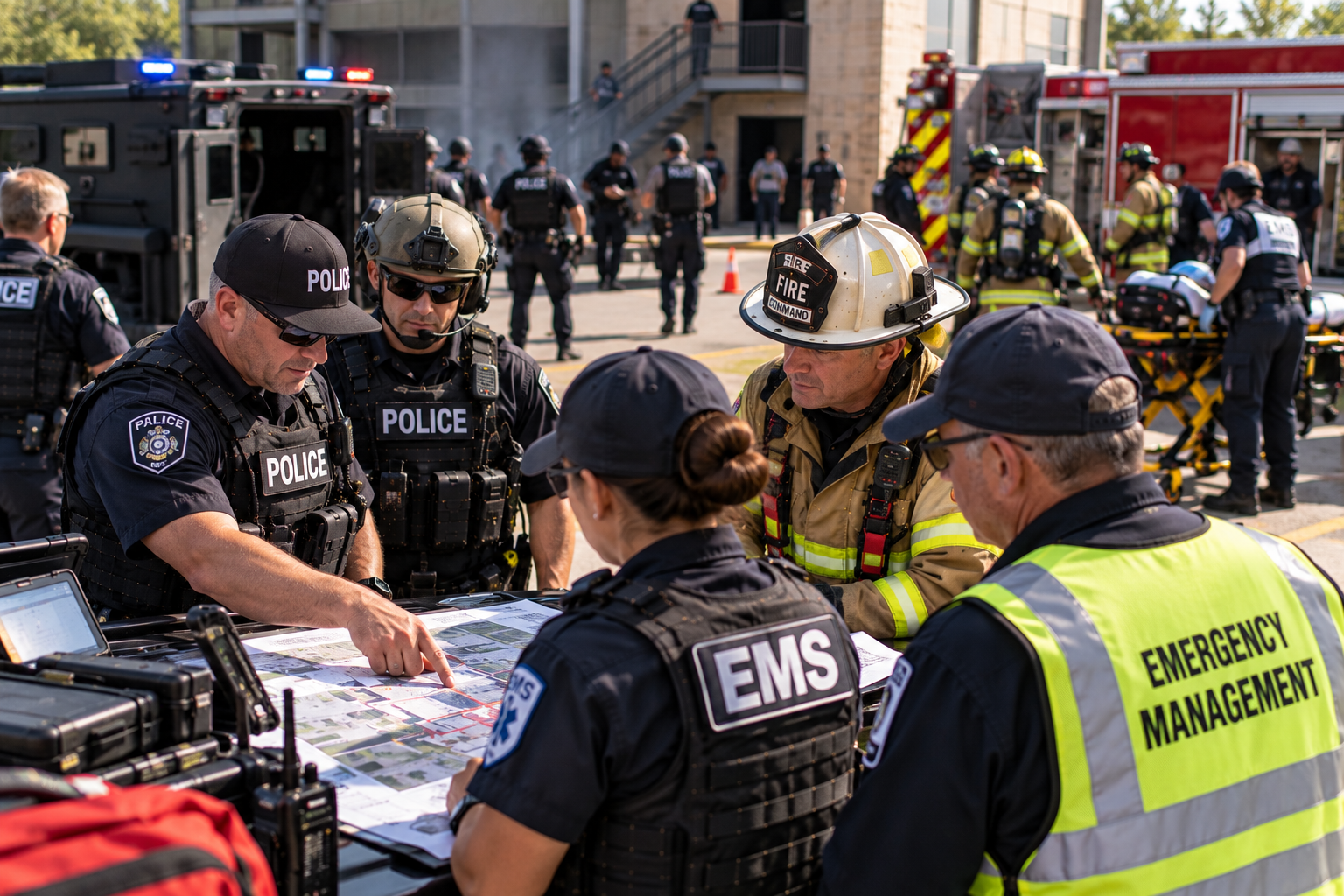
Joint training is not simply multi-agency attendance at the same event. It is purposeful, scenario-driven practice designed to force interaction across disciplines. When done well, it creates shared operational expectations and reduces uncertainty during real incidents.
Effective joint training:
Aligns terminology and decision thresholds
Clarifies when and how agencies support one another
Normalizes operating in contested, ambiguous environments
Builds trust through repeated interaction
These outcomes cannot be achieved through classroom instruction alone. They require practical application under stress, time pressure, and imperfect information—conditions that approximate real incidents.
Critically, joint training reshapes attention. Responders learn not only their own tasks, but how those tasks fit into a larger system of action.
Exercises as Diagnostic Tools, Not Demonstrations
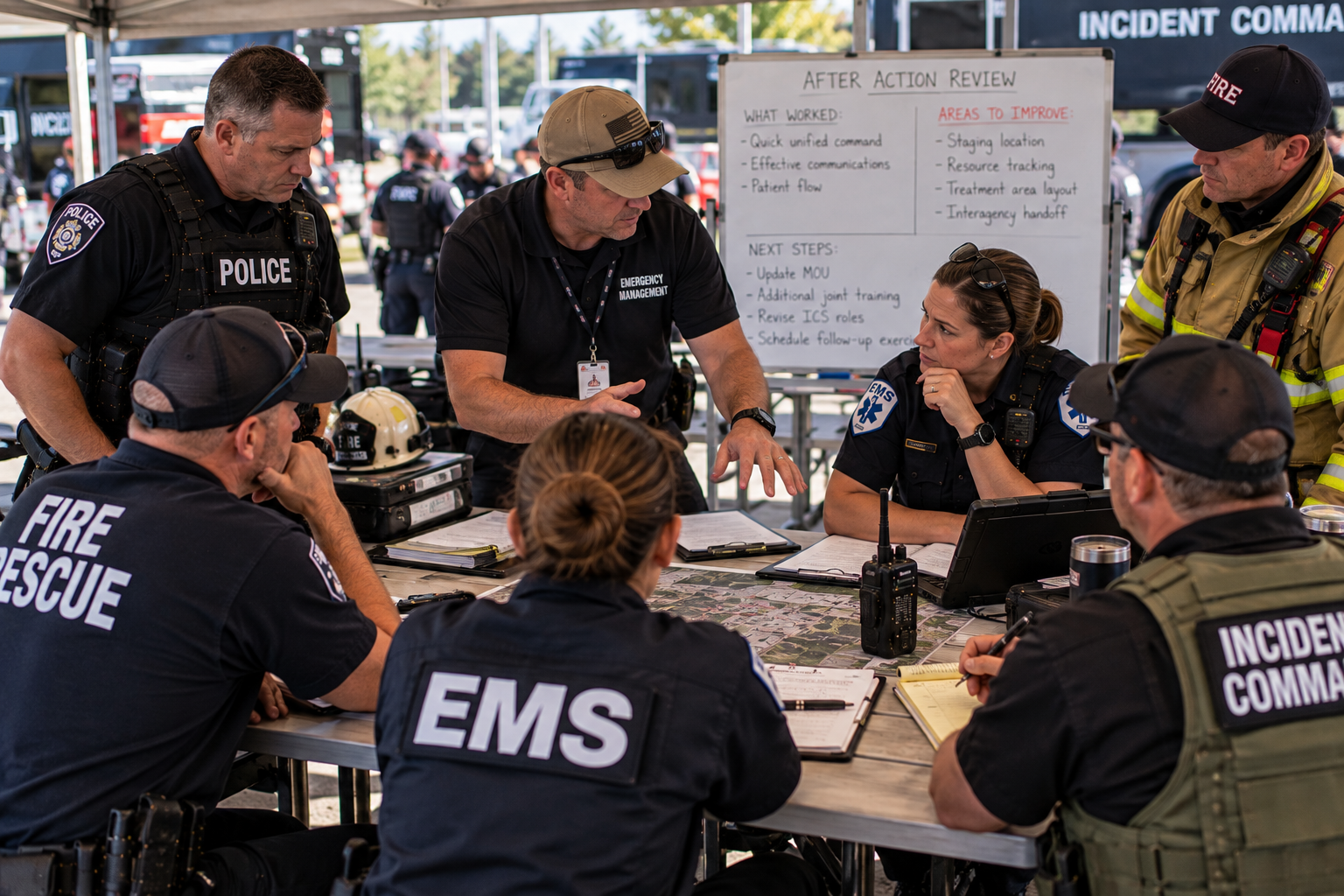
Exercises are often misunderstood as validation events—opportunities to demonstrate capability. In reality, their greatest value lies in revealing weaknesses before lives depend on performance.
Well-designed interagency exercises deliberately stress systems. They introduce:
Conflicting information
Resource shortages
Communications failures
Leadership transitions
Competing operational priorities
These stressors expose where coordination breaks down: unclear authority, incompatible procedures, or unrealistic assumptions about other agencies’ capabilities.
Tabletop exercises identify conceptual gaps. Functional and full-scale exercises reveal behavioral gaps. Together, they create a feedback loop that informs policy, training, and doctrine.
Exercises should be uncomfortable. Comfort is a sign that scenarios are not testing the system deeply enough.
Building Shared Mental Models Through Repetition
Coordination during crisis depends on shared mental models—common expectations about how situations unfold and how partners will act. These models do not emerge spontaneously. They are built through repetition with variation.
Repeated joint training allows responders to:
Anticipate partner actions
Recognize cues for phase transitions
Adjust tempo without explicit direction
Maintain alignment despite incomplete information
Over time, agencies begin to operate less as separate entities and more as a unified system. This reduces the cognitive burden of coordination and accelerates decision-making under stress.
Shared mental models are particularly important in high-threat incidents, where verbal communication may be degraded or delayed.
Memoranda of Understanding as Operational Anchors
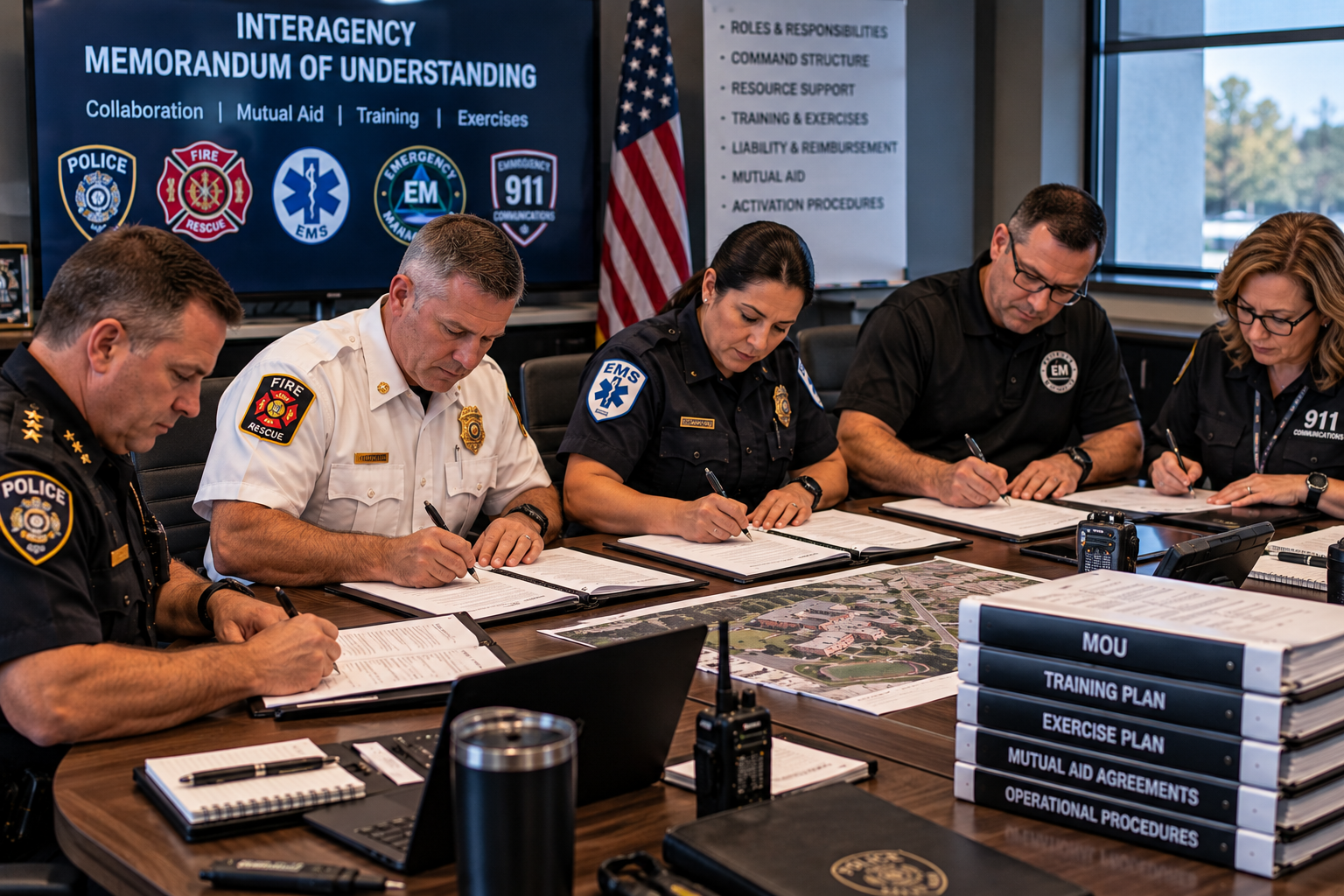
Training alone is insufficient without formal agreements that define authority, responsibility, and resource use. Memoranda of understanding translate collaborative intent into enforceable structure.
Effective MOUs:
Define roles across incident phases
Clarify command relationships and decision authority
Establish expectations for resource deployment
Address liability, reimbursement, and mutual aid
Reduce ambiguity during activation
In the absence of MOUs, agencies may hesitate to act beyond perceived jurisdictional or functional boundaries. This hesitation costs time—often during the most survivable window for intervention.
MOUs do not constrain action; they enable decisive action by removing uncertainty.
Alignment with Incident Command and Unified Operations
Interagency training and MOUs must align with established command frameworks such as the Incident Command System. ICS provides a common structure, but structure alone does not guarantee coordination.
Joint training operationalizes ICS by teaching agencies how unified command functions under pressure. Exercises reveal where ICS assumptions break down in dynamic, non-linear incidents. MOUs ensure that ICS roles are not merely theoretical but supported by policy and authority.
When agencies train together within a shared command framework, they learn how to synchronize rather than sequence their actions.
Revealing and Correcting Operational Assumptions
One of the most valuable outcomes of joint training is the exposure of flawed assumptions. Agencies often assume:
Other disciplines have more resources than they do
Certain tasks “belong” to another agency
Legal or policy barriers prevent early action
Capabilities are interchangeable across jurisdictions
Exercises force these assumptions into the open. When corrected before real incidents, they prevent hesitation, duplication, and conflict during response.
This corrective process strengthens operational realism and reduces reliance on idealized models that fail under stress.
Administrative and Leadership Support as Sustainment Factors
Interagency preparedness cannot be sustained by enthusiasm alone. It requires administrative commitment and leadership endorsement.
Sustainment depends on:
Dedicated training time protected from routine demands
Funding for joint exercises and evaluators
Policy updates informed by exercise outcomes
Leadership participation that signals priority
Accountability mechanisms to track progress
Without this support, joint training becomes episodic rather than institutionalized. Skills degrade, relationships weaken, and lessons learned are forgotten.
Preparedness is a process, not an event.
Legal, Ethical, and Cultural Considerations
Interagency collaboration raises legitimate legal and ethical questions. MOUs must address liability, authority, and scope of practice, particularly in high-risk environments. Training provides a venue to explore these issues before they become barriers during crisis.
Cultural differences also matter. Law enforcement, fire, and EMS operate under different norms and incentives. Joint training builds mutual respect by exposing each discipline to the realities faced by others.
When culture is ignored, coordination suffers. When culture is acknowledged and integrated, collaboration strengthens.
Continuous Relevance to Real-World Performance
Every major after-action review following active shooter incidents highlights coordination failures that were foreseeable and preventable. These failures rarely stem from lack of courage or commitment. They stem from systems that were never trained to function together under stress.
Interagency training, exercises, and MOUs address this gap directly. They move coordination from aspiration to practice, from policy to behavior.
Preparedness achieved this way is not theoretical. It is operational, repeatable, and resilient under pressure.
Conclusion
Effective interagency response is built long before the first call is received. Joint training develops shared understanding. Exercises expose weaknesses while correction is still possible. MOUs remove ambiguity and empower decisive action.
Together, these elements form the backbone of collaborative preparedness. They ensure that when high-threat incidents occur, agencies do not waste time discovering how to work together. They already know.
In environments where minutes determine survival, pre-incident coordination is not optional—it is lifesaving infrastructure.