
Joint Training as the Foundation of Effective Multi-Agency Response
Joint Training as the Foundation of Effective Multi-Agency Response
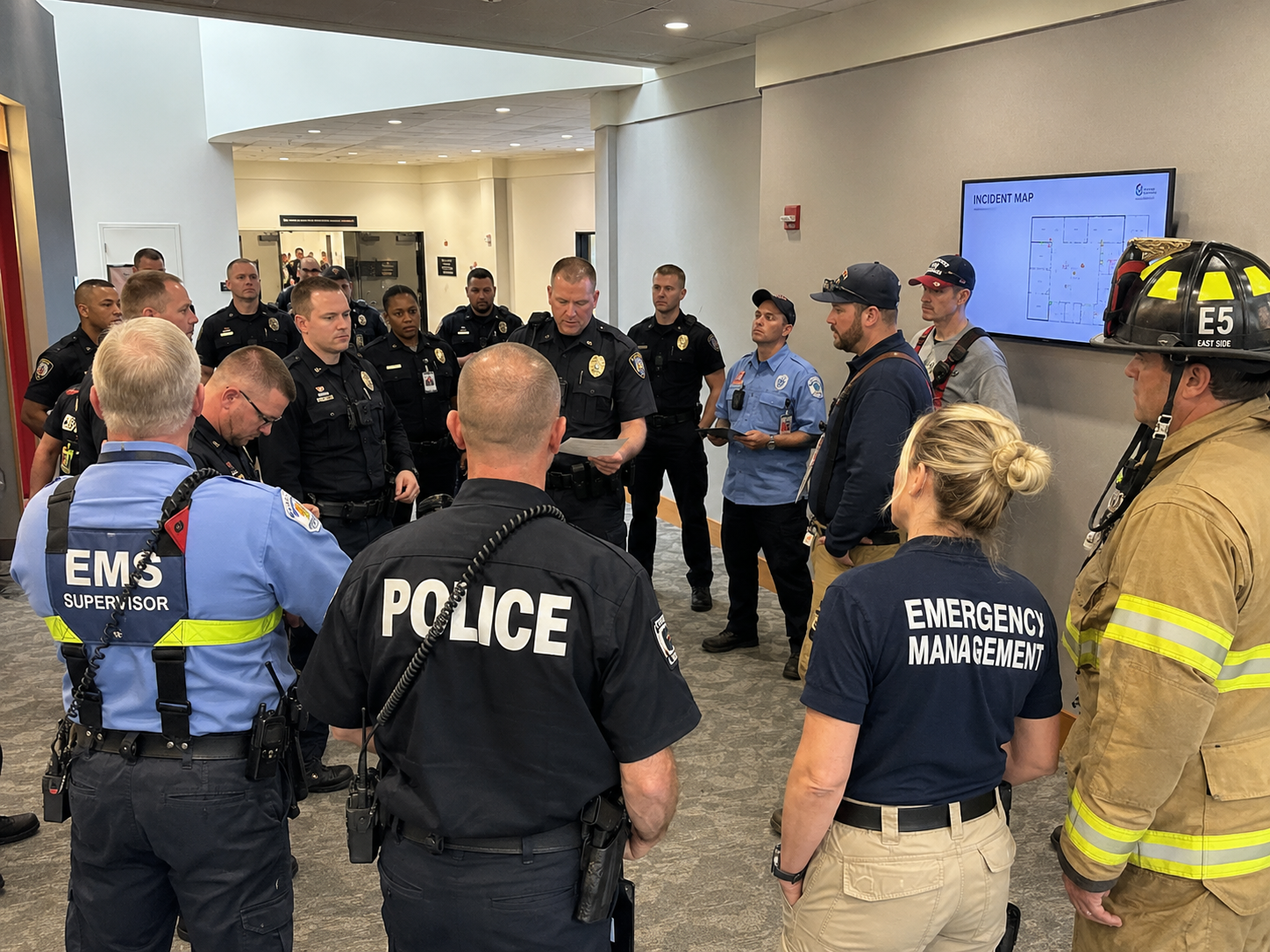
High-threat incidents do not expose a lack of equipment or intent; they expose a lack of integration. Active shooter and mass-casualty events compress time, increase uncertainty, and demand immediate coordination across law enforcement, EMS, fire services, and emergency management. In these environments, agencies that have trained separately are forced to collaborate for the first time under extreme stress. The result is often predictable: delayed decisions, fragmented operations, and preventable loss of life. The most reliable way to prevent these failures is not better improvisation during crisis, but deliberate joint training before crisis occurs.
The central argument of this analysis is that joint training is the foundational mechanism that enables effective multi-agency response in high-threat incidents. It is through shared exercises—not policies alone—that agencies learn to coordinate movement, align priorities, communicate clearly, and make decisions under pressure. When designed intentionally, joint training transforms independent capabilities into a cohesive operational system. This article examines why joint training is essential, how it exposes collaboration barriers, and how it strengthens multidisciplinary response through repetition, evaluation, and relevance to real-world threats.
Why Joint Training Is Operationally Essential
High-threat incidents unfold too quickly to allow agencies to negotiate roles, language, and expectations in real time. Decisions must be made in seconds, often with incomplete information. In these moments, responders do not rise to a new level of performance; they fall to the lowest level of training they have mastered. If that training occurred in isolation, isolated behavior will dominate—even when collaboration is required.
Joint training establishes shared experience. It allows agencies to encounter complexity together, resolve friction in controlled environments, and build familiarity that carries forward into real incidents. This shared experience reduces cognitive load during actual response. Responders spend less time interpreting one another’s actions and more time executing life-saving tasks.
Importantly, joint training does not replace discipline-specific training; it complements it. Tactical proficiency, medical competence, and command expertise remain essential. Joint training ensures those proficiencies can be applied together, rather than competing for space, time, or authority during an incident.
Exposing Collaboration Barriers Before They Become Casualties
One of the most valuable functions of joint training is its ability to reveal barriers that remain invisible during routine operations. In classroom settings or policy documents, coordination often appears straightforward. In realistic scenarios, friction emerges quickly.
Common barriers exposed through joint training include:
Conflicting assumptions about scene safety and access
Inconsistent interpretations of common terminology
Unclear authority transitions within Unified Command
Delayed medical access due to overly conservative security postures
Inefficient use of personnel caused by redundant tasking
These issues rarely stem from incompetence or unwillingness to cooperate. They arise because agencies are trained within different professional cultures, legal frameworks, and operational priorities. Joint training surfaces these differences in a setting where they can be discussed, corrected, and institutionalized into improved practice—rather than discovered during a real event when correction is costly.
By encountering friction early, agencies gain the opportunity to transform it into clarity.
Integrating Law Enforcement and Medical Operations
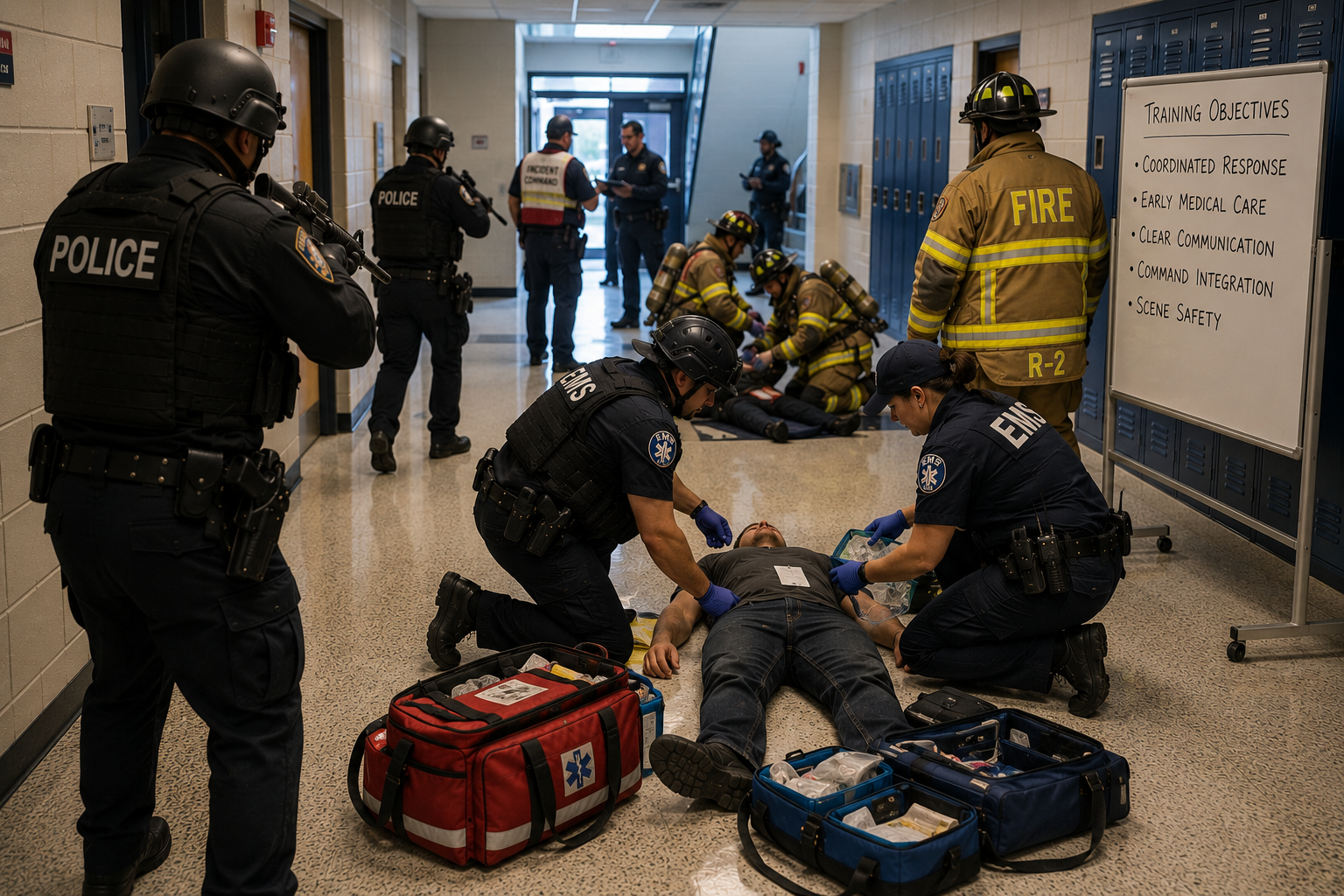
High-threat incidents demand more than tactical resolution; they demand simultaneous life-saving care. Yet many response models continue to separate law enforcement tactics from medical operations, reinforcing a sequential mindset: stop the threat first, then treat the wounded. Joint training challenges this paradigm by integrating essential medical skills directly into tactical environments.
When law enforcement officers train alongside EMS and fire personnel, they learn how their movement and positioning affect medical access. When medical providers train within protected but dynamic environments, they gain a realistic understanding of threat-mitigated care. This integration produces a multidisciplinary response model where:
Law enforcement actions deliberately create space for care
Medical interventions begin as soon as conditions allow
Casualty Collection Points (CCPs) are established earlier and closer to the point of injury
Evacuation planning begins while the incident is still evolving
This integration does not compromise safety; it manages risk intelligently. Joint training reinforces that medical care and tactical operations are not competing priorities, but mutually reinforcing ones.
Practicing Decision-Making Under Stress
Stress fundamentally alters cognition. Fine motor skills degrade, attention narrows, and decision-making defaults to habit. Joint training that replicates stress—through time pressure, noise, uncertainty, and competing objectives—prepares responders for these realities.
In multidisciplinary exercises, participants must balance threat control, casualty care, communication, and command coordination simultaneously. This environment forces responders to prioritize, adapt, and collaborate in real time. Over repeated iterations, teams develop shared mental models that accelerate decision-making during actual incidents.
Crucially, joint training normalizes deliberate communication under stress. Responders practice clarifying intent, confirming understanding, and adjusting plans without hesitation. These behaviors become instinctive, reducing the likelihood of miscommunication when it matters most.
Structured Evaluation as a Catalyst for Improvement
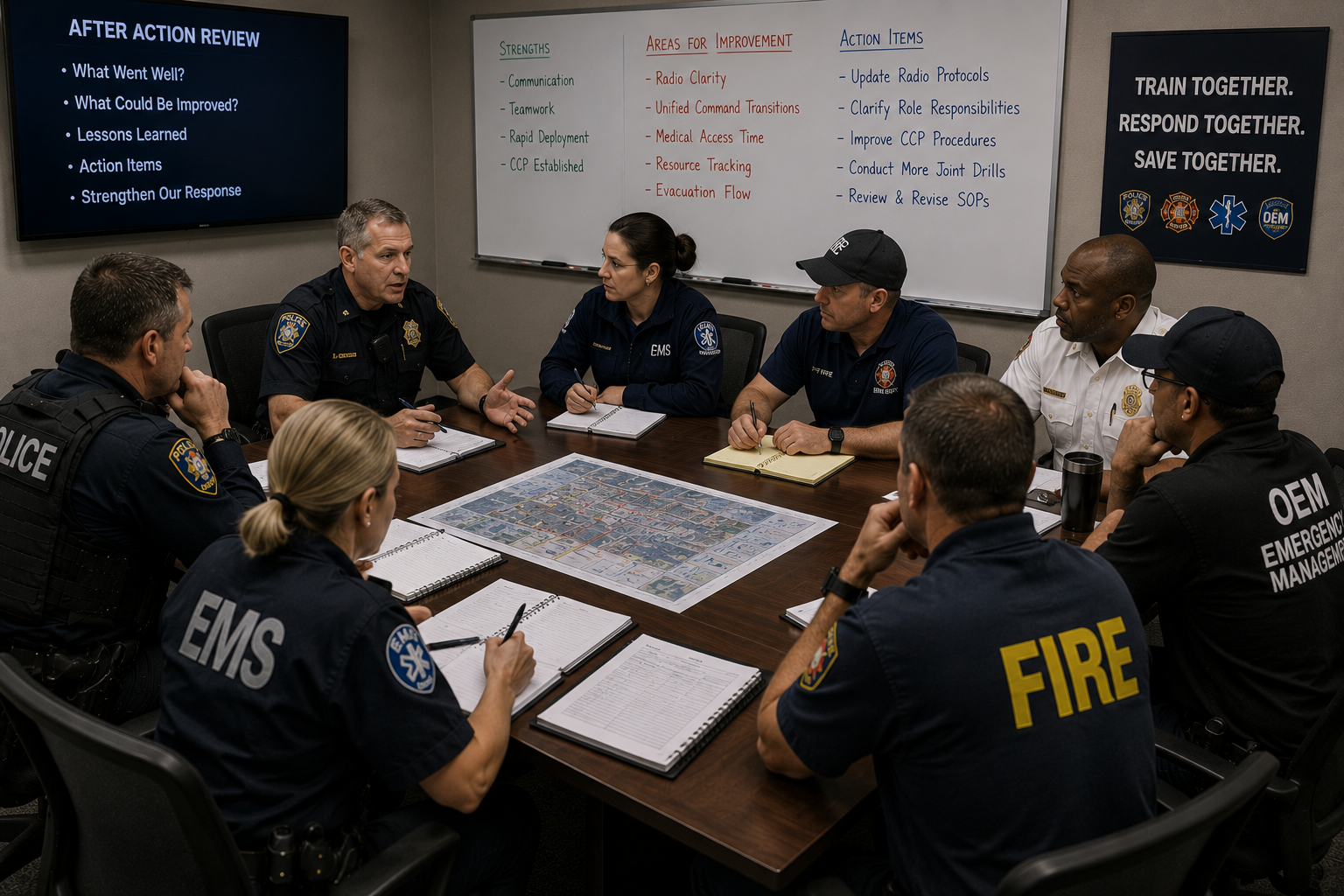
Joint training without structured evaluation risks becoming performative rather than transformative. Effective exercises include deliberate evaluation mechanisms that identify weaknesses and drive improvement. These evaluations focus not only on what occurred, but why it occurred.
Structured evaluations examine:
Timing of medical access and CCP establishment
Clarity and consistency of communication
Effectiveness of Unified Command coordination
Appropriateness of risk decisions
Alignment between tactical actions and life-safety outcomes
By grounding feedback in observable outcomes, agencies avoid subjective blame and instead focus on system performance. Lessons learned are translated into updated protocols, revised training objectives, and clearer role definitions.
Evaluation ensures that joint training remains relevant, accountable, and continuously improving.
Refining Communication and Shared Language
Language is one of the most underestimated factors in multi-agency response. Words that seem universally understood often carry discipline-specific meanings. Joint training provides the environment necessary to identify and resolve these discrepancies.
During exercises, agencies hear how others interpret terms such as secure, clear, warm zone, or safe to enter. Misalignments become immediately apparent when actions diverge. Through facilitated discussion and repetition, agencies develop shared definitions that carry forward into real operations.
Shared language improves more than communication; it improves predictability. Responders can anticipate one another’s actions, reducing hesitation and duplication. Command intent becomes actionable rather than abstract. Over time, shared language becomes embedded in organizational culture.
Strengthening Teamwork and Trust
Trust is not built through policy; it is built through experience. Joint training creates opportunities for responders to rely on one another, observe competence across disciplines, and develop confidence in shared decision-making. This trust directly affects willingness to act under uncertainty.
When agencies trust one another, they are more likely to accept managed risk, initiate early care, and adjust plans collaboratively. When trust is absent, responders default to conservative postures that delay action. Joint training replaces unfamiliarity with confidence, allowing teams to move faster without sacrificing safety.
Preparing for Realistic Staffing and Resource Constraints
High-threat incidents rarely unfold under ideal staffing conditions. Early response often involves limited personnel performing multiple roles. Joint training allows agencies to rehearse these constraints realistically.
Exercises that account for low staffing force creative problem-solving and cross-disciplinary support. Law enforcement may assist with casualty movement; fire personnel may support medical operations; EMS may adapt care delivery to austere conditions. These adaptations cannot be improvised effectively without prior experience.
Joint training ensures that responders are prepared not only for best-case scenarios, but for the resource limitations that define most real incidents.
Linking Joint Training to Faster, Safer Outcomes
The ultimate measure of joint training effectiveness is outcome improvement. Agencies that train together consistently demonstrate:
Faster initiation of life-saving medical care
Earlier establishment of CCPs
Reduced communication delays
More efficient resource deployment
Improved survivability for victims and responders
These outcomes are not theoretical. They emerge when agencies internalize shared priorities and practice coordinated execution. Joint training aligns preparation with reality, ensuring that response performance reflects the demands of modern threats.
Sustaining Joint Training as an Organizational Commitment
Joint training must be sustained to remain effective. One-time exercises create awareness but do not produce lasting change. Agencies must institutionalize joint training through recurring exercises, shared standards, and leadership support.
Sustained joint training signals that collaboration is not optional. It reinforces expectations, maintains shared language, and adapts coordination to evolving threats. Over time, collaboration becomes habitual rather than exceptional.
Conclusion
Joint training is the foundation of effective multi-agency response in high-threat incidents. It transforms independent capabilities into a cohesive operational system capable of managing complexity, uncertainty, and extreme time pressure. Through shared exercises, agencies expose collaboration barriers, integrate tactical and medical operations, refine communication, and strengthen decision-making under stress.
When structured evaluation and sustained commitment accompany joint training, preparedness improves measurably. Responses become faster, safer, and more effective—not because agencies work harder, but because they work together.
In high-threat environments, coordination cannot be improvised. It must be practiced. Joint training ensures that when lives depend on collaboration, collaboration is already in place.