
Legal, Ethical, and Use-of-Force Considerations
Legal, Ethical, and Use-of-Force Considerations
High-threat incidents force public safety systems to operate at the edges of law, ethics, and professional identity. As medical personnel move closer to the point of injury—often into warm or hot zones—the questions that follow are no longer theoretical. Who is authorized to operate where? Under what legal authority? With what protections, obligations, and limits? And, critically, how much risk can or should be assumed by medical professionals whose mission is to save life rather than apply force?
This analysis examines legal, ethical, and use-of-force considerations as operational determinants, not administrative footnotes. The central premise is that expanding medical access in high-threat environments without equally expanding legal clarity and ethical guidance creates risk for responders, agencies, and patients alike. Clear frameworks do not slow response; they enable it by replacing hesitation with confidence and ambiguity with accountability.
Why Legal Clarity Matters in High-Threat Medical Operations
In the earliest moments of an active shooter or mass-violence incident, responders make decisions under extreme time pressure. When legal authority is unclear, decision-making slows. Medical personnel hesitate, supervisors over-control, and agencies default to the most conservative interpretation of risk—often at the expense of survivability.
Traditional EMS doctrine evolved in environments where scenes were either safe or not. Modern threat environments invalidate that binary. As a result, medical operations increasingly occur in spaces that are partially controlled, dynamically evolving, or threat-mitigated but not secure. Legal frameworks that do not explicitly account for this reality leave responders exposed to post-incident scrutiny and litigation.
Front-loading this relevance is essential: medical delay driven by legal uncertainty is a policy failure with clinical consequences.
Armed EMS: Capability, Controversy, and Context
Few topics generate more debate than armed EMS programs. Proponents argue that arming select medical personnel increases survivability and operational flexibility in high-threat environments. Critics counter that it blurs professional roles, introduces liability, and risks escalation.
Legally, armed EMS programs raise several questions:
Under what statutory authority may medical personnel carry weapons?
Are they acting as law enforcement, medical providers, or both?
What use-of-force standards apply if a weapon is discharged?
Ethically, the issue is equally complex. Medical professionals are bound by principles of beneficence and nonmaleficence. Introducing lethal force into that role challenges traditional interpretations of medical ethics, even when framed as self-defense.
Operationally, context matters. Armed EMS models developed in specific environments—often rural, austere, or tactical—do not translate universally. The absence of standardized national guidance results in inconsistent implementation, uneven training, and heightened liability exposure.
The critical lesson is not that armed EMS is inherently right or wrong, but that capability without doctrine invites failure.
Liability in Warm and Hot Zone Medical Operations
Liability concerns loom large whenever medical personnel operate under threat. These concerns are not abstract; they shape policy, training, and on-scene behavior. Agencies fear civil litigation, criminal charges, and reputational damage stemming from decisions made under chaos.
Common liability questions include:
Was it reasonable to enter a partially secured area?
Did the agency adequately train and equip personnel?
Were policies clear and followed?
Did responders exceed their scope or authority?
Ironically, fear of liability often produces the very outcomes agencies seek to avoid. Delayed medical access increases preventable death, which in turn generates legal exposure rooted in negligence or failure to act. Courts and juries increasingly evaluate decisions based on what was reasonable given the circumstances, not what was safest for the organization.
Well-defined policies, training aligned with policy, and documented decision-making processes reduce liability far more effectively than blanket prohibition.
Ethical Dimensions of Risk Assumption
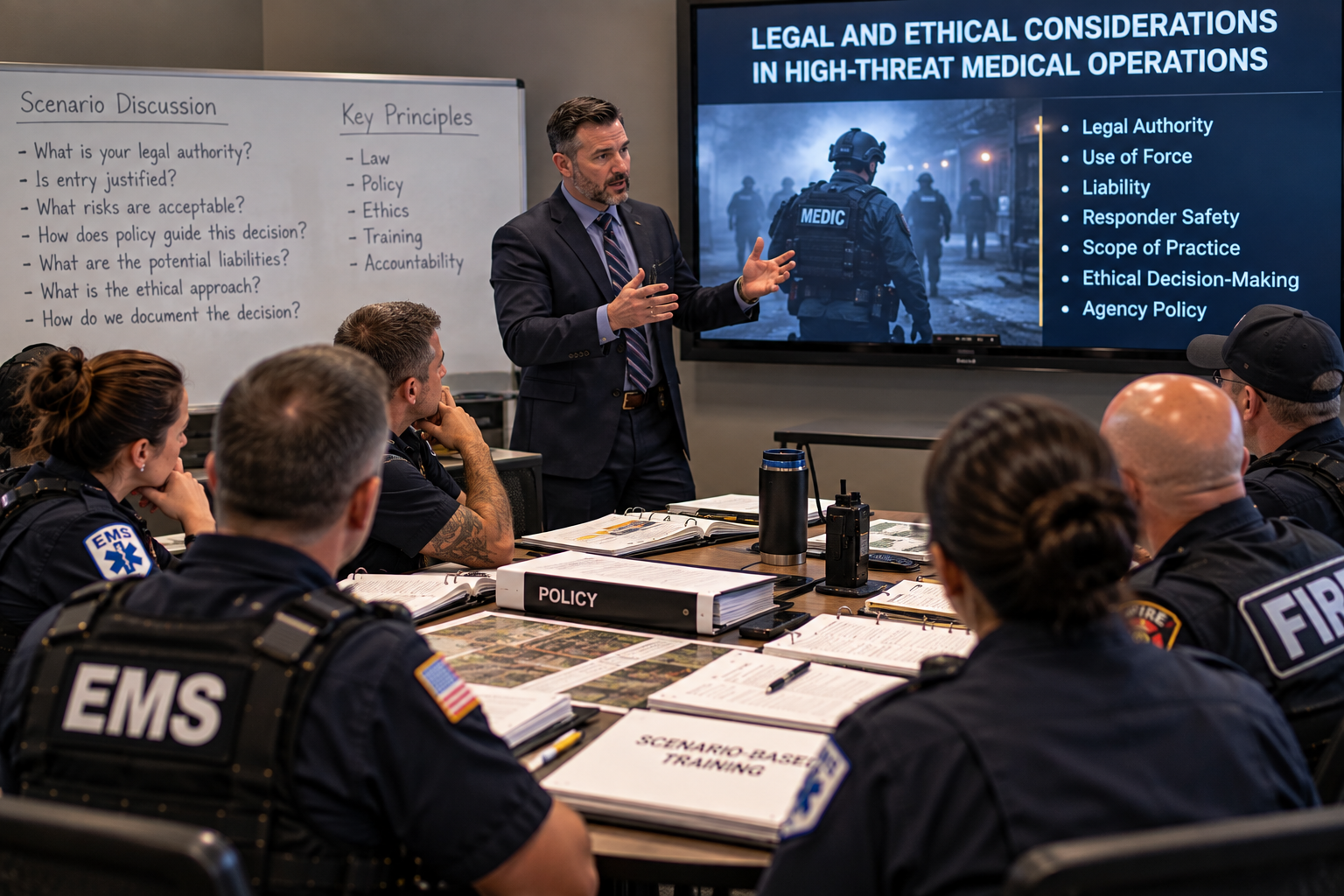
At the heart of high-threat medical operations lies an ethical tension: how much risk should medical personnel assume to save others? Unlike law enforcement, medical professionals are not traditionally expected to confront threats. Yet neither are they ethically justified in withholding care when intervention is possible.
Ethical analysis must consider proportionality. Expecting unprotected medics to enter uncontrolled kill zones is indefensible. Conversely, prohibiting medical access to threat-mitigated areas where protection exists may violate ethical obligations to preserve life.
Ethics also demand voluntariness. Medical personnel should not be coerced—explicitly or implicitly—into roles for which they are untrained, unequipped, or unwilling. Clear role definitions and opt-in models respect professional autonomy while enabling capability.
Ultimately, ethical practice requires alignment between mission, training, equipment, and authority. When these elements diverge, ethical injury follows.
Use-of-Force Considerations and Medical Identity
Even when medical personnel are not armed, use-of-force considerations still apply. Force protection by law enforcement, movement under armed escort, and presence in contested spaces raise questions about how medical identity is perceived by threats and civilians alike.
If medical personnel are viewed as extensions of law enforcement, they may become targets. If they are perceived as neutral caregivers, access may improve—but only if that neutrality is credible. Uniforms, markings, behavior, and integration all influence perception.
In armed EMS models, the use-of-force continuum must be explicitly addressed. Medical personnel cannot default to law enforcement standards without equivalent training, oversight, and accountability. Nor can agencies ignore the reality that any use of force by a medic will be scrutinized through both medical and legal lenses.
Clear doctrine defining when, why, and how force may be used—if at all—is essential to preserving legitimacy and safety.
Policy Gaps and Operational Consequences
Many agencies operate in legal gray zones because policy has not kept pace with practice. Informal expectations emerge: medics “might” go forward, “should” wait, or “can” enter with protection—but without written guidance. These gaps place responders at risk and undermine consistency.
Policy gaps produce predictable consequences:
Inconsistent decision-making across incidents
Conflicting instructions from command
Hesitation during critical windows
Increased post-incident blame shifting
Effective policy does not prescribe every action. It establishes guardrails within which professional judgment can operate. Policies that articulate acceptable risk, required conditions, and decision authority empower responders rather than constrain them.
Building Clear Legal Frameworks
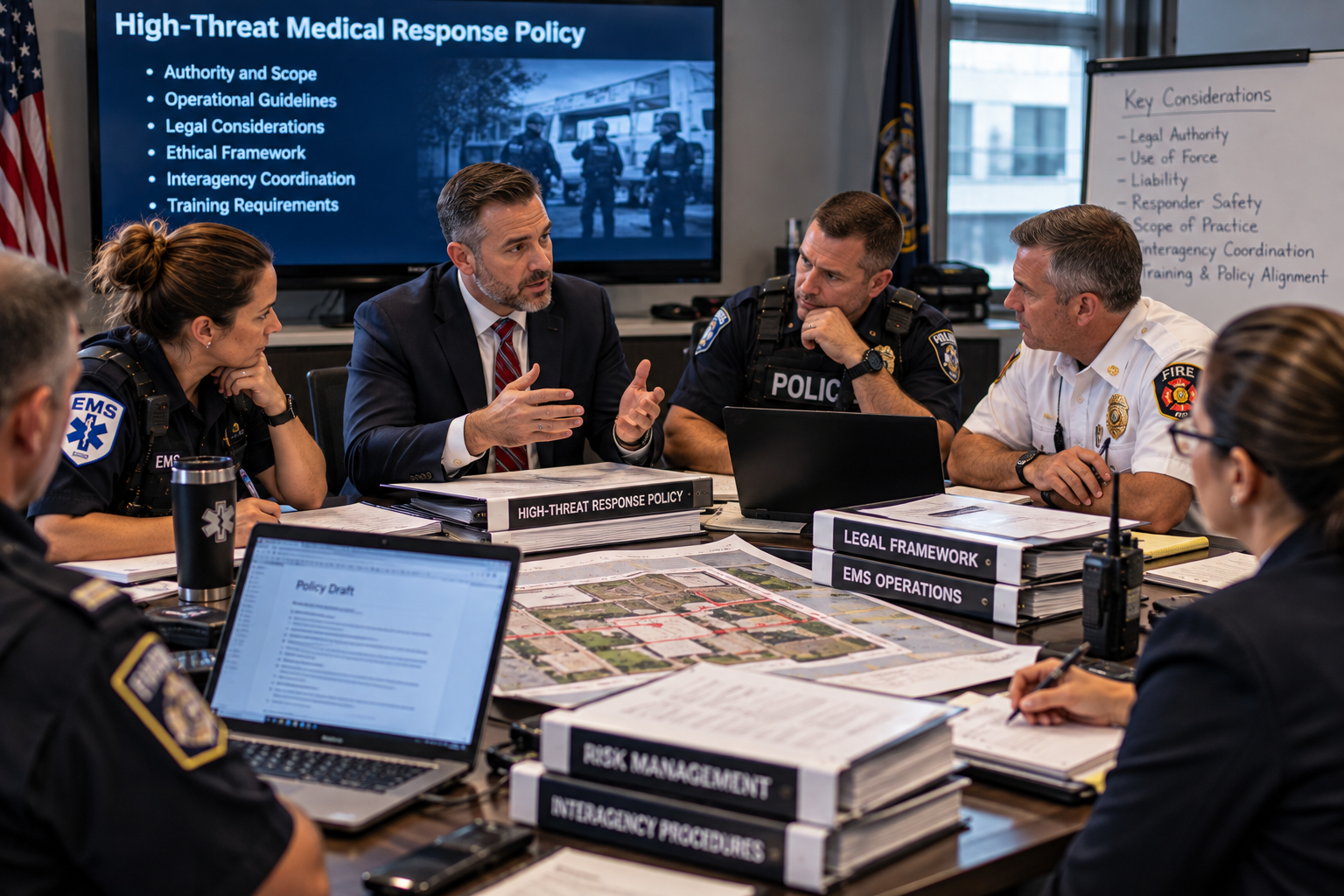
Clear legal frameworks begin with collaboration. Law enforcement, EMS, fire, legal counsel, risk management, and labor organizations must participate in policy development. This collaboration ensures that operational realities inform legal language and vice versa.
Key elements of effective frameworks include:
Defined operational zones and associated authorities
Explicit conditions for medical entry under protection
Clarified scope of practice in high-threat contexts
Documentation standards for decision-making
Alignment with state statutes and case law
Agencies that proactively establish these frameworks reduce uncertainty and improve compliance. Responders who understand their authority act with greater confidence and consistency.
Training as Legal Risk Mitigation
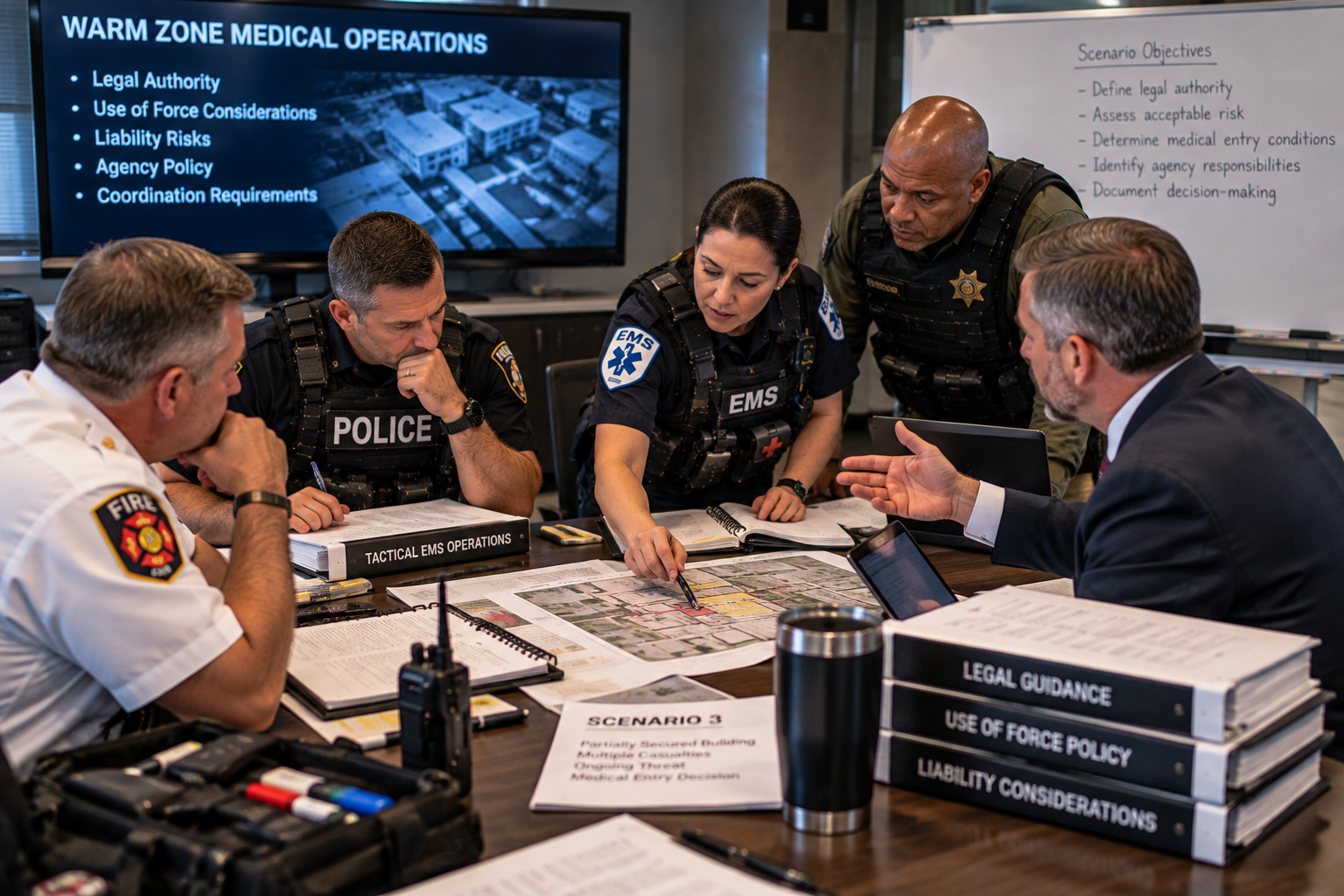
Training is not merely an operational necessity; it is a legal safeguard. Courts routinely evaluate whether agencies trained their personnel appropriately for foreseeable risks. When doctrine expands medical roles without corresponding training, liability increases.
Training must reflect policy. Scenario-based exercises should incorporate legal decision points, ethical dilemmas, and command considerations alongside tactical and medical skills. This integration prepares responders to articulate their decisions clearly after the fact.
Documentation of training completion, policy acknowledgment, and competency assessment further strengthens legal defensibility.
Continuous Relevance: Law and Ethics as Enablers, Not Barriers
Legal and ethical considerations are often framed as obstacles to operational effectiveness. In reality, they are enablers when addressed proactively. Clear authority accelerates action. Ethical clarity reduces hesitation. Defined use-of-force standards preserve legitimacy.
As medical operations move closer to the point of injury, the cost of ambiguity increases. Agencies that fail to adapt their legal and ethical frameworks force responders to choose between patient survival and personal risk.
That choice is unacceptable in a modern response system.
Implications for Leadership and Governance
Leadership bears ultimate responsibility for aligning mission, policy, and practice. Delegating these issues to the field without guidance is a governance failure. Leaders must articulate acceptable risk, support responders who act within policy, and accept institutional responsibility for outcomes.
Governance structures that integrate continuous review—incorporating lessons learned, legal updates, and ethical reflection—remain adaptive rather than reactive.
Conclusion
Legal, ethical, and use-of-force considerations sit at the core of modern high-threat medical response. As EMS and fire personnel operate closer to danger, clarity becomes a life-saving asset. Ambiguity breeds hesitation; clarity enables action.
Armed EMS debates, liability fears, ethical tensions, and policy gaps cannot be resolved through avoidance. They require deliberate, evidence-based frameworks that align authority, training, and expectation.
When legal and ethical guidance is clear, responders act decisively, agencies reduce risk, and patients receive care sooner. In high-threat environments, the question is no longer whether medical operations will occur under threat—but whether they will occur under clarity or confusion.