
Resource Exhaustion in Mass Casualty Incidents
Resource Exhaustion in Mass Casualty Incidents
In mass casualty incidents (MCIs), failure rarely occurs because responders lack intent, courage, or commitment. Failure occurs because resources—time, personnel, and medical supplies—are consumed faster than systems anticipate. Among these constraints, medical resource exhaustion is both predictable and preventable. Individual First Aid Kits (IFAKs) deplete rapidly, trauma kits are underutilized or misapplied, casualty collection points (CCPs) become bottlenecks, and mortality rises not from injury severity alone but from the collapse of care tempo. Understanding how and why resource exhaustion occurs—and how to design systems that assume scarcity rather than abundance—is essential to modern mass casualty planning.
The central problem is not that responders do not carry medical equipment. It is that equipment is often allocated, staged, and used in ways that ignore the realities of MCIs. When systems treat personal survivability tools as scene-care assets, delay scalable resources, or plan as though resupply will arrive quickly, they build fragility into response. MCIs punish fragility. They reward systems that expect depletion, plan for redundancy, and preserve care momentum under pressure.
The Speed of IFAK Depletion in MCIs
The IFAK is optimized for self-aid and immediate buddy-aid under fire. It is not designed to support sustained operations or multiple patients. Yet during MCIs, IFAKs are frequently pressed into service as ad hoc trauma bags. This practice leads to predictable and rapid depletion.
MCIs generate clusters of casualties with similar injury patterns—primarily hemorrhage from ballistic or blast mechanisms. Responders encountering multiple bleeding patients often default to the equipment they have on their person. Tourniquets, hemostatic gauze, and pressure dressings are expended within minutes. Once used, they are gone. There is no redundancy, no depth, and no mechanism for replenishment at the point of injury.
This depletion has two immediate consequences. First, responders lose their own survivability capability while the threat may still be unresolved. Second, subsequent casualties—whether civilians or responders—encounter an environment where initial life-saving tools are no longer available. The system becomes brittle early, long before EMS transport or resupply can compensate.
The speed of IFAK depletion is not a surprise. It is a function of design. Treating this outcome as a failure of individual judgment rather than a predictable result of misallocation obscures the real issue: IFAKs were never meant to absorb mass casualty demand.
Trauma Kits and the Preservation of Care Tempo
Trauma kits exist to solve precisely this problem. Properly configured, they function as scalable extensions of IFAK logic—designed to support 10–15 patients with high-yield interventions such as hemorrhage control, airway support, and chest injury management. Their value lies not merely in volume, but in tempo preservation.
Care tempo refers to the ability to deliver repeated life-saving interventions without interruption. In MCIs, tempo matters as much as speed. A responder who can treat one patient quickly but cannot treat the next has not sustained care; they have merely delayed collapse. Trauma kits, when staged and deployed early, allow responders to maintain momentum across multiple patients while the incident evolves.
However, trauma kits often fail to perform this role because they are delayed, inaccessible, or treated as specialty assets reserved for later phases. When trauma kits arrive only after IFAKs are exhausted and CCPs are overwhelmed, they cannot restore tempo—they can only attempt to stabilize a failing system. Effective mass casualty planning requires trauma kits to be present early, close to the point of injury, and integrated into warm-zone and CCP operations.
Improper Kit Use and the Collapse of CCP Flow
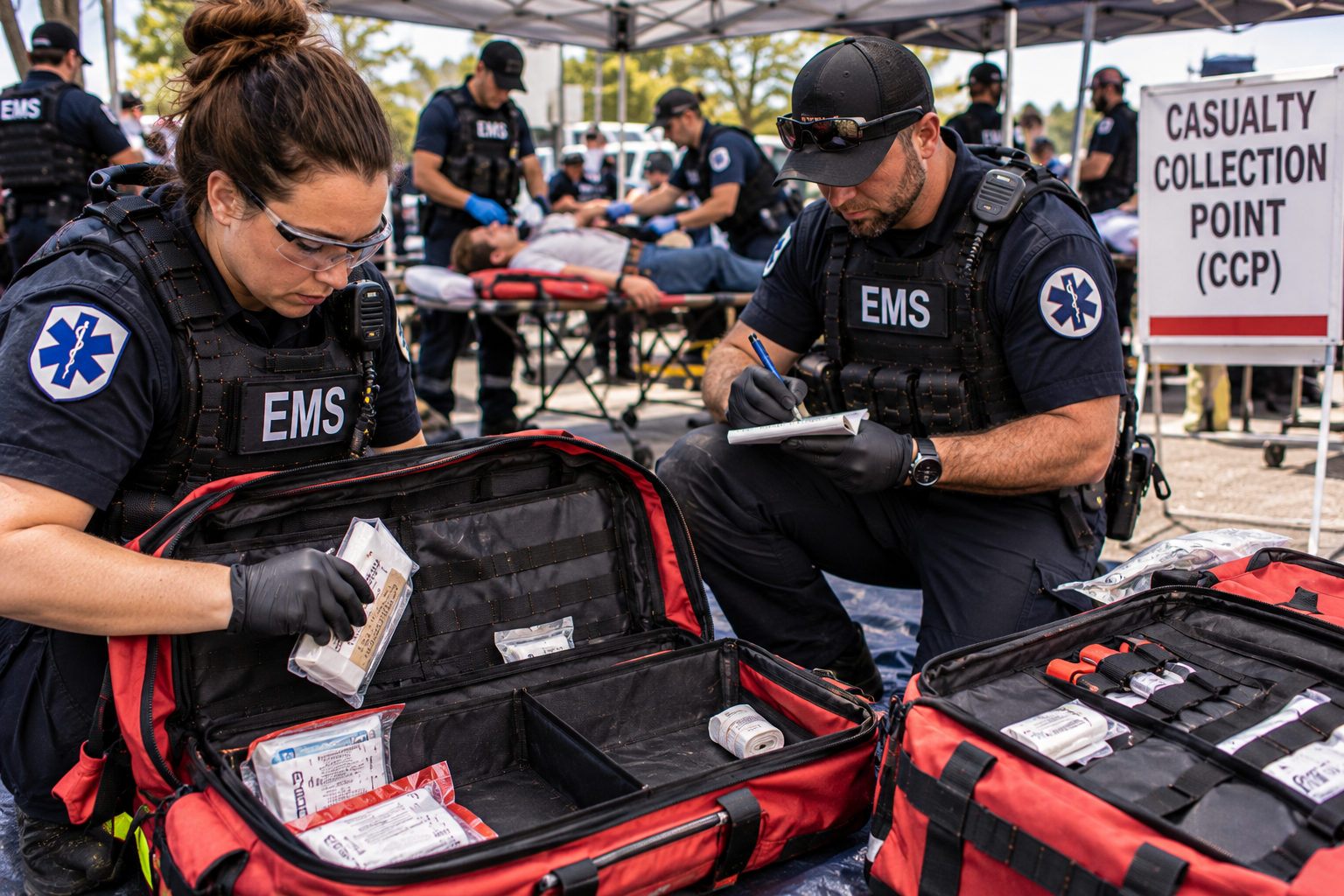
Casualty collection points are intended to organize chaos. They provide structure for triage, treatment, and evacuation. Yet CCPs are highly sensitive to resource flow. When medical supplies are misallocated, CCPs become chokepoints rather than accelerators of care.
Improper kit use contributes directly to CCP collapse. When responders arrive at CCPs having already expended their IFAKs on scene, the CCP inherits patients without the means to treat them effectively. Conversely, when trauma kits are consumed piecemeal outside of CCP structure—used without coordination or prioritization—CCPs are deprived of the resources they need to function.
The result is predictable: patients accumulate faster than they can be treated, reassessment is delayed, and evacuation priorities become distorted. CCPs shift from treatment nodes to holding areas, and preventable deterioration follows. This collapse is not due to poor triage decisions alone; it is driven by upstream failures in equipment discipline and resource allocation.
Effective CCP operations depend on deliberate kit roles. IFAKs preserve individual survivability. Trauma kits sustain CCP throughput. When these roles blur, flow collapses.
Early Resource Exhaustion and Increased Mortality
The relationship between early resource exhaustion and mortality is not abstract. Trauma physiology is unforgiving. Hemorrhage, airway compromise, and tension pneumothorax operate on timelines measured in minutes. When resources are exhausted early, delays compound rapidly.
Each delay increases the likelihood of shock, hypoxia, and irreversible injury. Even when evacuation eventually occurs, patients arrive in worse condition, requiring more intensive intervention and consuming additional downstream resources. Early exhaustion thus creates a feedback loop: depleted supplies lead to delayed care, which leads to sicker patients, which further strains the system.
Importantly, mortality increases not only among civilians but also among responders. A system that exhausts its medical resources early is less capable of protecting its own personnel. Injured responders without access to immediate care become additional casualties, further accelerating collapse.
This pattern has been observed repeatedly in after-action reviews. The lesson is consistent: early resource exhaustion is not a secondary concern. It is a primary driver of preventable death.
Planning That Assumes Scarcity, Not Abundance
One of the most damaging assumptions in mass casualty planning is the expectation of timely resupply. Plans often presume that additional ambulances, medical caches, or mutual aid resources will arrive quickly enough to offset early depletion. In reality, MCIs frequently overwhelm local capacity, delay access, and disrupt logistics.
Effective planning must therefore assume scarcity. This does not mean accepting inadequate resources; it means designing systems that function despite depletion. Scarcity-aware planning emphasizes redundancy, staged resources, and disciplined allocation from the outset.
This approach includes several key principles. First, trauma kits must be staged forward and early, not held in reserve. Second, IFAK use must be doctrinally constrained to preserve responder survivability. Third, CCP operations must be resourced deliberately, with clear authority over supply use. Fourth, training must condition responders to expect depletion and manage it proactively.
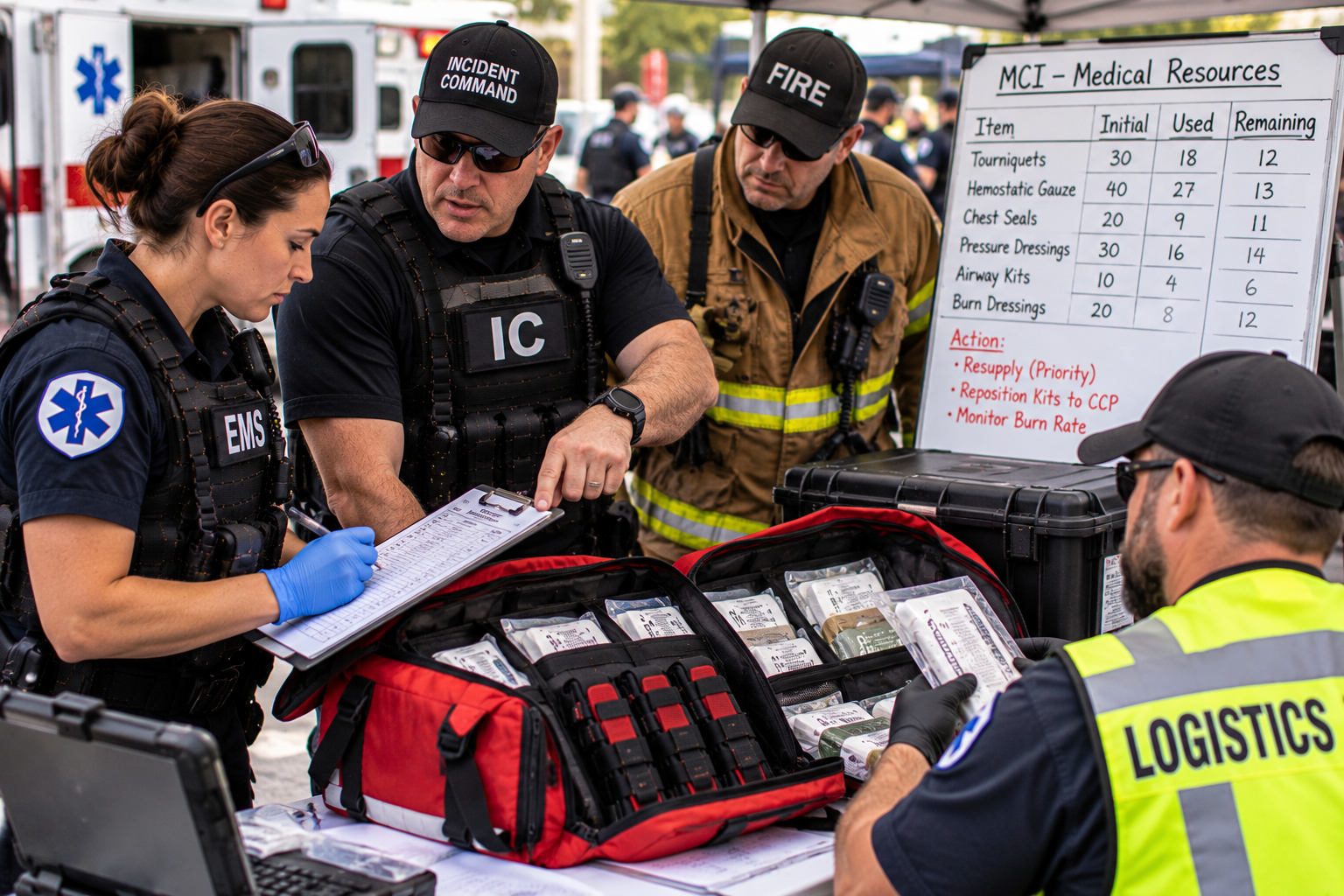
Assuming scarcity also reshapes leadership decision-making. Command must monitor not only patient counts but resource burn rates. Knowing how quickly tourniquets, gauze, and dressings are being consumed is as important as knowing how many casualties are present. This awareness allows for early adjustments rather than reactive scrambling.
Training for Depletion and Decision-Making Under Constraint
Resource exhaustion is as much a cognitive challenge as a logistical one. Under stress, responders default to familiar patterns. If training environments never simulate depletion, responders are unprepared to adapt when it occurs.
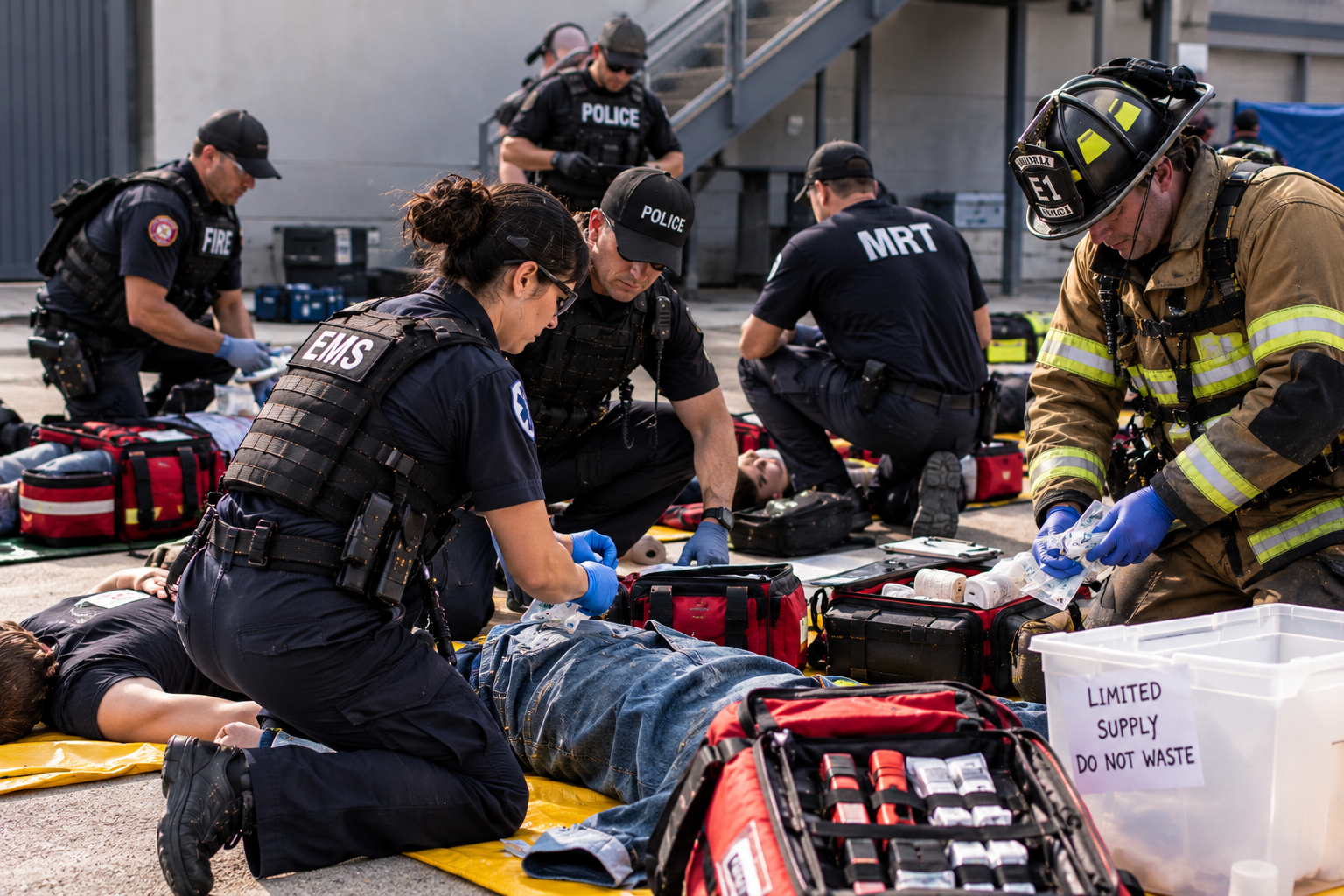
Training must therefore include scenarios where supplies run out, choices become constrained, and prioritization carries real consequences. These experiences recalibrate expectations and reinforce disciplined use of equipment. Repetition with variation—different casualty loads, delayed resupply, contested access—builds resilience rather than complacency.
Crucially, training should frame scarcity not as failure, but as a normal condition of MCIs. When responders expect scarcity, they make more deliberate choices. They preserve critical tools, coordinate more effectively, and communicate needs earlier. This mindset transforms depletion from a crisis into a managed variable.
System-Level Alignment and Interagency Implications
Resource exhaustion is rarely confined to a single agency. Law enforcement, fire, and EMS draw from overlapping pools of medical equipment and personnel. Without alignment, one discipline may exhaust resources in ways that cripple another.
Interagency planning must therefore establish shared expectations about equipment roles, staging, and priorities. Trauma kits intended for CCPs should not be cannibalized for ad hoc use without coordination. IFAKs should not be treated as communal resources during ongoing threats. These boundaries must be explicit and reinforced through joint training.
Unified command structures play a critical role here. Command must have visibility into medical resource status and authority to direct allocation across disciplines. Without this oversight, well-intentioned actions at the tactical level can undermine system performance.
Conclusion
Resource exhaustion in mass casualty incidents is not an anomaly; it is an inevitability unless systems are designed to anticipate and manage it. IFAKs deplete rapidly, trauma kits preserve care tempo, improper kit use collapses CCP flow, and early exhaustion increases mortality. These outcomes are predictable and repeatable—and therefore preventable.
Effective mass casualty planning assumes scarcity, preserves role clarity between medical assets, stages scalable resources early, and trains responders to operate under constraint. When systems align equipment, doctrine, and training with the realities of depletion, they sustain function longer, protect responders, and save more lives.
In MCIs, abundance is a myth. Discipline is the substitute.