Reinterpreting Fundamental Ideas in Modern Active Shooter Response
Reinterpreting Fundamental Ideas in Modern Active Shooter Response: From Singular Tactics to Civilian-Centered Mission Execution
Stopping the violence is necessary—but it is no longer sufficient. In modern active shooter incidents, outcomes hinge not only on how quickly the immediate threat is neutralized, but on how effectively responders transition to protecting life, managing casualties, and restoring community safety in parallel. This reality demands a reinterpretation of foundational ideas that have long shaped response doctrine. Tactics derived from military contexts—while valuable—must be examined through a civilian lens that accounts for legal authority, staffing realities, mixed-discipline operations, and the moral imperative to preserve life beyond threat suppression.
The central argument of this analysis is clear: modern active shooter response requires reinterpreting core tactical principles to support simultaneous civilian mission demands. By applying the science of listener attention—front-loaded relevance (primacy), structured cognitive chunking, progressive emphasis, repetition with variation, and continuous relevance anchoring—this article demonstrates how law enforcement can adapt threat-neutralization doctrine to enable casualty protection, coordinated operations, and community recovery without sacrificing speed or decisiveness.
Primacy: Why Reinterpretation Is Urgent
Front-loading relevance matters because active shooter incidents unfold at a tempo that punishes linear thinking. Historically, response models privileged a singular objective: stop the shooter. While this priority remains foundational, the moment the threat is disrupted, the mission expands—often within seconds. Casualties must be located and protected, medical access must be enabled, and secondary risks must be managed. Agencies that fail to anticipate this expansion lose time precisely when survivability depends on it.
This is not a critique of decisiveness; it is an argument for decisiveness with foresight. Reinterpreting tactics before incidents occur ensures that once violence is halted, responders can pivot immediately to life-preserving operations without doctrinal friction.
Section 1: Threat Neutralization as the Opening Move, Not the End State
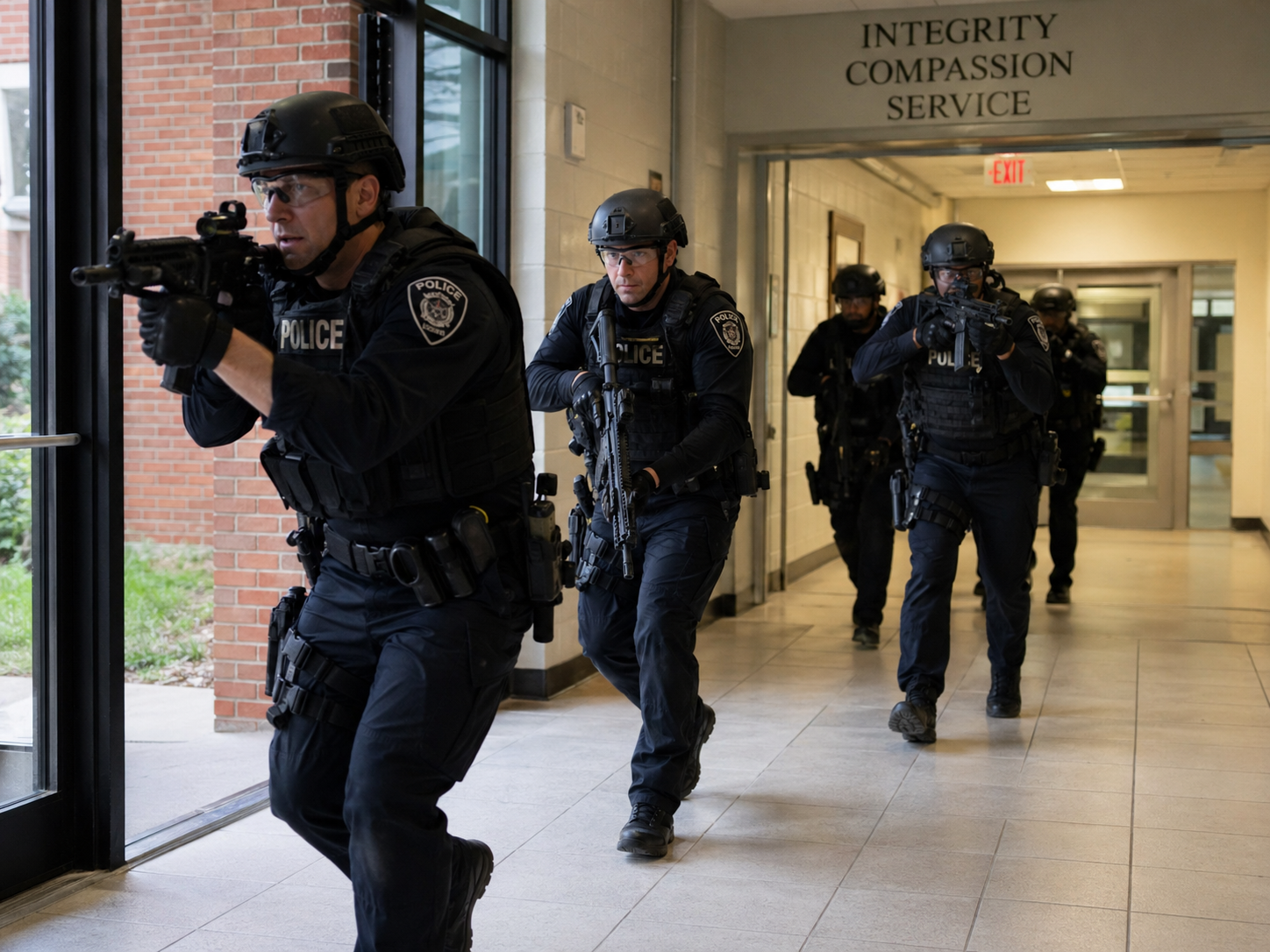
Law enforcement’s initial objective—to rapidly disrupt or neutralize the immediate threat—remains non-negotiable. Swift entry, movement toward the sound of violence, and decisive action save lives by halting further harm. Yet modern incidents demonstrate that neutralization is an opening move, not an end state.
Once the threat is disrupted, responders must avoid the trap of tactical fixation—continuing to operate as if threat suppression remains the sole priority. The environment shifts from singular danger to complex risk: wounded civilians, potential secondary threats, and chaotic movement patterns. Reinterpreting neutralization as a gateway rather than a conclusion allows teams to transition seamlessly into protection and stabilization tasks.
Repetition with variation reinforces this principle: stopping the shooter stops additional injuries; protecting the wounded determines who survives.
Section 2: Transitioning to Structured Follow-On Operations
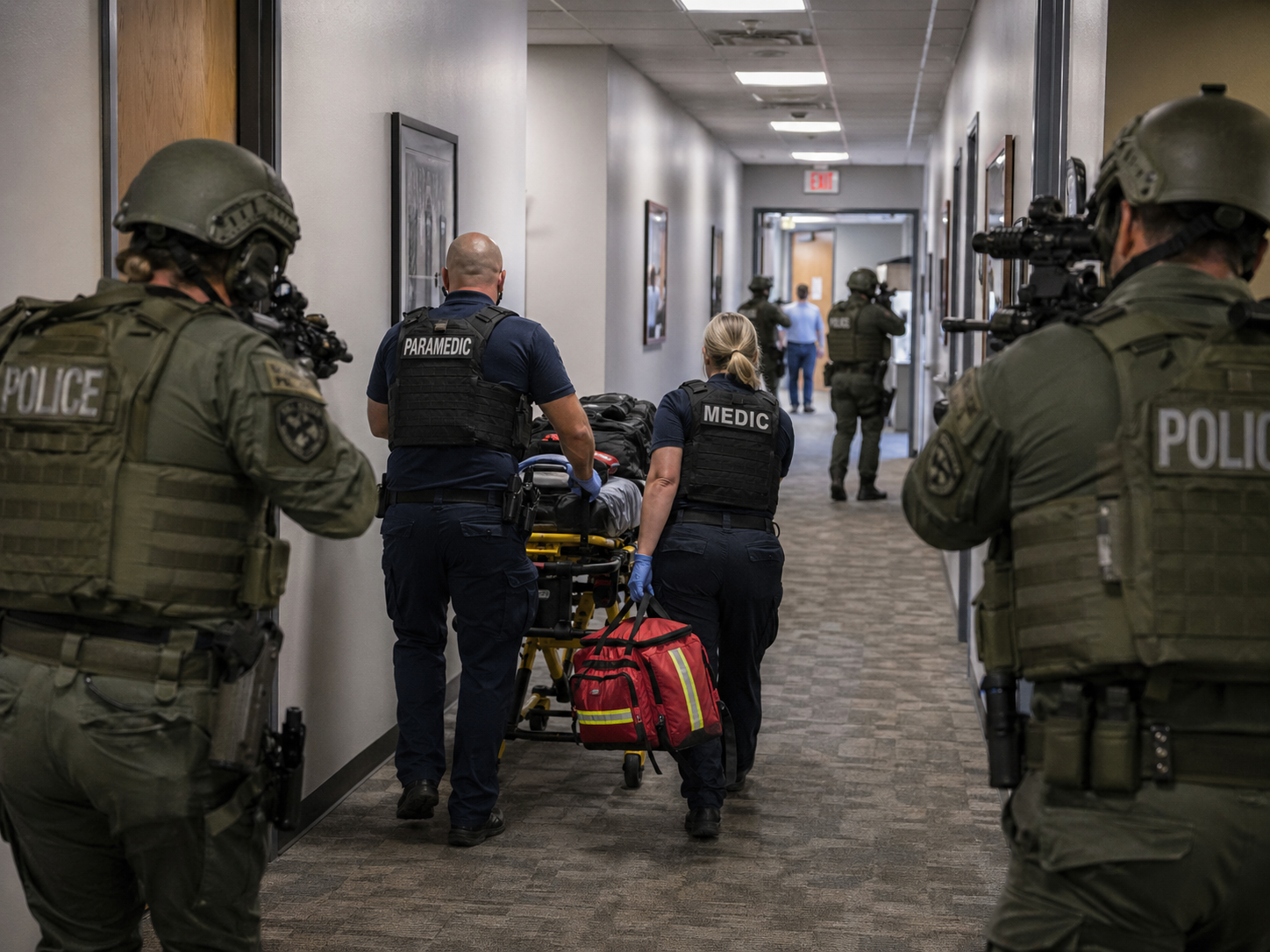
The post-disruption phase demands structure. Responders must locate casualties, establish protective corridors, and enable medical access—all while maintaining situational awareness. This transition cannot be improvised; it must be pre-planned and trained.
Structured follow-on operations include:
Rapid casualty identification and protection from residual hazards
Establishing zones and corridors that balance access and security
Coordinating with EMS and fire to accelerate life-saving care
Maintaining containment and overwatch to prevent re-escalation
The reinterpretation here is subtle but critical: tactics must be designed not only to move toward threats, but to create space for care. Teams that plan for this transition reduce hesitation and friction under stress.
Section 3: Personnel Density and the Reality of Parallel Objectives
Military-derived tactics often presume robust manpower and homogeneous training. Civilian agencies rarely enjoy these conditions. Active shooter response requires sufficient personnel to execute parallel objectives—threat control, casualty protection, coordination, and information management—simultaneously.
When staffing is limited, tactics that require extended clearing or prolonged dominance may inadvertently delay casualty access. Reinterpreting tactics through a civilian lens means asking hard questions:
Do our movement patterns free personnel for follow-on tasks?
Are we prioritizing actions that unlock medical access early?
Can our teams sustain multiple objectives without overextension?
Progressive emphasis underscores the point: tactics that monopolize personnel may win the contact but lose the outcome.
Section 4: Assessing Military-Derived Tactics Against Civilian Mission Demands
Military tactics are optimized for combat objectives, permissive rules of engagement, and unit cohesion. Civilian missions differ. They prioritize life preservation, legal accountability, and interagency coordination in public spaces.
Reinterpretation requires assessment—not rejection—of military-derived tactics. Agencies must evaluate whether specific techniques:
Align with civilian legal and policy constraints
Support rapid transition to casualty care
Scale appropriately with available staffing
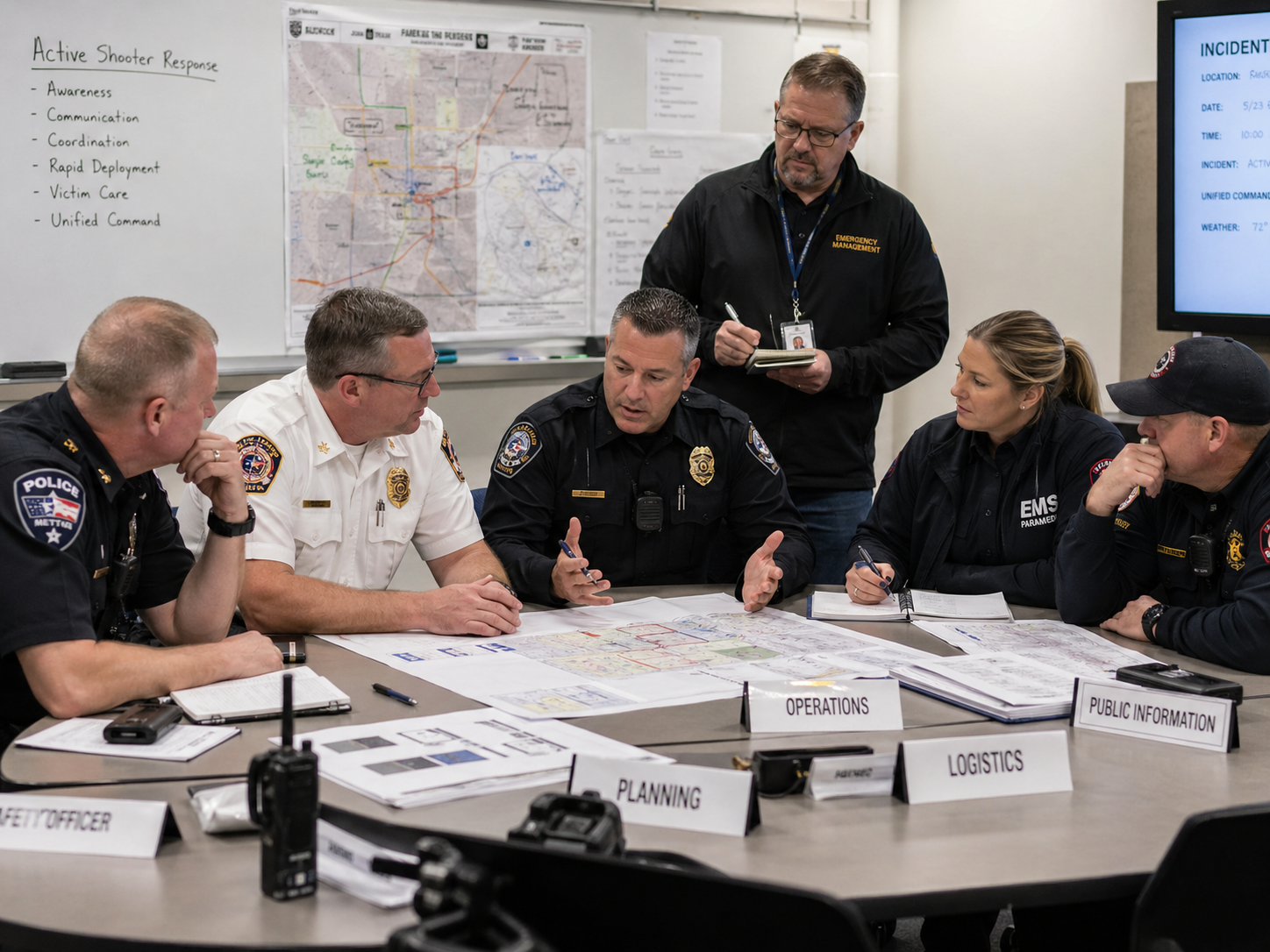
Integrate cleanly with EMS and fire operations
This assessment is not academic. It is operational risk management. Tactics that impede medical access or confuse interagency roles—even if tactically sound in isolation—must be modified or replaced.
Section 5: Contextual Understanding as the Anchor
Context is the anchor that prevents misapplication. Civilian environments include bystanders, complex architecture, media presence, and immediate public scrutiny. Responders operate under constitutional constraints and duty-of-care obligations absent from combat settings.
Interpreting tactics through this context ensures actions remain proportional and purposeful. For example, clearing strategies should prioritize routes to casualties, not exhaustive searches that delay care. Containment should focus on protecting access corridors, not achieving total dominance at the expense of time.
Continuous relevance anchoring keeps attention on the outcome: preserving life and restoring safety.
Section 6: Simultaneity as the Civilian Operational Standard
Modern response success depends on simultaneity—multiple objectives executed at once. Law enforcement continues threat management while medical operations begin; command synchronizes resources while information is validated; security expands as care advances.
This simultaneity demands tactics that enable rather than inhibit parallel action. Reinterpreting fundamentals means designing entry, movement, and positioning to support co-equal priorities. The result is not diluted focus, but amplified effectiveness.
Repetition with variation reinforces the idea: speed is multiplied when actions align; it is squandered when actions compete.
Section 7: Training for Reinterpretation, Not Memorization
Reinterpretation must be trained deliberately. Scenario-based training should stress the transition from neutralization to casualty protection, forcing teams to juggle objectives under realistic constraints. Exercises should ask participants to justify tactical choices based on civilian mission outcomes, not tradition.
Effective training emphasizes:
Decision points where priorities shift
Communication that clarifies intent across disciplines
Resource allocation under staffing limits
Metrics tied to casualty outcomes and time-to-care
This approach embeds reinterpretation into muscle memory, ensuring responders fall to the right defaults under stress.
Section 8: Command’s Role in Translating Tactics to Outcomes
Command structures must reinforce reinterpretation. Leaders set priorities, define acceptable risk, and arbitrate trade-offs between speed and access. When command language emphasizes life preservation alongside threat control, teams align accordingly.
Clear intent—communicated early and reinforced often—reduces ambiguity during transitions. Command that anticipates the expanded mission prevents the common failure mode of “winning tactically” while losing time for care.
Progressive Emphasis: From Winning the Fight to Winning the Outcome
Across these chunks, a progression emerges. First, neutralize the threat. Next, protect and locate casualties. Then, enable care and coordination. Finally, restore safety and confidence. Each step builds on the last; none can be skipped without consequence.
The reinterpretation of fundamentals does not weaken response—it completes it. By aligning tactics with civilian mission demands, agencies preserve what matters most: lives and legitimacy.
Conclusion
Modern active shooter response requires more than rapid threat neutralization; it requires tactical adaptation that supports parallel civilian objectives. Reinterpreting foundational ideas—through a civilian lens—ensures that tactics enable casualty protection, medical access, and coordinated operations without sacrificing speed or decisiveness.
When law enforcement evaluates military-derived tactics against civilian constraints and mission outcomes, response becomes more effective and humane. Actions remain focused on preserving life, stabilizing the environment, and restoring community safety.
In the end, the measure of success is not how quickly the threat was stopped alone, but how many lives were saved and how confidently safety was restored.