
Multi-Objective Law Enforcement Operations During High-Threat Incidents
Multi-Objective Law Enforcement Operations During High-Threat Incidents: Managing Simultaneity to Preserve Life and Accelerate Stabilization
High-threat incidents do not reward sequential thinking. In active shooter events and similarly dynamic threats, the environment evolves faster than any single discipline can act in isolation. Violence unfolds in minutes, casualties deteriorate in seconds, and operational decisions made early determine whether survivable injuries remain survivable. Yet many response models continue to treat law enforcement operations, medical access, and command coordination as separate phases rather than simultaneous imperatives. This mismatch between incident tempo and response structure remains one of the most persistent contributors to preventable harm.
The central premise of this analysis is that law enforcement operations during high-threat incidents must be deliberately multi-objective from the outset. Threat neutralization, space security, casualty access, and command integration are not competing priorities—they are interdependent ones. Applying the science of listener attention—front-loaded relevance (primacy), structured cognitive chunking, progressive emphasis, repetition with variation, and continuous relevance anchoring—this article examines how multi-objective execution improves survivability, reduces delay, and accelerates stabilization when compared to linear, single-mission approaches.
Why Multi-Objective Operations Are a Necessity, Not an Option
Front-loading relevance is essential because the cost of delay is physiological, not procedural. In high-threat incidents, the majority of preventable deaths result from uncontrolled hemorrhage, airway compromise, and rapid shock progression—conditions that worsen long before scenes are fully secured or specialized medical teams arrive. If law enforcement focuses exclusively on threat engagement without enabling concurrent medical access, the response system forfeits its most valuable resource: time.
Multi-objective operations acknowledge a fundamental truth: threat control alone does not save lives—time to care does. The earlier law enforcement integrates casualty considerations into tactical movement, the more survivability improves. This does not diminish the importance of neutralizing the threat; it reframes neutralization as the gateway to parallel life-saving action rather than the endpoint of response.
The Reality of Simultaneous Mission Demands
High-threat incidents impose multiple mission demands at once. Law enforcement must locate and disrupt the threat, prevent further harm, manage movement, and maintain situational awareness. At the same time, casualties require protection, identification, and rapid access to care. Command elements must synthesize incomplete information, allocate limited resources, and coordinate across disciplines. These demands do not wait their turn.
A multi-objective mindset replaces the question “What happens next?” with “What can begin now?” This shift aligns operations with reality. As soon as a space is controlled—even temporarily—medical access becomes possible. As soon as a corridor is established, evacuation planning can begin. Repetition with variation reinforces the lesson: partial control enables partial care, and partial care saves lives.
Law Enforcement’s Expanded Operational Role
In multi-objective operations, law enforcement functions not only as the mechanism of threat disruption, but also as the enabler of survivability. As officers move, clear, and contain, they create protected space that allows casualty care to begin. This expanded role does not dilute tactical focus; it increases mission effectiveness by ensuring that movement produces tangible life-saving outcomes.
Operationally, this includes:
Identifying areas of reduced threat probability suitable for care
Establishing temporary security sufficient for rapid intervention
Communicating access windows to command and medical partners
When officers understand that their movement directly enables medical intervention, tactical decisions naturally account for casualty access alongside threat suppression. The result is not slower movement, but movement with purpose.
Early CCP Establishment as a Force Multiplier
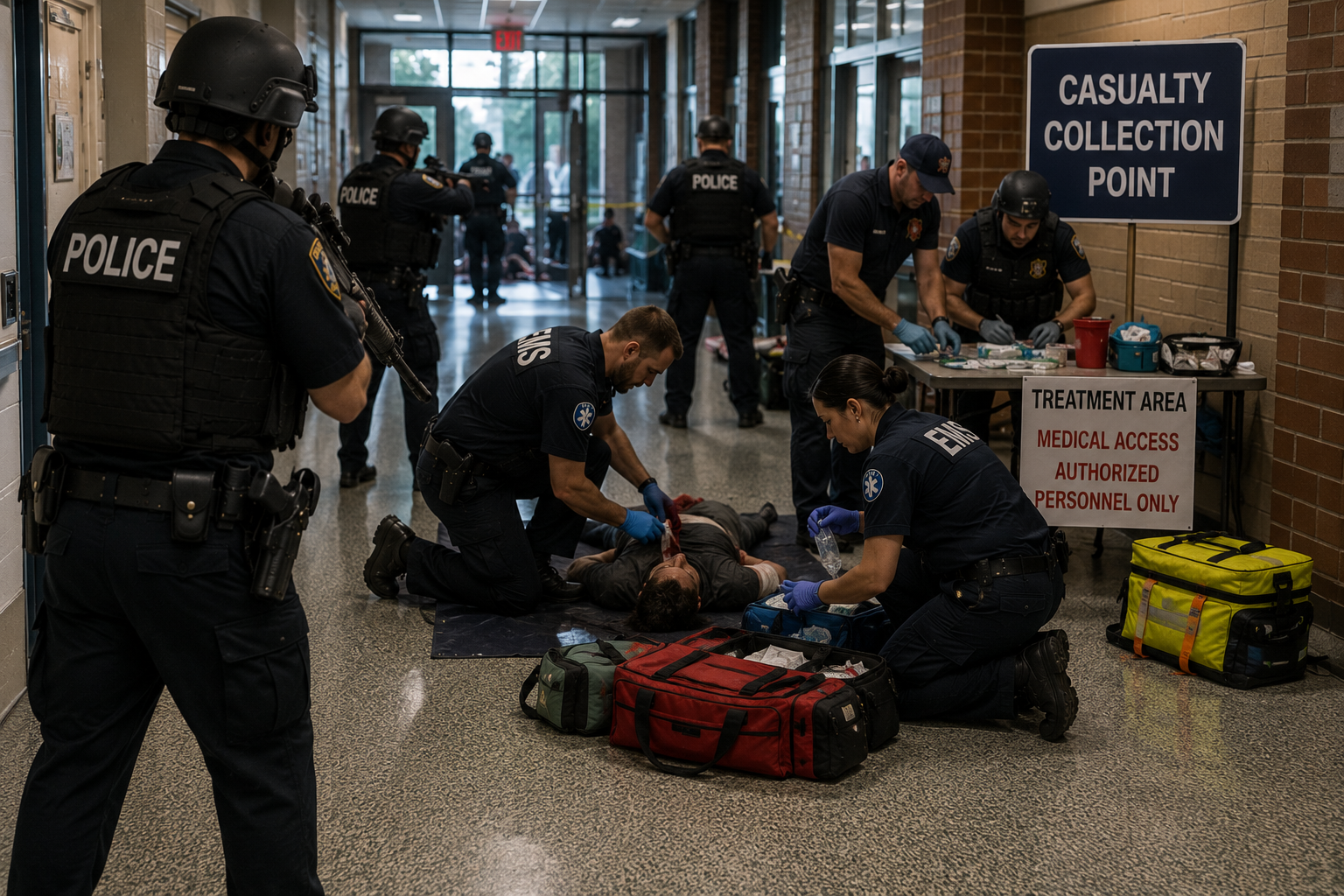
One of the most significant advantages of multi-objective execution is early Casualty Collection Point (CCP) establishment. Traditional models often delay CCP creation until full scene security is achieved, pushing care farther from the point of injury and extending time-to-treatment. Multi-objective operations invert this logic by establishing CCPs as soon as space allows.
Early CCPs may be austere and mobile, but their impact is disproportionate. Immediate hemorrhage control, airway positioning, and rapid triage can occur while the incident is still unfolding. Continuous relevance anchoring keeps focus on physiology: a minimally equipped CCP that exists early saves more lives than a fully equipped CCP that exists late.
Parallel Operations and Personnel Utilization
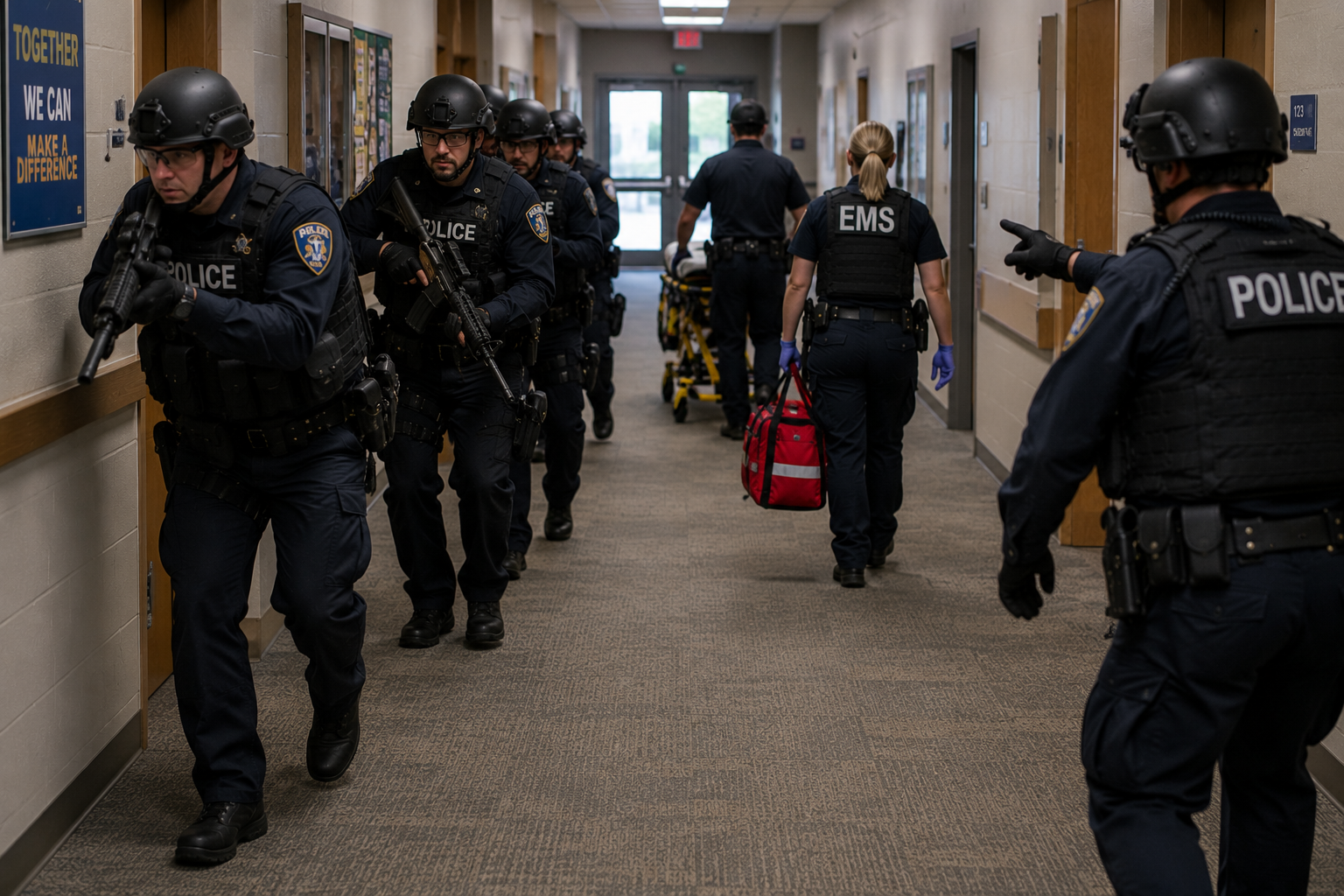
Effective multi-objective operations depend on parallel tasking across disciplines. Law enforcement, EMS, fire, and support elements must work simultaneously rather than sequentially, distributing tasks based on capability and proximity rather than organizational boundaries.
Examples include:
Law enforcement maintaining containment while escorting medical access
Fire personnel assisting with extraction while EMS initiates treatment
Command reallocating resources dynamically as conditions evolve
Parallel operations reduce idle time, prevent bottlenecks, and maintain momentum. Repetition with variation underscores the point: waiting for perfect conditions is more dangerous than acting under managed uncertainty.
Staffing Realities and Operational Sustainability
Multi-objective execution requires sufficient staffing and realistic task allocation. High-threat incidents often begin with limited personnel, making it critical that tactics scale appropriately. Strategies that monopolize all available officers for clearing operations may inadvertently delay casualty care and command functions.
Operational sustainability requires asking:
Can this tactic free personnel for parallel tasks?
Does it scale down without breaking under low staffing?
Can it be sustained as the incident evolves?
Progressive emphasis highlights the risk: a tactic that consumes all hands delays care, regardless of its tactical merit.
Tactical Flexibility in a Fluid Environment
High-threat incidents are inherently fluid. Threat locations change, casualty numbers increase, and access routes evolve. Multi-objective operations demand tactical flexibility—the ability to adjust priorities without losing alignment.
Flexibility includes:
Relocating CCPs as space expands or contracts
Reprioritizing casualties through dynamic triage
Modifying movement patterns to preserve access corridors
Rigid plans fracture under these conditions. Flexible execution preserves momentum and continuity of care, preventing operational paralysis when conditions shift.
Coordinating MRT Integration Without Delay
While dedicated medical teams may take time to deploy fully, multi-objective operations ensure that life-saving care does not wait for their arrival. Law enforcement and early-arriving personnel can initiate care, establish CCPs, and prepare the environment so MRTs integrate seamlessly upon arrival.
This requires:
Clear communication of CCP locations and access routes
Shared understanding of protection levels required for care
Command oversight to synchronize tactical and medical movement
Repetition with variation reinforces the concept: integration is fastest when preparation begins early.

Command as the Synchronization Engine
Multi-objective operations succeed only when command functions as a synchronization engine rather than a sequential gatekeeper. The Incident Command Post must identify opportunities for parallel action, authorize managed risk, and communicate intent clearly across disciplines.
Effective command:
Prioritizes life safety alongside threat control
Anticipates transitions rather than reacting to them
Adjusts objectives dynamically as information improves
By reinforcing shared priorities, command prevents divergence and ensures that parallel actions converge toward stabilization.
Survivability as the Primary Measure of Success
Traditional metrics often emphasize threat resolution alone. Multi-objective operations shift success metrics toward survivability. How quickly was care initiated? How many casualties received early hemorrhage control? How efficiently were patients moved toward definitive care?
Centering survivability aligns tactics with purpose. Decisions are judged not by tradition or optics, but by outcomes that matter to victims, responders, and communities.
From Linear Response to Integrated Action
Across these cognitive units, a clear progression emerges. Linear models delay care. Parallel models compress time. Compressed time saves lives. This logic is cumulative and unavoidable. Multi-objective operations are not a conceptual preference; they are an operational necessity dictated by incident tempo and human physiology.
Continuous Relevance Anchoring: Stabilization Through Simultaneity
The ultimate objective of high-threat response is stabilization—of the threat, the casualties, and the community. Simultaneous action accelerates this process. When threat control, space security, medical access, and command integration advance together, chaos shortens and recovery begins sooner.
Conclusion
Multi-objective law enforcement operations are essential to effective high-threat response. Managing simultaneous mission elements—threat control, space security, early CCP establishment, and coordinated medical access—aligns response systems with the realities of modern incidents. Sequential models cannot keep pace with the speed at which casualties deteriorate or threats evolve.
By embracing tactical flexibility, parallel tasking, and survivability-focused metrics, law enforcement and partner agencies dramatically improve outcomes for victims and responders alike. The science of listener attention reinforces what operational experience confirms: what begins early matters most, what happens together matters more, and what remains relevant saves lives.