Non-SWAT Operations in Warm and Hot Zones
Non-SWAT Operations in Warm and Hot Zones
In contemporary high-threat incidents, the distinction between “tactical” and “non-tactical” responders collapses quickly. Firefighters and EMS personnel are no longer operating solely on the periphery of violence, awaiting a clear declaration of safety before engaging. Instead, they increasingly find themselves operating under threat—sometimes deliberately, sometimes by necessity, and often without the training, equipment, or cultural preparation required to survive and function effectively in those environments. This reality demands a recalibration of how public safety systems conceptualize non-SWAT operations in warm and hot zones.
The central premise of this analysis is straightforward: non-SWAT responders are already operating in contested environments, whether doctrine acknowledges it or not. Survival and effectiveness in these spaces depend on movement discipline, use of cover, appropriate protective equipment, and—most critically—a training and cultural framework that normalizes tactical integration rather than resisting it. Hesitation does not arise from lack of courage; it arises from lack of preparation. Training resolves hesitation by replacing uncertainty with competence.
Fire and EMS Increasingly Operate Under Threat
The traditional assumption that fire and EMS operate only after threats are neutralized no longer reflects operational reality. Active shooter incidents, hybrid attacks, and rapidly evolving violent events compress timelines to the point where medical and rescue actions must occur while hazards persist. In many incidents, the threat is mobile, partially contained, or intermittently active, creating conditions where “secure” is neither absolute nor enduring.
Fire and EMS are already entering these environments—sometimes to perform rescue, sometimes to assist law enforcement, and sometimes simply because casualties are inaccessible otherwise. Even when responders stage outside, secondary threats, perimeter instability, and uncontrolled movement by victims and bystanders bring risk to their location. The boundary between safe and unsafe space becomes fluid rather than fixed.
This shift exposes a critical mismatch between doctrine and practice. Responders are operating under threat without a corresponding evolution in training, equipment, or expectation. When doctrine denies reality, responders are forced to improvise under stress, often defaulting to avoidance rather than managed engagement. The result is delayed care, increased mortality, and preventable risk to responders themselves.
Movement and Cover Skills Are Essential
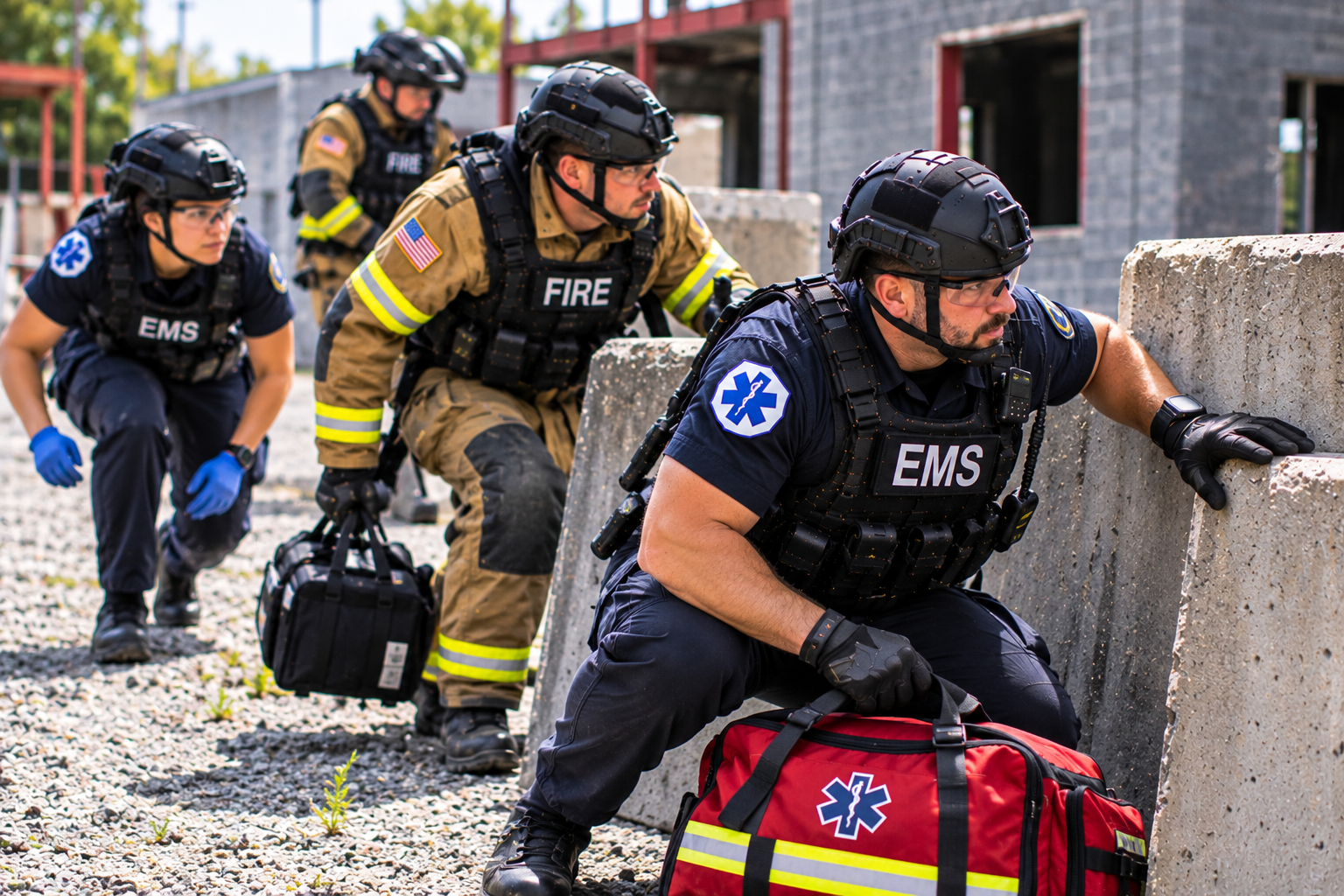
Operating in warm and hot zones is not defined by aggressive tactics; it is defined by disciplined movement. For non-SWAT responders, the ability to move deliberately, minimize exposure, and exploit cover is foundational to survivability. These skills are not intuitive, nor are they interchangeable with routine fireground or medical movement patterns.
Untrained movement in a threat environment magnifies risk. Standing upright in open spaces, clustering near doorways, lingering in fatal funnels, or moving without situational awareness exposes responders to hazards they are neither prepared nor equipped to manage. Conversely, basic instruction in movement techniques—spacing, angles, bounding, use of cover, and rapid assessment of exposure—dramatically reduces vulnerability.
Importantly, these skills do not require responders to adopt law enforcement roles. They are defensive competencies designed to allow medical and rescue tasks to occur under imperfect conditions. Just as firefighters learn to read smoke and structure stability, non-SWAT responders must learn to read threat space. Movement becomes a form of risk mitigation rather than risk creation.
PPE Gaps Limit Survivability
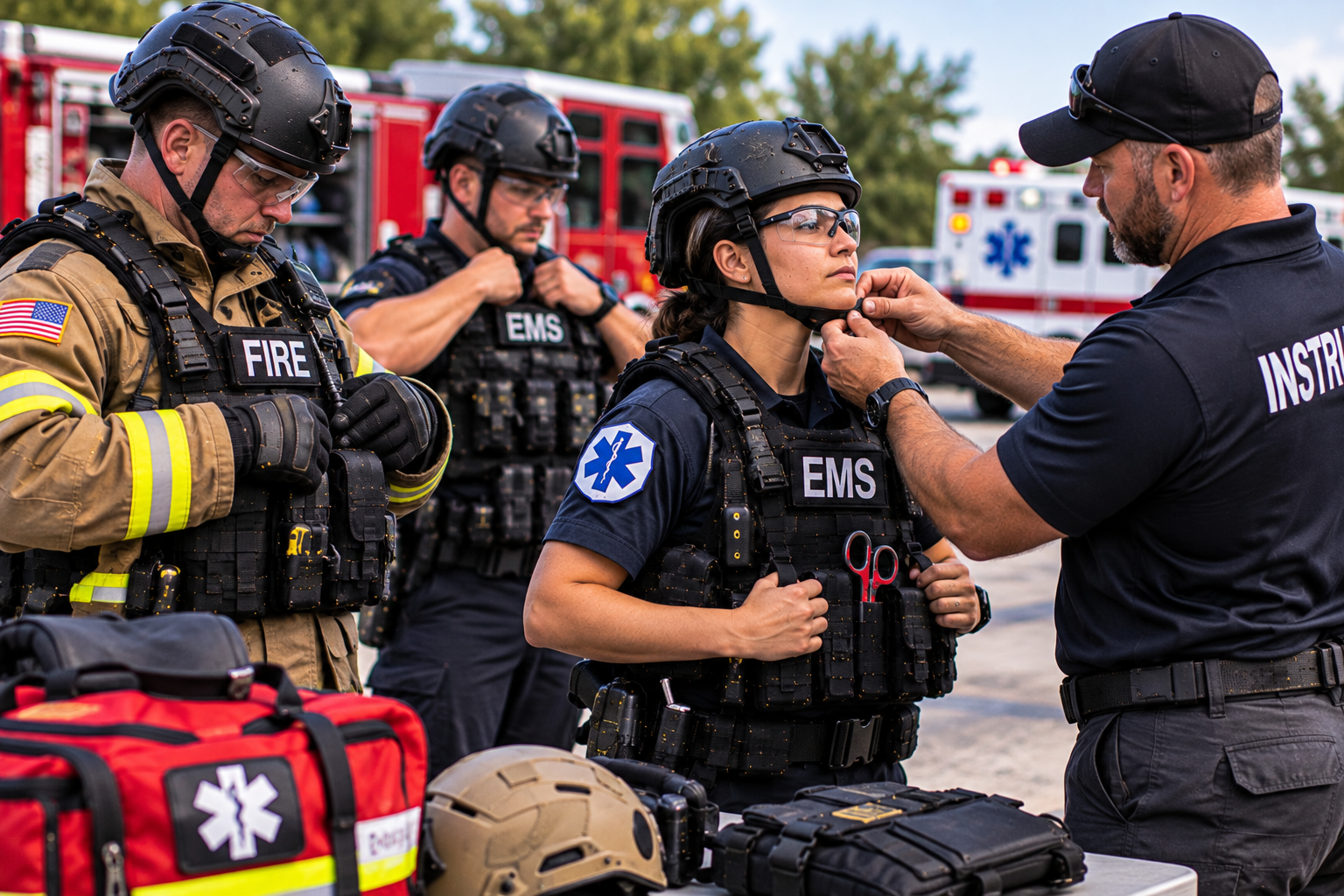
Protective equipment is the physical boundary between responders and injury. Yet in many jurisdictions, non-SWAT personnel lack adequate PPE for operating in environments where ballistic or blast threats exist. This gap undermines both safety and confidence.
The absence of appropriate PPE—such as ballistic helmets, armor, eye protection, and identification markings—forces responders into an impossible calculus: accept unacceptable personal risk or delay care entirely. Neither option is operationally sound. When responders feel unprotected, hesitation increases, movement slows, and coordination degrades. Even when entry is authorized, lack of PPE amplifies stress and cognitive load, reducing performance.
PPE is not a guarantee of safety, but it is an enabler of action. Its presence signals institutional recognition of risk and commitment to responder survivability. Its absence communicates the opposite. Bridging this gap requires policy decisions that acknowledge warm and hot zone operations as legitimate missions for non-SWAT personnel, rather than exceptional anomalies.
Cultural Resistance to Tactical Integration
Perhaps the most significant barrier to effective non-SWAT operations in contested environments is cultural rather than technical. Many fire and EMS organizations maintain a deeply ingrained identity rooted in neutrality, rescue, and post-threat response. Tactical integration is often perceived as mission creep, militarization, or abandonment of traditional values.
This resistance is understandable, but it is increasingly untenable. Culture shapes behavior under stress more powerfully than policy. When responders are taught—implicitly or explicitly—that tactical considerations are “not their job,” they hesitate when confronted with reality that contradicts that belief. This hesitation is not a failure of character; it is a predictable outcome of cultural conditioning.
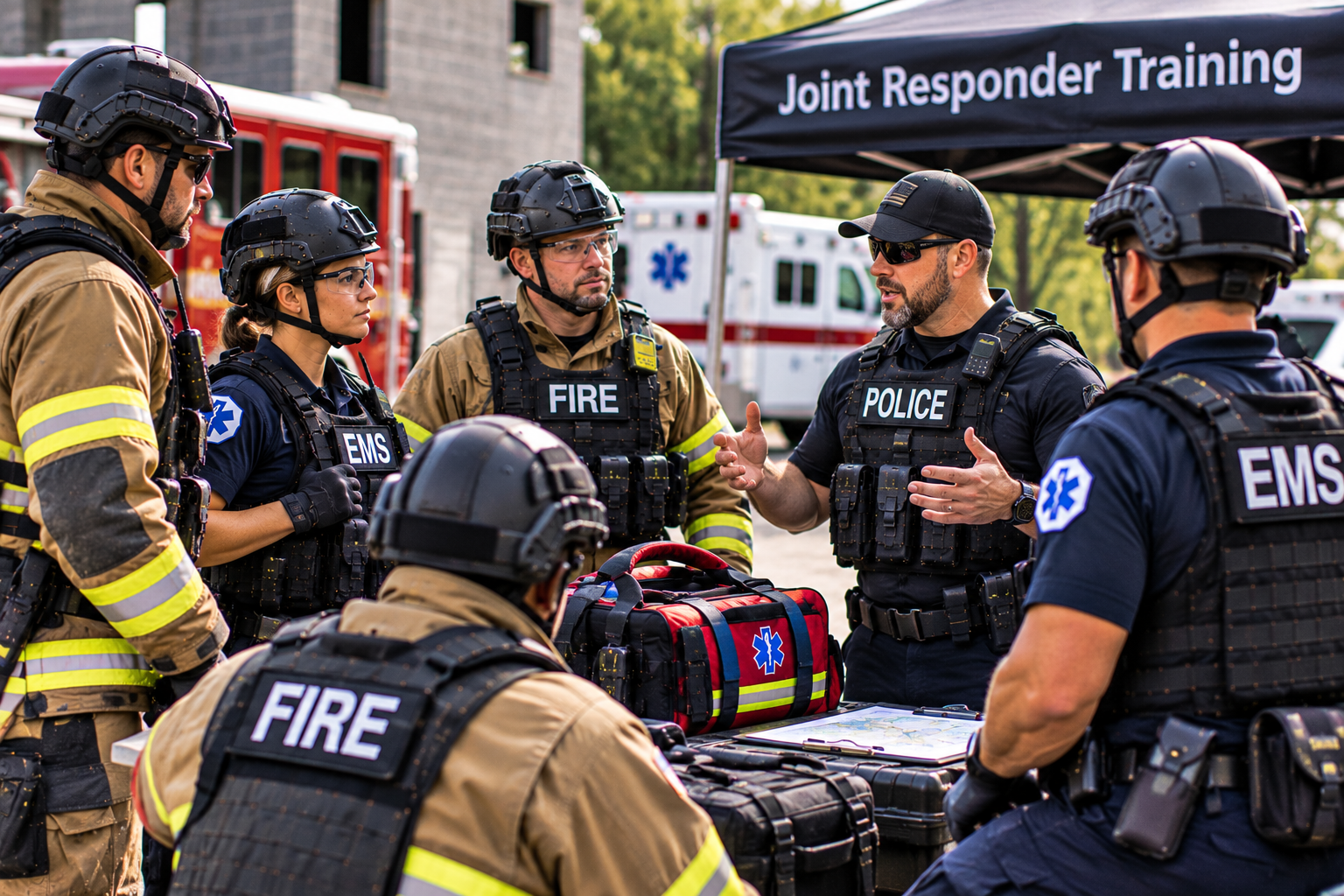
Cultural resistance also manifests in training silos. Fire and EMS train separately from law enforcement, reinforcing divergent mental models of the same incident. When integration is attempted during real events, the lack of shared expectations produces friction, confusion, and delay. Overcoming this resistance requires reframing tactical integration not as role replacement, but as role preservation. Survivability skills protect the ability to provide care; they do not redefine the mission.
Training Resolves Hesitation
Hesitation in high-threat environments is often misattributed to fear. In reality, hesitation most often arises from uncertainty. When responders are unsure of what they are allowed to do, how to move, or how to protect themselves, inaction becomes the default. Training resolves hesitation by replacing ambiguity with structured decision-making.
Effective training for non-SWAT warm and hot zone operations must be realistic, interdisciplinary, and repetitive. Classroom instruction alone is insufficient. Responders must practice movement, communication, casualty access, and withdrawal under simulated threat conditions. Scenarios should reflect incomplete information, evolving hazards, and imperfect protection, mirroring the conditions responders will face.
Equally important is command-level training. Leaders must be prepared to authorize managed risk and support decisions made under uncertainty. When responders believe they will be punished for acting within trained parameters, hesitation persists regardless of skill level. Training must therefore align tactical competence with institutional trust.
Risk Management, Not Risk Elimination
A persistent misconception surrounding non-SWAT operations in contested environments is the belief that the goal is to eliminate risk. In high-threat incidents, risk cannot be eliminated—only managed. Attempting to remove all risk before acting simply transfers risk from responders to casualties.
Managed risk involves continuous assessment, communication, and adjustment. It recognizes that conditions change and that safety is provisional rather than absolute. Non-SWAT responders trained in this mindset are better equipped to make nuanced decisions about when to advance, when to pause, and when to withdraw.
This approach aligns with how other public safety disciplines already operate. Firefighters enter unstable structures based on risk-benefit analysis. Law enforcement advances toward threats with incomplete information. Extending similar reasoning to medical and rescue operations is not radical; it is consistent with existing professional norms.
Operational and Ethical Implications
The failure to prepare non-SWAT responders for warm and hot zone operations has both operational and ethical consequences. Operationally, delayed medical access increases preventable deaths and prolongs incidents. Ethically, asking responders to enter contested environments without training or protection violates the duty of care owed to them by their organizations.
Conversely, equipping responders with skills, PPE, and doctrine that acknowledge reality respects both responder safety and patient survivability. It affirms that saving lives—including the lives of responders—requires preparation for the environments in which harm actually occurs.
Conclusion
Non-SWAT operations in warm and hot zones are no longer exceptional; they are inevitable. Fire and EMS personnel are already operating under threat, often without the tools, training, or cultural support required to do so safely and effectively. Movement and cover skills are essential. PPE gaps undermine survivability. Cultural resistance delays adaptation. Training resolves hesitation.
The path forward is not to turn non-SWAT responders into tactical operators, but to equip them as survivable professionals capable of functioning in contested spaces. When responders are trained, protected, and culturally supported, care can move forward with purpose rather than pause in uncertainty.
In modern high-threat incidents, readiness is not defined by waiting for perfect safety. It is defined by the ability to act decisively, deliberately, and together—where the need is greatest and the time is shortest.