
Point-of-Injury Care and the Gaps in Traditional Response Models
Introduction
In high-threat, time-compressed incidents, survivability is determined not by how efficiently casualties are evacuated, but by how quickly life-saving care reaches the point of injury. Hemorrhage does not pause during movement. Airways do not stabilize while patients are carried. Shock does not wait for a Casualty Collection Point (CCP) to be established. Yet for decades, traditional response models have been built around a single assumption: patients must be moved to care before care can begin. In dynamic threat environments, this assumption is no longer merely outdated, it is lethal.
The central argument of this analysis is clear: legacy evacuation-first medical models introduce avoidable delays, increase exposure to secondary threats, and contribute directly to preventable mortality. By contrast, point-of-injury care—delivered by tactically integrated Medical Rescue Teams (MRTs) within the Hot Zone—aligns medical action with both human physiology and modern threat dynamics. Within the Chaos–Stabilization–Recovery (CSR) framework, this shift corrects long-standing operational deficiencies while remaining fully consistent with Tactical Emergency Casualty Care (TECC) principles.
The Legacy Evacuation Paradigm: How CCPs Became the Default
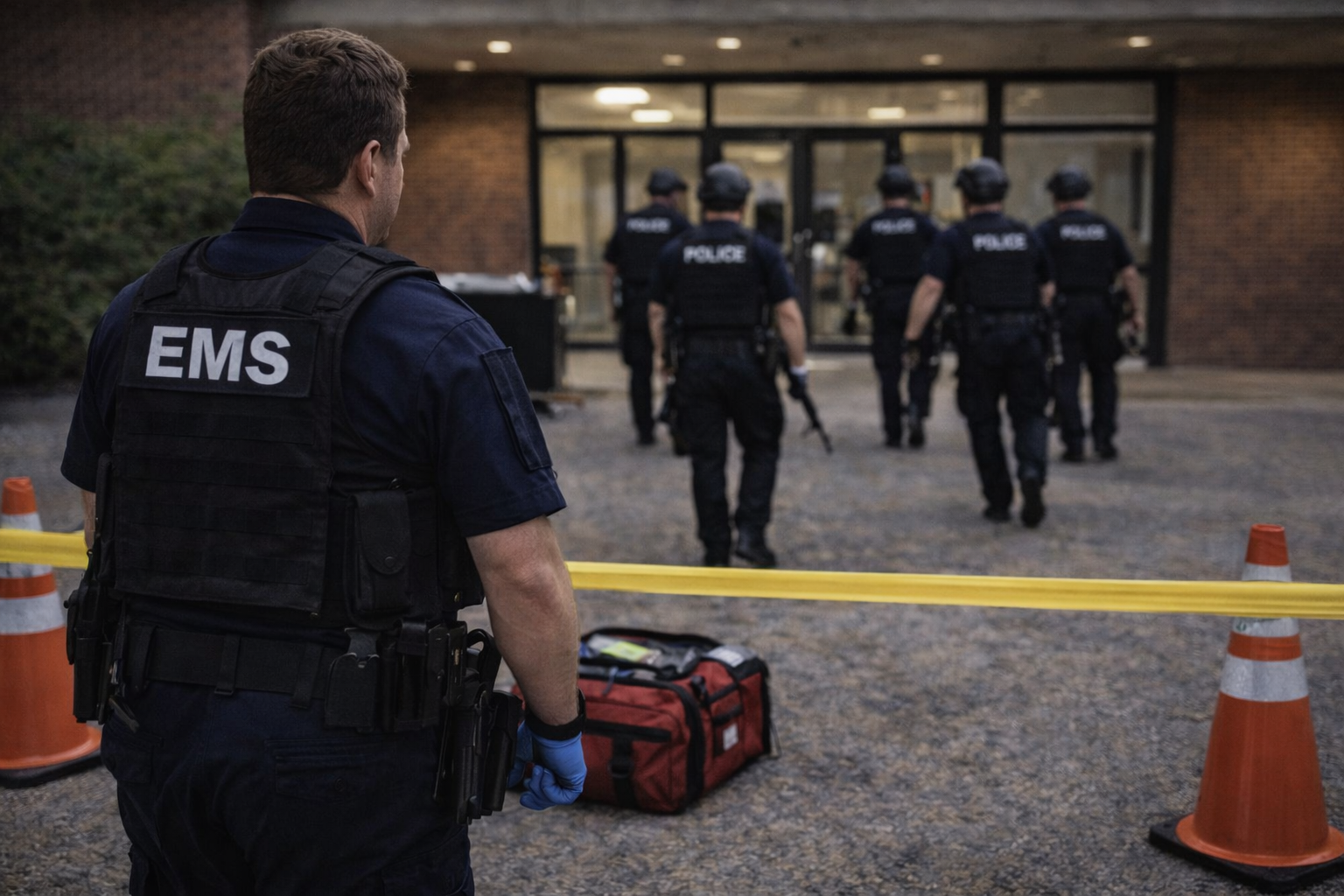
Traditional civilian EMS response evolved in environments defined by relative safety, predictable hazards, and linear incident progression. In these contexts, moving patients to a CCP before treatment was logical. Centralization improved efficiency, simplified triage, and protected providers from unnecessary risk. CCPs became the organizing hub of medical response.
Over time, this model hardened into doctrine. Treatment began after evacuation. Medical action was downstream of security. Care followed clearance. In low-threat or accidental incidents, this sequence worked. In intentional violence and dynamic threats, it does not.
The problem is not the existence of CCPs—it is their misplaced priority. When CCPs become prerequisites for care rather than transition points after life-saving intervention, they delay treatment during the most survivable window.
Physiological Reality: Why Delays Kill
Trauma physiology is indifferent to operational convenience. The leading causes of preventable death in violent incidents—uncontrolled hemorrhage, airway compromise, and tension physiology—progress rapidly and predictably. The effectiveness of simple interventions declines sharply with time.
A tourniquet applied early saves lives; applied late, it saves none.
Airway positioning prevents hypoxia early; delayed, it cannot reverse injury.
Shock worsens with each minute of untreated bleeding.
Legacy evacuation strategies often require casualties to be moved before these interventions occur. During movement, bleeding continues, airways obstruct, and shock accelerates. By the time a CCP is reached, the opportunity for survival has narrowed or closed entirely.
This is the core failure of evacuation-first models: they prioritize geography over physiology.
Excessive Movement as a Source of Harm
Beyond delay, excessive casualty movement introduces additional risk. In dynamic threat environments, movement itself is hazardous. Carrying or dragging patients through unsecured or partially secured areas increases exposure to secondary threats, including additional attackers, explosive hazards, and environmental dangers.
Medically, movement worsens outcomes. Uncontrolled hemorrhage intensifies with motion. Fractures destabilize. Airway compromise worsens. Hypothermia accelerates. Each transfer compounds deterioration.
Operationally, movement consumes time, personnel, and attention. Responders focused on evacuation are diverted from threat awareness and scene control. The system becomes reactive, not adaptive.
These harms are not incidental—they are structural consequences of a model that delays care until after movement.
Cognitive Anchoring and the Persistence of CCP Reliance
The endurance of CCP-centric models is not a failure of evidence, but of cognition. What responders learn first—and practice most often—becomes their default under stress. For generations, EMS education has emphasized evacuation as the gateway to care. Under pressure, responders revert to this pattern, even when it conflicts with reality.
Listener-attention science explains this persistence. Primacy anchors behavior. If care is framed as something that happens later, responders will delay it. Repetition without correction reinforces the error. Good intentions do not overcome ingrained habits.
Correcting this requires deliberate reframing and repetition with variation—training that places responders in environments where movement without care clearly worsens outcomes. Only then does the mental model shift.
Point-of-Injury Care: Reversing the Sequence
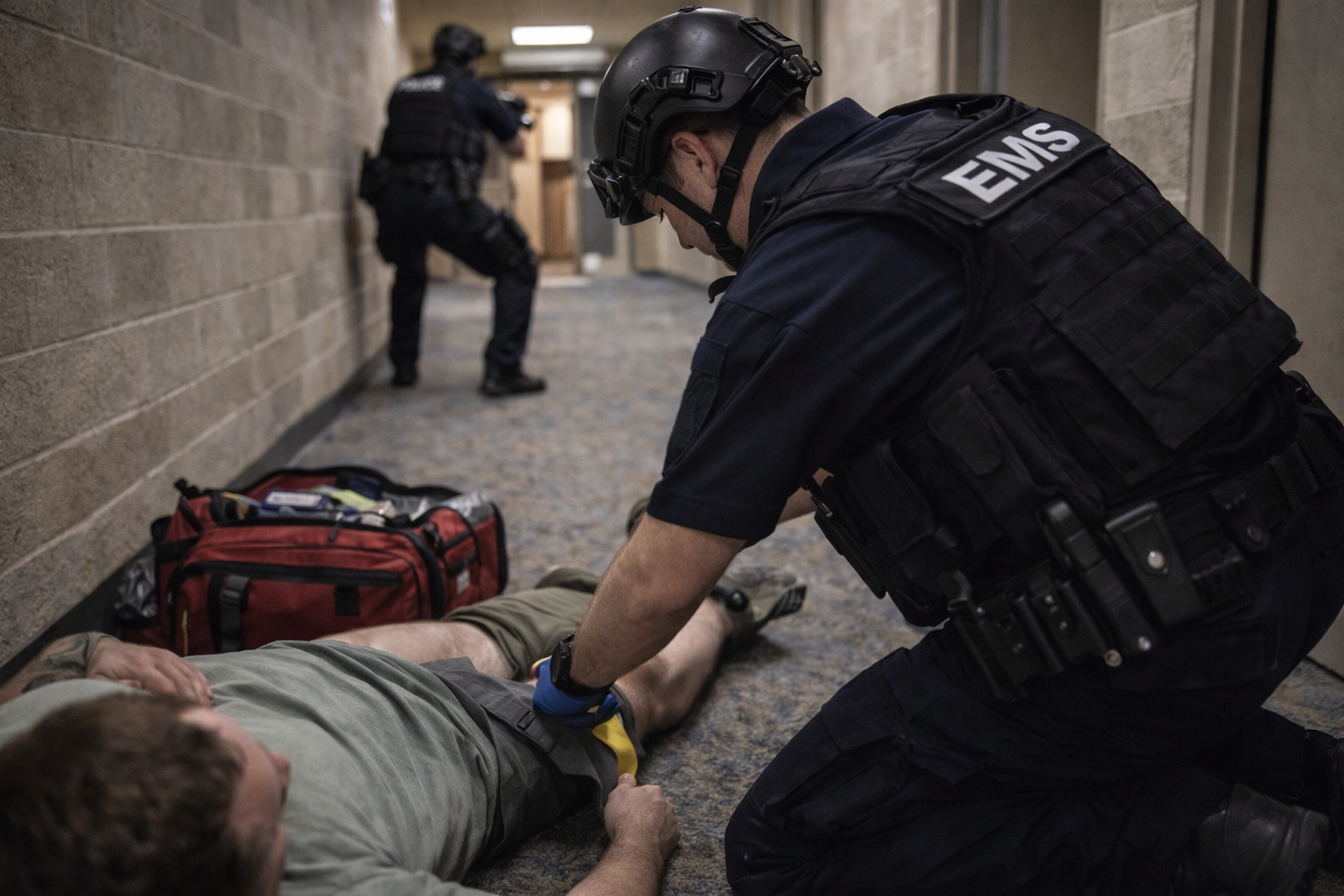
Point-of-injury care inverts the legacy sequence. Instead of moving patients to care, care moves to patients—as early as threat conditions allow. This approach prioritizes immediate hemorrhage control, airway management, and rapid triage before evacuation.
The objective is not definitive care, but physiological interruption of death. These interventions stabilize patients enough to survive movement. They shorten extraction timelines by preventing deterioration during transit.
This model recognizes a fundamental truth: evacuation without stabilization is not rescue—it is displacement.
MRT Deployment: Filling the Operational Gap
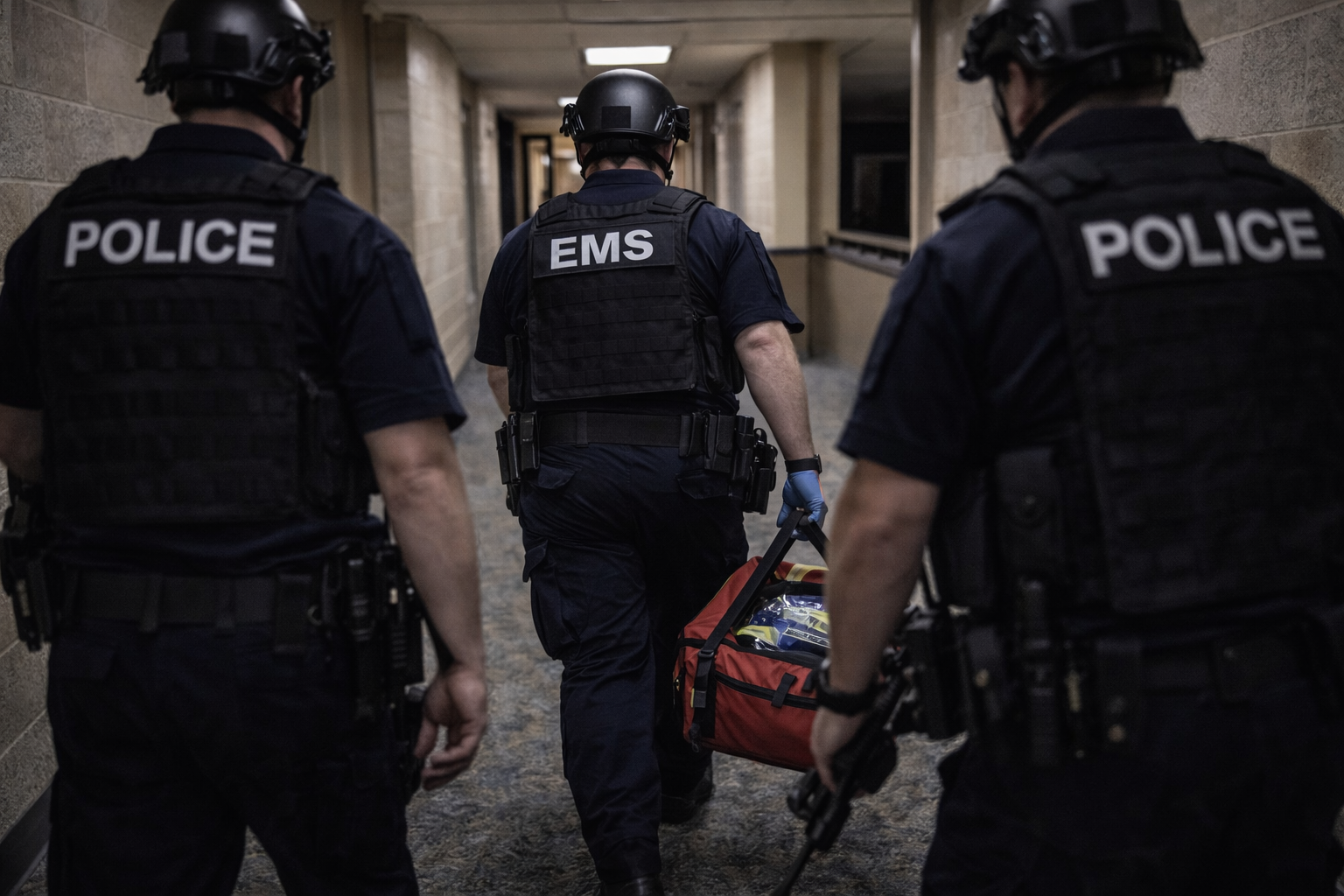
Medical Rescue Teams exist to operationalize point-of-injury care under threat. MRTs are tactically trained, equipped, and integrated to move with law enforcement and deliver life-saving interventions inside the Hot Zone.
Unlike traditional EMS units, MRTs are not staged at distance awaiting clearance. They are positioned forward, embedded within managed-risk operations. Their mission is narrow but critical: control hemorrhage, manage airways, triage rapidly, and facilitate movement.
MRTs fill the exact gap created by CCP-dependent models. They remove the delay between injury and care, transforming the Hot Zone from a place of unavoidable death into a space where survivability is actively preserved.
TECC Alignment: Doctrine Without Delay
Point-of-injury care within CSR aligns directly with TECC’s Direct Threat Care (DTC) principles. TECC recognizes that during active threats, care must be limited, rapid, and focused on interventions that save lives immediately.
CSR builds on this foundation by addressing the operational mechanics TECC assumes but does not fully define. It integrates MRT deployment, Warm Zone staging, and command synchronization to ensure DTC is not merely theoretical, but executable.
Where legacy models delay DTC until after evacuation, CSR embeds it at the point of injury—correcting the gap between doctrine and practice.
Operational Benefits of Point-of-Injury Care
The benefits of point-of-injury care compound rapidly:
Reduced time-to-intervention, the strongest predictor of survival
Improved casualty stability, enabling safer extraction
Decreased secondary exposure, limiting movement through unsecured space
Sustained operational momentum, as responders are not consumed by evacuation logistics
These benefits are not marginal. They directly translate into fewer preventable deaths and smoother transition into stabilization and recovery.
Command and Coordination: Making Early Care Possible
Point-of-injury care does not occur spontaneously; it requires command endorsement and coordination. The Incident Command Post must prioritize parallel operations, allowing medical action to occur alongside threat management rather than after it.
This requires predefined triggers for MRT movement, shared risk language, and leadership willing to authorize managed risk in pursuit of survivability. When command structures delay medical action awaiting certainty, the system reverts to evacuation-first failure.
Effective command enables early care by trusting trained teams to act within defined parameters.
Training Implications: Rewriting the Default
Shifting from CCP-first to point-of-injury care demands training that mirrors reality. Scenarios must deny early evacuation and force responders to confront the consequences of delay. Repetition with variation—different environments, threat profiles, and casualty loads—builds adaptive competence.
Training must reinforce a simple sequence:
Stop life-threatening problems where they occur.
Then move the patient.
When this sequence is practiced consistently, it becomes automatic under stress.
Progressive Emphasis: Time Over Terrain
Across every layer of this discussion, one principle returns: time matters more than location. CCPs are not inherently flawed; their misuse is. When they delay care, they kill. When they follow early intervention, they support recovery.
CSR’s emphasis on point-of-injury care realigns response with physiology, threat dynamics, and human performance. It replaces waiting with action and movement with meaning.
Conclusion
Legacy CCP-based response models were built for environments that no longer define modern high-threat incidents. By requiring evacuation before care, they delay life-saving interventions, increase exposure to secondary threats, and contribute to preventable mortality.
Point-of-injury care—delivered by MRTs within the Hot Zone—corrects these deficiencies. Within the CSR framework, it aligns operational reality with TECC doctrine and human physiology, ensuring care begins when it matters most.
Lives are not saved at collection points. They are saved where people fall.