
Public Education and Community Preparedness
Public Education and Community Preparedness
In modern acts of mass violence, the public is no longer a passive population awaiting rescue. Civilians are often the first witnesses, the first reporters, and—critically—the first caregivers. In the minutes before law enforcement, fire, or EMS can arrive and deploy, bystanders determine outcomes. This reality reframes community preparedness from a public-relations concept into an operational necessity. Educating the public is not ancillary to response; it is an extension of the response system itself.
This analysis argues that public education and community preparedness are force multipliers in high-threat incidents. When civilians understand hemorrhage control, evacuation and lockdown options, and how to report suspicious behavior, survivability improves and responder effectiveness increases. Conversely, when the public is untrained, confusion, panic, and preventable deaths dominate the early phase of incidents. Community preparedness therefore occupies a critical position between prevention, response, and recovery.
The Time Gap the Public Always Fills
No emergency response system arrives instantly. Even the most aggressive law enforcement response models acknowledge that several minutes elapse between the onset of violence and effective intervention. Trauma science demonstrates that these minutes matter most. Uncontrolled hemorrhage, airway compromise, and shock progress rapidly, often before professional medical care is available.
In this gap, civilians act—whether prepared or not. They attempt self-aid, aid others, flee, hide, or call for help. Public education does not create new behaviors; it shapes inevitable behaviors toward survivability. When bystanders are trained, their actions align with medical priorities and responder objectives. When they are not, well-intended actions often worsen outcomes.
Preparedness, therefore, is about influence, not control.
Bystander Hemorrhage Control as a Determinant of Survival
Hemorrhage remains the leading cause of preventable death in traumatic injury. This is not disputed within emergency medicine or trauma surgery. What has changed is recognition that hemorrhage control is not a specialized skill—it is a time-critical action that can be taught, retained, and applied by non-medical personnel.
Public hemorrhage-control education, including initiatives such as Stop the Bleed, has demonstrated that civilians can effectively apply tourniquets, wound packing, and direct pressure when trained and equipped. These interventions do not replace professional care; they preserve life until professional care arrives.
From an operational perspective, effective bystander care reduces the severity of casualties that responders encounter. This improves triage efficiency, shortens on-scene treatment time, and increases overall system capacity during mass-casualty events.
Hemorrhage control education is therefore not only a public health intervention—it is a response-system optimization strategy.
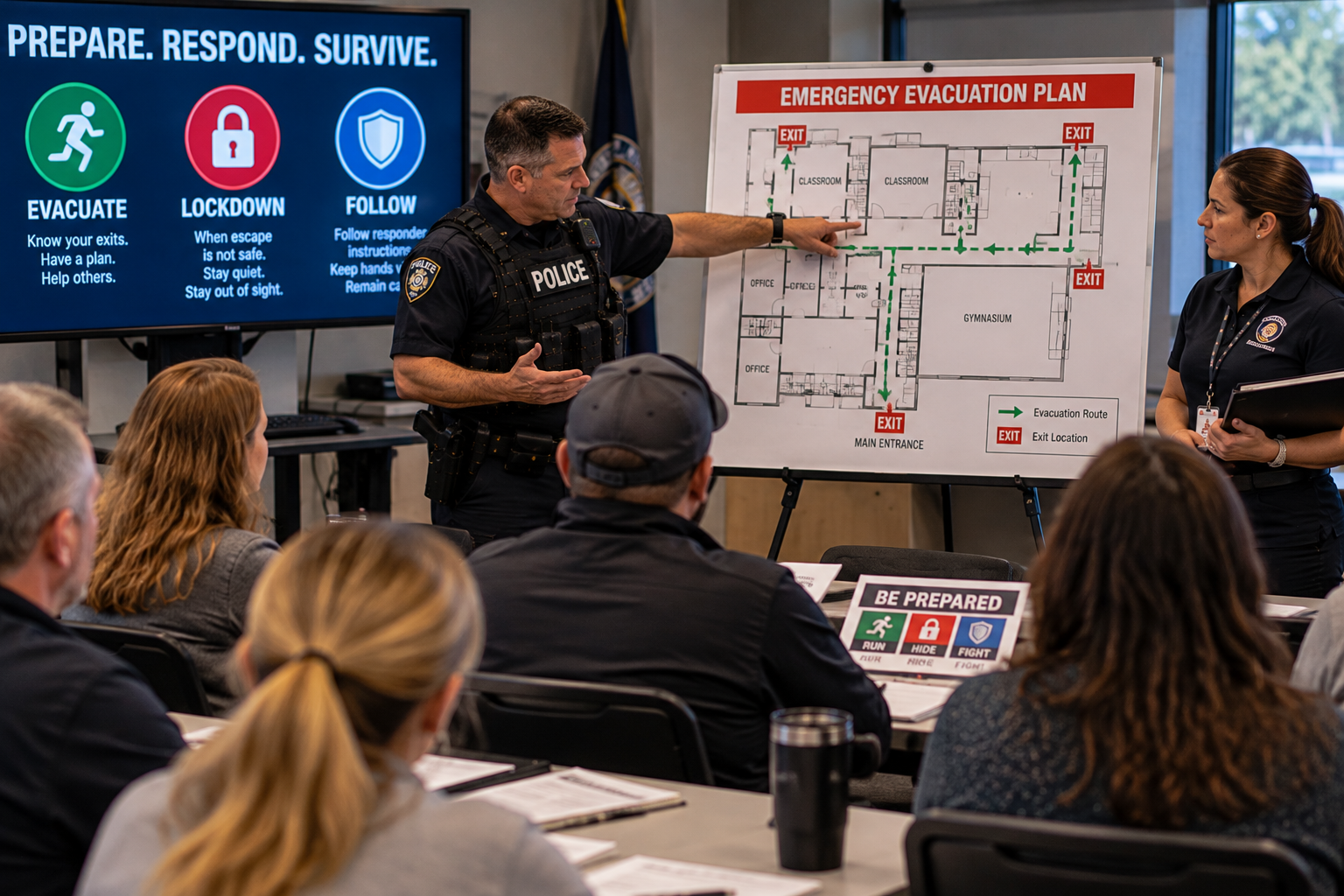
Evacuation, Lockdown, and the Problem of Conflicting Messages
One of the most consistent sources of harm during active violence is confusion about protective actions. Civilians are often told to “run, hide, fight” without understanding context, limitations, or transition points between options. This oversimplification creates hesitation, congestion, and dangerous movement patterns.
Effective public education reframes protective actions as decision pathways, not slogans. Civilians must understand:
When evacuation is safer than sheltering
When lockdown is protective versus trapping
How to move without drawing attention or creating bottlenecks
How to respond to responder instructions under stress
This understanding reduces panic-driven movement that interferes with law enforcement operations and casualty access. It also improves compliance with responder direction, accelerating stabilization of the environment.
Prepared civilians do not just save themselves; they make the scene more manageable for responders.
Community Reporting and Pre-Incident Prevention
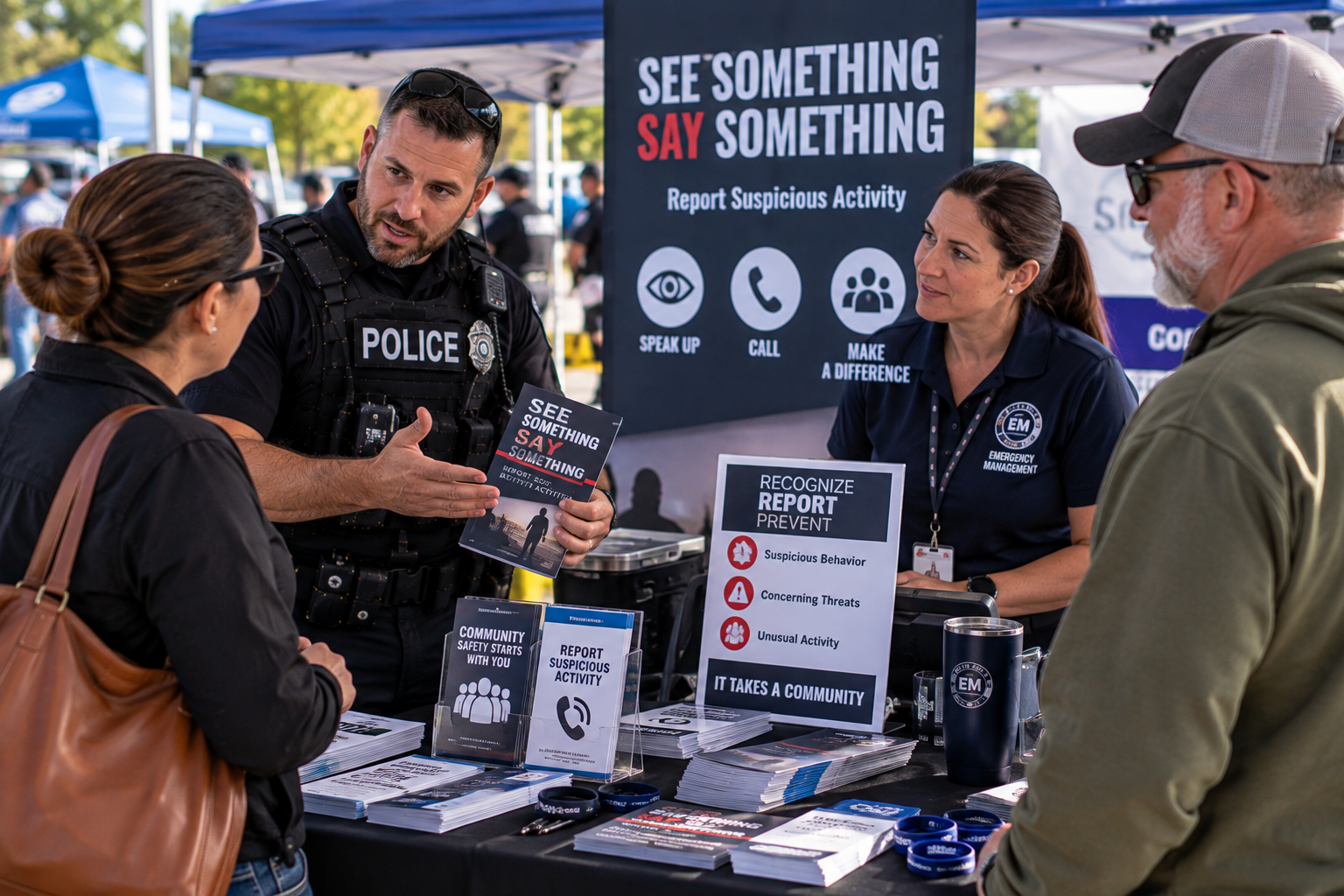
Preparedness begins before an incident occurs. Numerous post-incident analyses reveal missed opportunities for intervention due to unreported or misinterpreted warning signs. Civilians often observe concerning behaviors—threats, leakage, fixation, or surveillance—but lack clarity on what to report or fear consequences of being wrong.
Public education must therefore normalize responsible reporting. This includes:
Understanding behavioral warning signs
Knowing how and where to report concerns
Trusting that reports will be evaluated responsibly
Recognizing reporting as a protective act, not an accusation
From a systems perspective, community reporting expands the intelligence network far beyond formal agencies. It increases the probability of early intervention and shifts response from reactive to preventive.
Prepared communities are not paranoid communities; they are situationally aware communities.
Training as a Builder of Community Resilience
Resilience is often discussed abstractly, but it is built concretely through training. When individuals know what to do under stress, their psychological response changes. Fear is replaced with task focus, and chaos is reduced.
Public preparedness training builds resilience by:
Increasing confidence in personal actions
Reducing feelings of helplessness
Creating shared expectations within communities
Improving post-incident recovery trajectories
Communities that train together—schools, workplaces, faith organizations—develop collective competence. This competence persists beyond individual incidents, strengthening the social fabric that supports recovery.
Preparedness training is therefore not only about survival; it is about long-term community health.
Schools and Businesses as Anchors of Preparedness
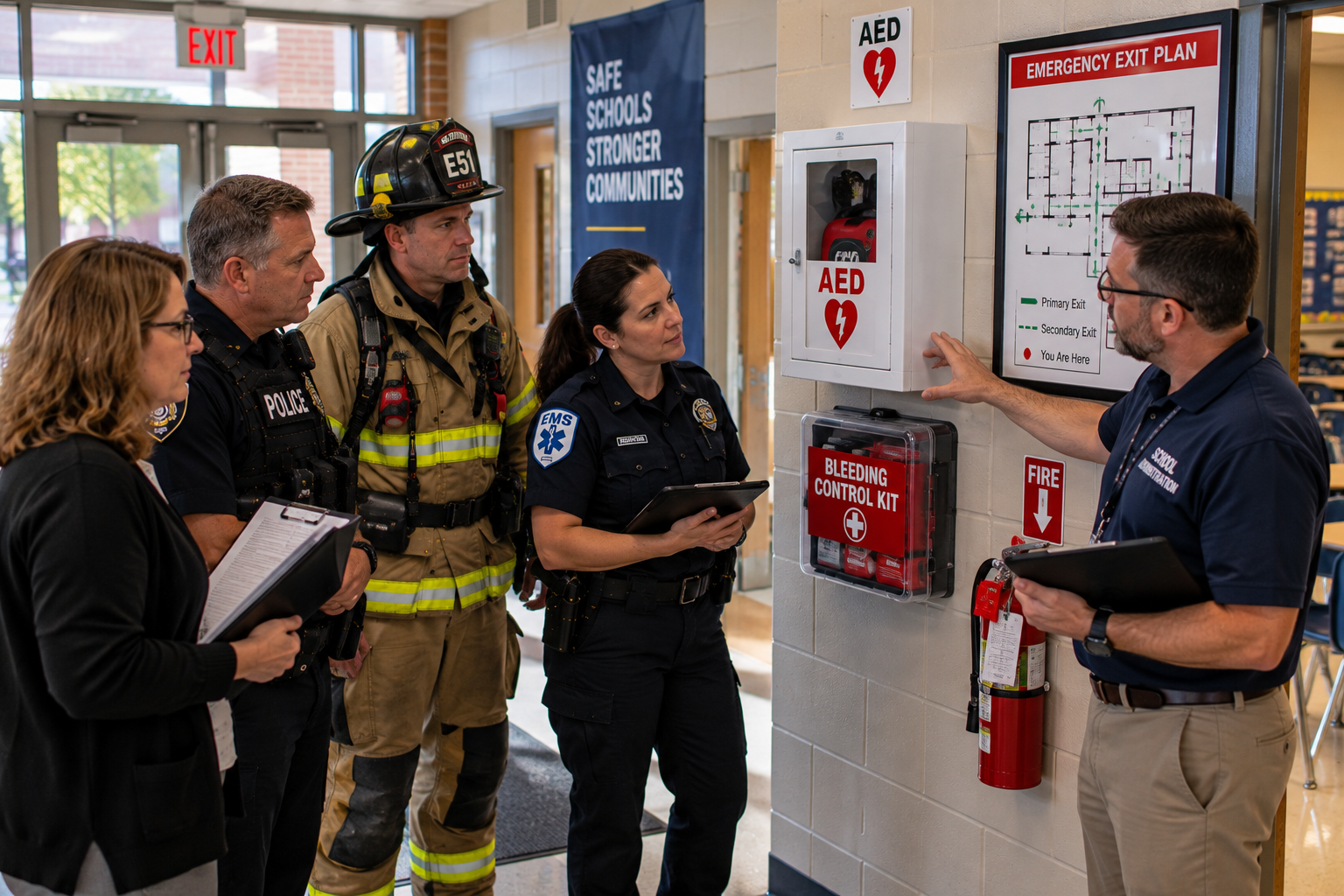
Community preparedness cannot rely on voluntary individual participation alone. Institutions with fixed populations and predictable routines—schools, universities, businesses—are essential partners.
These environments present both risk and opportunity. High occupancy and predictable schedules increase vulnerability, but structured leadership enables standardized training, drills, and equipment placement.
Effective partnerships focus on:
Age-appropriate training for students
Staff empowerment rather than dependence on responders
Integration of hemorrhage-control kits and AEDs
Clear internal communication plans
When institutions are prepared, responders encounter organized environments rather than unmanaged crowds. This accelerates rescue operations and reduces secondary harm.
Prepared institutions act as force multipliers for public safety systems.
Alignment with Responder Operations
Public education is most effective when aligned with responder doctrine. Teaching civilians actions that conflict with responder priorities creates friction during incidents. For example, uncoordinated self-evacuation may impede law enforcement movement or overwhelm medical facilities.
Alignment requires collaboration between agencies and community educators. Messaging should reinforce:
Compliance with responder direction
Avoidance of re-exposure to threats
Preservation of access routes
Basic triage awareness without self-transport chaos
When public behavior aligns with responder expectations, operational tempo improves. This alignment reduces cognitive load on responders, allowing them to focus on threat mitigation and advanced care.
Prepared civilians become participants in response, not obstacles to it.
Repetition, Retention, and Realism
Preparedness is not achieved through one-time training. Skill decay is well documented across all domains, including professional responders. Public education must therefore emphasize repetition and reinforcement.
Effective programs use:
Short, focused refreshers
Scenario-based discussion rather than rote drills
Visual cues and environmental reminders
Integration into existing community activities
Repetition with variation strengthens retention while avoiding complacency. Realistic framing prevents false confidence and emphasizes adaptability.
Preparedness is sustained through ongoing relevance, not fear-based messaging.
Equity and Access in Community Preparedness
Preparedness efforts must address disparities in access to training and equipment. Communities with fewer resources often face higher risk and slower response times. Public education that fails to reach these populations widens survivability gaps.
Equitable preparedness includes:
Free or low-cost training options
Multilingual materials
Culturally appropriate messaging
Strategic placement of hemorrhage-control kits
From a public safety perspective, equity is not a social add-on; it is an operational imperative. Systems perform only as well as their most vulnerable components.
The Feedback Loop Between Preparedness and Trust
Transparent public education builds trust. When agencies invest in community capability, they signal respect and partnership rather than authority alone. This trust pays dividends during incidents, when compliance, cooperation, and patience are essential.
Post-incident communication further reinforces this loop. Communities that understand response limitations and priorities are less likely to misinterpret delays or tactical decisions.
Preparedness therefore strengthens not only outcomes, but legitimacy.
Conclusion
Public education and community preparedness are no longer optional components of high-threat response. They are foundational elements of survivability, prevention, and resilience. In the critical minutes before responders can intervene, civilians determine trajectories through their actions—whether informed or improvised.
By teaching hemorrhage control, clarifying evacuation and lockdown decisions, encouraging responsible reporting, and partnering with institutions, public safety agencies extend their reach far beyond uniforms and vehicles. Prepared communities reduce chaos, preserve life, and accelerate recovery.
In modern high-threat environments, the public is part of the response system. The question is not whether civilians will act, but whether their actions will save lives or cost them.