
Right Tools, Wrong Assumptions: Clarifying the Role of Individual First Aid Kits in Modern Response
Introduction
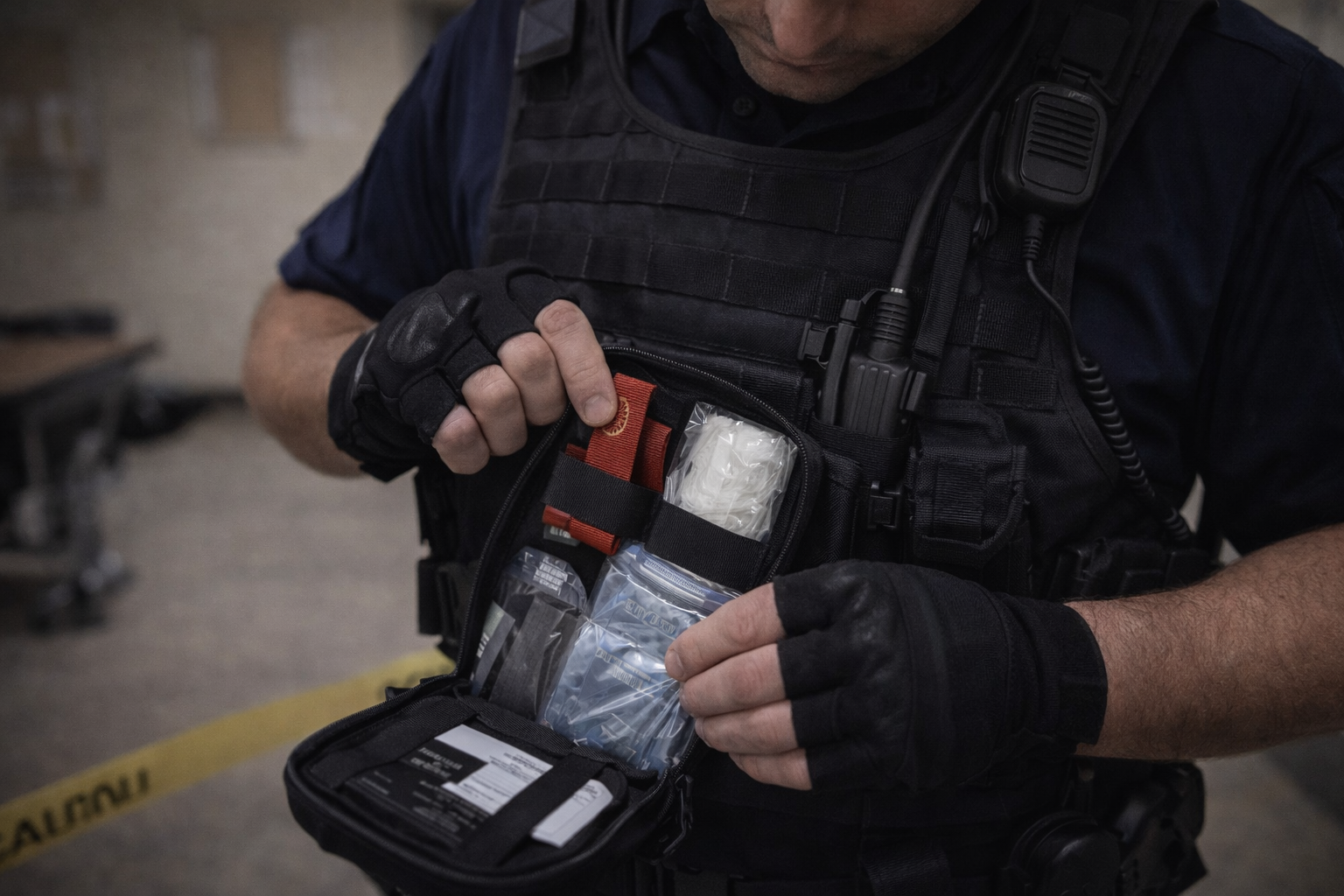
In modern high-threat and time-compressed incidents, the difference between effective response and operational failure is rarely the absence of equipment. More often, it is the misapplication of the equipment that is already present. Individual First Aid Kits (IFAKs) are now widely issued across law enforcement, EMS, fire, and specialized response units. Their presence is frequently cited as evidence of preparedness. Yet repeated after-action reviews reveal a persistent and dangerous disconnect between what IFAKs are designed to do and how they are expected to function during real-world events.
The central issue is not whether IFAKs work—they do. The issue is whether responders understand their role within the broader medical and operational system. When IFAKs are treated as miniature trauma bags, communal medical resources, or substitutes for scene-care assets, they fail—not because of design flaws, but because of flawed assumptions. This analysis argues that clarifying the role of the IFAK is essential to modern response effectiveness. Right tools, when paired with wrong assumptions, become liabilities rather than assets.
Modern IFAK Design in Evolving Threat Environments
The modern IFAK is a product of operational medicine shaped by asymmetric warfare, delayed evacuation, and persistent threat. Its design reflects a single, uncompromising objective: prevent death at the point of injury long enough for higher-level care to occur. To achieve this, the IFAK addresses the most common causes of preventable death—massive hemorrhage, airway compromise, and penetrating chest trauma—using tools that can be applied rapidly under extreme stress.
Every element of the IFAK reinforces this intent. It is carried on the individual, accessible with one hand, and limited in scope to reduce cognitive load. Tourniquets, hemostatic gauze, pressure dressings, chest seals, and gloves are selected for reliability and speed, not versatility. Redundancy is intentionally minimal. The kit is not designed for prolonged care, multi-system management, or multiple patients.
This design aligns with environments where the injured individual may be isolated, under fire, and responsible for their own survival. In such contexts, the IFAK is a personal survivability system, not a treatment platform. Understanding this origin is critical, because it defines how the kit should—and should not—be used in modern civilian response.
Assumptions That Misalign Gear With Mission
Despite its clear design intent, IFAKs are routinely burdened with expectations they were never meant to meet. Several assumptions drive this misalignment.
One common assumption is that similarity of contents implies similarity of purpose. Because IFAKs contain tourniquets and dressings—items also found in trauma bags—responders assume functional interchangeability. This overlooks the difference between interrupting death for one person and managing care for many.
Another assumption is that external care will arrive quickly enough to offset personal risk. Responders may believe that expending their IFAK to treat others is acceptable because “someone else will treat me if I’m injured.” In high-threat or rapidly evolving incidents, this assumption is rarely justified.
A third assumption is that possession equals proficiency. Issuing IFAKs without reinforcing doctrine and training creates a false sense of readiness. Responders may know what the equipment is, but not when its use is appropriate—or when it must be preserved.
These assumptions are not born of negligence. They are the product of training gaps, cultural messaging, and well-intentioned but incomplete guidance. Under stress, responders default to these assumptions, often with irreversible consequences.

Patient-Load Limitations of IFAKs
One of the most tangible consequences of IFAK misuse is patient-load failure. An IFAK is designed to save one life. It contains just enough equipment to address one critical injury profile. When responders attempt to stretch that capability across multiple patients, effectiveness collapses.
In multi-casualty incidents, IFAKs are rapidly depleted. Tourniquets are applied to one patient, leaving none for the responder or others. Hemostatic gauze is divided between wounds, reducing efficacy. Pressure dressings are improvised or omitted altogether. The result is partial care delivered to many, instead of decisive care delivered where it matters most.
This creates a cascading effect. Responders without intact self-aid capability become medically fragile. Scene care becomes improvised and disorganized. Time is lost redistributing limited supplies rather than executing structured triage and extraction. A system designed for scalability—through trauma kits and organized medical assets—is replaced by ad hoc redistribution of personal survivability tools.
Patient-load failure is not a theoretical risk. It is a predictable outcome when IFAKs are misapplied beyond their design limits.

Slowed Casualty Extraction and Operational Tempo
Equipment misunderstanding also directly affects casualty extraction timelines. When IFAKs are treated as scene-care solutions, responders often delay movement while attempting to provide definitive care that the kit cannot support. Instead of rapid hemorrhage control followed by movement to higher care, responders linger, exhausting supplies and time.
This delay is especially costly in high-threat environments. Casualty survival depends not only on initial intervention, but on speed of movement away from danger. Self-aid and immediate stabilization are meant to enable self-rescue or assisted extraction—not replace it.
When responders overestimate the capability of IFAKs, they unintentionally trade movement for misplaced treatment. Extraction corridors are not established early. Casualty flow stagnates. Patients deteriorate while responders attempt to do more than the equipment allows.
Operational tempo slows, not because responders are unwilling to act, but because they are acting on incorrect assumptions about what their tools can accomplish.
Cognitive Load, Stress, and Default Behavior
The science of human performance under stress explains why these patterns persist. Under extreme stress, cognitive bandwidth narrows. Fine motor skills degrade. Decision-making becomes rigid. In these conditions, responders do not innovate—they revert to what they have practiced and what has been implicitly endorsed.
If training and culture normalize the use of IFAKs as general trauma resources, that behavior becomes the default. If doctrine fails to distinguish self-aid systems from scene-care assets, responders fill the gap with assumption. Intent is irrelevant; conditioning governs action.
Listener attention research highlights the importance of primacy—what responders learn first shapes how they interpret everything that follows. When IFAKs are introduced as “medical kits” without emphasizing their personal survivability role, that initial framing persists. Repetition without correction reinforces the error.
Only through repetition with variation—training that places responders in realistic, high-stress scenarios where misuse of IFAKs has consequences—can these defaults be changed.
Evidence-Based Guidance for Proper IFAK Utilization
Clarifying the role of the IFAK requires moving beyond slogans to evidence-based guidance grounded in operational reality.
First, agencies must explicitly define IFAKs as personal self-aid and immediate buddy-aid systems. This definition should be codified in policy, reinforced in training, and modeled by leadership. Ambiguity invites misuse.
Second, agencies must pair IFAK issuance with scene-care assets—trauma kits designed to manage multiple patients. These kits should be standardized, scalable, and positioned to support organized triage and extraction. Expecting IFAKs to fill this role is neither efficient nor safe.
Third, training must integrate self-aid, buddy-aid, and scene care as distinct but sequential capabilities. Responders should understand when to transition from one to the next, and what equipment supports each phase. This progression anchors attention and reinforces relevance.
Fourth, inspections and evaluations should assess not just possession of equipment, but understanding of purpose. A complete IFAK carried incorrectly or used indiscriminately represents a readiness gap, not a strength.
Progressive Emphasis: Aligning Tools With Mission Phase
Effective doctrine emphasizes progression. In the earliest moments of injury, self-aid dominates. As additional responders arrive, buddy-aid and assisted movement follow. Once conditions allow, scene care using trauma kits enables structured triage and evacuation.
Each phase has distinct objectives and equipment requirements. The IFAK belongs to the first phase. Trauma kits belong to the latter. Confusing these phases collapses the system and degrades outcomes.
Progressive emphasis in training—returning repeatedly to this sequence across different scenarios—helps responders internalize not just what to do, but why timing and tool selection matter. This sustained relevance improves performance when stakes are highest.
From Equipment to Outcomes: Reframing Readiness
Ultimately, readiness is not about how many kits are issued, but about whether equipment use aligns with operational goals. An IFAK used correctly may save one responder who can then continue the mission. An IFAK misused may save no one and create additional casualties.
Reframing readiness requires shifting focus from inventory to outcomes. Agencies should ask not “Do we have IFAKs?” but “Do our responders understand when an IFAK is the right tool—and when it is not?”
This reframing sustains attention because it ties abstract doctrine to tangible survival outcomes. Responders recognize intuitively that misuse carries cost.
Conclusion
The Individual First Aid Kit is one of the most important survivability tools in modern response. Its effectiveness, however, depends entirely on correct assumptions about its role. When IFAKs are treated as trauma bags, communal resources, or substitutes for scene-care systems, they fail—not by design, but by misuse.
Modern response demands clarity. The IFAK is a personal survivability system intended to interrupt death at the point of injury. It is not designed to manage multiple patients, sustain prolonged care, or replace trauma kits. Confusing these roles slows extraction, degrades operational tempo, and increases preventable mortality.
Right tools save lives only when paired with right assumptions. Clarifying the role of the IFAK—through doctrine, training, and culture—is therefore not a minor adjustment. It is a prerequisite for effective casualty management and operational success in the environments responders now face.