
School-Based Response and Campus Security Integration
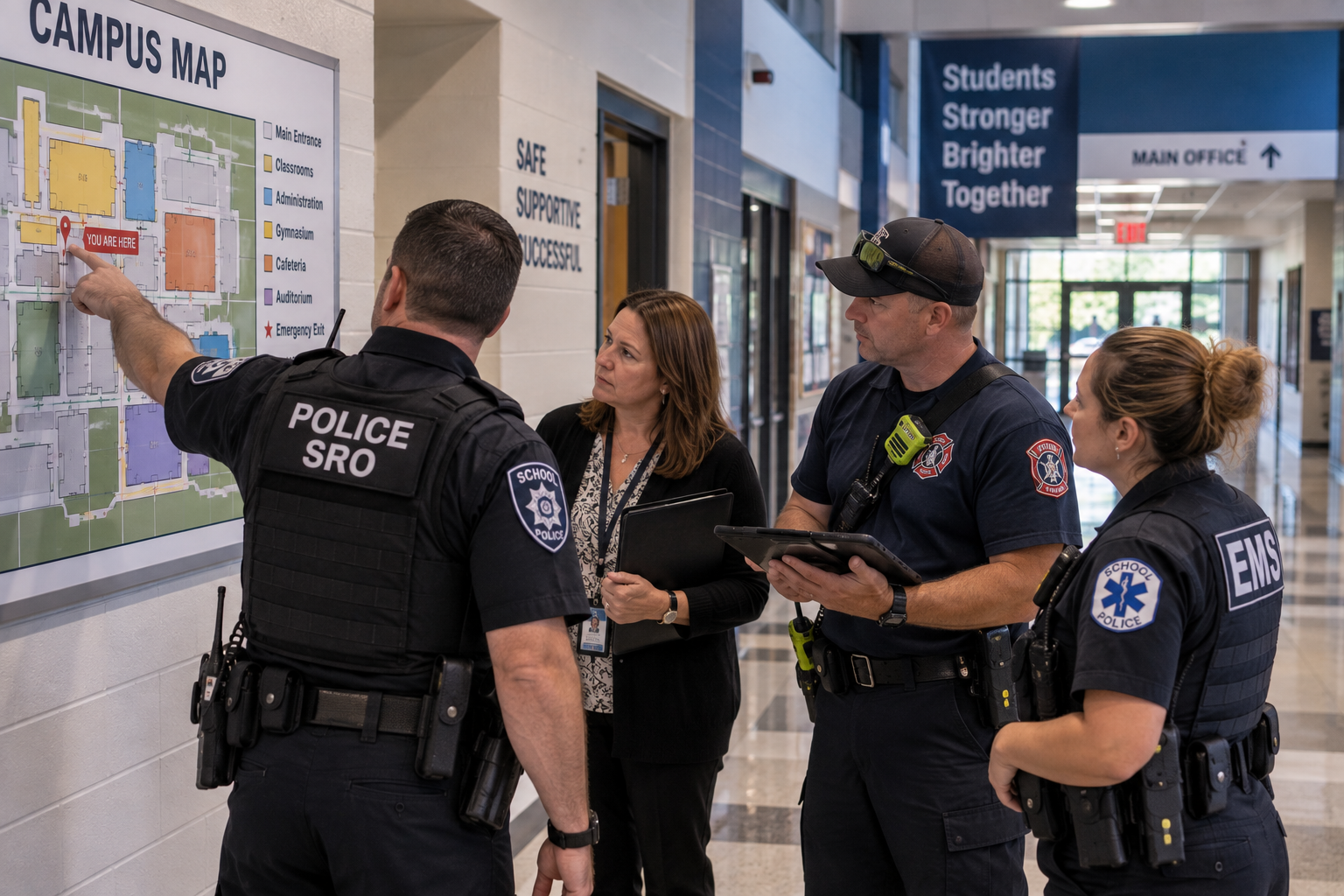
School-Based Response and Campus Security Integration
When violence occurs in an educational setting, the operational problem confronting responders changes immediately. Schools are not simply smaller versions of other public venues; they are unique terrain defined by dense populations, restricted movement, developmental vulnerability, and intense emotional amplification. In these environments, the difference between an effective response and a failed one is often determined by how well public safety agencies integrate with school security, administrators, and staff before an incident ever occurs. Once an attack begins, there is no time to learn the building, the culture, or the internal procedures. Integration must already exist.
This analysis examines school-based response through an operational and survivability lens. It argues that effective response in K–12 and higher education environments depends on deliberate coordination with campus security and staff, realistic understanding of school-specific constraints, and early alignment between law enforcement, EMS, fire services, and School Resource Officers (SROs). Pediatric casualty considerations further complicate response and demand preparation beyond traditional adult-focused models. The central conclusion is clear: schools require purpose-built response integration, not generic active shooter doctrine applied after the fact.
Educational Environments as Distinct Operational Terrain
Schools present structural and human characteristics that fundamentally shape response. Architecturally, they are often composed of long corridors, multiple access points, interior classrooms with locking mechanisms, and areas designed to funnel movement—stairwells, cafeterias, gymnasiums, and auditoriums. These features can either protect occupants or create chokepoints depending on how they are used.
Human terrain is even more complex. K–12 campuses house large numbers of children with limited ability to self-evacuate, interpret instructions, or provide self-aid. Colleges and universities add population density, open-access design, and variable security presence. Panic spreads rapidly in these settings, affecting students, staff, parents, and the broader community almost simultaneously.
These realities mean that response cannot rely solely on external control. Internal coordination—with people who know the building, the population, and the routines—is indispensable.
The Necessity of Collaboration With School Security and Staff
School administrators, teachers, and security personnel are not passive occupants during an incident; they are active participants in the outcome. Their actions in the first minutes—locking doors, moving students, providing information—shape casualty patterns and responder access.
Effective response requires that public safety agencies understand:
How lockdown procedures are initiated and communicated.
Which doors auto-lock, which require manual action, and which cannot lock at all.
How attendance is tracked and how accountability is established.
Where students are likely to congregate during transitions.
Without this knowledge, responders may waste critical time forcing doors that are already locked for safety, searching areas that are empty, or misinterpreting staff actions as noncompliance. Pre-incident collaboration reduces friction and replaces confusion with predictability.
Locked Rooms: Protection and Complication
Locked classrooms are one of the defining features of modern school security. When used correctly, they save lives by denying access to attackers. When misunderstood by responders, they become barriers that slow clearance and casualty access.
Responders entering a school must immediately reconcile two priorities: threat interdiction and victim access. Locked doors may contain terrified but uninjured students, or they may conceal injured individuals who cannot call for help. Forcing every locked door indiscriminately wastes time and may expose occupants unnecessarily.
Coordination with staff and SROs helps differentiate between these scenarios. Teachers can signal room status, administrators can provide occupancy data, and security staff can guide responders toward areas of greatest need. This collaboration allows responders to focus effort where it matters most.
Large Populations and the Amplification of Panic
Schools concentrate large populations in confined spaces. Once violence occurs, panic propagates rapidly through sound, movement, and rumor. Students flee, hide, or freeze. Parents converge on the campus. Social media accelerates misinformation.
This amplification affects operations in several ways:
Evacuation routes become congested or unsafe.
Casualties may be dispersed unpredictably.
Responders encounter emotional bystanders interfering with movement.
Preparedness planning must anticipate these dynamics. Unified command structures must include school leadership early, enabling coordinated messaging and controlled movement. Failure to integrate campus leadership allows panic to drive behavior rather than coordinated instruction.
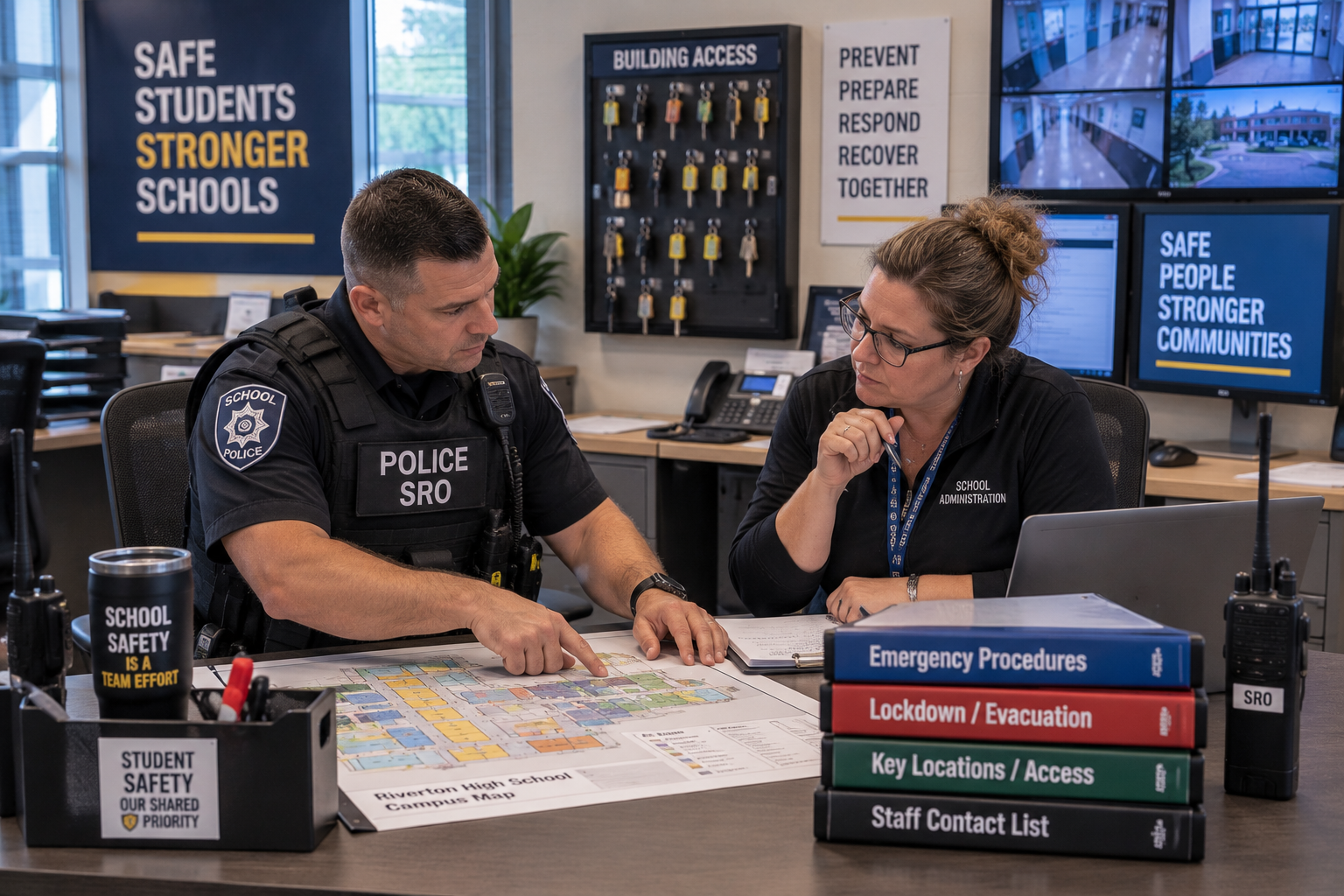
The Critical Role of School Resource Officers (SROs)
SROs occupy a unique operational niche. They are often the first law enforcement presence on scene, embedded within the environment before an incident begins. Their familiarity with the campus, staff, and students gives them an intelligence advantage unmatched by external responders.
When integrated properly, SROs:
Provide immediate threat location and movement updates.
Facilitate access through secured areas.
Identify vulnerable populations and special needs students.
Serve as liaisons between responders and school leadership.
However, SRO effectiveness depends on integration. Agencies that treat SROs as isolated officers rather than integral components of response planning squander their value. Joint training, shared radio access, and clear expectations transform SROs into force multipliers.
Accelerating Response Through Pre-Established Relationships
Response speed in schools is not determined solely by distance or dispatch time. It is heavily influenced by relationship readiness. Agencies that have pre-existing relationships with school administrators and security personnel transition faster from arrival to action.
These relationships enable:
Immediate access to building schematics.
Rapid identification of key decision-makers.
Trust-based compliance during evacuation or sheltering.
Clear understanding of internal communication systems.
Trust cannot be improvised during crisis. It must be built through regular engagement, planning meetings, and joint exercises. Where trust exists, response accelerates; where it does not, hesitation and conflict emerge.
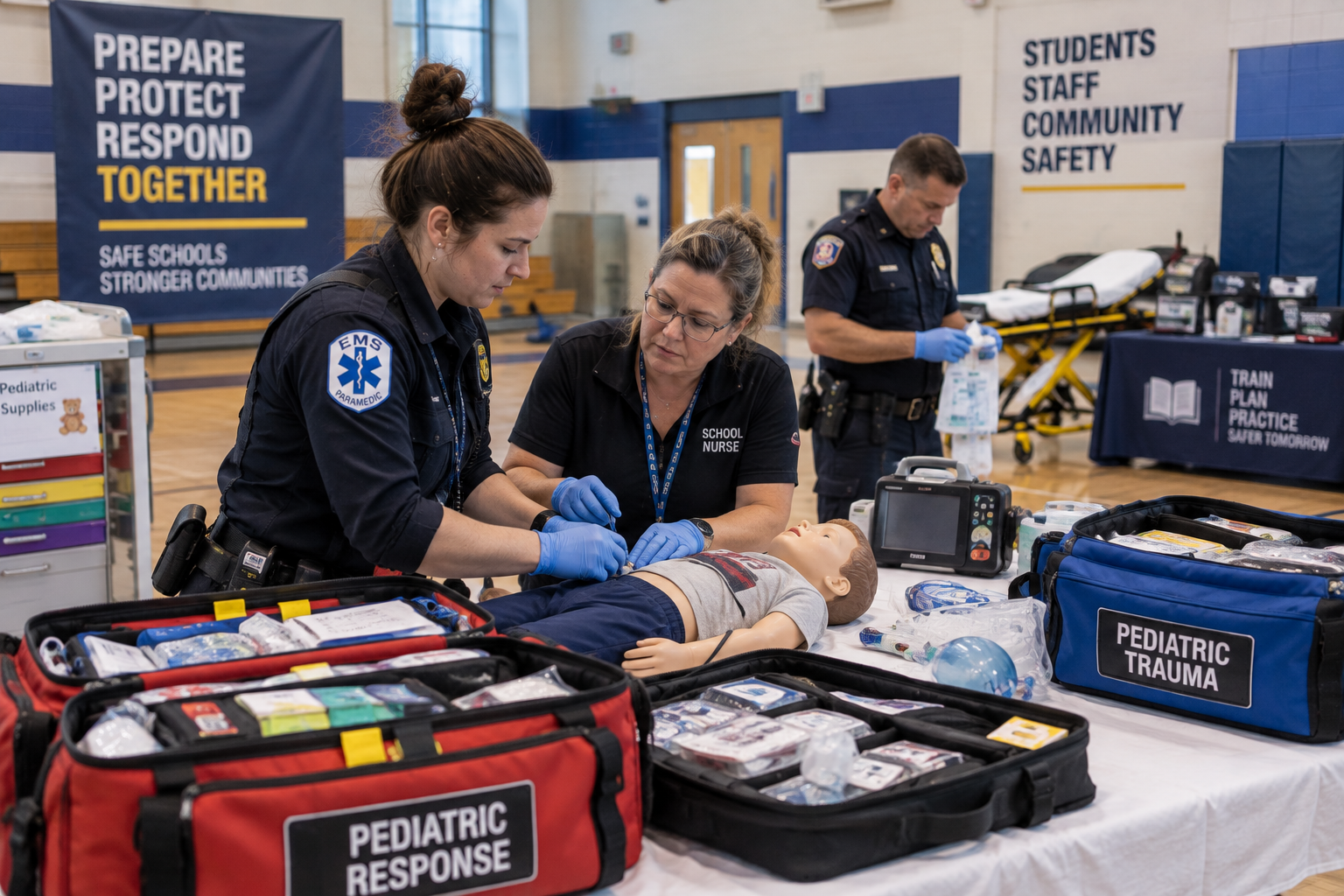
Pediatric Casualty Considerations
Pediatric casualties introduce physiological, emotional, and ethical complexities that demand preparation. Children differ from adults in airway anatomy, blood volume, and response to trauma. Hemorrhage control, airway management, and medication dosing require pediatric-specific knowledge and equipment.
Beyond physiology, pediatric care imposes emotional strain on responders. The presence of injured children intensifies stress and can disrupt decision-making if responders are unprepared. Training that incorporates pediatric scenarios reduces shock and improves performance.
Additionally, schools may house children with disabilities or medical dependencies. Integrating this information into response planning ensures responders are not encountering surprises under fire.
Medical Operations in Educational Settings
Medical response in schools is constrained by space, security, and population density. Hallways may be narrow, classrooms crowded, and evacuation routes compromised. Establishing casualty collection points (CCPs) requires careful selection to balance access, protection, and flow.
Integration with school staff assists in identifying suitable locations—nurse’s offices, gyms, or adjacent facilities—while accounting for explosive or secondary threats when applicable. Pediatric-capable equipment and personnel must be prioritized early.
Delayed medical access in schools carries particularly severe consequences. Children deteriorate rapidly from blood loss, and psychological trauma compounds physical injury. Early intervention is therefore not merely beneficial; it is ethically imperative.
Higher Education: A Different but Related Challenge
Colleges and universities present a distinct variant of the school-based problem. Campuses are often open-access, geographically expansive, and populated by adults who move independently. Security presence may be decentralized, and SRO equivalents vary widely.
However, integration remains equally critical. Campus police, security departments, housing staff, and administrators must be aligned with external agencies. The scale of these environments amplifies coordination challenges, but the principles remain consistent: shared planning, clear roles, and practiced communication.
Training as the Unifying Mechanism
No amount of planning substitutes for training. Joint exercises that include law enforcement, fire, EMS, school staff, security, and SROs expose assumptions and reveal friction points. They allow participants to practice movement, communication, and decision-making in realistic conditions.
Effective training addresses:
Locked-door management.
Pediatric casualty care.
Communication with frightened staff and students.
Unified command integration with school leadership.
Training also reinforces mental models. When responders have rehearsed school-specific scenarios, they are less likely to default to inappropriate tactics during real events.
Managing Public Expectations in School Incidents
School incidents attract intense public scrutiny. Parents expect immediate protection and care for their children. Delays—whether operationally justified or not—are interpreted emotionally rather than analytically.
Transparent communication, coordinated through school leadership and public information officers, is essential. Explaining what is happening, why certain actions take time, and how children are being protected helps stabilize community response.
Preparedness includes messaging strategies as much as tactical plans. Silence breeds rumor; clarity builds trust.
Continuous Relevance: Why Integration Cannot Be Optional
Every school-based incident reinforces the same lesson: integration determines outcome. Agencies that operate in isolation struggle against terrain, panic, and uncertainty. Those that integrate with campus security and staff act with clarity and speed.
Educational environments magnify both strengths and weaknesses in response systems. Preparation is therefore not optional—it is a moral obligation.
Conclusion
School-based response demands more than rapid law enforcement entry. It requires deep integration with campus security, administrators, teachers, and SROs who understand the environment and population. Locked rooms, large populations, and pediatric vulnerabilities reshape operational priorities and demand specialized preparation.
When agencies collaborate before an incident, response accelerates, medical access improves, and survivability increases. When they do not, confusion and delay dominate the most critical minutes.
Schools are among the most emotionally charged environments responders will ever enter. Effective response honors that reality through preparation, integration, and disciplined execution. In these settings, coordination is not a bureaucratic ideal—it is the mechanism by which children live or die.