Self-Aid First: Why Responder Survival Precedes Scene Care
Self-Aid First: Why Responder Survival Precedes Scene Care
In high-threat and time-compressed emergencies, the instinct to help others is both human and deeply ingrained in public safety culture. Yet this instinct, when unexamined, can become operationally dangerous. In environments defined by ballistic threats, explosives, or rapidly evolving violence, responder survival is not a secondary concern—it is the prerequisite for all subsequent lifesaving action. The principle of self-aid first is not a rejection of duty or compassion; it is a recognition that injured responders cannot provide aid, maintain security, or sustain operational momentum. When responder survival is compromised, scene care collapses with it.
This reality demands a reframing of how agencies conceptualize medical priorities during high-threat incidents. Scene care is often discussed as a moral imperative, but in practice, it is contingent upon the physical and cognitive capacity of responders to function. Self-aid preserves that capacity. Without it, even the most robust response plans fail at the point of injury. Understanding why self-aid must precede scene care requires examining responder physiology, training culture, human performance under stress, and the systemic consequences of neglecting survivability doctrine.
Injured Responders Cannot Provide Aid
The most immediate and incontrovertible truth in tactical medicine is that an injured responder becomes a casualty. Once injured, the responder’s ability to move, communicate, apply force protection, or render aid to others is degraded or eliminated entirely. This is not a matter of willpower; it is a physiological constraint.
Hemorrhage, airway compromise, and blast-related injuries rapidly impair motor function and cognition. Even minor wounds can significantly reduce situational awareness and reaction time. In high-threat environments, these deficits place not only the injured responder at risk, but also teammates, casualties, and bystanders who rely on that responder’s presence and capability.
From an operational perspective, every responder injury creates an additional mission requirement: rescue, extraction, and treatment. This diverts resources away from threat mitigation and casualty care. The failure to prioritize self-aid thus multiplies harm rather than alleviating it. By contrast, immediate self-aid interrupts this cascade, preserving the responder’s ability to remain operational or, at minimum, stabilize long enough to reach safer care.
Self-Aid Preserves Mission Continuity
Mission continuity is rarely discussed in medical terms, yet it is inseparable from survivability. In active shooter and other high-threat incidents, missions unfold in parallel: threat suppression, area control, casualty access, and evacuation. These missions depend on responder availability. When responders fall out of the fight due to preventable injuries, continuity fractures.
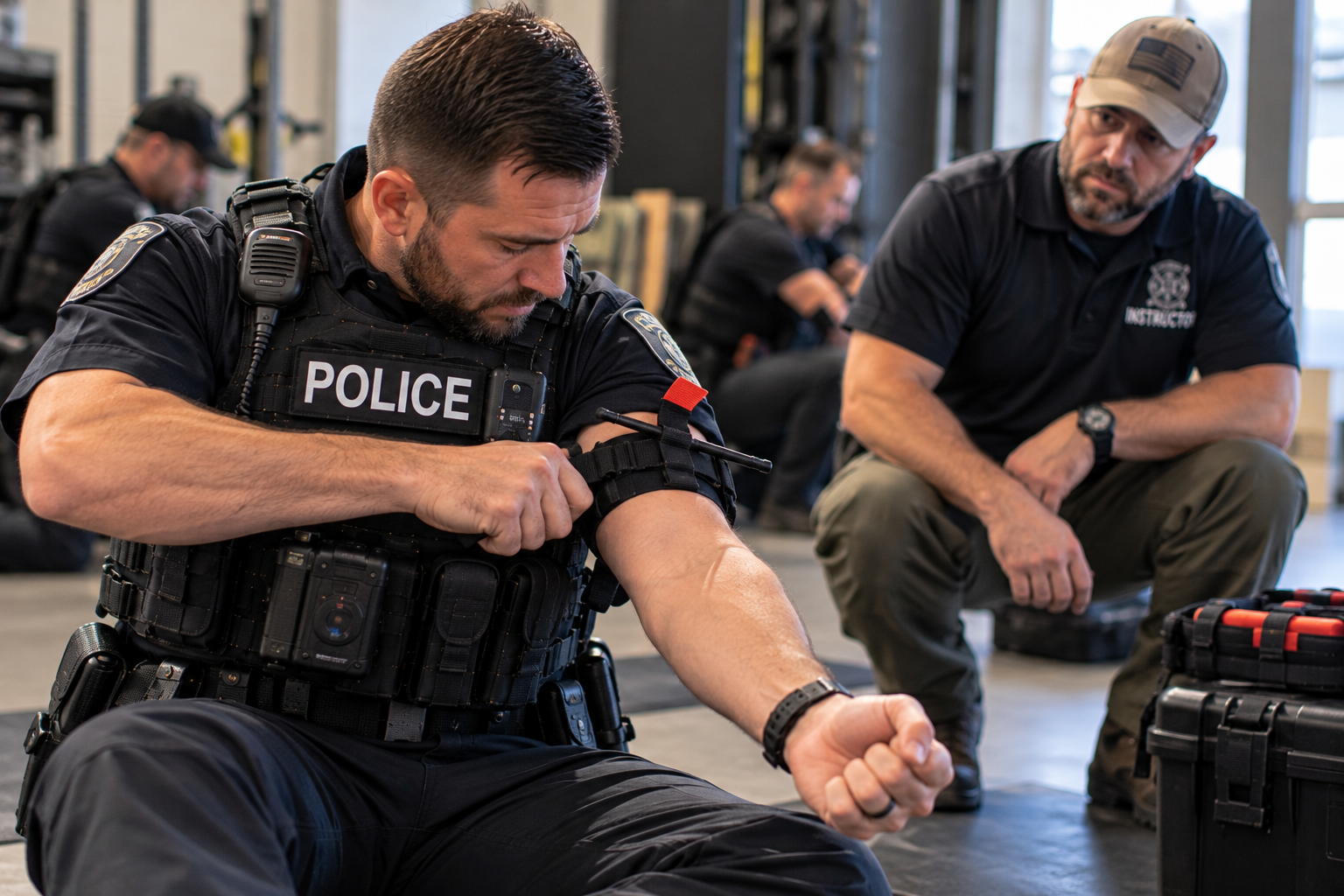
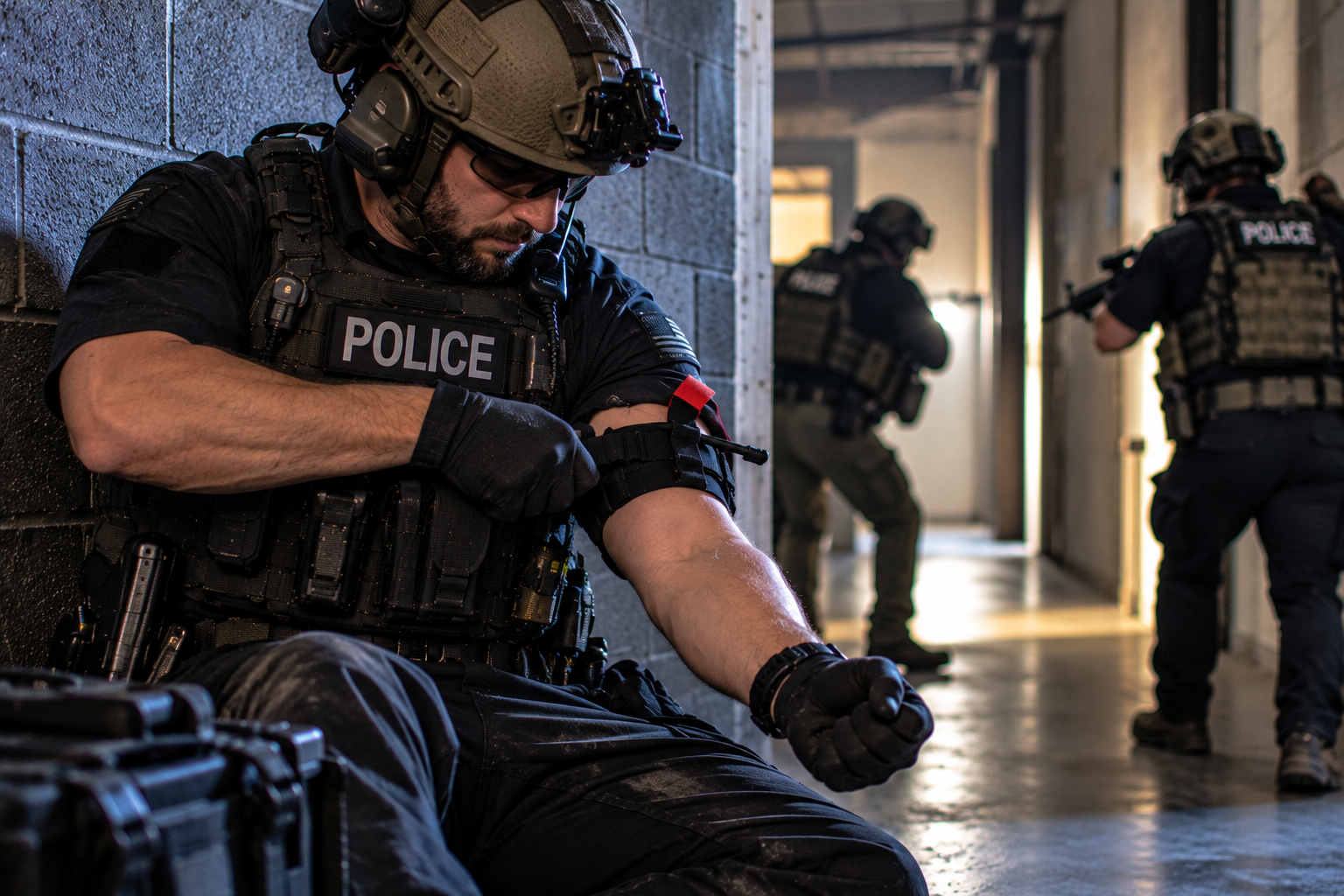
Self-aid functions as a force multiplier. A responder who can rapidly control their own bleeding, manage an airway, or seal a chest wound may continue moving, communicating, and providing security. Even when full recovery is not possible, self-aid often buys critical time—time that prevents escalation, preserves momentum, and allows structured medical intervention to occur later.
This principle mirrors lessons long established in military operational medicine but is equally applicable to civilian public safety. Firefighters understand that personal protective equipment preserves their ability to rescue others. Law enforcement recognizes that body armor enables continued engagement. Self-aid is the medical equivalent of these protections. It safeguards the responder’s capacity to serve.
Training Failures Reinforce Altruistic Misuse
Despite its importance, self-aid is frequently deprioritized in training environments. Many responders are taught how to use medical equipment but not when or why it must be reserved for personal survivability. This omission creates a subtle but powerful training failure.
When training scenarios reward immediate treatment of others using personal medical equipment, responders internalize the message that altruistic use is expected—even during unresolved threats. Over time, this becomes normalized behavior. The Individual First Aid Kit (IFAK), for example, is often treated as a general-purpose trauma resource rather than a personal survivability tool. This mindset is reinforced not by policy, but by practice.
Such training failures are rarely intentional. They emerge from a desire to emphasize compassion and service. However, without explicit doctrinal boundaries, training inadvertently teaches responders to sacrifice their own survivability early in incidents. This sacrifice does not increase overall lifesaving capacity; it reduces it.
Corrective training must therefore do more than teach skills. It must reshape priorities. Responders must repeatedly experience scenarios in which self-aid preserves their ability to function, and where premature altruistic use results in operational failure. Only then does self-aid become an instinct rather than an afterthought.
Stress Drives Default Behavior, Not Policy
In high-stress environments, responders do not consciously recall policy language or procedural manuals. Instead, they default to the behaviors most deeply ingrained through repetition. This principle is well documented in human performance research and is particularly relevant to tactical medicine.
Under stress, cognitive bandwidth narrows. Fine motor skills degrade. Decision-making becomes reactive rather than deliberative. In these conditions, responders rely on habit. If habit dictates treating others first at personal expense, that is what will occur—regardless of written doctrine.
This reality exposes a critical vulnerability in many agencies: a gap between stated policy and trained behavior. Policies may emphasize responder safety, but if training scenarios consistently reward self-sacrifice without consequence, policy becomes performative rather than operational.
Normalizing self-aid requires aligning training, evaluation, and leadership messaging. Responders must hear, see, and practice the principle that self-aid is not selfish—it is necessary. Over time, this alignment ensures that when stress strips away conscious deliberation, the remaining instinct supports survivability.
Normalizing Self-Aid Doctrine Across Disciplines
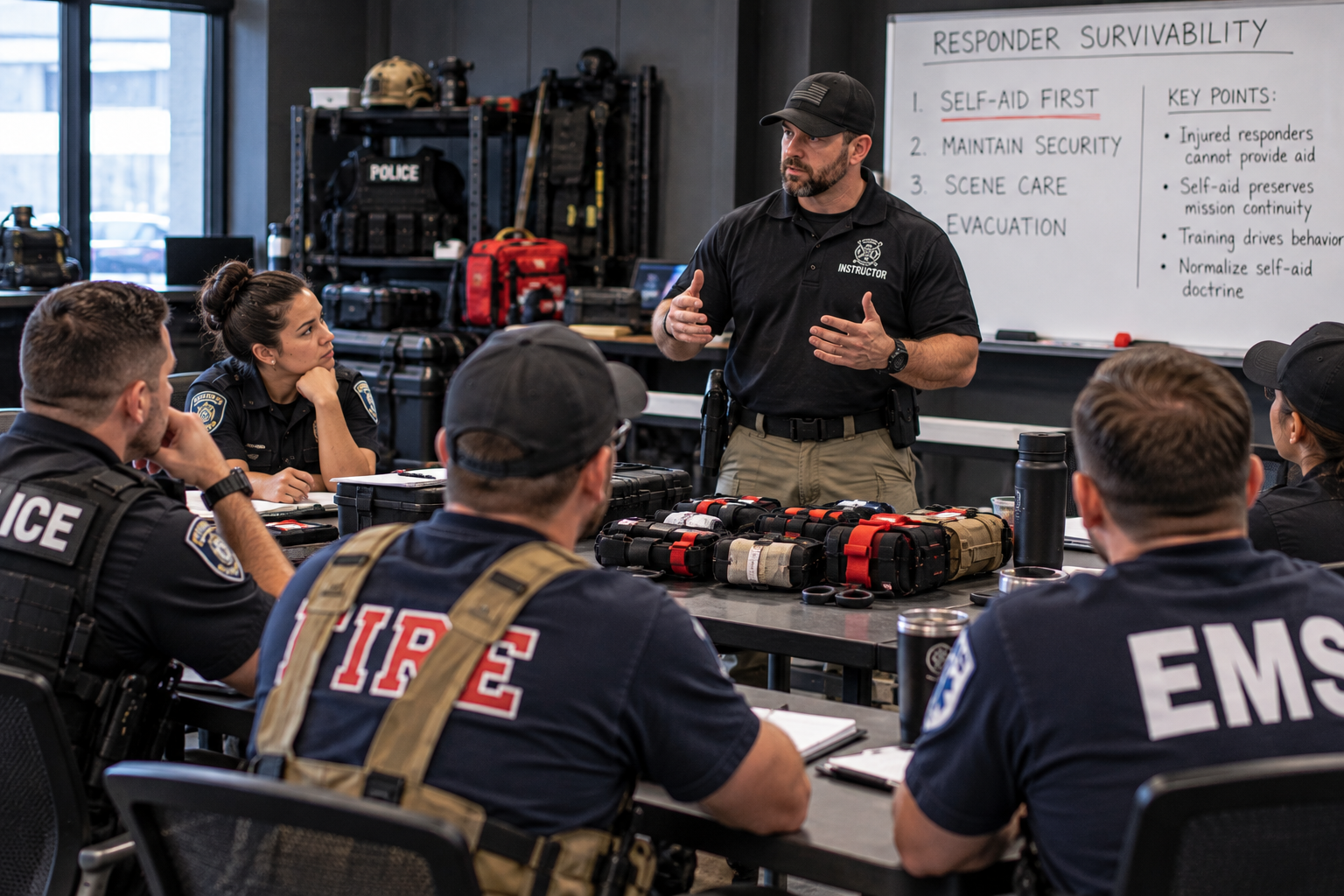
For self-aid to function as intended, it must be normalized across law enforcement, fire, and EMS disciplines. This normalization cannot occur in isolation. It must be embedded within interagency doctrine, joint training, and leadership culture.
Agencies should explicitly articulate that self-aid is the first medical priority during high-threat incidents. This does not preclude aiding others; it sequences care logically. Once a responder is stabilized and operationally secure, scene care can proceed with greater effectiveness.
Leadership plays a decisive role in this process. Supervisors and instructors must reinforce self-aid doctrine consistently, even when it challenges deeply held cultural narratives. After-action reviews should examine not only what care was provided, but when and with what resources. Praise and corrective feedback should reflect doctrinal priorities rather than emotional impulses.
Over time, this normalization reshapes responder identity. Self-aid becomes synonymous with professionalism, preparedness, and commitment to mission—not with reluctance to help.
Relevance to Modern High-Threat Response
The need for self-aid-first doctrine is amplified by the realities of modern high-threat incidents. Events are faster, more lethal, and more complex than in previous decades. Law enforcement officers are often the first casualties. Fire and EMS increasingly operate in warm or hot zones. Medical access is delayed not by indifference, but by threat dynamics.
In this environment, responder survivability determines system survivability. A response system that hemorrhages personnel cannot sustain care, control, or command. Self-aid is therefore not a niche concept; it is foundational to operational resilience.
Frameworks such as Tactical Emergency Casualty Care (TECC) and integrated response models emphasize this reality by prioritizing immediate life-saving interventions at the point of injury. These frameworks implicitly recognize that the first patient may be the responder themselves. Codifying this recognition into doctrine closes the gap between theory and practice.
Conclusion
Self-aid must precede scene care because responder survival precedes all other outcomes. Injured responders cannot provide aid, maintain security, or sustain mission continuity. Self-aid preserves operational capacity, prevents cascading failures, and supports effective scene care once conditions allow.
Training failures that normalize altruistic misuse of personal medical equipment undermine this principle. Under stress, responders default to training—not policy. If self-aid is not deeply ingrained, it will not appear when it is most needed.
Normalizing self-aid doctrine requires intentional training, clear leadership messaging, and cultural alignment across disciplines. It requires reframing self-aid not as a retreat from duty, but as its fulfillment.
In high-threat environments, the responder who survives is the responder who can continue to save lives. Self-aid is not the end of care—it is the beginning.