
The Shooter Is the X: Correcting Civilian Misinterpretations
The Shooter Is the X: Correcting Civilian Misinterpretations
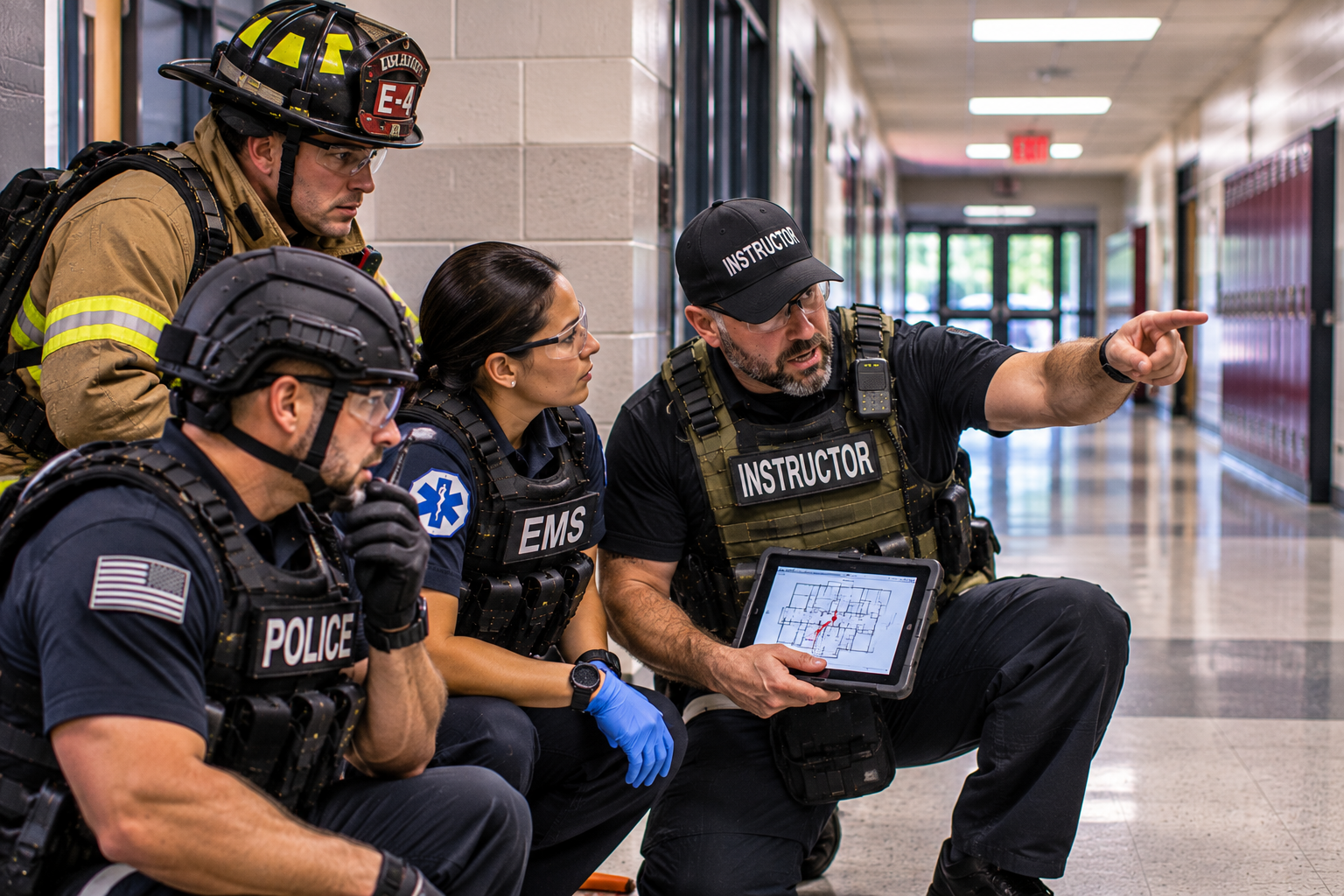
In high-threat civilian incidents, language does not merely describe reality—it shapes it. Few phrases illustrate this more clearly than the commonly repeated directive “get off the X.” Borrowed from military doctrine, this phrase has migrated into civilian law enforcement, EMS, and fire training with little scrutiny. The result is a subtle but dangerous misunderstanding that continues to influence movement decisions, delay medical access, and place responders and victims at unnecessary risk. The core problem is simple yet profound: in civilian active shooter incidents, the X is not a location. The X is the shooter.
This distinction matters because movement decisions determine exposure, survivability, and access to care. When responders treat the X as a physical point to flee rather than a mobile threat to manage, they may unintentionally increase danger. Correcting this misconception is not semantic nitpicking; it is a doctrinal correction essential to aligning civilian response with operational reality.
The Military Meaning of the “X”
In military doctrine, the term X has a precise and contextual meaning. It refers to a known or anticipated strike location—an ambush point, explosive detonation area, or concentrated zone of enemy fire. The instruction to “get off the X” assumes several conditions:
The threat vector is spatially defined.
Friendly forces possess suppressive capability.
Coordinated maneuver and overwatch are available.
Command authority can accept immediate risk in exchange for momentum.
Under these conditions, rapid movement away from a fixed kill zone reduces exposure and disrupts enemy effects. The directive is inseparable from force protection, coordinated fires, and disciplined maneuver. It is not a generic command to move; it is a calculated response to a specific tactical geometry.
When this phrase is lifted from its doctrinal environment and placed into civilian response training, the supporting assumptions vanish. What remains is a simplified instruction divorced from the realities that once made it effective.
Civilian Threats Are Mobile Actors, Not Fixed Locations
Civilian active shooter incidents are fundamentally different from the military scenarios that generated the “X” concept. The defining characteristic of these events is not geography—it is behavior. The threat is a human actor capable of movement, adaptation, and deception.
In these environments:
The shooter relocates unpredictably.
Threat vectors shift rapidly.
Violence follows people, not coordinates.
Areas thought to be “cleared” can become contested again.
Treating the X as a hallway, room, or doorway ignores the fact that the shooter’s intent and movement define danger. Moving casualties or responders away from a perceived location without accounting for the shooter’s position can place them directly into the path of violence.
This is the central civilian misinterpretation: assuming danger is tied to a place rather than a person.
When Moving Away Increases Risk
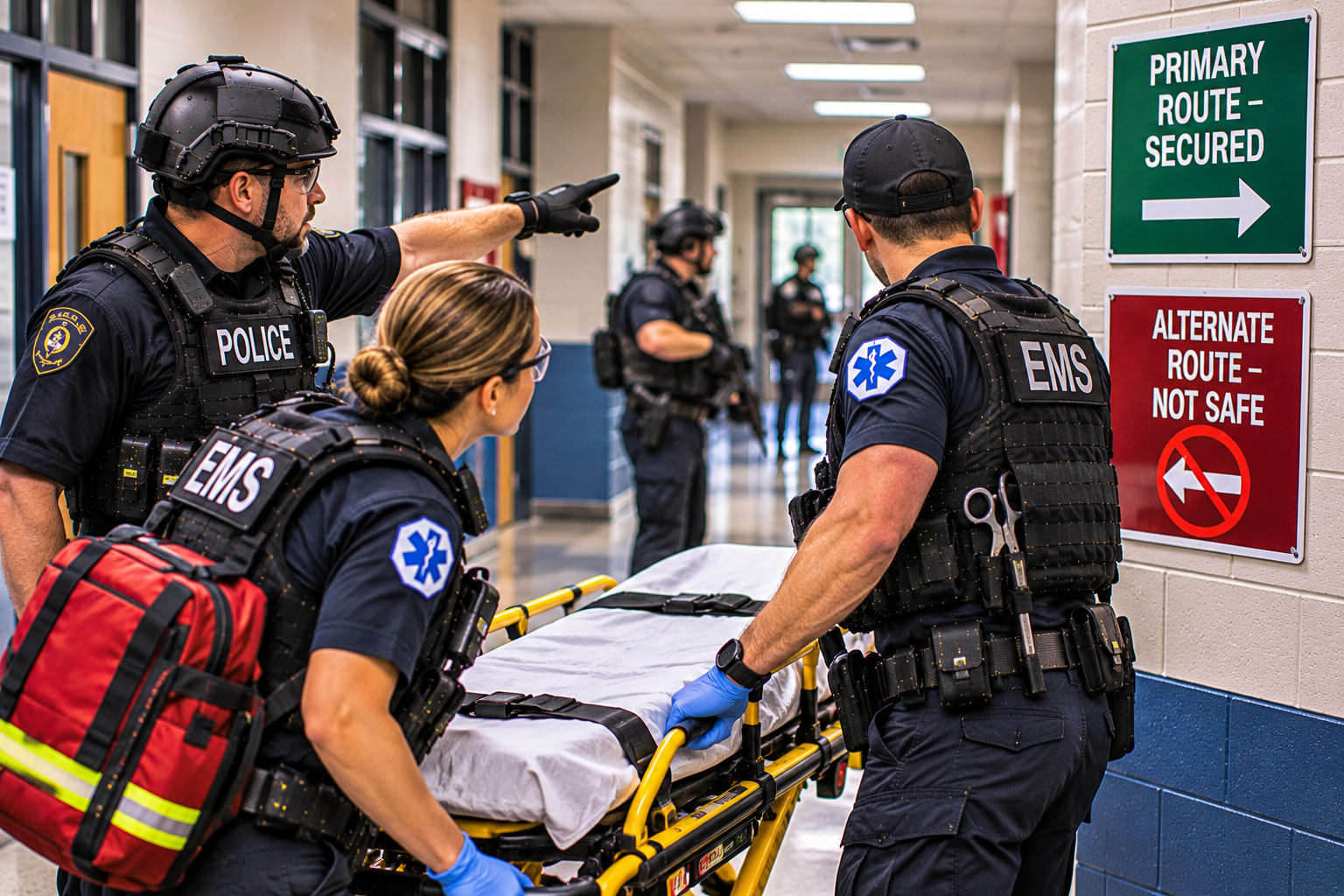
In civilian response, movement is not inherently protective. Movement without context can amplify exposure. Evacuating casualties down unsecured corridors, rushing responders out of perceived danger zones, or repositioning without threat awareness may increase vulnerability rather than reduce it.
Several operational patterns illustrate this risk:
Blind evacuation: Moving casualties “off the X” without protection may expose them to secondary threats or crossfire.
Responder displacement: Pulling medical or rescue teams away from viable access routes delays care while failing to improve safety.
False safety assumptions: Movement triggered by language rather than intelligence creates a sense of action without risk reduction.
In these cases, the instruction to “get off the X” becomes counterproductive because it prioritizes motion over threat management. The problem is not movement itself—it is movement driven by an incorrect mental model.
Medical Access Depends on Movement Toward the Threat
Perhaps the most consequential effect of this misinterpretation is its impact on medical care. In active shooter incidents, casualties occur where the shooter operates. Hemorrhage control, airway management, and rapid extraction cannot occur if responders refuse to move toward contested spaces.
Physiology does not wait for clearance declarations. Uncontrolled bleeding progresses regardless of language. When responders believe they must move away from danger before acting, the survivable window closes.
Correct civilian doctrine recognizes that:
Medical access often requires deliberate movement toward risk.
Managed exposure saves more lives than avoidance.
Protection and positioning matter more than distance.
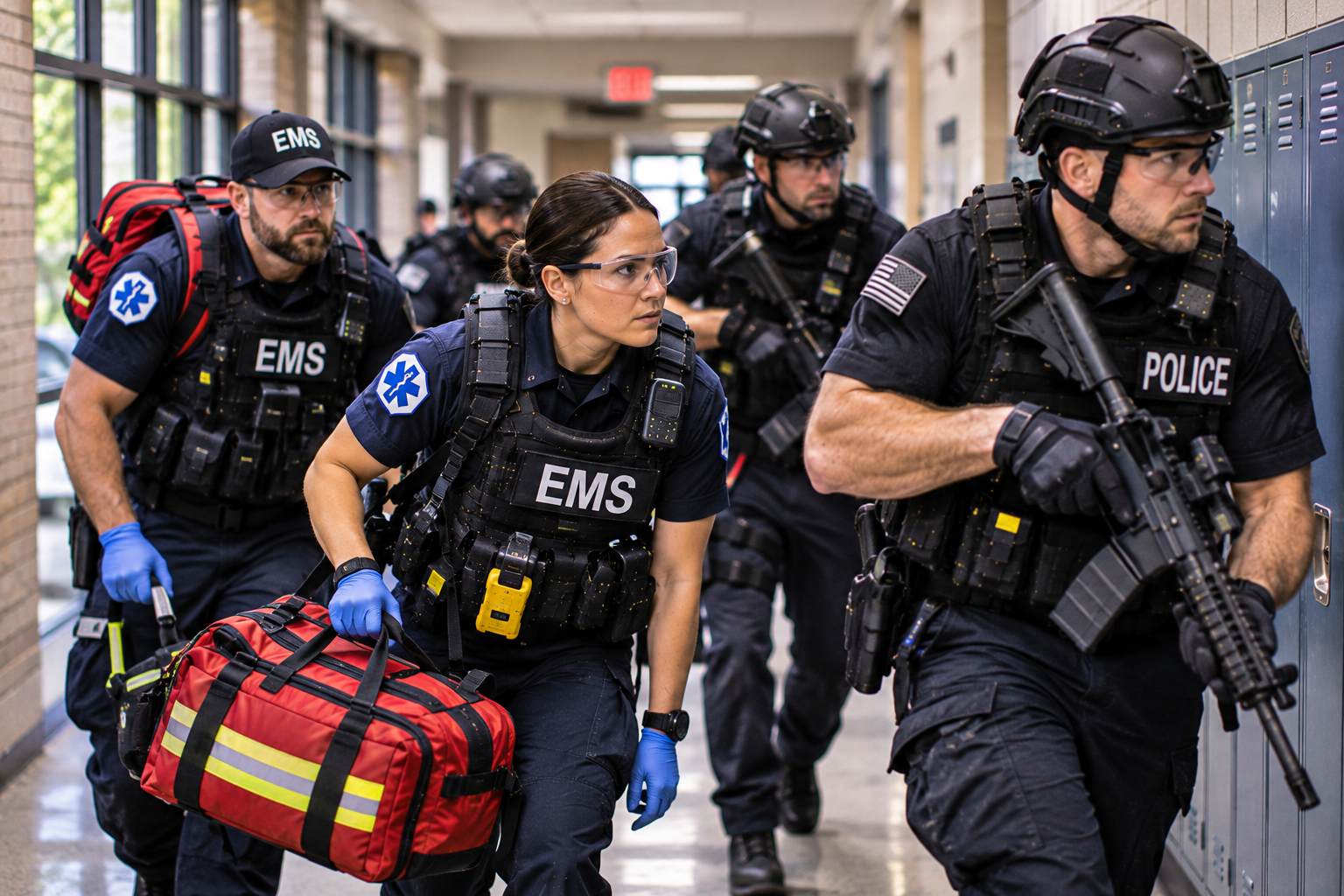
In this context, movement toward the shooter—under protection, with coordination—is not reckless. It is necessary. Treating the shooter as the X reframes movement decisions around threat containment rather than spatial avoidance.
How Language Shapes Responder Behavior
Under stress, responders rely on mental shortcuts. Words become cues that trigger rehearsed actions. If training has reinforced the idea that “get off the X” means immediate withdrawal, responders will disengage—even when conditions demand engagement.
This is not a failure of courage or commitment. It is a predictable outcome of language-driven conditioning. Terminology compresses complex decision-making into simple commands. When those commands are inaccurate, behavior follows error.
Repeated exposure to misapplied language embeds faulty assumptions:
That distance equals safety.
That movement away is always protective.
That threat resolution precedes care.
Correcting this requires more than redefining a phrase. It requires reshaping the mental model that responders carry into crisis.
The Shooter as the X: A Civilian Reframe
Reframing the X as the shooter accomplishes several critical corrections simultaneously:
It centers threat, not terrain.
Danger follows the actor, not the room.It emphasizes containment over displacement.
Movement is purposeful, not reflexive.It supports medical integration.
Care advances as protection advances.It aligns with civilian authority and capability.
Actions reflect what responders can actually do.
When responders internalize that the shooter is the X, movement decisions become more disciplined. Evacuation routes are chosen based on protection. Casualty movement is synchronized with threat management. Medical teams are positioned to intervene earlier rather than later.
This reframing does not eliminate risk—it makes risk intelligible.
Doctrinal Implications for Civilian Response
Civilian doctrine must abandon metaphorical borrowing that obscures operational truth. Military concepts can inform civilian response, but only when translated accurately.
Effective doctrine should:
Define threats as actors, not places.
Replace ambiguous commands with function-based language.
Specify conditions under which movement is protective.
Integrate medical and tactical considerations explicitly.
For example, rather than instructing responders to “get off the X,” doctrine might direct teams to:
Move casualties laterally under cover away from known threat vectors.
Advance medical access behind protected law enforcement movement.
Maintain orientation on shooter location at all times.
Precision replaces metaphor. Clarity replaces tradition.
Interagency Consequences of Misinterpretation
Misunderstanding the X does not affect one discipline alone. It disrupts coordination across law enforcement, EMS, and fire services. When agencies interpret movement directives differently, unified command degrades.
Law enforcement may believe movement is necessary to regain initiative. EMS may interpret the same movement as withdrawal from danger. Fire personnel may delay entry entirely. The result is fragmented action driven by divergent interpretations of the same words.
Shared language must be built on shared reality. Without that foundation, coordination becomes accidental rather than deliberate.
Ethical and Operational Costs
The cost of this misinterpretation is measured in lives. Casualties bleed while responders reposition. Medical access is delayed while threats remain mobile. Responders are exposed because movement decisions are disconnected from threat dynamics.
Ethically, continuing to teach language that produces predictable harm is indefensible. Operationally, it is unsustainable. Public expectations, responder safety, and casualty survivability all demand correction.
Correcting this concept is not about rejecting military influence. It is about honoring its intent by applying it correctly—or not at all.
Conclusion
In civilian active shooter response, the most dangerous misconception is not about tactics or equipment—it is about meaning. Treating the X as a place rather than a person distorts movement decisions, delays medical care, and increases exposure for responders and victims alike.
The shooter is the X. Until civilian doctrine reflects this reality, borrowed language will continue to drive borrowed mistakes.
Words matter. They guide action under stress. When words misrepresent reality, they lead responders away from solutions and toward harm. Correcting this misinterpretation is not an academic exercise—it is a necessary step toward safer, faster, and more effective civilian response in the moments that matter most.