
Rapid Hemorrhage Control and Stop the Bleed Limitations
Rapid Hemorrhage Control and Stop the Bleed Limitations
Uncontrolled hemorrhage remains the most common cause of preventable death in traumatic injury, particularly during active shooter incidents, complex assaults, and mass-casualty events. This reality is neither new nor disputed. What remains unresolved is why—despite widespread awareness, national campaigns, and decades of trauma research—hemorrhage control continues to fail at scale. The gap is not one of intent; it is one of execution. Rapid hemorrhage control saves lives, yet current Stop the Bleed (STB) implementation models reveal critical limitations in training consistency, skill retention, equipment quality, and pediatric preparedness. These shortcomings matter most in the moments when time, clarity, and resources are least available.
This analysis examines hemorrhage control through an operational lens. It argues that while Stop the Bleed has elevated public awareness, it has not reliably translated into durable, field-ready capability. Without standardized, evidence-based training and disciplined equipment doctrine, hemorrhage control becomes aspirational rather than operational. In high-threat environments, aspiration costs lives.
Hemorrhage as the Primary Preventable Killer
Trauma science is unequivocal: severe external hemorrhage can cause death within minutes, often before definitive medical care is available. Arterial bleeding from extremity or junctional wounds rapidly overwhelms compensatory physiology, leading to hypovolemic shock and cardiac arrest. Unlike traumatic brain injury or complex internal injuries, hemorrhage is both immediately lethal and immediately correctable—if addressed early.
This duality is what makes hemorrhage control so consequential. When bleeding is controlled quickly, survival rates improve dramatically. When it is delayed—even briefly—mortality rises sharply. In active shooter incidents, where EMS access is often delayed and casualties are dispersed, hemorrhage control is frequently the only intervention capable of altering outcome.
Despite this, hemorrhage control success remains inconsistent. The problem is not ignorance of hemorrhage’s lethality; it is inconsistency in how hemorrhage control is taught, practiced, and resourced.
Stop the Bleed: Awareness Without Uniform Capability
The Stop the Bleed initiative has succeeded in one critical area: visibility. It has normalized tourniquet use, demystified bleeding control, and expanded the pool of potential responders. However, awareness alone does not equate to competence, particularly under stress.
STB training varies widely in duration, depth, and instructional rigor. Some programs offer hands-on repetition with realistic scenarios; others provide brief lectures or video-based instruction with minimal skill validation. As a result, the phrase “Stop the Bleed trained” encompasses an enormous range of actual capability.
This variability undermines reliability. In high-stress environments, individuals do not rise to the level of their awareness—they fall to the level of their training. When training is shallow, infrequent, or poorly reinforced, hemorrhage control skills degrade rapidly. The consequence is hesitation, improper application, or complete failure to intervene.
Skill Decay and Retention Failures
Hemorrhage control is a psychomotor skill. Like any hands-on intervention, it requires repetition to maintain proficiency. Yet most STB programs are delivered as one-time exposures, often without scheduled refreshers or reassessment.
Research on skill retention consistently demonstrates rapid decay when skills are not reinforced. Tourniquet application technique, wound packing under pressure, and decision-making regarding placement and priority all deteriorate over time. Infrequent practice produces false confidence—a dangerous condition in emergency response.
Operational environments amplify this risk. Under threat, cognitive bandwidth narrows, fine motor skills degrade, and stress hormones impair recall. Only deeply ingrained skills survive these conditions. Training models that rely on initial exposure rather than sustained competency are structurally mismatched to reality.
Equipment Quality: A Hidden Vulnerability
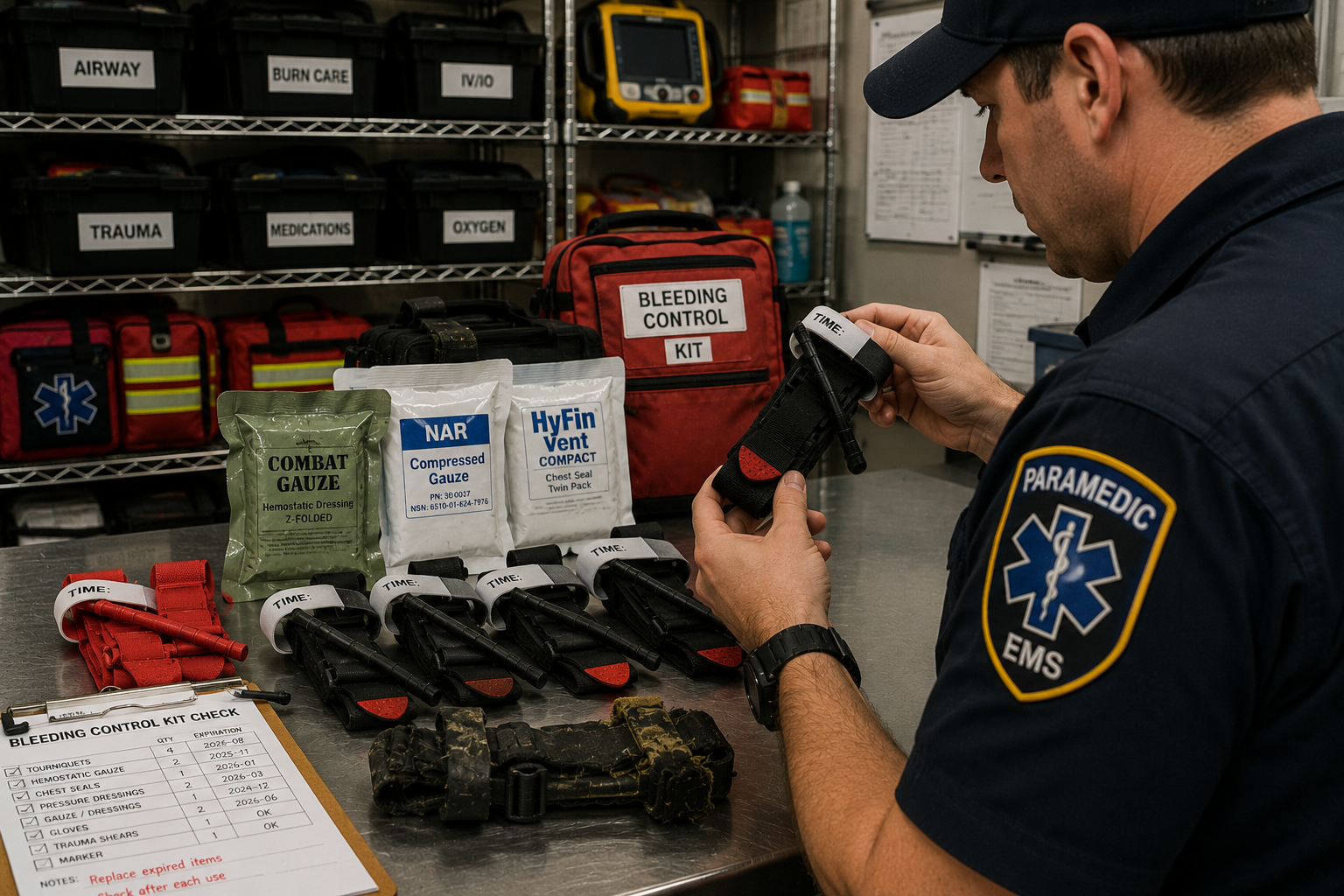
Even perfect technique fails with poor equipment. One of the least discussed limitations of hemorrhage control programs is equipment inconsistency. Tourniquets of unknown origin, expired hemostatic agents, and poorly maintained bleeding control kits are common findings during audits and after-action reviews.
Low-quality tourniquets may fail mechanically, slip under tension, or require excessive force to achieve occlusion. Expired or improperly stored hemostatic gauze may lose efficacy. In some cases, responders encounter tourniquets that appear intact but are brittle, delaminated, or compromised.
These failures are not theoretical. They occur at the point of need, when redundancy is limited and replacement is unavailable. Equipment doctrine that emphasizes quantity over quality creates an illusion of preparedness while introducing single points of failure.
The Pediatric Hemorrhage Gap
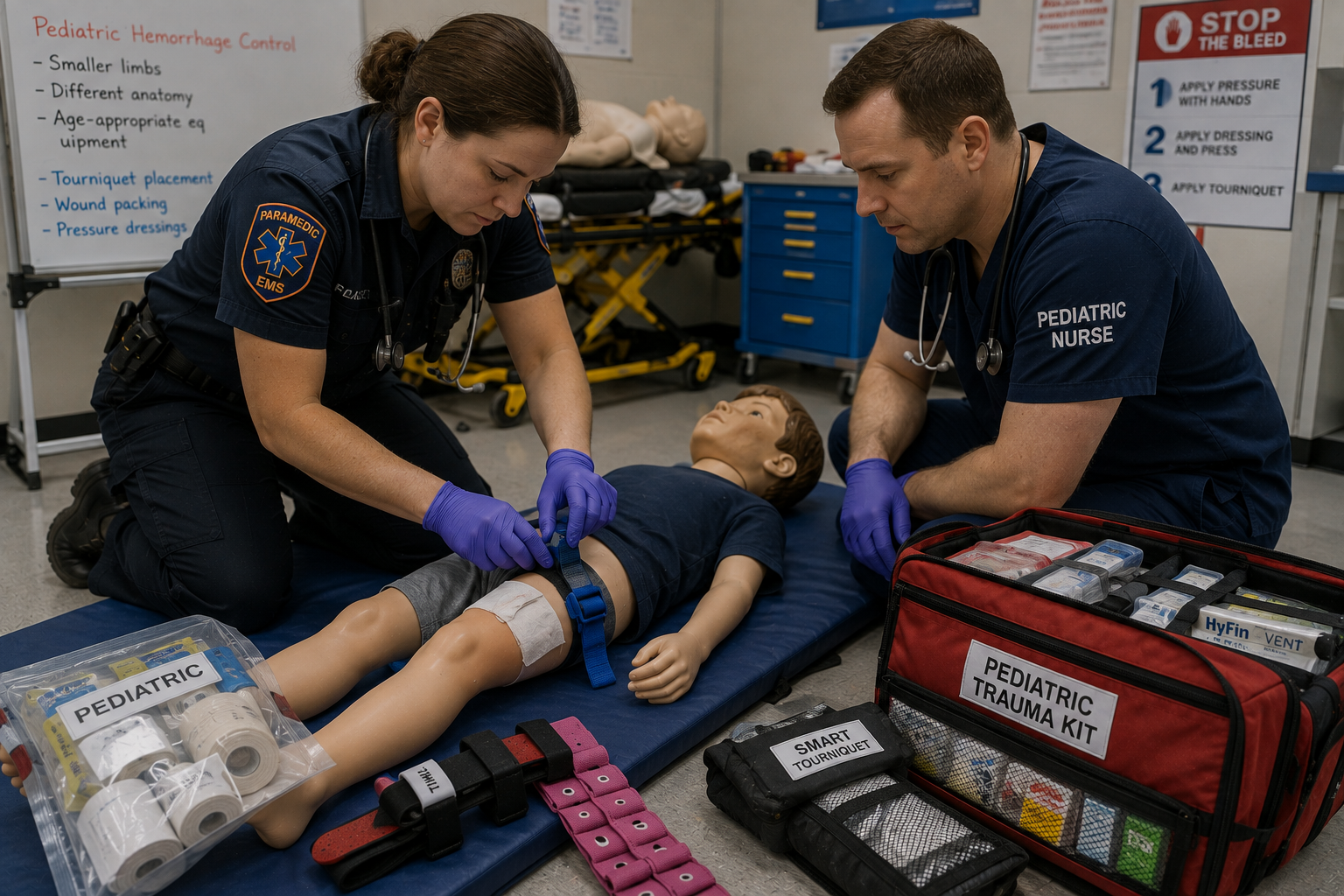
One of the most consequential limitations of current hemorrhage control programs is the systematic neglect of pediatric considerations. Children are not simply smaller adults. Their anatomy, physiology, and injury patterns differ in ways that directly affect hemorrhage control.
Standard adult tourniquets may not fit pediatric extremities effectively. Improvised solutions—pressure, elastic wraps, or pediatric-specific devices—require training that many responders and civilians never receive. Junctional and truncal bleeding in children presents additional challenges, particularly in chaotic environments.
Despite this, pediatric hemorrhage control is often relegated to a footnote in STB curricula, if addressed at all. The absence of pediatric-capable equipment in many bleeding control kits further compounds the issue. This gap becomes catastrophic in incidents involving schools, playgrounds, or family-centered venues.
Context Matters: Civilian vs. High-Threat Environments
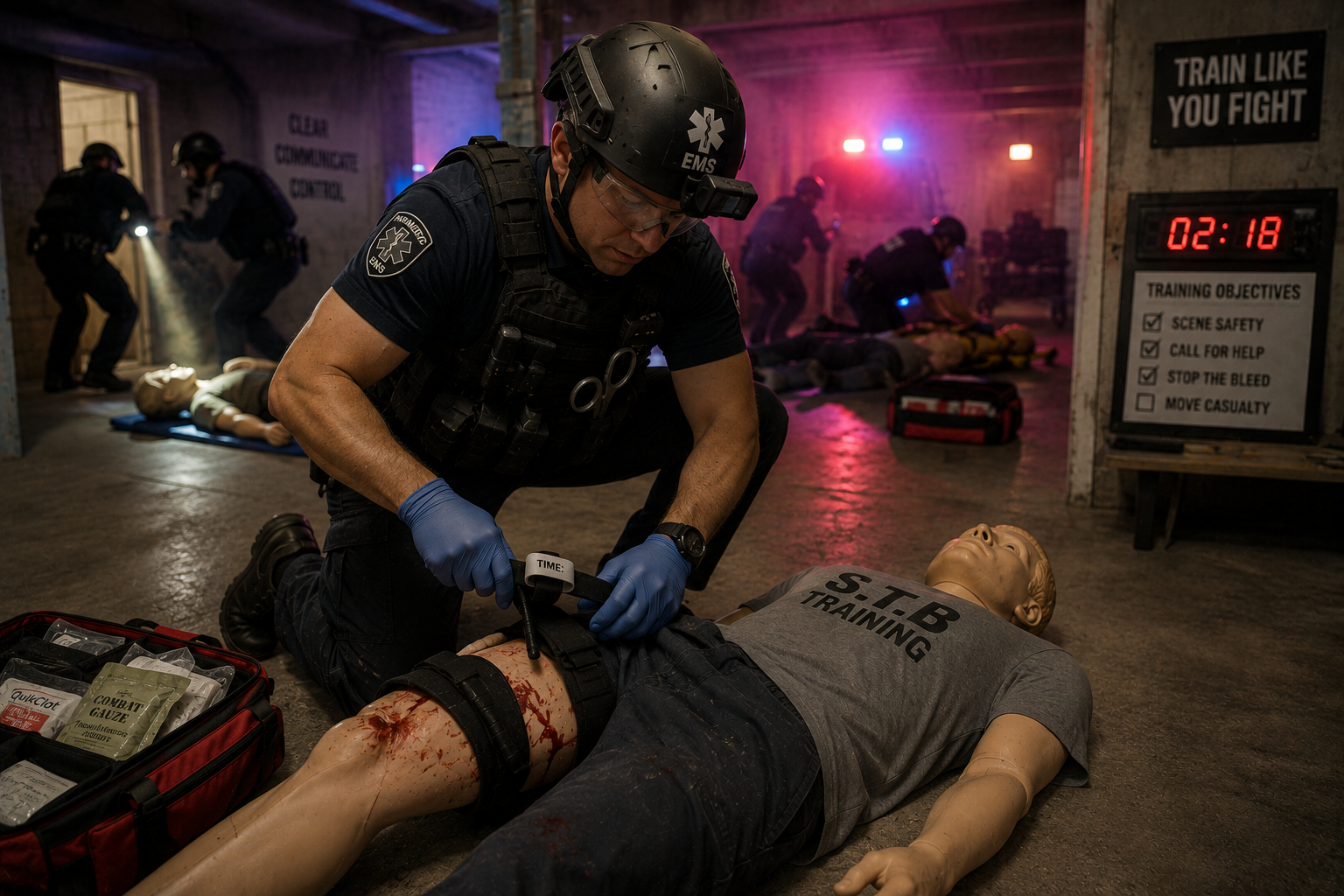
Much of Stop the Bleed training is delivered in low-threat, controlled settings. Participants practice on mannequins or cooperative classmates, without noise, movement, or competing hazards. While this environment supports initial learning, it does not prepare individuals for the conditions under which hemorrhage control is most needed.
In high-threat environments, hemorrhage control must occur under pressure, often while moving, seeking cover, or coordinating with others. Decision-making must be rapid and adaptive. Static training environments do not build this capability.
This mismatch explains why hemorrhage control performance often degrades during real incidents. The skill exists in theory but fails in execution because it was never trained in context.
Pediatric and Civilian Responders: Parallel Vulnerabilities
Both pediatric casualties and civilian responders share a common vulnerability: they are often afterthoughts in system design. STB programs frequently target adult physiology and adult decision-makers, assuming that responders will adapt as needed.
This assumption fails repeatedly. Without explicit instruction, equipment, and repetition, adaptation does not occur under stress. Systems that do not deliberately plan for pediatric hemorrhage and non-medical responders produce predictable failure modes.
Effective hemorrhage control systems are inclusive by design. They account for variability in casualty size, responder capability, and environmental threat.
Standardization as a Force Multiplier
The solution to these limitations is not abandonment of Stop the Bleed, but standardization and elevation. Evidence-based hemorrhage control training must be standardized across agencies and communities, with clear benchmarks for competency, retention, and equipment quality.
Standardization accomplishes three critical objectives:
It ensures a minimum level of performance across diverse responders.
It enables interoperability during multi-agency incidents.
It reinforces consistent mental models under stress.
Standardized training must be scenario-based, recurrent, and validated. Equipment must be vetted, maintained, and appropriate for adult and pediatric use. Without these elements, hemorrhage control remains fragile.
Relevance to High-Threat Response Doctrine
Rapid hemorrhage control is not an isolated skill; it is a cornerstone of modern high-threat response doctrine. TECC, tactical EMS models, and integrated response frameworks all assume early bleeding control as a prerequisite for survivability.
When hemorrhage control fails, downstream systems are overwhelmed. Transport timelines become irrelevant if patients exsanguinate before evacuation. Command decisions are constrained by preventable deterioration. The entire response system inherits the consequences of early failure.
Thus, hemorrhage control quality is not a medical issue alone—it is an operational one.
Training for Performance, Not Compliance
Many hemorrhage control programs prioritize certification over competence. Attendance is tracked, certificates are issued, and boxes are checked. What is often missing is performance under stress.
Effective programs test application under time pressure, with degraded visibility, competing tasks, and realistic distractions. They require participants to demonstrate—not merely describe—capability. They reinforce decision-making as much as technique.
This shift from compliance-based training to performance-based training is essential. Lives depend not on what responders know, but on what they can do when clarity is scarce.
Continuous Relevance: Why This Cannot Wait
Every high-threat incident reinforces the same lesson: bleeding kills quickly, and systems that delay or dilute hemorrhage control fail predictably. The limitations of Stop the Bleed are not abstract critiques; they are recurring contributors to preventable death.
Addressing these limitations requires commitment—from agencies, educators, and policymakers—to treat hemorrhage control as a core operational skill, not a public awareness campaign alone.
Conclusion
Rapid hemorrhage control remains the single most effective intervention for preventing death in traumatic injury. Stop the Bleed has brought this truth into public consciousness, but consciousness without competence is insufficient. Variability in training quality, skill retention, equipment reliability, and pediatric preparedness undermines the very outcomes STB seeks to improve.
To close this gap, hemorrhage control must be standardized, evidence-based, and operationally grounded. Training must be recurrent and contextual. Equipment must be reliable and inclusive. Pediatric considerations must be explicit, not implied.
In high-threat environments, bleeding does not wait for perfect conditions. Systems that fail to prepare responders accordingly will continue to produce preventable loss. The solution is not more awareness—it is better capability, delivered consistently, when it matters most.