
Tactical Evacuation and Prioritization of Care
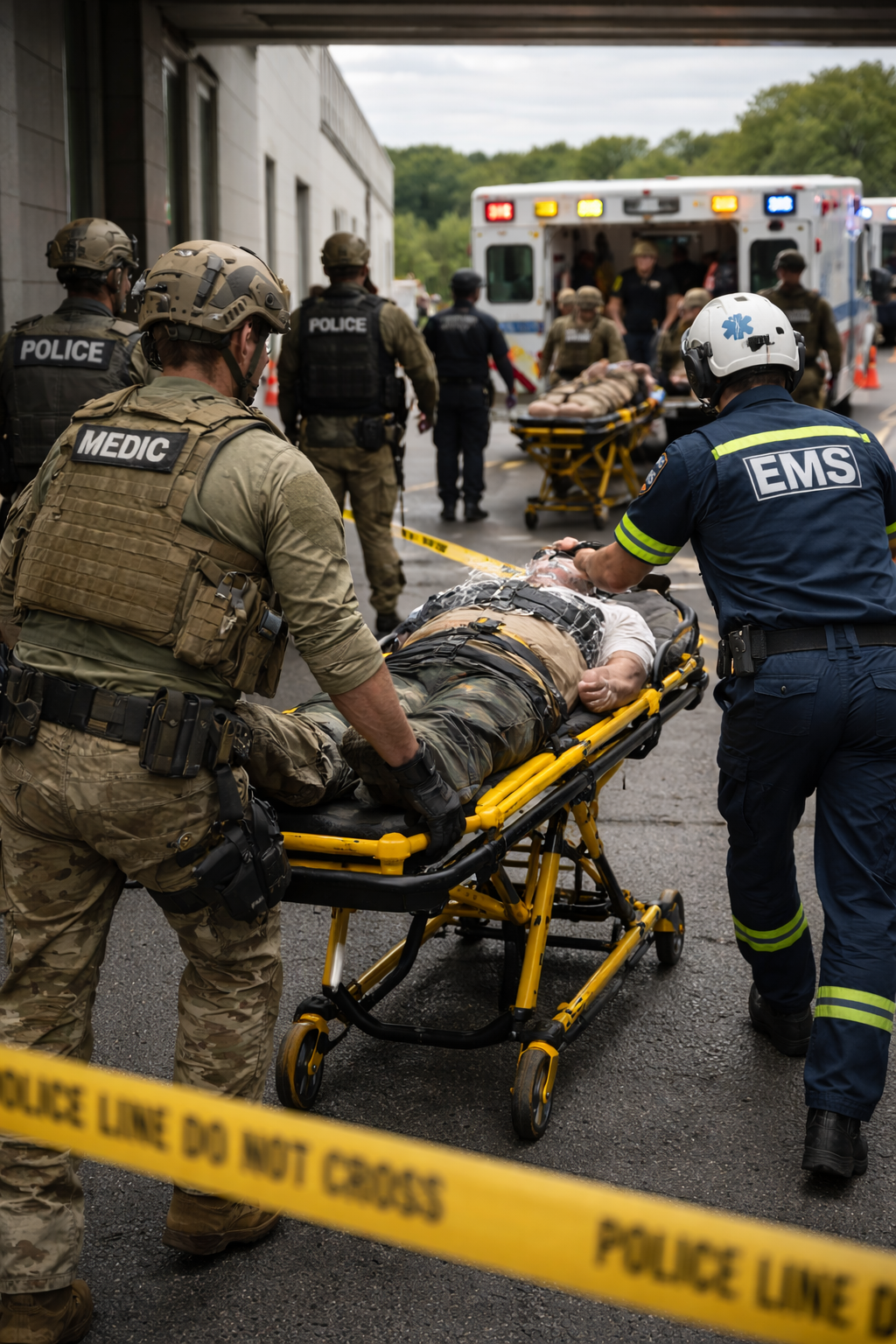
Tactical Evacuation and the Prioritization of Care: Moving Patients Without Creating New Risk
In high-threat incidents, evacuation is not simply transport—it is a tactical act that directly shapes survivability, responder safety, and operational control. Casualties do not survive because they are moved quickly; they survive because they are moved deliberately, in the correct order, through controlled space, after the right care has been applied. When evacuation is rushed, improvised, or driven by emotion rather than prioritization, it creates secondary harm: preventable deaths, compromised security, and operational collapse.
The central argument of this analysis is precise: tactical evacuation must be structured, prioritized, and security-informed to preserve life and maintain control in high-threat environments. Evacuation is a continuation of care and threat management—not a handoff that occurs after decisions are finished. By applying the science of listener attention—front-loaded relevance (primacy), structured cognitive chunking, progressive emphasis, repetition with variation, and continuous relevance anchoring—this article explains why disciplined evacuation doctrine is essential during the Stabilization Phase of the CSR framework and beyond.
Why Evacuation Decisions Matter More Than Speed
In mass-casualty and active-threat incidents, evacuation often becomes the emotional center of gravity. Responders feel pressure to “get people out” as quickly as possible. While understandable, this instinct can be dangerous. Unprioritized evacuation converts urgency into chaos.
Evacuation decisions determine:
Which patients receive definitive care in time
Which responders remain exposed during movement
Whether secure corridors remain intact
Whether suspects are controlled or reintroduced as threats
Front-loading this relevance is essential: evacuation is not the end of the medical mission—it is one of its most consequential phases.
Tactical Evacuation Defined: Movement Under Control
Tactical evacuation differs fundamentally from routine EMS transport. It is defined by three characteristics:
Movement occurs within secure or managed cordons
Evacuation order is based on survivability, not visibility or severity alone
Security considerations remain active throughout transport
Within the CSR framework, tactical evacuation typically expands during the Stabilization Phase, when internal and external cordons are established and command synchronization improves. However, the principles apply regardless of phase: movement must never outpace control.
Evacuation corridors are deliberate constructs—protected routes from CCPs to ambulances. When these corridors are established and enforced, patient flow becomes predictable, responder exposure decreases, and command maintains situational awareness.
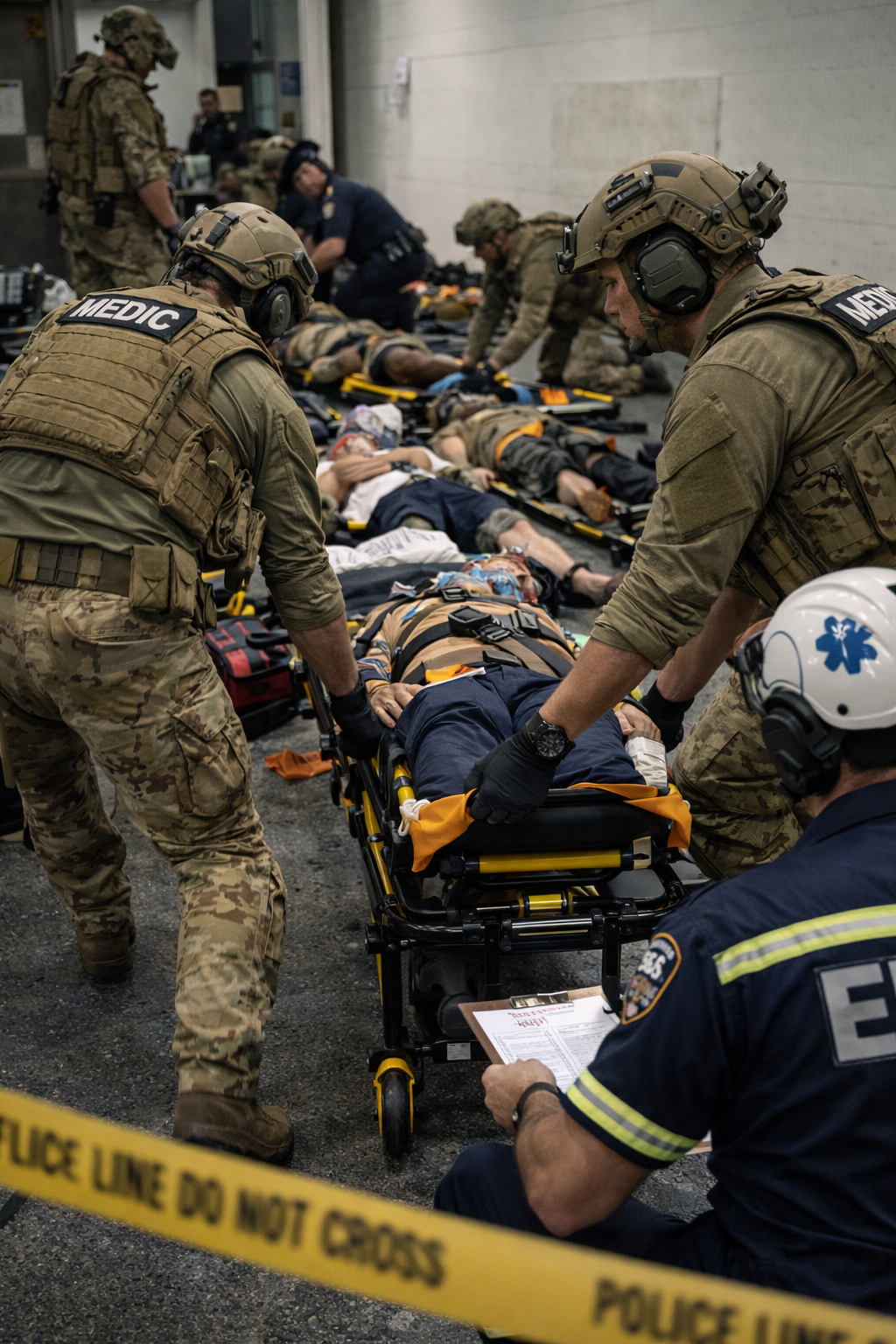
Prioritization of Care: Survivability Over Severity
One of the most critical—and frequently misunderstood—elements of tactical evacuation is prioritization. Priority is not determined by how injured a patient appears, but by who is most likely to survive with timely intervention.
This distinction is essential. In high-threat incidents:
Some critically injured patients may be non-salvageable despite rapid transport
Some moderately injured patients may deteriorate rapidly without evacuation
Transport resources are limited and must be allocated deliberately
Dynamic triage feeds evacuation prioritization. Patients are reassessed continuously, and evacuation order adapts as conditions change. This ensures that ambulances are used where they will have the greatest impact.
Repetition with variation reinforces this point: the sickest patient is not always the first patient who should move. The patient who can live is.
CCPs as Launch Points for Evacuation
Casualty Collection Points (CCPs) function as launch points, not holding areas. Their role in evacuation is to ensure patients leave stabilized, packaged, and prioritized. When CCP operations are efficient, evacuation accelerates safely. When CCPs are overwhelmed or disorganized, evacuation becomes erratic.
Effective CCP-to-ambulance flow includes:
Clear documentation of interventions performed
Visible triage and evacuation priority indicators
Physical separation of patients by movement readiness
Continuous communication with transport officers and command
This structured approach reduces on-scene decision friction and prevents repeated reassessment at the ambulance door—one of the most common sources of delay and confusion.
Security Considerations During Evacuation
Evacuation is one of the most vulnerable moments in a high-threat incident. Responders are focused on movement rather than observation. Patients are exposed. Corridors can be disrupted. For these reasons, security must be actively managed during evacuation.
Key security principles include:
Law enforcement maintains overwatch of evacuation corridors
Movement occurs only through cleared and controlled routes
Ambulance loading zones remain within secured perimeters
Communications remain open between transport units and command
Evacuation without security is not rescue—it is risk transfer. Tactical evacuation integrates security so that care and control advance together.
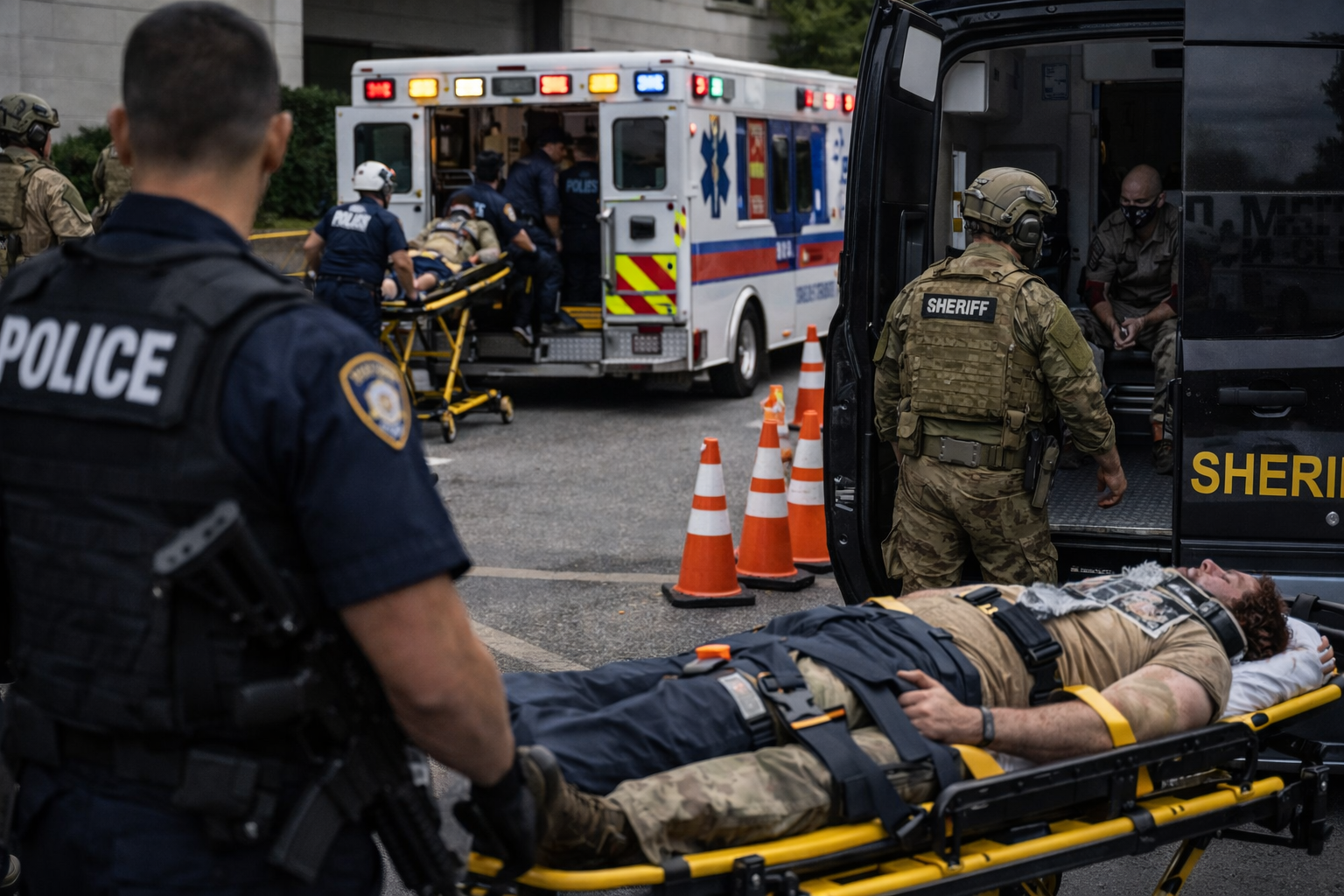
The Complication of Injured Suspects
One of the most operationally sensitive aspects of tactical evacuation involves injured suspects. These individuals present unique risks: they may conceal weapons, feign incapacity, or become violent during transport. Mishandling suspect evacuation has resulted in secondary assaults, vehicle takeovers, and responder injury.
Doctrine must be explicit:
Civilian and responder casualties are prioritized first
Injured suspects are evacuated only after critical patients are secured
Suspect transport occurs separately from civilians
Law enforcement maintains custody throughout movement
This is not a moral judgment; it is a security necessity. Mixing suspects with civilian casualties or EMS crews creates unacceptable risk. Separate transport preserves control and protects medical personnel.
Clear policy protects responders from hesitation and second-guessing in moments of pressure.
Separate Transport as a Safety Imperative
Separate transport of injured suspects is not optional—it is a risk mitigation strategy. Ambulances are not detention environments. EMS providers are not custodial officers. When suspects are transported alongside victims, the medical system inherits a security burden it is not designed to manage.
Separate transport ensures:
EMS crews can focus on patient care
Law enforcement maintains direct control of suspects
Civilians are not exposed to additional threat
Chain-of-custody and investigative integrity are preserved
This separation simplifies evacuation decision-making and reinforces interagency role clarity—an essential component of Unified Command.
Cognitive Load and Evacuation Discipline
High-stress environments amplify cognitive load. Evacuation discipline reduces it. When responders know who moves first, where they move, and under what protection, decisions become faster and more consistent.
Listener attention science emphasizes that under stress, responders fall to their lowest level of training. If evacuation is trained as ad hoc and improvisational, chaos follows. If it is trained as structured and prioritized, discipline emerges under pressure.
Evacuation plans must therefore be simple, repeatable, and rehearsed. Complexity kills tempo.
Command and Control: Preventing Evacuation Collapse
The Incident Command Post plays a critical role in preventing evacuation collapse. Command must:
Track available transport assets
Maintain a real-time evacuation priority list
Coordinate hospital destinations to prevent overload
Adjust priorities as patient conditions evolve
Without centralized oversight, evacuation devolves into first-come, first-served transport—one of the most common failure modes in mass-casualty response.
Unified Command ensures that medical urgency, security risk, and system capacity are balanced simultaneously.
Operational Efficiency and System Recovery
Effective tactical evacuation does more than save individual lives—it stabilizes the system. As critical patients leave the scene, resource strain decreases. CCP congestion eases. Law enforcement consolidates security. Fire and EMS can transition to secondary tasks.
This cascading benefit explains why evacuation discipline is a force multiplier. Each properly prioritized transport improves the next decision.
Progressive emphasis reinforces the idea: good evacuation decisions reduce downstream chaos.
Training Implications: Practicing the Hard Decisions
Tactical evacuation cannot be learned in theory alone. Training must include:
Prioritization under scarcity
Injured suspect management scenarios
Corridor security during movement
Command-level evacuation tracking
Scenarios should force responders to delay transport of visibly injured patients in favor of more salvageable ones—an uncomfortable but necessary skill. Repetition with variation builds confidence to make these decisions under real pressure.
Training must normalize discipline, not heroics.
Ethical Realism in Evacuation
Evacuation prioritization is often mischaracterized as morally fraught. In reality, it is ethically grounded in outcomes. Saving the most lives requires accepting that not all patients can move first.
Ethical realism acknowledges scarcity and chooses actions that maximize survival. Avoiding prioritization does not eliminate moral weight—it simply shifts it into worse outcomes.
Clear doctrine and training support responders by ensuring these decisions are institutional, not personal.
Progressive Emphasis: Movement With Purpose
Across every layer of tactical evacuation, one theme recurs: movement must have purpose.
Purposeful prioritization saves lives
Purposeful corridors preserve security
Purposeful separation prevents secondary harm
Evacuation that lacks purpose creates new emergencies. Evacuation that is disciplined resolves them.
Conclusion
Tactical evacuation is one of the most consequential phases of high-threat incident response. When executed deliberately, it preserves life, protects responders, and stabilizes operations. When rushed or unstructured, it creates secondary risk and preventable death.
By prioritizing survivability over severity, maintaining secure evacuation corridors, separating injured suspects, and synchronizing movement through Unified Command, response systems align evacuation with both medical reality and security necessity.
In high-threat environments, evacuation is not simply about getting patients out. It is about getting the right patients out, in the right order, without creating new danger.