
Technology Integration in Active Shooter Response
Technology Integration in Active Shooter Response
Technology now shapes the difference between reacting to violence and managing it. In active shooter and mass-casualty incidents, seconds matter, information is incomplete, and decisions must be made under extreme stress. Traditional response models relied heavily on human observation, radio reports, and delayed situational awareness. Modern threat environments no longer allow that luxury. When responders operate without real-time intelligence, they move slower, hesitate longer, and expose both themselves and victims to unnecessary risk.
This analysis examines technology integration as an operational force multiplier rather than a discretionary enhancement. The central argument is clear: technology does not replace sound tactics or medical judgment—it amplifies them by reducing uncertainty, compressing decision timelines, and improving coordination across disciplines. When integrated deliberately, modern tools enhance situational awareness, accelerate medical care, and support unified command during the most chaotic phases of response.
Why Technology Matters in the First Minutes
The earliest minutes of an active shooter incident are defined by ambiguity. Threat location is unclear. Victim counts are unreliable. Floor plans are unfamiliar. Human reporting is fragmented and often contradictory. Historically, responders advanced into these conditions with limited information, relying on experience and intuition.
Technology directly addresses this information deficit. Real-time data collection, visualization, and transmission allow responders to shift from assumption-based action to evidence-informed movement. This shift does not eliminate risk, but it makes risk intelligible—a critical distinction in high-threat environments.
Front-loading this relevance is essential: technology integration is not about sophistication; it is about speed, clarity, and survivability.
Drones as Real-Time Overwatch and Reconnaissance
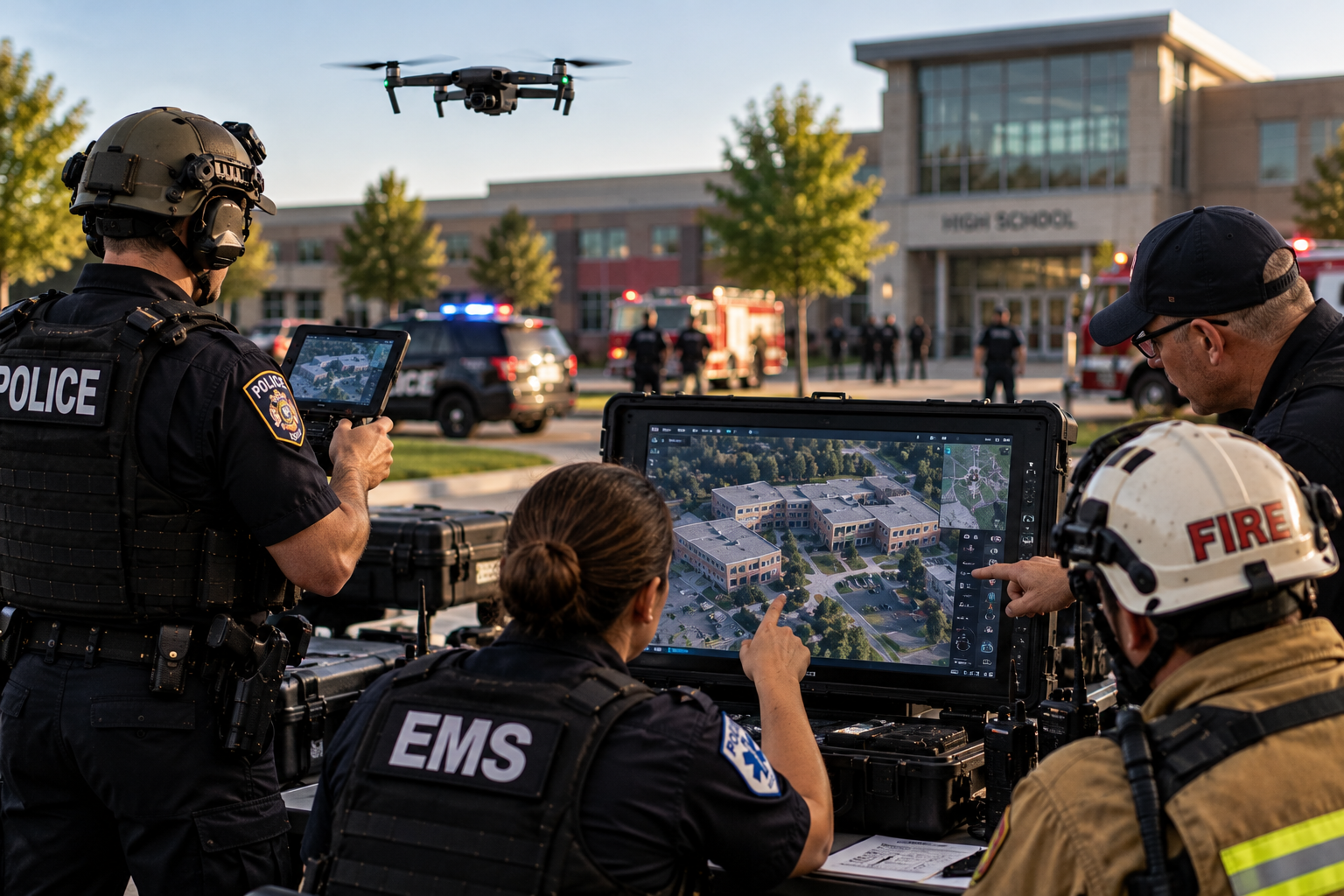
Unmanned aerial systems (UAS), commonly referred to as drones, have emerged as one of the most impactful technologies in active shooter response. Their value lies in their ability to provide rapid, overhead situational awareness without exposing personnel to danger.
Drones can:
Identify threat location and movement
Confirm or refute reports from callers and witnesses
Detect secondary threats or suspicious devices
Provide overwatch during entry and extraction
International and domestic deployments consistently demonstrate that aerial perspective reduces uncertainty. Command staff can see what responders cannot, enabling faster tasking and fewer blind movements. Importantly, drones also reduce cognitive overload by replacing fragmented radio traffic with visual confirmation.
Operational success depends on integration, not mere possession. Drone data must feed directly into command decision-making and be accessible to field elements when appropriate.
Digital Building Schematics and Interior Mapping
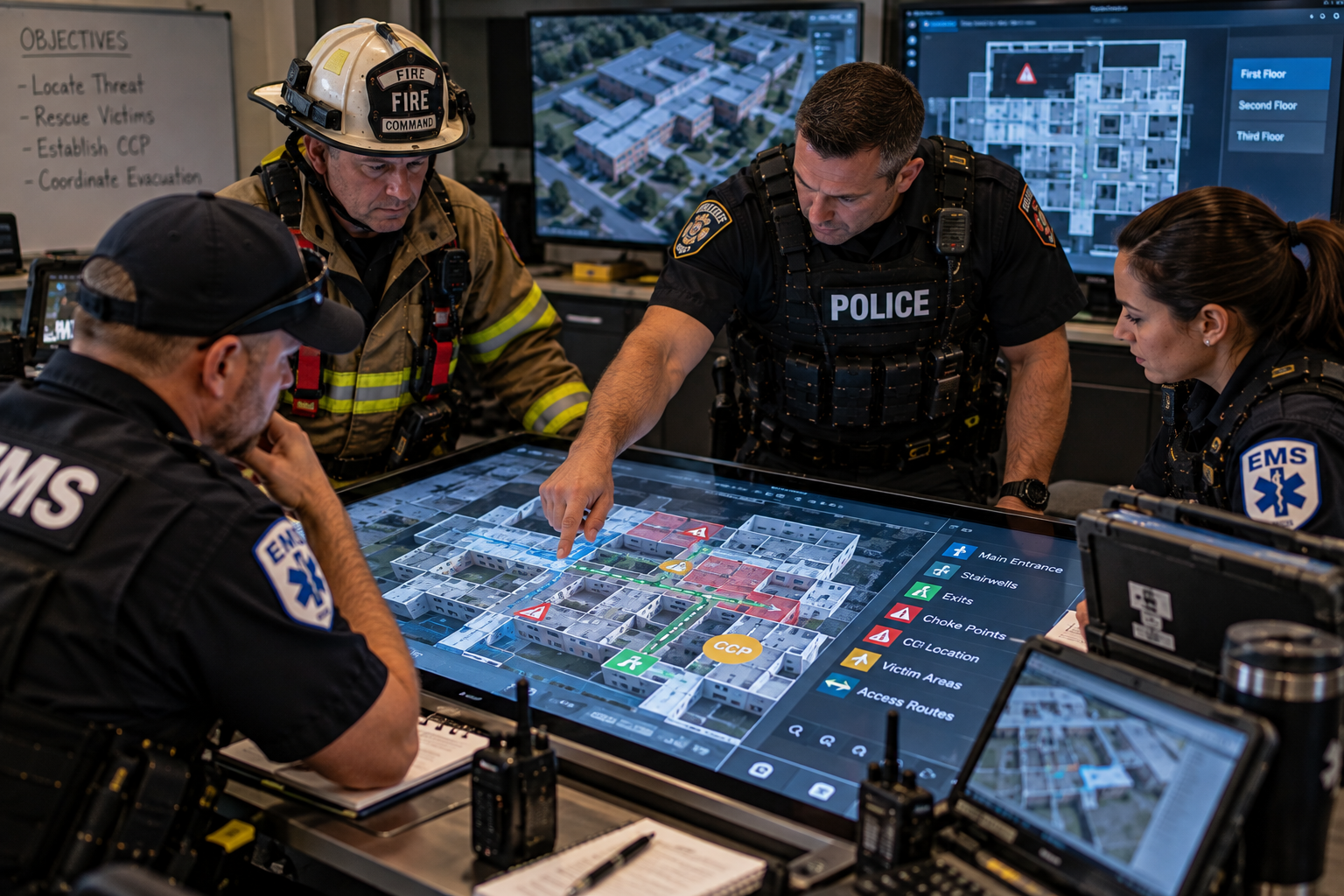
One of the most persistent challenges in active shooter response is navigating unfamiliar structures under stress. Paper floor plans, when available, are often outdated or incomplete. Verbal descriptions rarely translate into usable mental models during movement.
Digital building schematics—especially when integrated with live positioning data—transform entry planning. Responders can identify:
Stairwells, choke points, and access corridors
Areas of likely victim congregation
Optimal CCP locations
Safer extraction routes
When paired with drone or camera feeds, digital maps allow command to anticipate movement rather than react to it. This capability is particularly valuable in complex venues such as schools, hospitals, and transit hubs.
The benefit is cumulative: each reduction in uncertainty shortens decision time and reduces exposure.
Wearable Technology and Responder Tracking
Knowing where responders are is as critical as knowing where the threat is. In chaotic environments, verbal accountability quickly degrades. Wearable tracking technology—whether GPS-enabled radios, inertial sensors, or integrated personnel trackers—enhances command’s ability to maintain situational awareness.
Responder tracking supports:
Rapid accountability during mayday or officer-down events
Deconfliction of movement between teams
More precise tasking and reinforcement
Faster extraction when injury occurs
From a safety perspective, tracking reduces the likelihood of friendly interference and lost personnel. From a command perspective, it enables parallel operations rather than sequential guesswork.
Responder trust is essential. Tracking technology must be framed as a safety tool, not a surveillance mechanism, to ensure adoption and effective use.
Telemetry and Digital Triage in Medical Operations
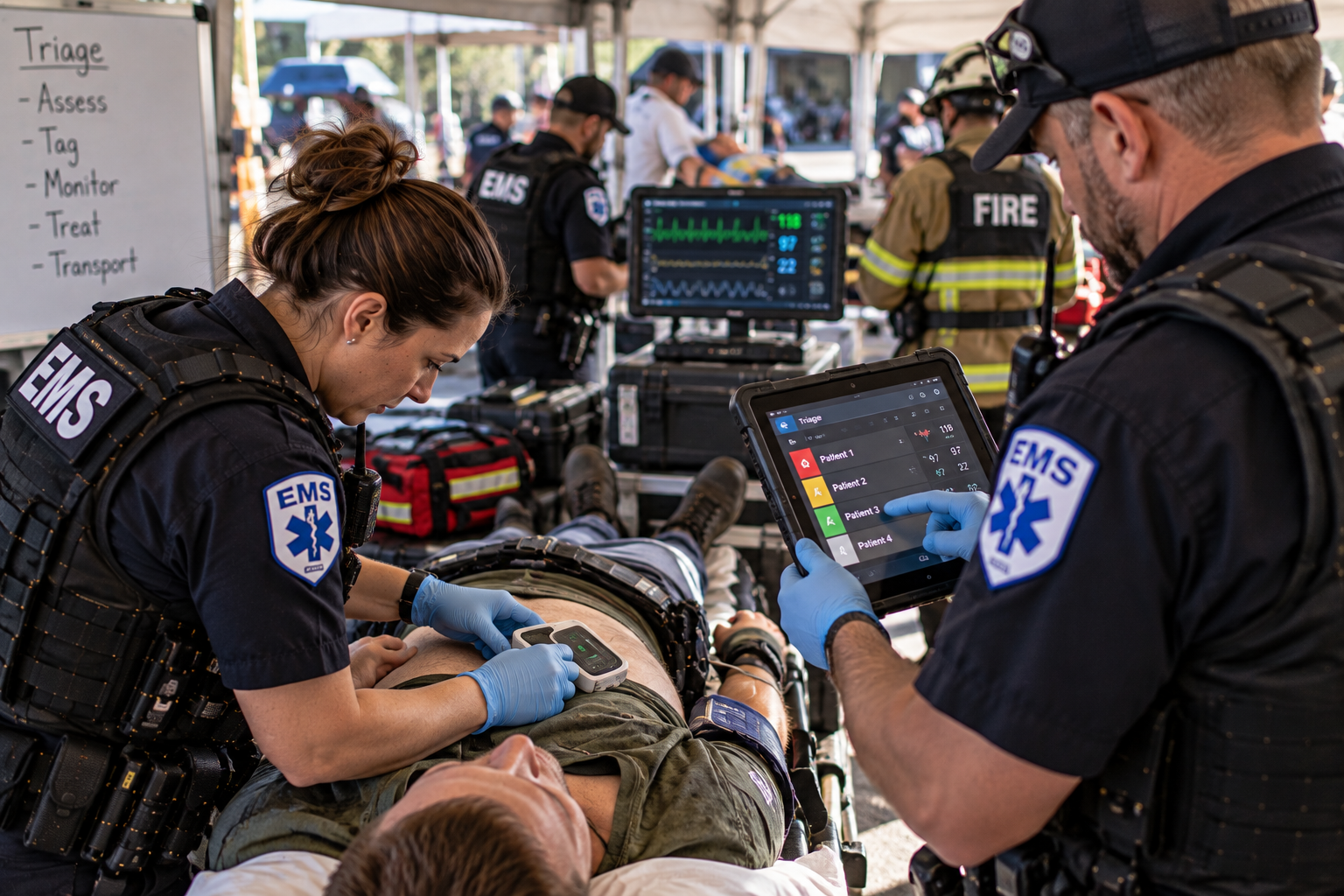
Medical response benefits significantly from technology that compresses assessment, documentation, and communication. Digital triage tools and physiological telemetry allow responders to prioritize care more effectively and communicate patient status upstream without delay.
These tools can:
Capture vital signs automatically
Flag deteriorating patients in real time
Transmit triage status to CCPs and transport units
Reduce documentation burden under stress
In mass-casualty settings, digital triage enhances dynamic reassessment. Rather than relying on static tags or memory, responders can track patient trends and adjust priorities as conditions evolve.
The result is not only faster care, but more accurate care—aligned with survivability rather than convenience.
Technology as a Situational Awareness Integrator
Situational awareness is not a single data point; it is a synthesis of location, movement, threat, and time. Technology excels at integration—combining disparate inputs into a coherent operational picture.
When drones, building schematics, responder tracking, and medical telemetry converge at the Incident Command Post, decision-making improves. Command can:
Identify gaps in coverage
Predict congestion and bottlenecks
Allocate resources proactively
Transition phases more deliberately
This integration reduces reliance on intuition alone. It supports shared understanding across law enforcement, EMS, fire, and dispatch—strengthening unified command.
Cognitive Load Reduction and Human Performance
Under stress, human cognitive capacity narrows. Responders struggle to process complex verbal information, especially when fatigued or emotionally taxed. Technology mitigates this limitation by externalizing memory and visualization.
Maps replace mental reconstruction. Video replaces verbal description. Dashboards replace fragmented reports. Each substitution reduces cognitive load and preserves decision-making bandwidth for critical judgment.
Importantly, technology should simplify—not complicate—operations. Poorly designed interfaces or excessive data streams overwhelm rather than assist. Integration must prioritize clarity and relevance.
Training and Familiarity: The Critical Enabler
Technology unused in training fails in crisis. Responders do not adopt new tools instinctively under stress; they default to what they know. Effective integration therefore requires routine exposure, repetition, and evaluation.
Training must include:
Hands-on operation under realistic conditions
Scenario-based decision-making using live data
Interagency coordination around shared platforms
Failure-mode exercises when technology degrades
This approach ensures that technology enhances performance rather than distracting from it.
Limitations and Ethical Considerations
Technology is not infallible. Connectivity fails. Batteries deplete. Data can be misinterpreted. Overreliance without contingency planning introduces new vulnerabilities.
Ethical considerations also arise, particularly with surveillance tools and data retention. Agencies must balance operational benefit with privacy, transparency, and public trust. Clear policies governing use, storage, and access are essential.
Technology should support human decision-making, not replace accountability.
Continuous Relevance: Technology as an Operational Baseline
What was once innovative is now expected. Communities increasingly assume responders will leverage available technology to protect life. Failure to do so appears negligent rather than cautious.
As threats evolve, so must tools. Technology integration is not a one-time upgrade but a continuous process of assessment, adaptation, and alignment with doctrine.
Implications for Policy and Leadership
Leaders determine whether technology becomes capability or clutter. Procurement without integration wastes resources. Integration without training creates risk. Policy must define how tools support operational objectives, not merely authorize their use.
Successful agencies treat technology as part of doctrine—embedded in planning, training, and evaluation rather than bolted on after incidents.
Conclusion
Technology integration fundamentally reshapes active shooter response by reducing uncertainty, accelerating decision-making, and enhancing coordination across disciplines. Drones, digital schematics, responder tracking, and medical telemetry provide actionable intelligence when it matters most.
These tools do not replace skill, courage, or judgment. They sharpen them. When integrated deliberately and trained consistently, technology transforms chaos into manageability and reaction into control.
In modern high-threat response, situational awareness is survival. Technology, properly employed, is one of its most powerful enablers.