
Trauma Kits as Scalable IFAKs: Supporting 10–15 Casualties
Trauma Kits as Scalable IFAKs: Supporting 10–15 Casualties
In high-threat and mass-casualty environments, survivability hinges on how quickly lifesaving interventions reach the injured—not on how rapidly an incident is declared “secure” or how soon transport assets arrive. While Individual First Aid Kits (IFAKs) remain essential for self-aid and immediate buddy-aid, they are structurally incapable of supporting the medical demands of multi-patient incidents. This gap between personal survivability tools and full EMS units is where trauma kits operate. Properly understood and deployed, trauma kits function as scalable IFAKs: multi-patient extensions of the same life-saving logic, designed to sustain care for approximately 10–15 casualties until higher-level resources can engage.
The failure to recognize trauma kits as a distinct and essential layer of medical capability has contributed to repeated operational breakdowns in active shooter and mass-violence responses. When agencies attempt to stretch IFAKs beyond their design limits or delay trauma kit deployment until traditional EMS staging occurs, preventable deaths increase. Restoring clarity around the role of trauma kits—and deliberately integrating them into warm-zone and casualty collection point (CCP) operations—is a necessary evolution in tactical medical doctrine.
Bridging the Gap Between IFAKs and EMS Units
IFAKs and EMS transport units represent two ends of the medical response spectrum. The IFAK is optimized for speed, simplicity, and personal survivability at the point of injury. EMS units, by contrast, are designed for advanced assessment, sustained treatment, and transport once a degree of control has been established. Trauma kits exist to bridge the operational gap between these two capabilities.
In modern active shooter incidents, this gap is not theoretical—it is temporal and spatial. FBI data and after-action reports consistently show that most incidents conclude within minutes, yet medical access often lags far behind. During this interval, responders encounter multiple casualties with life-threatening hemorrhage, airway compromise, and chest injuries. IFAKs are exhausted quickly, and EMS units remain staged or delayed by security constraints.
Trauma kits provide an intermediate solution: mobile, responder-carried medical systems capable of sustaining life-saving care across multiple patients while the incident remains fluid. They extend the logic of the IFAK—rapid hemorrhage control, airway support, chest injury management—but scale it to meet the realities of mass injury.
Designed for Multi-Patient Hemorrhage Control
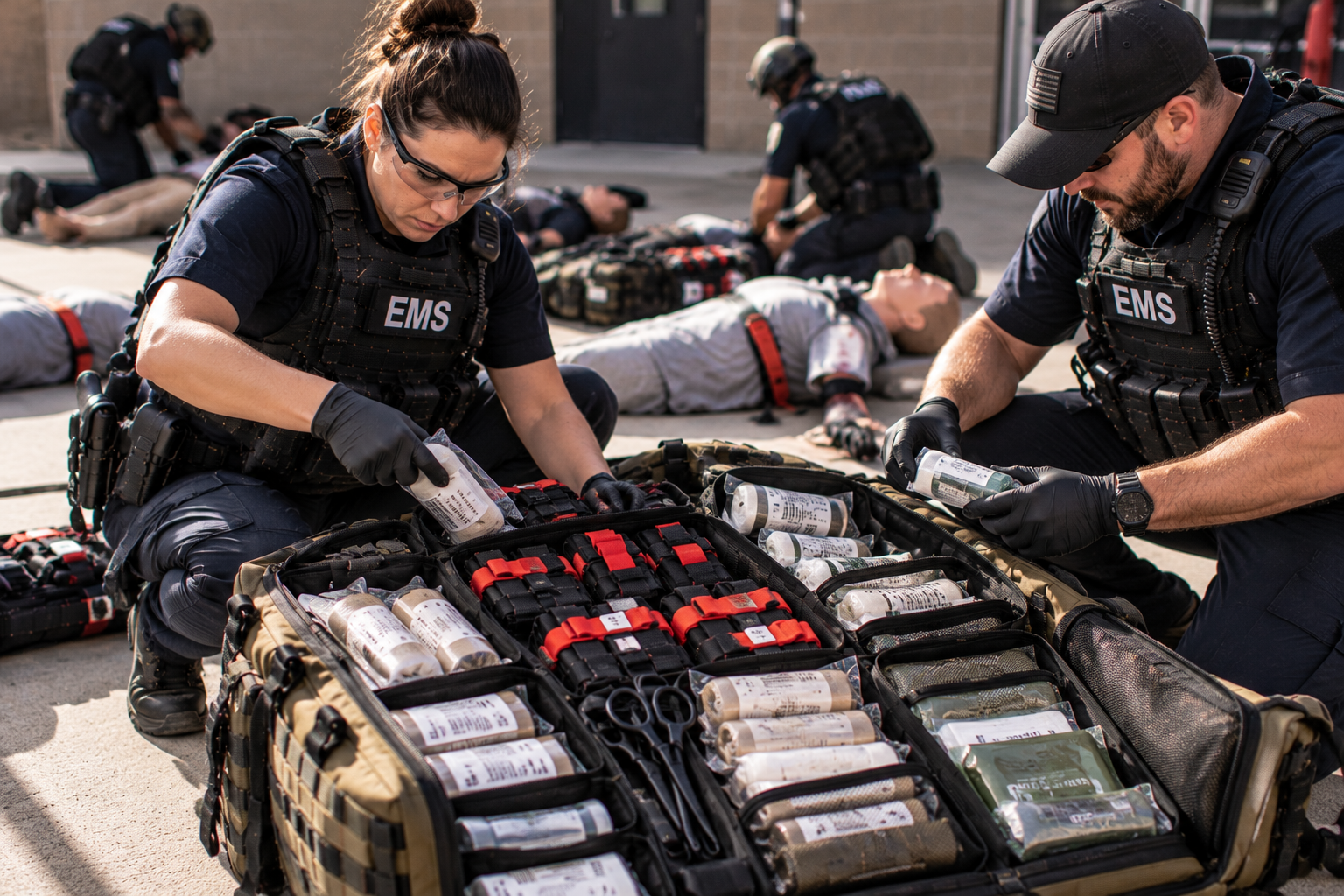
At the core of trauma kit design is the recognition that hemorrhage control must be repeatable, not singular. Unlike IFAKs, which assume one casualty, trauma kits are deliberately stocked with redundancy. Multiple tourniquets, large quantities of hemostatic gauze, pressure dressings, and chest seals allow responders to address repeated life-threatening injuries without immediately exhausting resources.
This redundancy is not excess; it is alignment with known injury patterns. Mass shooting and hybrid attacks frequently produce clusters of casualties with similar injury mechanisms—extremity gunshot wounds, junctional bleeding, and penetrating thoracic trauma. A trauma kit configured to manage 10–15 patients reflects both empirical data and physiological reality.
Importantly, trauma kits prioritize high-yield interventions. They do not attempt to replicate ambulance-level capabilities. Instead, they focus on stopping bleeding, supporting breathing, and stabilizing patients long enough to move them forward in the care continuum. This focus preserves speed, minimizes cognitive load, and ensures that care can be delivered under stress by responders operating in contested environments.
Enabling Sustained Operations During Delays
One of the most dangerous assumptions in traditional response models is that advanced medical care will arrive quickly once the threat is controlled. In practice, access delays are common. Secondary threats, large geographic footprints, communication failures, and resource limitations frequently slow EMS entry and transport.
Trauma kits mitigate these delays by enabling sustained operations. Rather than providing a single intervention and moving on, responders equipped with trauma kits can maintain pressure, replace saturated dressings, reapply tourniquets, and manage multiple patients over extended periods. This sustained capability is especially critical in incidents involving large venues, multiple floors, or delayed evacuation routes.
From an operational perspective, trauma kits buy time. They prevent physiological deterioration while command, security, and transport elements catch up to the medical problem. Without this capability, casualties deteriorate silently, and survivability declines long before ambulances arrive.
Supporting CCP and Warm-Zone Care
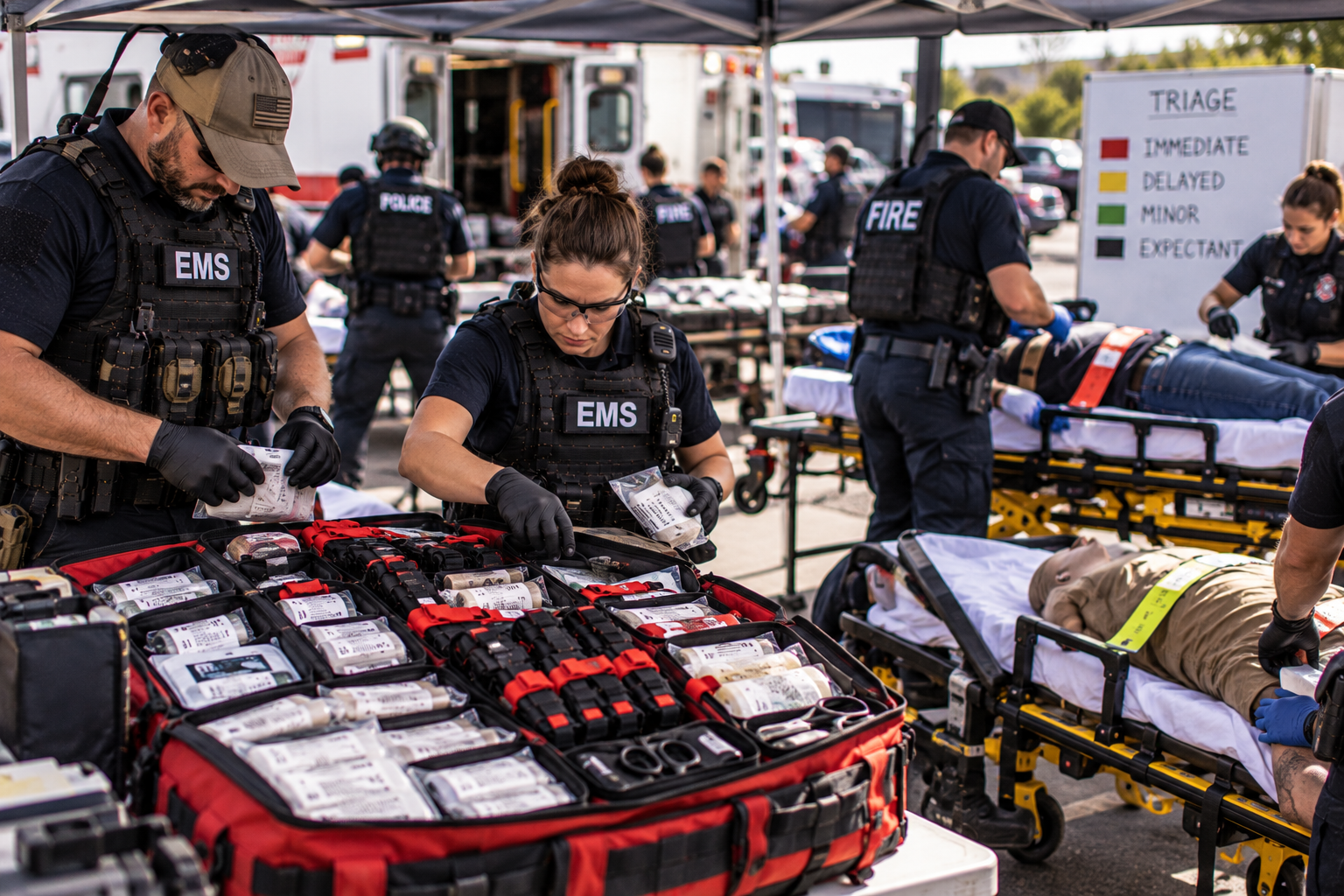
Trauma kits are most effective when integrated into casualty collection points and warm-zone operations. CCPs function as nodes of organization within chaos—locations where triage, treatment, and preparation for evacuation converge. Without sufficient medical resources, CCPs become little more than holding areas.
Trauma kits transform CCPs into functional treatment sites. Their contents support rapid triage, immediate hemorrhage control, airway positioning, and chest injury management across multiple patients. When deployed early, they allow CCPs to absorb patient flow rather than bottleneck it.
In warm-zone operations, trauma kits enable responders to initiate care closer to the point of injury, reducing movement distances and time to intervention. This forward placement aligns with Tactical Emergency Casualty Care (TECC) principles and modern evidence showing that earlier care improves outcomes. By contrast, reliance on evacuation-first models delays treatment and exposes casualties to secondary threats during movement.
Intentional Staging and Accessibility
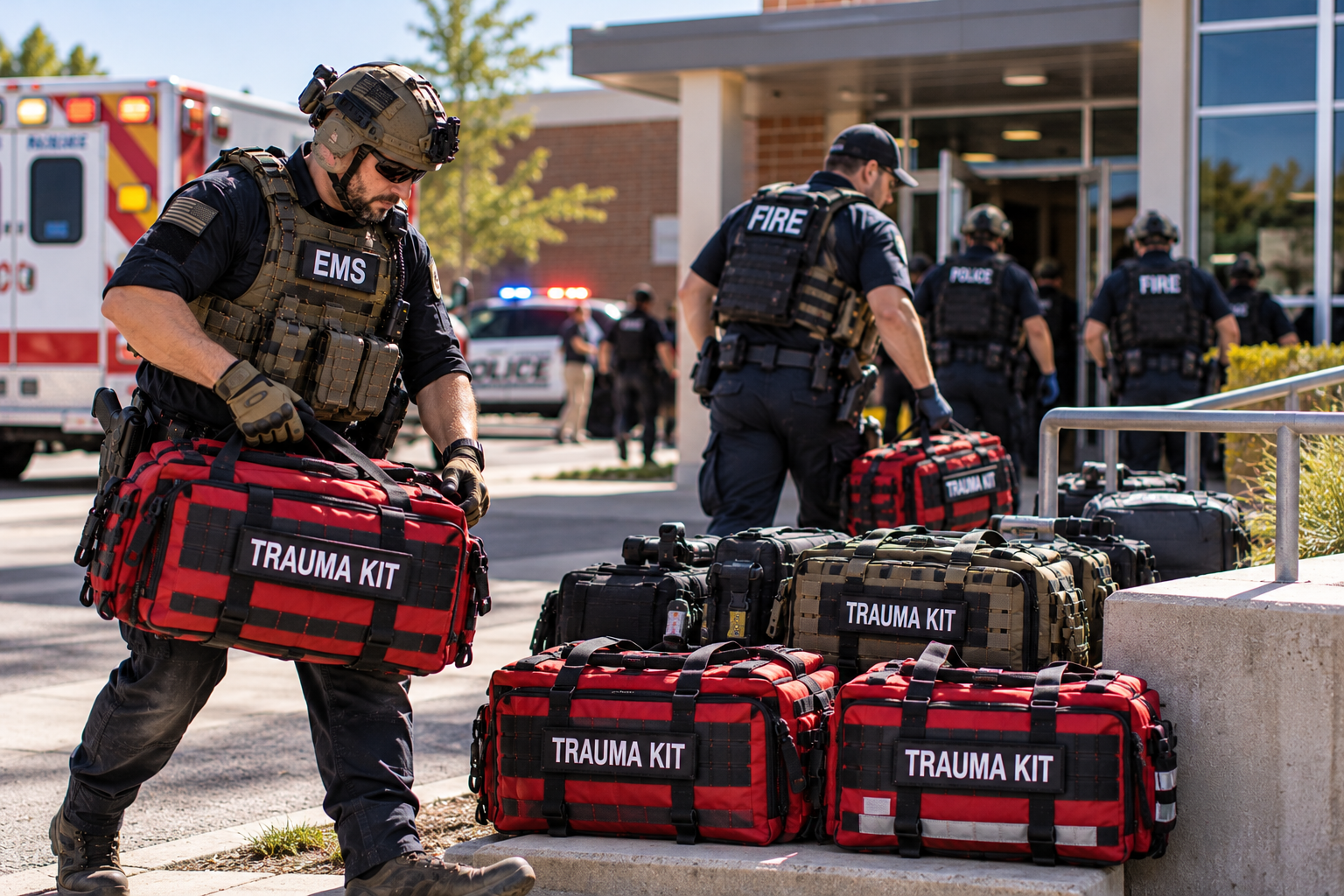
Despite their importance, trauma kits often fail not because of poor contents, but because of poor staging. Kits locked in vehicles, stored in distant apparatus, or treated as specialty equipment are effectively absent when seconds matter. Intentional staging is therefore a doctrinal requirement, not an administrative detail.
Trauma kits must be positioned where responders can access them early—near entry points, with rescue task forces, or embedded within law enforcement and fire response elements. Accessibility must account for movement under threat, not ideal conditions. A kit that cannot be reached without traversing unsecured space is unlikely to be used when needed.
Additionally, responders must know who carries trauma kits and where they are located. This requires standardization, labeling, and consistent deployment practices. When trauma kits are treated as shared operational assets rather than optional accessories, their impact increases dramatically.
Trauma Kits Versus Misused IFAKs
A recurring failure pattern in mass-casualty incidents is the attempt to substitute IFAKs for trauma kits. Responders expend their personal survivability equipment on multiple casualties, leaving themselves vulnerable and still failing to meet the scale of medical need. This misuse reflects the absence—or misplacement—of appropriate trauma resources.
Trauma kits resolve this contradiction by preserving the IFAK’s self-aid role while providing a scalable solution for scene care. When responders trust that trauma kits are available and staged intentionally, they are less likely to misuse IFAKs prematurely. This alignment protects both responder survivability and casualty outcomes.
Training and Cognitive Alignment
Trauma kits are only effective when responders are trained to use them under realistic conditions. Training must emphasize rapid identification of life threats, efficient use of supplies, and coordination within CCPs and warm zones. Just as importantly, training must reinforce the distinction between IFAKs and trauma kits—what each is for, and when each should be used.
Under stress, responders default to familiar patterns. If training consistently integrates trauma kits into scenarios involving multiple casualties and delayed transport, their use becomes intuitive. Repetition with variation—different environments, casualty profiles, and threat conditions—builds adaptability without sacrificing clarity.
Conclusion
Trauma kits are not optional enhancements to tactical medical response; they are essential bridges between personal survivability tools and advanced medical systems. As scalable IFAKs, they provide the redundancy, sustainment, and flexibility required to support 10–15 casualties during high-threat and mass-casualty incidents.
By bridging the gap between IFAKs and EMS units, trauma kits enable sustained operations during delays, support effective CCP and warm-zone care, and preserve responder survivability. Their effectiveness depends on intentional staging, standardized deployment, and disciplined training that aligns equipment with mission realities.
In modern active shooter response, the question is not whether trauma kits are needed, but whether agencies are prepared to deploy them correctly. When trauma kits are treated as scalable extensions of the IFAK—rather than improvised substitutes—the system functions as designed, and lives are saved in the moments that matter most.