
Unifying Active Shooter Response Through the CSR Framework
Unifying Active Shooter Response Through the CSR Framework
Active shooter incidents remain among the most complex and unforgiving challenges faced by modern public safety systems. These events compress time, amplify uncertainty, and demand simultaneous action across law enforcement, emergency medical services (EMS), fire services, and emergency management agencies. Despite decades of research, policy development, and operational experience, after-action reviews continue to identify the same persistent deficiencies: fragmented response, unclear role delineation, delayed medical access, and inconsistent coordination under stress. The consequences of these shortcomings are not theoretical. They manifest as preventable deaths, responder risk, and operational breakdown during moments when clarity and cohesion matter most.
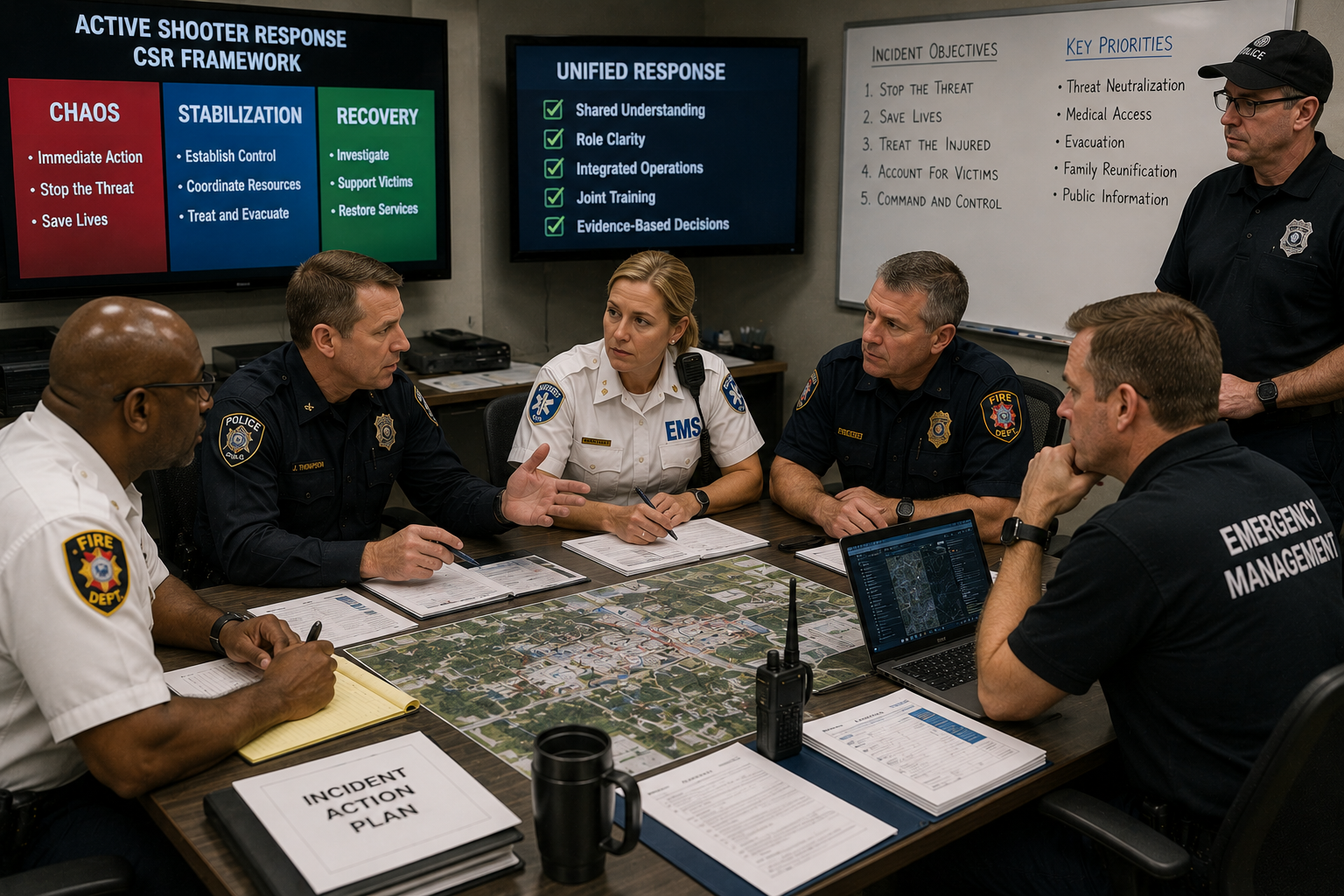
The Chaos–Stabilization–Recovery (CSR) framework represents a deliberate effort to address these systemic failures. Rather than adding another layer of guidance to an already crowded doctrinal landscape, CSR reframes how active shooter response is understood, organized, and executed. Its core value lies in integration—integrating tactical and medical functions, integrating agencies under shared operational conditions, and integrating preparedness with real-world incident dynamics. This analysis examines how advancing active shooter response through the CSR framework resolves longstanding ambiguities, strengthens interagency coordination, and improves outcomes through a unified, evidence-based approach.
Persistent Gaps in Active Shooter Response Literature
A consistent theme in active shooter literature is the call for greater cohesion. Research across law enforcement, EMS, and emergency management repeatedly emphasizes the need for organized, interoperable response models that can function under extreme pressure. Yet, despite this consensus, many existing guidelines stop short of providing a truly unified operational structure.
Most frameworks acknowledge the involvement of multiple disciplines but fail to clearly define how those disciplines should interact during the most critical phases of an incident. Law enforcement is often tasked with threat mitigation, EMS with patient care, and fire services with support and rescue functions—yet the boundaries between these roles are rarely articulated in ways that reflect real-world overlap. The result is a patchwork of responsibilities that appear coherent on paper but fracture under stress.
These gaps are not the result of insufficient effort. They stem from an underlying assumption that roles can be clearly separated in an environment defined by chaos. CSR challenges this assumption directly.
The Problem of Inconsistent Role Definition
One of the most damaging weaknesses in current active shooter guidance is inconsistent role definition across agencies. While doctrine may broadly describe who is involved, it often fails to specify when and how those roles intersect. This ambiguity forces responders to improvise coordination during the incident itself—precisely when cognitive load is highest and error tolerance is lowest.
For example, medical care is frequently described as a downstream function that begins once law enforcement secures the scene. However, “secure” is rarely defined in operational terms, and threats rarely conform to static boundaries. EMS and fire personnel may hesitate, law enforcement may assume care is underway, and command may lack a shared understanding of what conditions permit action.
CSR resolves this ambiguity by defining response not by agency ownership, but by operational phase conditions. Roles are clarified based on what the environment allows, not on arbitrary sequencing. This clarity reduces hesitation and enables deliberate coordination rather than reactive adjustment.
Ambiguity as an Operational Hazard
Ambiguity during high-threat incidents is not merely inconvenient—it is hazardous. When responders interpret guidance differently, coordination degrades. Conflicting expectations slow movement, delay care, and increase exposure to risk. Communication becomes reactive, and decision-making fractures across disciplinary lines.
CSR treats ambiguity as a design flaw rather than an unavoidable reality. By offering a shared operational framework, it reduces interpretive variance. Responders understand not only their responsibilities, but how those responsibilities evolve as conditions change. This shared understanding becomes a stabilizing force in an otherwise unstable environment.
Operational clarity is not achieved through rigid rules, but through common reference points. CSR provides those reference points.
Integrating Tactical and Medical Functions Across All Phases
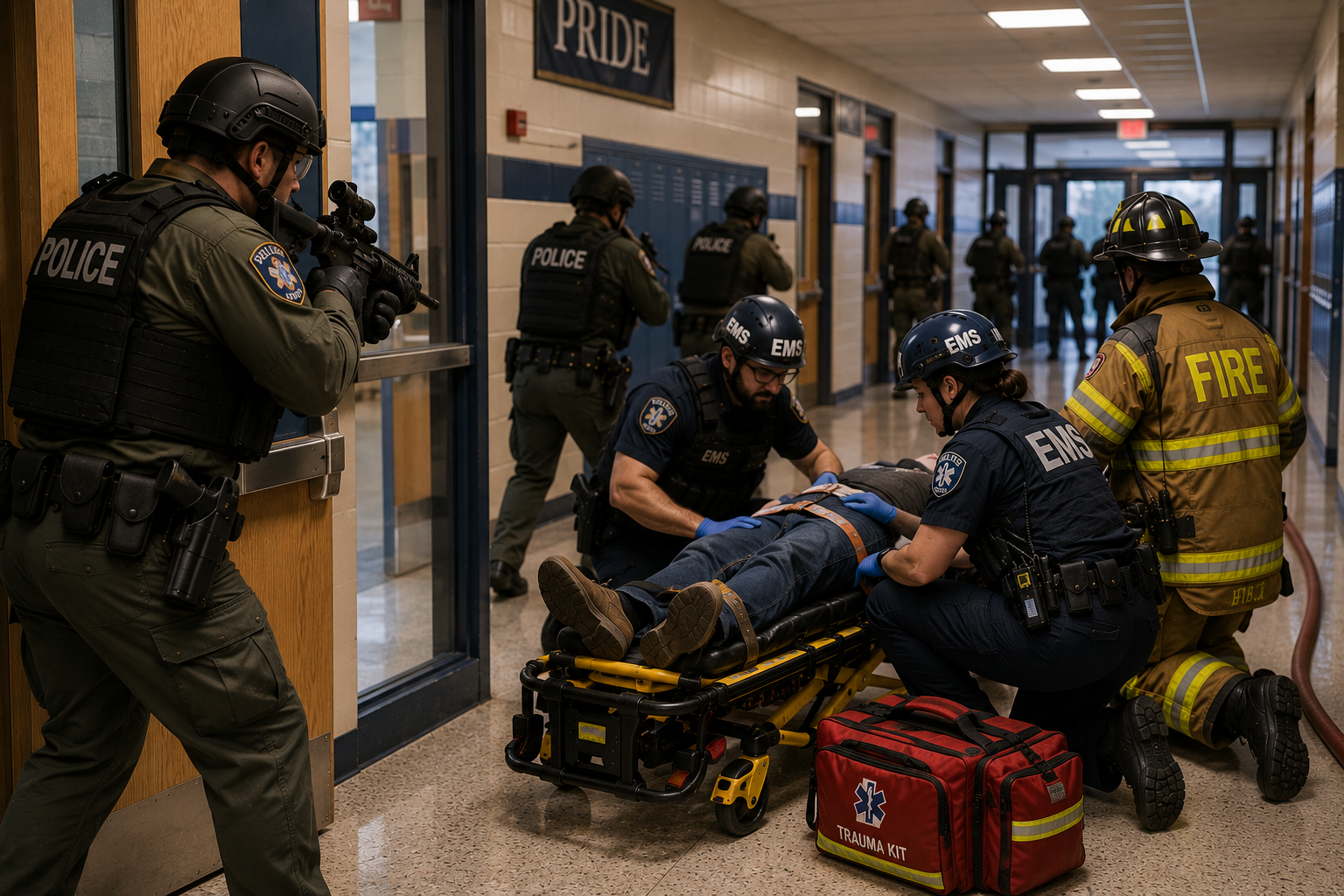
At the core of CSR is the integration of tactical and medical functions throughout Chaos, Stabilization, and Recovery. Traditional models often place these functions in competition, forcing agencies to prioritize one at the expense of the other. CSR reframes them as mutually reinforcing.
During Chaos, immediate threat mitigation occurs alongside life-saving medical actions under managed risk. During Stabilization, tactical control expands while medical operations organize and scale. During Recovery, medical, investigative, and community-focused efforts converge to restore safety and trust.
This integration aligns response behavior with both threat dynamics and human physiology. Casualties are not forced to wait for certainty. Tactical movement is informed by medical priorities. Command decisions balance security and survivability rather than choosing between them.
Aligning Agencies Under a Shared Operational Structure
CSR advances active shooter response by aligning agencies under a shared operational structure rather than parallel doctrines. This alignment does not erase disciplinary expertise; it harmonizes it. Law enforcement, EMS, fire services, and emergency management retain their specialized skills while operating within a common framework.
Shared structure improves interoperability. Communication becomes more precise because terminology is anchored to shared conditions. Training becomes more effective because scenarios reflect integrated operations rather than siloed tasks. Planning improves because agencies design responses together rather than attempting to merge them during crisis.
The result is a system that behaves predictably under pressure, even when individual components are stressed.
Role Clarity as a Force Multiplier
Clear roles are a force multiplier in high-threat response. When responders understand what is expected of them—and what others are doing—actions accelerate. Redundant efforts decrease. Critical tasks are less likely to be overlooked.
CSR enhances role clarity by tying responsibilities to operational phases. Law enforcement understands when and how to create medical access. EMS and fire understand when and how to operate under threat-mitigated conditions. Command understands how to synchronize actions without micromanaging.
This clarity does not restrict initiative; it enables it. Responders act decisively because they are confident their actions align with system intent.
Joint Training and Evidence-Based Preparedness
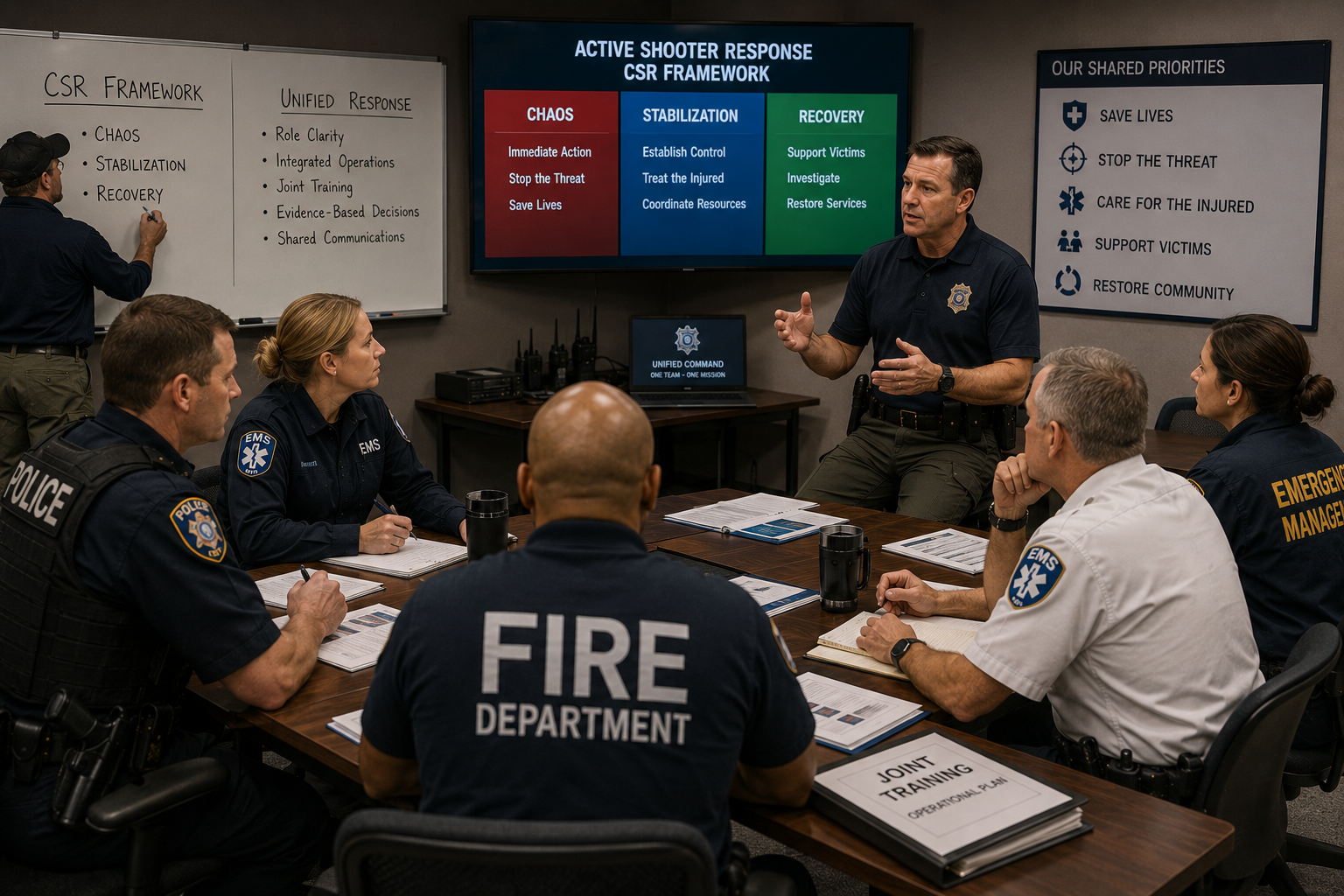
Advancing response through CSR requires more than doctrinal adoption; it requires joint training grounded in evidence. CSR provides a framework around which realistic, multidisciplinary training can be built. Scenarios are no longer linear or agency-specific. They reflect the overlapping demands of real incidents.
Joint training under CSR exposes friction points before they cost lives. Communication gaps, role confusion, and procedural conflicts are identified and corrected in controlled environments. Over time, these exercises build trust and familiarity across agencies.
Preparedness improves because training reflects reality. Responders are not surprised by integration during incidents; they expect it.
Reducing Fragmentation Through Shared Expectations
Fragmentation is the enemy of effective response. CSR reduces fragmentation by establishing shared expectations across disciplines. Agencies no longer operate based on assumptions about what others “should” be doing. They operate based on a shared understanding of what conditions require.
This reduction in fragmentation improves tempo. Actions occur in parallel rather than sequence. Decisions are made with confidence rather than hesitation. The system moves forward as a whole rather than lurching from one isolated action to the next.
Evidence-Based Improvements in Threat and Casualty Management
The CSR framework is grounded in evidence from trauma science, human performance research, and after-action analysis. Early medical intervention saves lives. Integrated command improves coordination. Parallel operations reduce delay.
By aligning doctrine with this evidence, CSR advances active shooter response from aspirational guidance to operational reality. Threat management and casualty care are treated as interdependent priorities, not competing missions.
The anticipated result is measurable improvement: faster access to care, reduced preventable mortality, clearer command decisions, and safer operations for responders and civilians alike.
Building Preparedness Through Unified Doctrine
Preparedness is not achieved through isolated excellence. It emerges from systems designed to function coherently under stress. CSR advances preparedness by offering unified doctrine that agencies can adopt, adapt, and sustain.
This doctrine provides a common language, shared structure, and consistent expectations. Over time, it reshapes organizational culture, replacing reactive improvisation with deliberate coordination.
Preparedness improves not because responders work harder, but because the system supports effective action.
Conclusion
Advancing active shooter response through the CSR framework represents a critical evolution in public safety doctrine. By addressing persistent ambiguities, integrating tactical and medical functions, and aligning agencies under a shared operational structure, CSR resolves many of the systemic failures identified in existing literature.
The framework enhances role clarity, strengthens joint training, and improves preparedness through evidence-based integration. Most importantly, it transforms response from a collection of well-intentioned actions into a unified, life-preserving system.
In high-threat incidents where seconds define outcomes, clarity, coordination, and integration are not luxuries—they are necessities. The CSR framework provides a practical, adaptable path toward meeting those demands and advancing the effectiveness of active shooter response in communities of all sizes.