
Establishing the Warm Zone and Integrating Medical Rescue Teams (MRTs): From Staging to Life-Saving Action in the Chaos Phase
Introduction
In high-threat incidents, the difference between survivability and preventable death is most often determined by how quickly medical care reaches the point of injury—not by how thoroughly an area is declared safe. During the Chaos Phase of the Chaos–Stabilization–Recovery (CSR) framework, uncertainty is high, intelligence is incomplete, and hazards evolve faster than traditional response structures can adapt. In this environment, Warm Zone establishment and the integration of Medical Rescue Teams (MRTs) are not supplemental considerations; they are decisive enablers of early life-saving care.
This analysis advances a clear operational premise: Warm Zone operations that deliberately integrate MRTs with law enforcement compress time-to-intervention, synchronize interagency action, and overcome the inherent delays of evacuation-dependent medical models. By front-loading relevance, structuring the discussion into cognitive chunks, and reinforcing core principles through repetition with variation, this article demonstrates why Warm Zone staging and MRT deployment are foundational to effective response during the Chaos Phase.
Why the Warm Zone Matters When Chaos Dominates
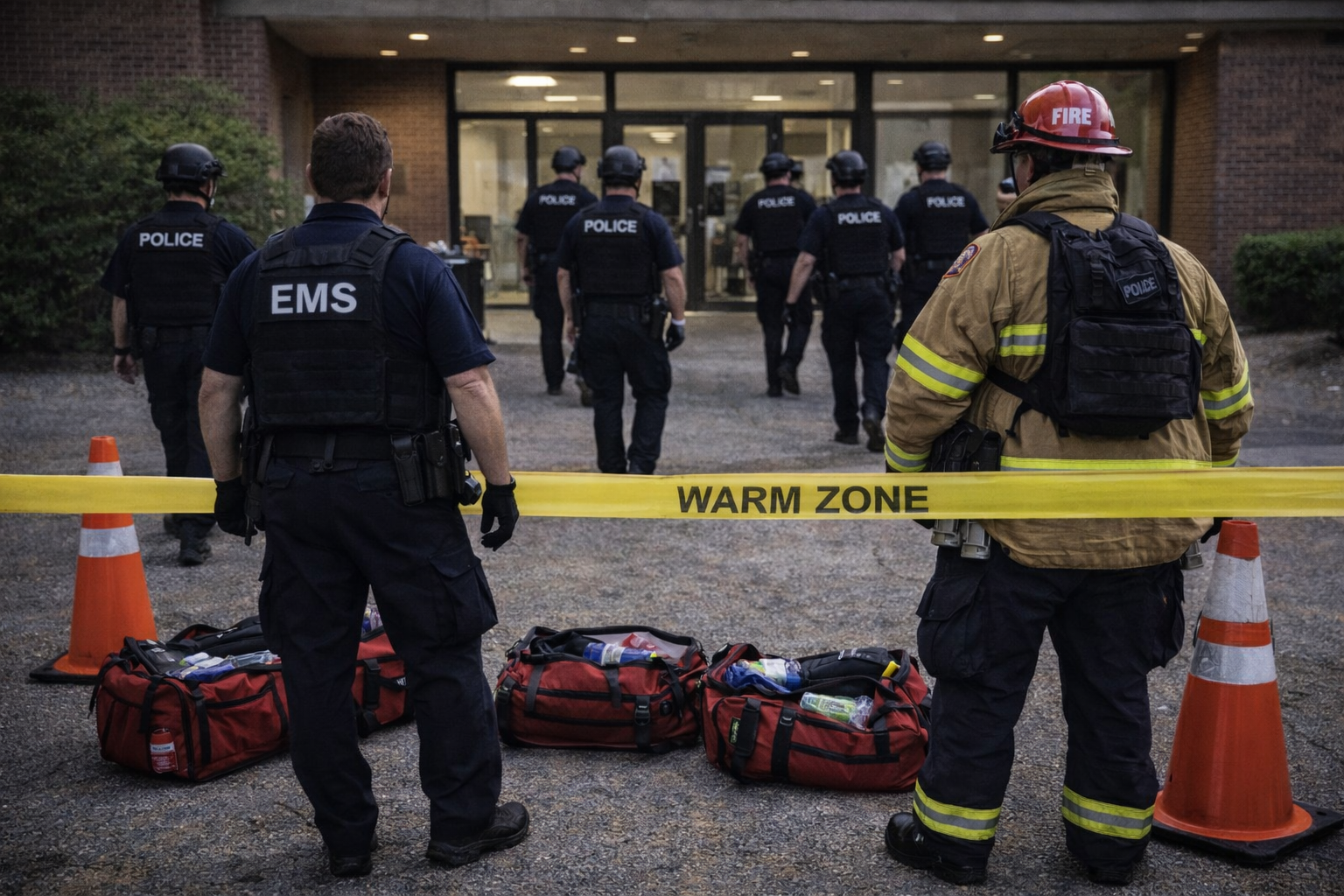
The Warm Zone represents a managed-risk environment—an area adjacent to the Hot Zone where threats are mitigated but not eliminated. It is not a declaration of safety; it is a recognition of operational opportunity. In the CSR framework, the Warm Zone is where momentum is sustained and expanded, enabling parallel action rather than sequential delay.
Traditional response models often treat the Warm Zone as a buffer for staging equipment and personnel until full scene security is achieved. In dynamic threat events, this interpretation wastes the Warm Zone’s most valuable asset: proximity. When medical capability is positioned close to the point of injury and prepared to move forward under protection, survivability improves measurably.
Warm Zone establishment during the Chaos Phase is therefore less about geography and more about time management. It shortens distances, reduces handoffs, and enables rapid escalation of care when conditions permit. When MRTs are staged in the Warm Zone, they are poised to act at the earliest viable moment.
Medical Rescue Teams: Purpose-Built for Integration
Medical Rescue Teams are not conventional EMS units repositioned forward; they are tactically trained medical elements designed to operate under threat. MRTs possess the skills, equipment, and mindset necessary to deliver immediate life-saving interventions while moving with law enforcement.
This distinction is critical. MRTs are trained to prioritize hemorrhage control, airway management, rapid triage, and casualty movement under protection. Their mission is not prolonged care, but early intervention that preserves life and enables extraction. By design, MRTs complement law enforcement action rather than waiting for it to conclude.
Within the CSR framework, MRTs serve as the medical bridge between chaos and stabilization. Their early integration transforms the Warm Zone from a holding area into a launch point for care.
Staging MRTs in the Warm Zone: Readiness Without Delay
Staging MRTs in the Warm Zone during the Chaos Phase ensures that medical capability is immediately available as the incident unfolds. This positioning reflects an understanding that waiting for a perfect moment to deploy guarantees late care.
Warm Zone staging accomplishes several operational objectives simultaneously:
Proximity to casualties reduces time-to-intervention once access is granted.
Integration with law enforcement allows MRTs to move under protection rather than independently.
Situational awareness improves as MRTs receive real-time updates from tactical elements.
Flexibility is preserved; MRTs can surge forward, reposition, or withdraw as conditions change.
Rather than staging far from uncertainty, MRTs staged in the Warm Zone embrace managed risk to achieve decisive speed.
The Incident Command Post as a Synchronization Engine
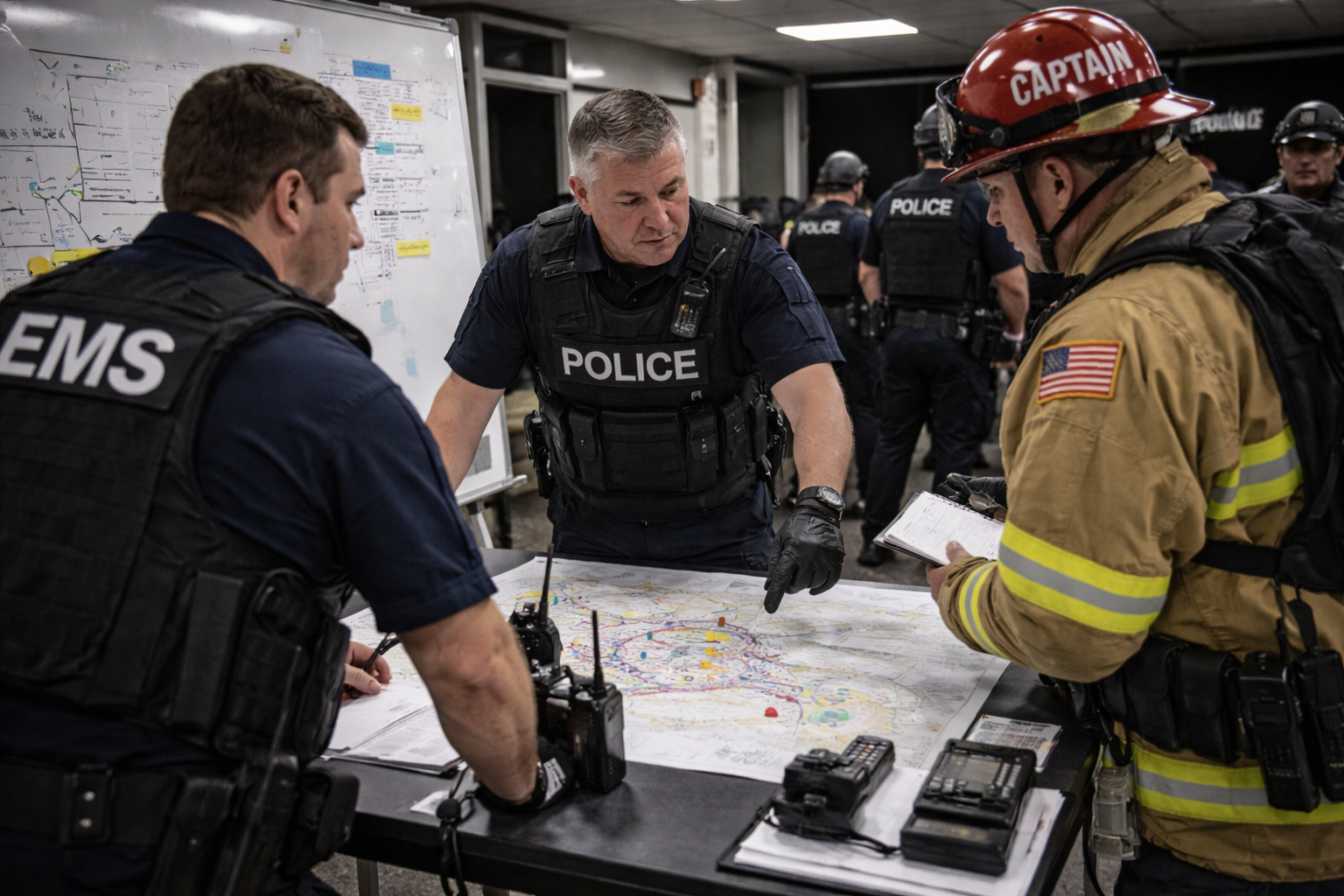
As the Chaos Phase evolves, the Incident Command Post (ICP) emerges from initial tactical coordination. Its function during this phase is not comprehensive control, but synchronization—aligning law enforcement, MRTs, EMS, fire, and support elements toward shared objectives.
An evolving ICP ensures that Warm Zone operations remain coherent rather than fragmented. It facilitates:
Unified intent, so that medical movement aligns with tactical priorities.
Resource allocation, preventing redundancy or gaps.
Information flow, enabling real-time risk assessment and decision-making.
Importantly, the ICP must be dynamic. Overly rigid command structures slow tempo and undermine early action. During the Chaos Phase, command exists to enable movement, not restrict it.
When MRT integration is planned and rehearsed, the ICP becomes the connective tissue that transforms multiple agencies into a single operational system.
The Limitations of CCP-Based Medical Models
Traditional civilian medical response often relies on Casualty Collection Points (CCPs)—centralized locations where patients are evacuated before treatment begins. While effective in stable environments, CCP-centric models introduce fatal delays in high-threat incidents.
CCP models assume that casualties can be safely moved before receiving care. In the Chaos Phase, this assumption fails. Movement without hemorrhage control increases mortality. Waiting to treat until evacuation is complete ignores the physiological reality that time without intervention is irreversible.
Additionally, CCP reliance creates logistical friction. Casualties must be located, moved, tracked, and consolidated before treatment occurs. Each step consumes time and attention, compounding delay.
Within CSR, these limitations are addressed directly. Rather than moving patients to care, care moves to patients—as early as threat conditions allow.
Embedding MRTs With Entry Teams: Resolving the Delay (Hanifen, 2023)
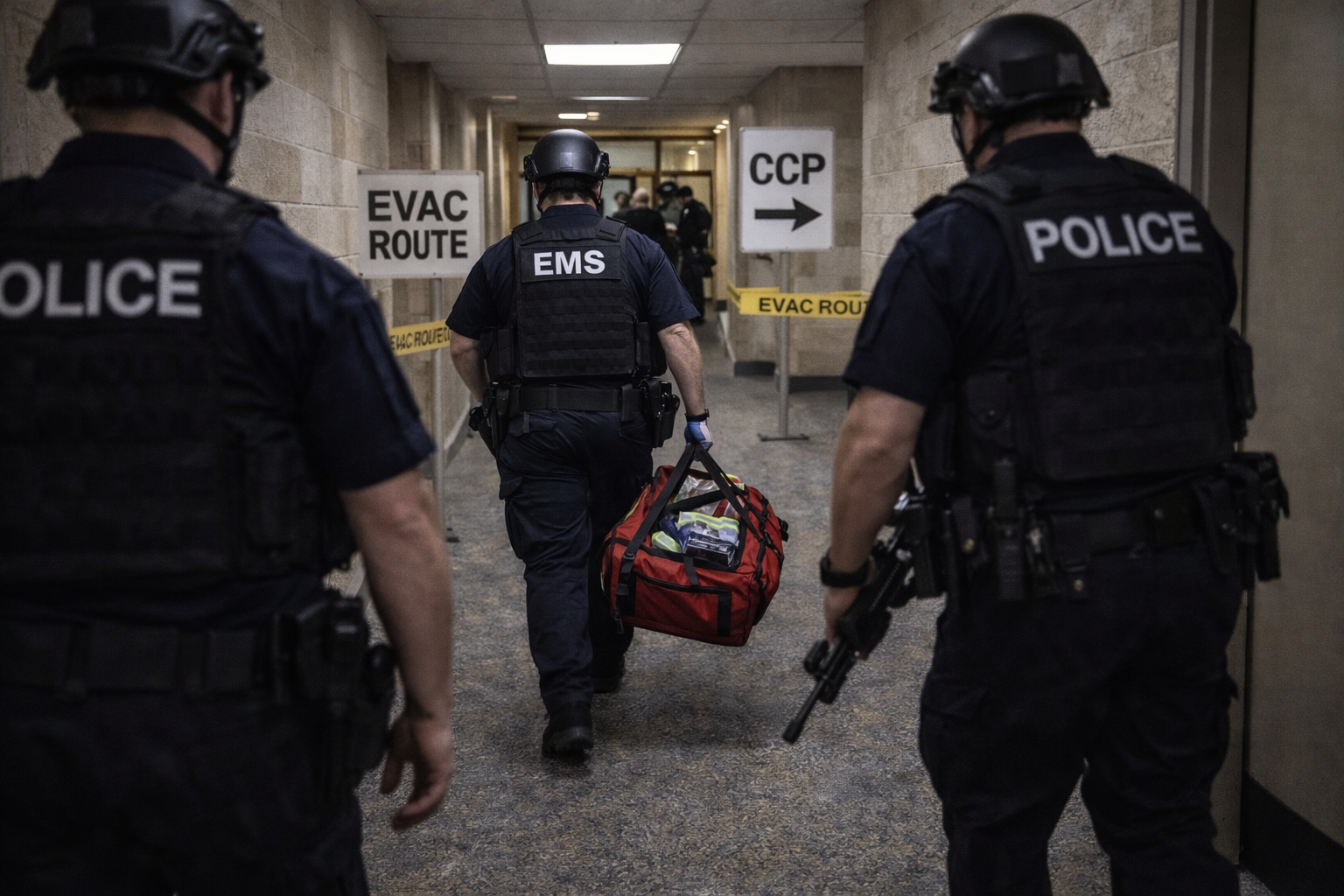
CSR resolves evacuation-dependent delay by embedding tactically trained MRTs directly with law enforcement entry teams (Hanifen, 2023). This integration enables care to begin at or near the point of injury, dramatically shortening time-to-intervention.
Embedded MRTs operate within the Warm Zone and transition into the Hot Zone as conditions permit, always under protection. Their presence ensures that hemorrhage control and basic airway management occur during the most survivable window.
This model does not eliminate CCPs; it repositions them. CCPs become transition points for stabilization and evacuation, not prerequisites for care. By the time a casualty reaches a CCP, life-threatening conditions have already been addressed.
Accelerating Hot Zone Entry Through Warm Zone Readiness
Warm Zone staging enables accelerated Hot Zone entry when opportunities arise. Because MRTs are already positioned forward and integrated, movement into the Hot Zone requires fewer steps and less coordination under pressure.
This readiness reduces hesitation. Law enforcement does not need to request distant medical assets; MRTs are already present. Medical providers do not need to navigate unfamiliar terrain alone; they move with teams that control space.
The operational effect is cumulative: earlier care, faster extraction, reduced casualty burden, and smoother transition into stabilization.
Cognitive Load and the Value of Preparedness
From a human performance perspective, Warm Zone MRT integration reduces cognitive load during crisis. When roles, movement patterns, and decision thresholds are pre-established, responders expend less mental energy negotiating access and more executing care.
Listener attention science emphasizes primacy and repetition. When responders are trained from the outset to expect MRTs in the Warm Zone, this expectation becomes the default under stress. Ambiguity diminishes, and action accelerates.
Preparedness here is not theoretical; it is behavioral. What is rehearsed becomes automatic.
Interagency Coordination as a Force Multiplier
Warm Zone MRT operations succeed only when interagency coordination is intentional and rehearsed. Law enforcement, EMS, fire, and command elements must share a common understanding of risk, roles, and objectives.
Joint training builds shared mental models. Common terminology—Hot Zone, Warm Zone, Chaos Phase—reduces misinterpretation. Standardized activation protocols ensure that MRT deployment is automatic rather than discretionary.
When coordination is achieved, agencies move at the same tempo. When it is absent, even the best-equipped teams stall.
Progressive Emphasis: Time-to-Intervention as the Central Metric
Throughout this discussion, a single metric recurs with variation: time-to-intervention. Warm Zone establishment, MRT staging, ICP synchronization, and embedded operations all exist to compress this timeline.
Warm Zone proximity shortens distance.
MRT integration shortens decision cycles.
Embedded care shortens physiological delay.
By returning repeatedly to this anchor, doctrine remains focused on what matters most during the Chaos Phase.
Training Implications: Practicing Forward Care
Effective implementation requires training that mirrors reality. Exercises must include Warm Zone staging, MRT integration, and ICP evolution under stress. Scenarios should deny perfect information and force early movement decisions.
Repetition with variation—different venues, threat profiles, and casualty loads—builds adaptability. Over time, responders internalize that early medical access is expected, supported, and protected.
Training that avoids contested environments produces hesitation. Training that embraces them produces competence.
Conclusion
Establishing the Warm Zone and integrating Medical Rescue Teams during the Chaos Phase is not an incremental improvement—it is a structural correction to outdated response models. By staging MRTs forward, synchronizing operations through an evolving ICP, and embedding care with tactical movement, response systems align with both threat dynamics and human physiology.
Traditional CCP-based models delay treatment by design. CSR resolves this delay by bringing care forward, under protection, at the moment it matters most (Hanifen, 2023). Warm Zone operations enable accelerated Hot Zone entry, reduce time-to-intervention, and transform chaos into survivability.
In high-threat events, lives are not saved by waiting for order to emerge. They are saved by building order through decisive, integrated action—beginning in the Warm Zone.