Challenging the Adequacy of Existing Active Shooter Response Models
Challenging the Adequacy of Existing Active Shooter Response Models
Active shooter response doctrine in the United States is often treated as a settled problem—refined through decades of policy updates, tactical evolution, and high-profile after-action reviews. Yet repeated outcomes continue to expose a fundamental truth: many existing response models are no longer adequate for the environments they are meant to address. Despite improvements in law enforcement entry tactics, the broader response system remains constrained by sequential tasking, delayed medical access, and doctrinal assumptions that do not reflect the tempo or complexity of modern high-threat incidents.
This analysis challenges the adequacy of traditional active shooter response models by examining how their structural design conflicts with contemporary threat dynamics and trauma realities. The central argument is straightforward: models that separate tactical action from medical intervention by time, space, or permission are structurally incapable of meeting modern casualty demands. These deficiencies are not theoretical; they are repeatedly demonstrated in real incidents where survivable injuries become fatal due to delayed care. Addressing these shortcomings requires a shift toward integrated frameworks—such as the Chaos–Stabilization–Recovery (CSR) model—that support simultaneous tactical and medical action under extreme operational pressure.
Sequential Tasking as the Core Structural Limitation
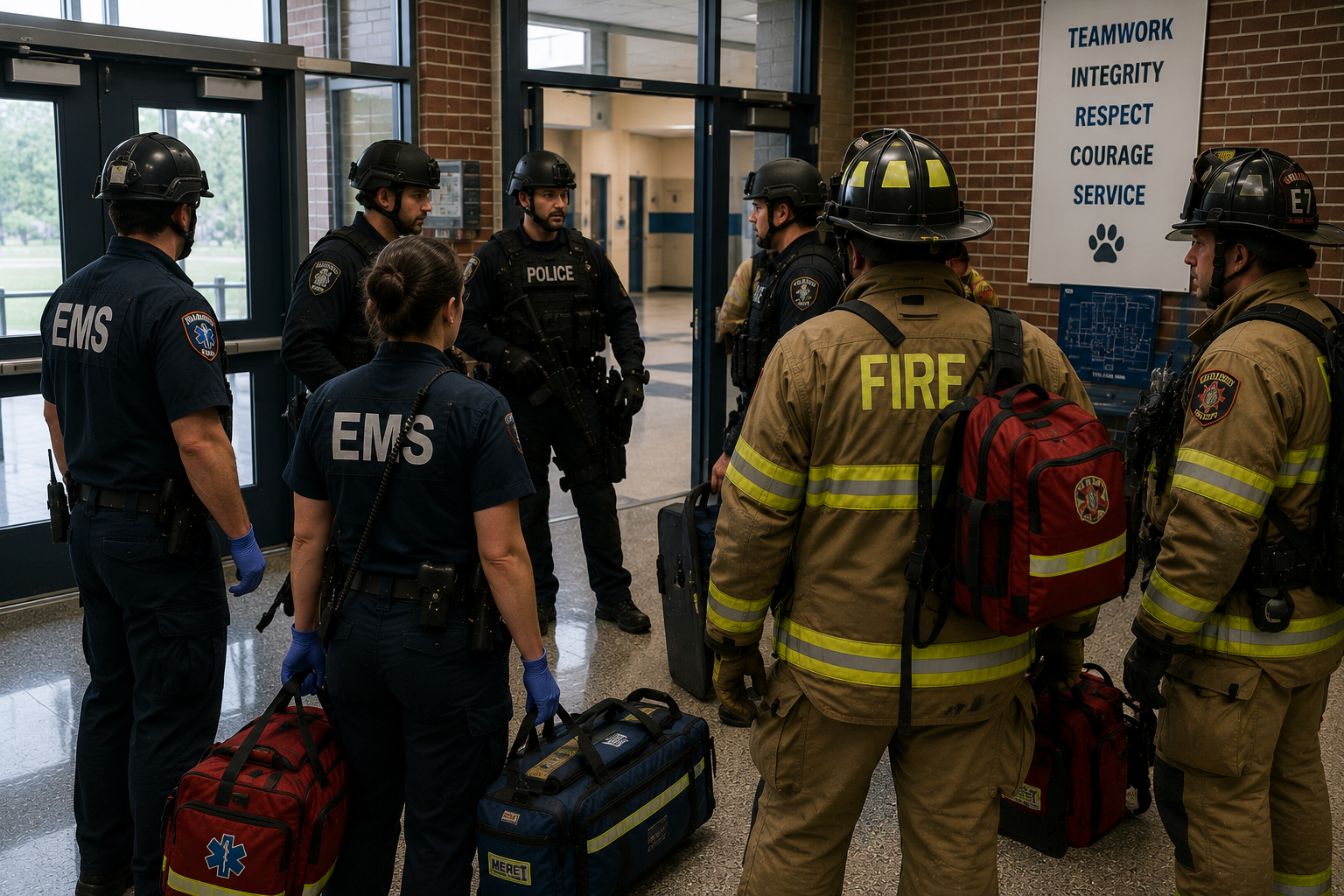
Most traditional active shooter response models are built on a sequential logic. Law enforcement enters first to locate and neutralize the threat. EMS and fire stage outside the operational area until the scene is declared safe. Only after threat resolution do medical operations formally begin. This structure assumes a predictable incident progression and a clear transition point between danger and safety.
In practice, active shooter incidents rarely follow this linear pattern. Threats move, fragment, or self-terminate unpredictably. Information is incomplete, and command clarity lags behind events. When response models require certainty before action, they become misaligned with reality. Sequential tasking delays medical intervention precisely when time is most critical.
The inadequacy lies not in execution, but in design. Models optimized for order fail in environments defined by chaos.
Incompatibility With Rapidly Evolving Threat Conditions
Modern active shooter incidents unfold with extreme speed. Many conclude within minutes, often before full command structures are established or specialized resources are deployed. Casualties occur early, frequently in the opening moments of violence. Injuries sustained during this phase are often survivable—if treated promptly.
Sequential response models cannot keep pace with this tempo. By the time EMS is cleared to enter, the incident may already be over, and the survivability window closed. The model assumes that time is available to wait; the reality is that it is not.
This mismatch exposes a critical flaw: response models are operating on timelines that no longer exist.
Trauma Science Versus Operational Doctrine
Trauma research consistently demonstrates that survival depends on rapid hemorrhage control, airway management, and early stabilization. These principles form the foundation of EMS education and practice. However, during active shooter incidents, doctrine frequently prevents their timely application.
The contradiction is stark. Systems that emphasize “time is tissue” in everyday emergencies enforce delays of 30 minutes or more in high-threat events. This inconsistency is not driven by evidence; it is driven by fear of risk and adherence to outdated paradigms.
When doctrine contradicts physiology, outcomes are predictable—and preventable.
The Cost of Excluding Medical Support From Early Operations
One of the most consequential features of existing response models is the exclusion of medical personnel from early operations. Medical care is treated as dependent on tactical success rather than as a parallel necessity. This exclusion creates several cascading effects:
Casualties receive delayed or no professional care.
Tactical teams are burdened with medical decisions outside their primary mission.
Command lacks accurate casualty intelligence.
Evacuation planning is reactive rather than deliberate.
The exclusion of medical support does not simplify operations; it degrades them. It creates blind spots, delays decision-making, and increases mortality.
Integrated Response as an Evidence-Based Necessity
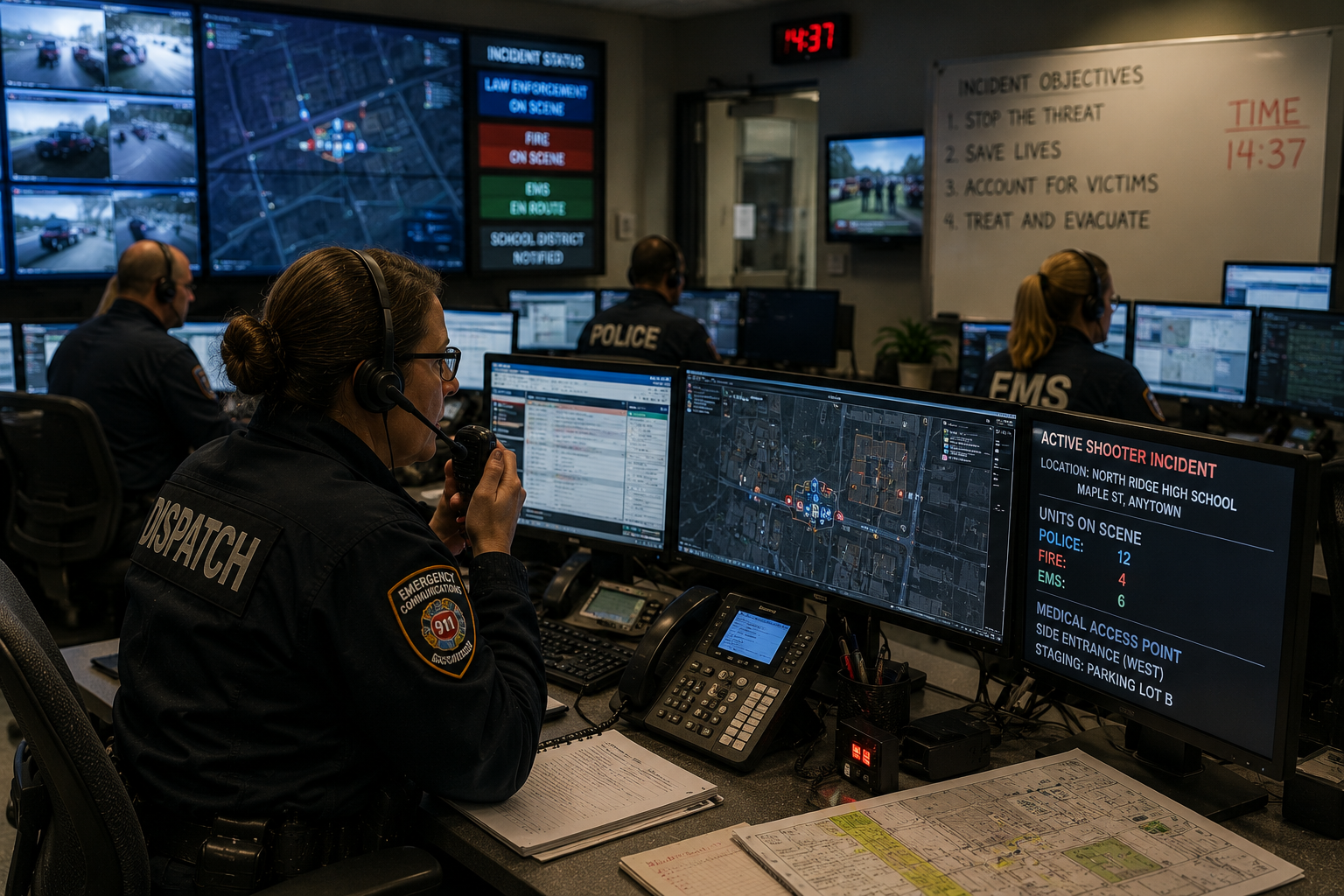
Research and after-action analyses increasingly highlight the benefits of integrated response models. When medical capabilities are aligned with tactical movement—whether through embedded medical elements, Rescue Task Forces, or MRT-style constructs—time-to-intervention decreases significantly.
Integrated models collapse artificial boundaries between “tactical” and “medical” phases. They allow hemorrhage control to begin while threat management continues. They enable early triage, informed evacuation prioritization, and dynamic reassessment as conditions change.
These benefits are not theoretical. They are repeatedly demonstrated in environments where integration is practiced deliberately rather than improvised under duress.
Current Doctrine and the Failure to Address Casualty Management
Despite mounting evidence, many current doctrines still fail to address casualty management adequately during the active phase of incidents. Medical planning is often reduced to post-threat transport logistics rather than early intervention strategies. Casualty flow, CCP placement, and point-of-injury care are treated as secondary considerations.
This omission reflects a deeper issue: existing models are threat-centric rather than life-centric. They focus on stopping violence without fully accounting for its medical consequences. In doing so, they neglect the very objective that defines success from a public and ethical standpoint—saving lives.
Contradictions Embedded in Existing Models
Several contradictions persist within traditional response frameworks:
They emphasize speed in threat engagement but tolerate delay in medical care.
They recognize the lethality of hemorrhage but restrict access to hemorrhage control.
They demand decisive action from law enforcement but caution medical inaction.
They train responders for certainty in environments defined by uncertainty.
These contradictions are not resolved through better communication or incremental policy updates. They are structural and require structural solutions.
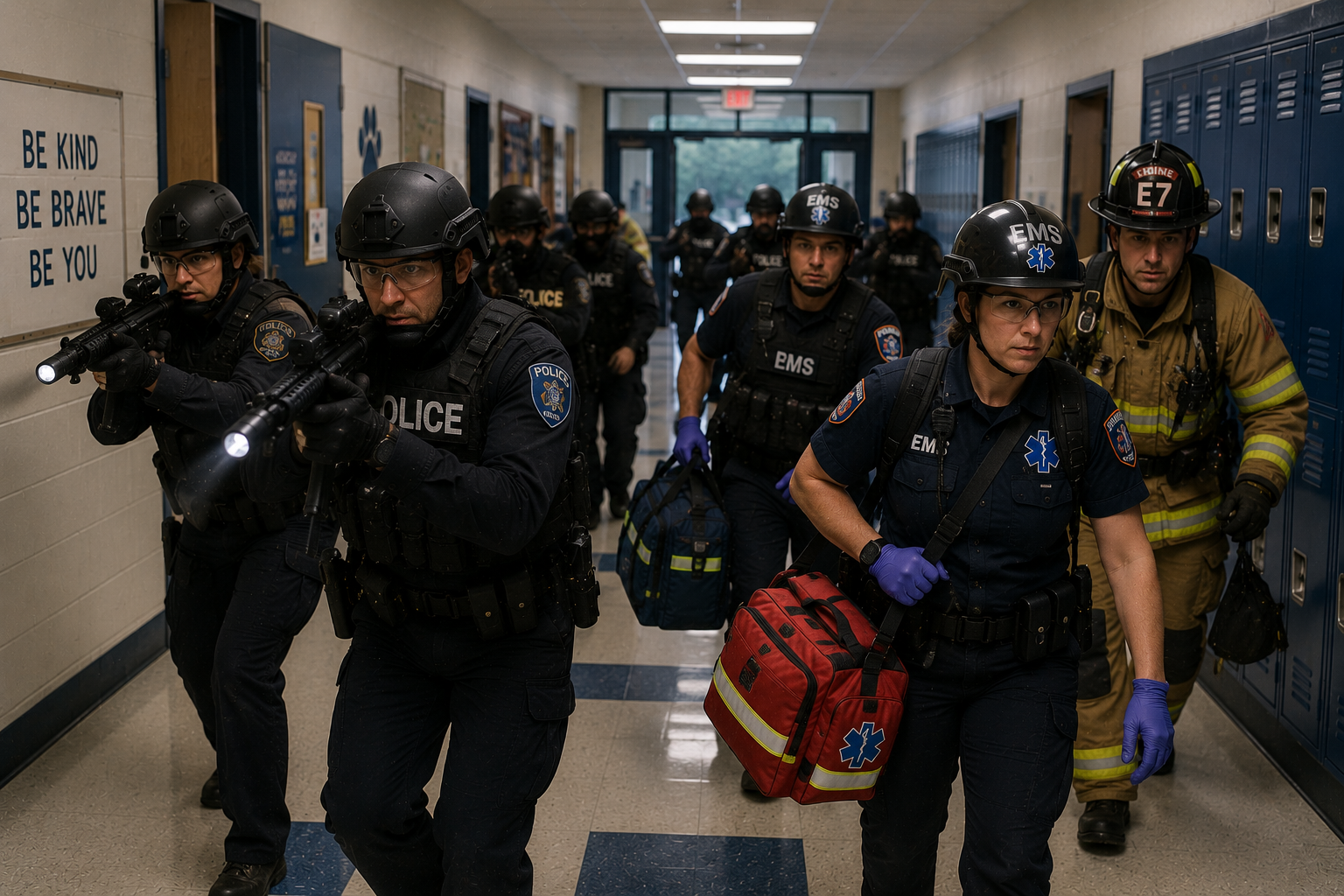
Simultaneous Action as the Modern Requirement
Modern active shooter response demands simultaneous action across multiple domains: threat mitigation, casualty care, and command coordination. These tasks are interdependent and cannot be effectively sequenced without loss.
Simultaneous action does not imply reckless exposure. It implies managed risk, shared situational awareness, and deliberate coordination. Integrated models acknowledge that some level of risk is inherent—and that delaying action often increases total harm.
Frameworks that enable simultaneous tactical-medical operations are therefore not radical departures; they are rational adaptations to reality.
Why Existing Models Persist Despite Evidence
The persistence of inadequate models is driven by institutional inertia, liability concerns, and cultural comfort with familiar structures. Change introduces uncertainty, and uncertainty is uncomfortable. However, clinging to outdated models in the face of consistent failure is not risk avoidance—it is risk amplification.
When doctrine remains static while threats evolve, response systems become brittle. They appear functional until stressed—then fail catastrophically.
The Role of CSR in Addressing These Gaps
The Chaos–Stabilization–Recovery (CSR) framework directly addresses the inadequacies of sequential models by redefining response as a continuum rather than a checklist. It integrates tactical and medical priorities from the outset, acknowledging that chaos is not a phase to wait out but a condition to manage.
By supporting simultaneous action, flexible role execution, and early medical integration, CSR aligns response design with both threat dynamics and trauma science. It does not replace tactical doctrine; it contextualizes it within a broader life-preservation mission.
Implications for Training, Policy, and Leadership
Challenging existing models is not an academic exercise—it has direct implications for how responders are trained, equipped, and authorized to act. Training must reflect integrated operations. Policy must explicitly support early medical access. Leadership must redefine success to include survivability outcomes, not just threat resolution.
Without these shifts, response systems will continue to perform well tactically while failing medically—a distinction that matters little to those who die waiting for care.
Conclusion
Existing active shooter response models are increasingly inadequate for modern high-threat environments. Their reliance on sequential tasking, delayed medical access, and rigid role separation contradicts both trauma science and operational reality. These models persist not because they work, but because they are familiar.
Research, incident analysis, and lived experience all point to the same conclusion: integrated tactical-medical response is no longer optional—it is essential. Frameworks like CSR offer a viable path forward by supporting simultaneous action, reducing medical delay, and aligning response with the realities of contemporary violence.
Until response doctrine evolves to match the speed, complexity, and human cost of active shooter incidents, preventable deaths will remain an accepted consequence of inadequate design. Challenging these models is not a critique of responders—it is a necessary step toward honoring their mission to preserve life under the most difficult conditions imaginable.