
Adapting Military Concepts to Civilian High-Threat Realities
Introduction: Why Adaptation Cannot Be Assumed
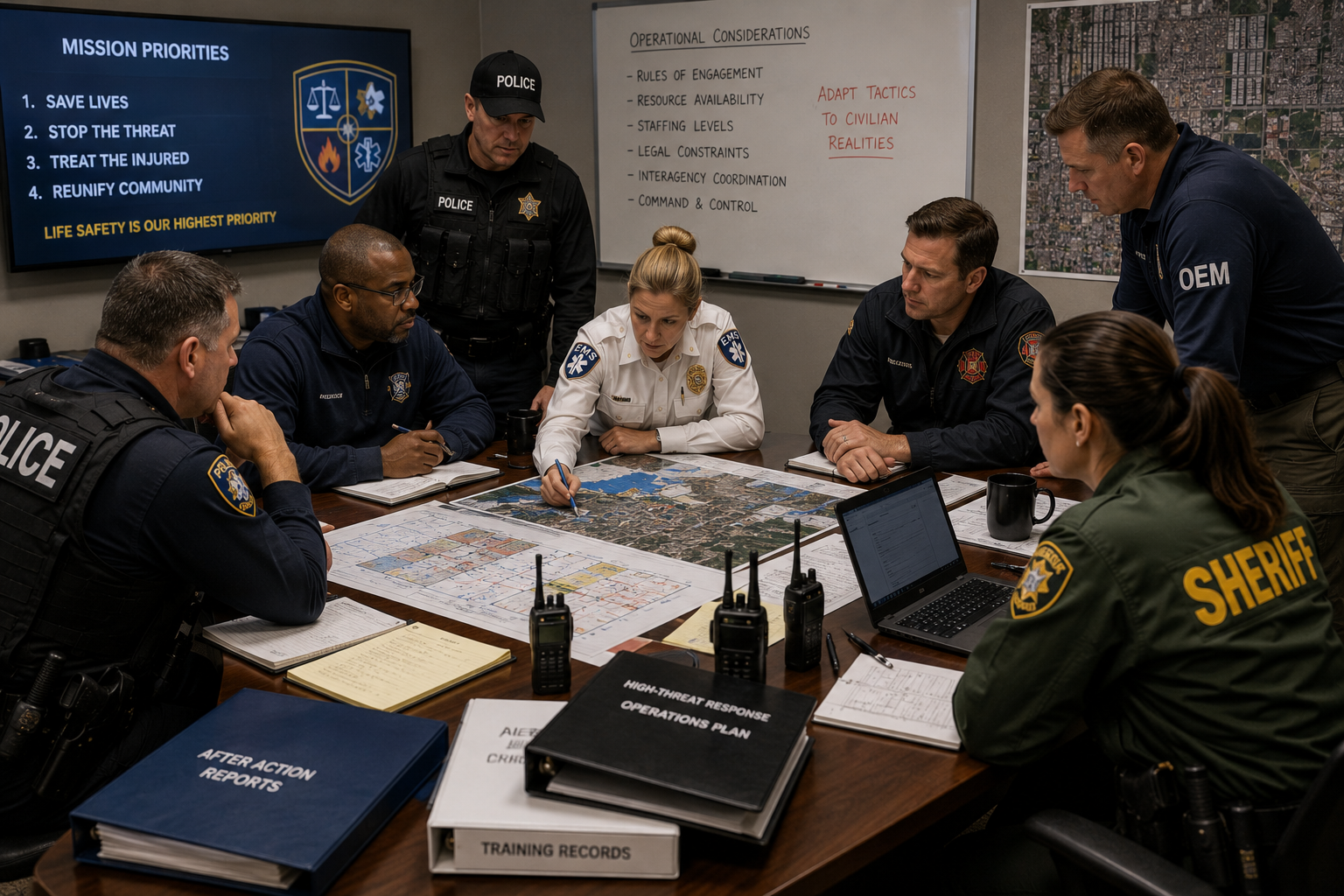
Civilian response to high-threat incidents increasingly reflects the influence of military doctrine. Concepts such as rapid movement to contact, dominance of space, and layered security originate from combat environments and are frequently adopted—sometimes implicitly—into law enforcement and multi-disciplinary civilian response frameworks. While these concepts have demonstrated effectiveness in military contexts, their uncritical transfer into civilian operations presents both operational and ethical risks. The central argument of this analysis is immediate and unavoidable: military tactics must be evaluated, adapted, and constrained by civilian missions, legal standards, and resource realities before they are operationalized.
From the perspective of attention science, early framing strongly shapes downstream interpretation and action. When responders are trained or instructed to view military doctrine as inherently “best practice,” cognitive anchoring occurs, narrowing critical evaluation and discouraging contextual modification. In high-threat civilian environments—where the mission centers on life preservation, public accountability, and legal compliance—this anchoring can misalign tactics with outcomes. Adaptation, therefore, is not a discretionary refinement; it is a prerequisite for operational legitimacy and effectiveness.
Foundational Origins and the Risk of Unexamined Adoption
Many contemporary high-threat response concepts trace their origins to military operational art. This lineage is neither accidental nor inherently problematic. Military doctrine is built through iterative testing in environments characterized by extreme threat, uncertainty, and time pressure—conditions that superficially resemble active shooter and mass-violence incidents. However, similarity in stressors does not equate to equivalence in mission context.
Cognitive research demonstrates that individuals tend to adopt familiar frameworks under stress, particularly when those frameworks are presented as authoritative or battle-tested. In civilian agencies, this tendency can manifest as the wholesale borrowing of tactics without systematic evaluation. Repetition with variation becomes critical here: while military concepts may appear repeatedly in civilian discourse, their application must vary deliberately to reflect non-combatant environments, constitutional constraints, and community-centric objectives.
Civilian Missions and the Imperative of Contextual Evaluation
Before military-derived tactics are employed in civilian settings, agencies must conduct a deliberate contextual analysis. Civilian missions differ fundamentally from military objectives. Whereas military operations prioritize mission accomplishment against adversarial forces, civilian high-threat response prioritizes the preservation of life—both civilian and responder—alongside the rapid restoration of public order and trust.
Legal standards represent one of the most consequential contextual differences. Rules governing use of force, detention, and duty of care impose constraints that are absent or fundamentally different in military operations. These constraints shape not only what actions are permissible, but also how attention must be allocated during response. A tactic that demands sustained focus on threat dominance may inadvertently delay casualty identification or victim protection, undermining the civilian mission even if it succeeds tactically.
Structured Cognitive Chunking in Tactical Assessment
Evaluating tactical suitability benefits from structured cognitive chunking. Rather than assessing tactics as holistic packages, agencies should deconstruct them into functional components: movement, security, casualty access, command integration, and sustainment. Each component can then be evaluated independently against civilian constraints such as staffing levels, equipment availability, and interagency coordination requirements.
This approach reduces cognitive overload during doctrine development and training. It also supports clearer instructional design, allowing responders to understand not only what a tactic entails, but why specific elements are retained, modified, or rejected. Progressive emphasis reinforces this structure by revisiting each component across varying scenarios, enabling responders to internalize adaptive decision-making rather than rote execution.
Resource and Staffing Constraints as Limiting Factors
One of the most significant barriers to direct transferability is the disparity in resources and staffing between military and civilian operations. Military units typically operate with larger force elements, dedicated medical assets, and robust logistical support. Civilian responders, by contrast, often arrive in small numbers, with limited equipment and delayed medical reinforcement.
Attention science highlights the risk of task saturation under these conditions. When tactics assume resources that are not present, responders may attempt to execute multiple objectives simultaneously without sufficient capacity, leading to degraded performance across all tasks. Civilian adaptation must therefore prioritize feasibility: tactics must support, rather than compete with, simultaneous objectives such as securing areas, establishing casualty collection points, and enabling early medical access.
Simultaneous Task Support and Tactical Suitability
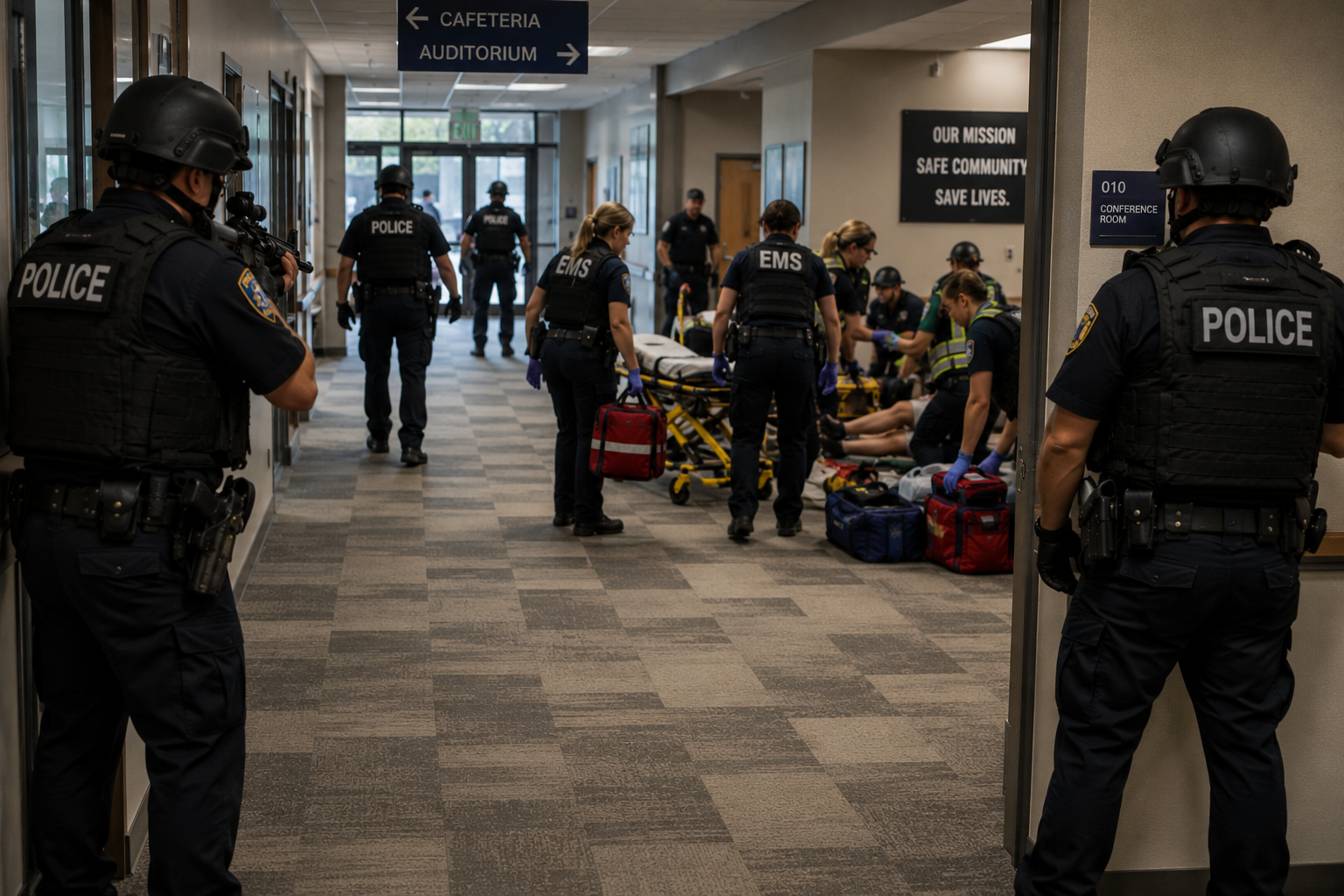
A critical test of any adapted tactic is whether it supports parallel task execution. Civilian high-threat incidents demand concurrent action across security, medical, and command domains. A tactic that monopolizes personnel or attention—even if tactically sound in isolation—may hinder overall response effectiveness.
For example, area security must be sufficient to allow casualty care without unnecessarily expanding the operational footprint. Establishing casualty collection points requires not only physical space but also cognitive prioritization; responders must recognize the transition from threat control to life-saving operations. Adapted tactics must explicitly facilitate these transitions, rather than assume a linear progression from one phase to the next.
Evidence-Based Adaptation Versus Doctrinal Imitation
Effective adaptation requires an evidence-based approach. This includes analysis of after-action reports, training outcomes, and incident reviews to determine whether adapted tactics improve or impede civilian objectives. Rote borrowing—replicating terminology, formations, or movement patterns without supporting evidence—risks creating doctrinal inertia that resists refinement.
Repetition with variation serves as a corrective mechanism. By repeatedly examining similar tactical concepts across diverse civilian scenarios, agencies can identify which elements consistently enhance performance and which introduce friction. This iterative process aligns with both adult learning principles and cognitive resilience research, reinforcing adaptability as a core competency.
Legal and Ethical Alignment as Operational Anchors
Continuous relevance anchoring is essential to ensure that adapted tactics remain aligned with civilian values. Legal and ethical considerations should not be appended as disclaimers; they must be embedded within tactical decision-making frameworks. This anchoring reinforces the primacy of life safety and accountability, particularly in environments where public scrutiny is intense and immediate.
By explicitly linking tactical choices to constitutional obligations and community impact, agencies help responders maintain cognitive clarity under stress. This alignment also supports post-incident review and public communication, demonstrating that actions taken were not only effective but appropriate within civilian governance structures.

Doctrine Development and Training Implications
Adapting military concepts to civilian realities carries significant implications for doctrine and training. Doctrine should articulate clear criteria for evaluating tactical transferability, emphasizing context, feasibility, and mission alignment. Training programs must move beyond demonstration of techniques to include structured decision-making exercises that challenge responders to adapt tactics dynamically.
Instructional design should leverage attention science by front-loading the rationale for adaptation, chunking complex concepts into manageable units, and reinforcing key principles through scenario variation. This approach enhances retention and transfer of learning, ensuring that responders can apply adapted tactics effectively under real-world conditions.
Conclusion: Adaptation as a Marker of Professional Maturity
The influence of military doctrine on civilian high-threat response is neither accidental nor inherently flawed. However, professional maturity demands discernment. Adapting military concepts requires more than translation of language or replication of techniques; it requires a disciplined evaluation of mission alignment, legal authority, and operational feasibility.
When agencies apply attention-centered adaptation—front-loading relevance, structuring cognitive load, emphasizing flexibility, and anchoring actions to life safety—they transform borrowed concepts into civilian-appropriate doctrine. Properly aligned, these adapted tactics enhance response effectiveness while preserving the ethical and legal foundations that distinguish civilian operations. In this way, adaptation becomes not a dilution of military effectiveness, but a refinement that ensures tactics serve the realities and responsibilities of civilian high-threat environments.