
Corrective Strategies and Doctrinal Realignment
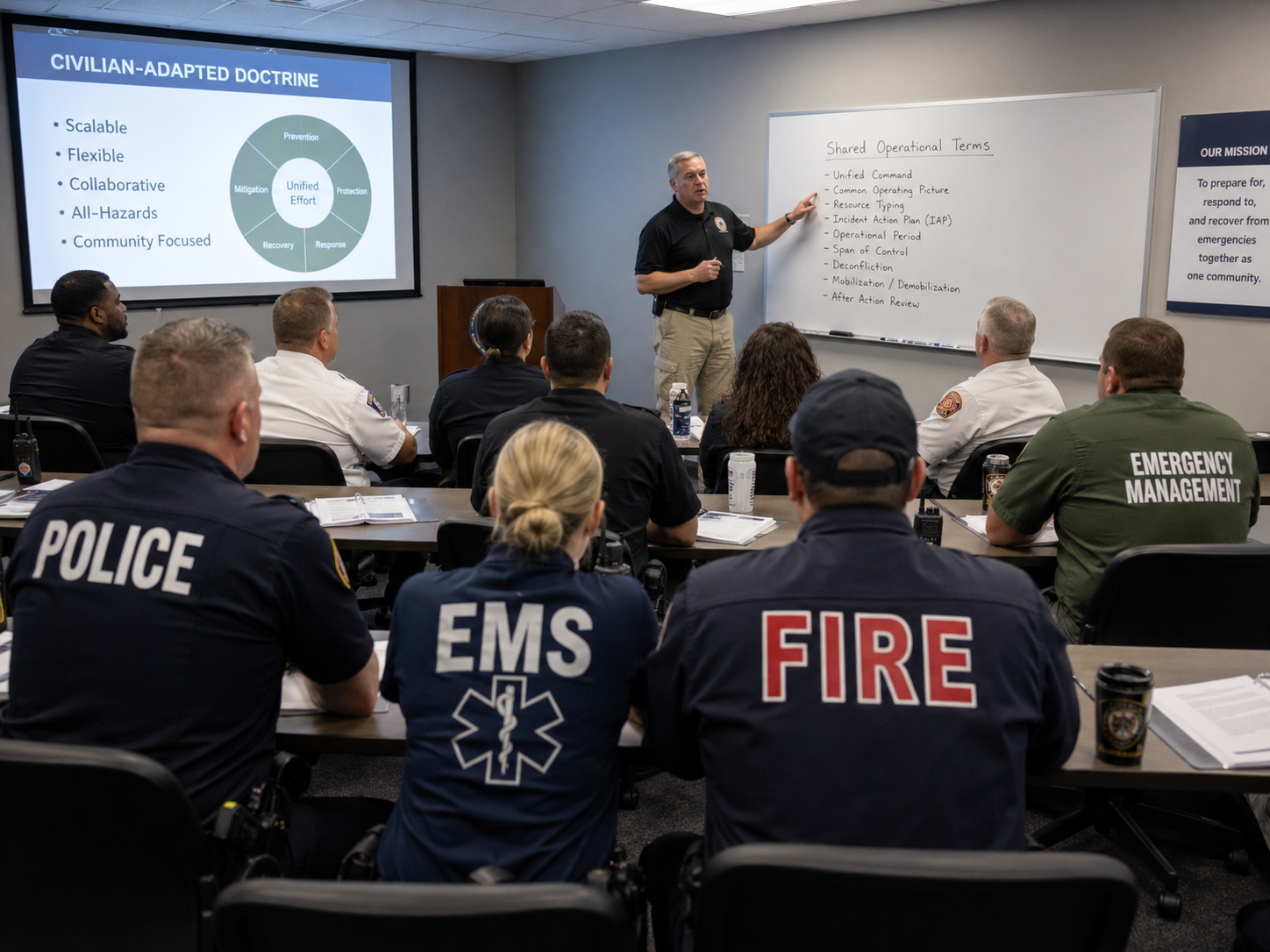
Corrective Strategies and Doctrinal Realignment: Rebuilding Operational Clarity Through Shared Language
In high-threat public safety operations, failure rarely begins with tactics—it begins with misunderstanding. Long before responders move, treat, or evacuate, they align (or misalign) around words. Those words frame expectations, authorize action, and define perceived risk. When terminology is borrowed wholesale from military contexts and inserted into civilian systems without translation, it introduces ambiguity precisely where clarity is required most. Corrective strategies are therefore not cosmetic adjustments to vocabulary; they are doctrinal realignments that directly affect safety, tempo, and mission success.
The central argument of this analysis is clear: public safety agencies must adapt terminology to civilian frameworks through deliberate standardization, cross-disciplinary training, and doctrine that emphasizes function over jargon. Applying the science of listener attention—front-loaded relevance (primacy), structured cognitive chunking, progressive emphasis, repetition with variation, and continuous relevance anchoring—this article outlines how agencies can correct linguistic drift, realign doctrine, and restore shared operational meaning across law enforcement, fire, EMS, and emergency management.
Why Corrective Action Is Urgent, Not Optional
Front-loading relevance matters. Miscommunication driven by terminology does not produce minor inefficiencies; it produces unsafe movement, delayed medical access, fractured Unified Command, and preventable injury. After-action reviews routinely identify “communication issues” without naming their source. In many cases, the source is language that sounded shared but was never defined.
Corrective strategies must therefore be treated as risk controls, not training preferences. Just as agencies standardize equipment, radio procedures, and incident command structures, they must standardize operational language. Without this, doctrine remains fragmented and execution unpredictable.
Principle One: Adapt Language to Civilian Frameworks
The first corrective principle is foundational: civilian public safety must adapt language to its own legal, operational, and organizational realities. Military terminology is built around assumptions that rarely hold in civilian response—centralized authority, uniform training, and broad risk acceptance. Importing words without adapting those assumptions creates misalignment.
Adaptation means:
Translating intent into civilian-appropriate actions
Explicitly acknowledging legal and policy constraints
Defining what a term authorizes—and what it does not
This is not dilution; it is precision. Adapted language preserves decisiveness while aligning execution with reality.
Repetition with variation reinforces the point: words are not wrong because they are military; they are wrong when they are untranslated.

Principle Two: Standardize Terminology Across Disciplines
Standardization is the cornerstone of doctrinal realignment. Without shared definitions, cross-disciplinary operations rely on assumption. Assumption is fragile under stress.
Effective standardization requires agencies to:
Identify high-risk terms commonly used across disciplines
Agree on single operational definitions for those terms
Document definitions in shared references and SOPs
Enforce consistent use during training and operations
Standardization does not require exhaustive glossaries. It requires agreement on the few words that matter most—those that authorize movement, access, or risk.
Progressive emphasis clarifies the payoff: standardization turns vocabulary into coordination.
Principle Three: Cross-Disciplinary Training as the Alignment Engine
Terminology cannot be standardized in isolation. It must be trained across disciplines, not within silos. Cross-disciplinary training exposes differences in interpretation and provides a safe environment to resolve them.
High-value training practices include:
Joint scenario briefings that define key terms upfront
Scenario injects that test how agencies interpret directives
Facilitated pauses to compare assumptions mid-exercise
After-action reviews that analyze language, not just actions
This approach leverages listener attention science. By surfacing differences repeatedly, with variation, responders internalize shared meaning. Over time, clarification becomes reflexive rather than disruptive.
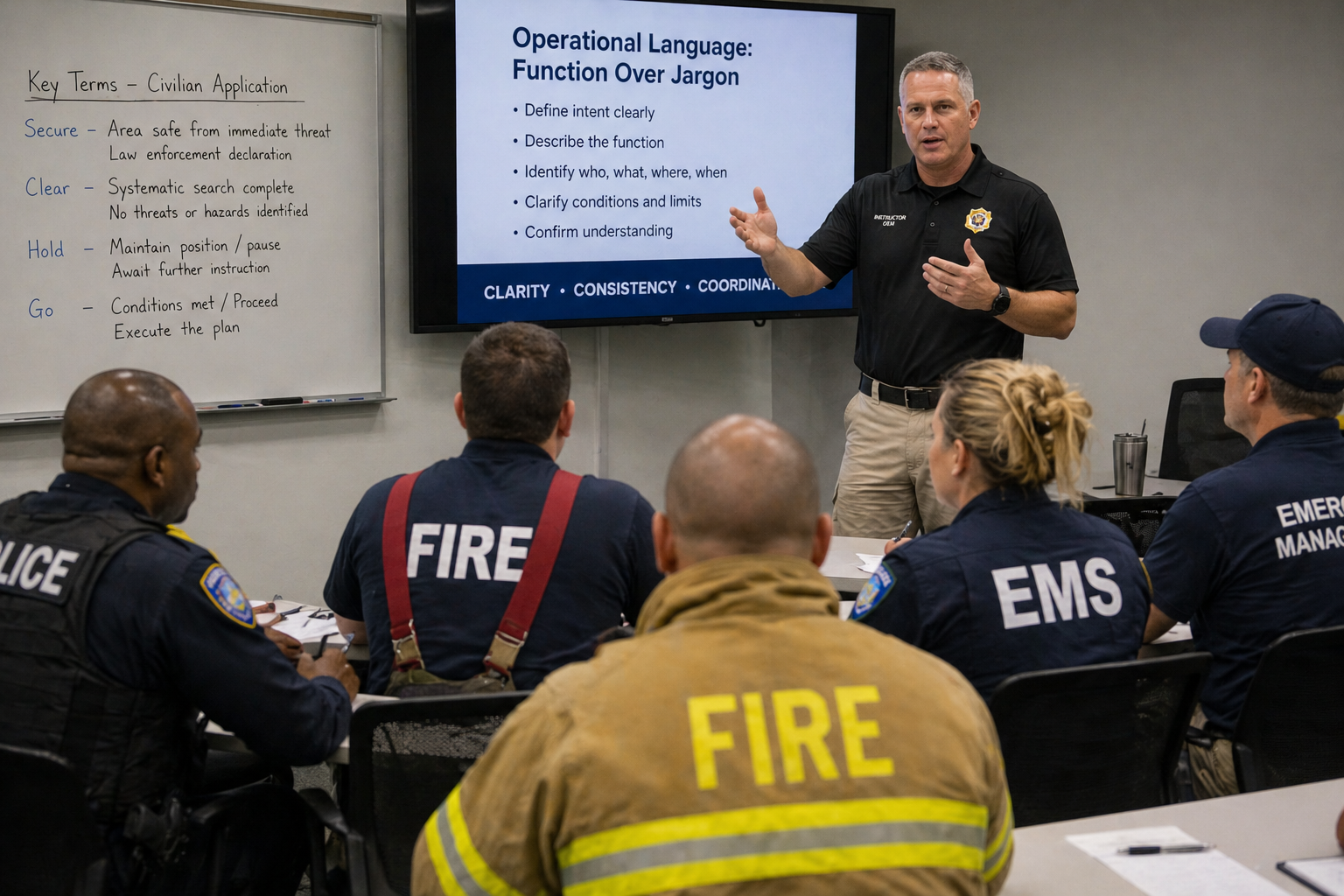
Principle Four: Embed Definitions in Doctrine and ICS Practice
Training alone cannot sustain alignment. Definitions must be embedded in doctrine—specifically within SOPs, ICS references, and Unified Command practices. When terminology is codified, it becomes stable; when it is informal, it drifts.
Doctrinal embedding includes:
Incorporating standardized terms into SOP language
Aligning definitions with ICS roles and responsibilities
Requiring defined terms during command briefings
Auditing plans and policies for ambiguous language
Embedding language into ICS practice ensures that command intent is communicated consistently, regardless of which agency is speaking.
Continuous relevance anchoring keeps attention on outcome: doctrine that defines language reduces friction before incidents occur.
Principle Five: Emphasize Function Over Jargon
One of the most powerful corrective strategies is deceptively simple: prioritize function over jargon. Jargon compresses complexity, but only when the audience shares context. In mixed-discipline environments, function-based language often performs better.
Function-based language:
Describes what must happen, not what it is called
Identifies who is responsible, under what conditions
Clarifies boundaries and constraints
For example, replacing a slogan with a task-oriented directive—movement parameters, access conditions, protective requirements—restores clarity without slowing tempo.
Repetition with variation reinforces the lesson: clarity outperforms cleverness under stress.
Reducing Miscommunication Through Structural Reinforcement
Corrective strategies must be reinforced structurally, not left to individual preference. This includes:
Checklists that prompt definition of key terms during planning
Briefing templates that require operational clarification
Evaluation criteria that assess language discipline during exercises
These structures normalize precision and remove stigma from asking for clarification. When systems prompt clarity, individuals follow.
Leadership’s Role in Doctrinal Realignment
Leadership is the decisive variable in sustaining corrective change. Leaders shape what language is acceptable, what ambiguity is tolerated, and what clarity is rewarded.
Effective leaders:
Model precise, function-based language
Interrupt ambiguous terminology during briefings
Encourage clarification without penalty
Reinforce that clarity equals professionalism
Leadership behavior signals whether doctrinal realignment is performative or real. When leaders insist on precision, culture follows.
Addressing Resistance and Cultural Friction
Terminology reform often encounters resistance—not because it is ineffective, but because language is tied to identity and experience. Some terms feel earned; others feel authoritative. Corrective strategies must therefore be framed not as critique, but as risk reduction.
Key reframing strategies include:
Emphasizing safety and coordination outcomes
Demonstrating real-world failure modes tied to ambiguity
Involving practitioners in defining shared terms
When responders see that reform protects them and their patients, resistance diminishes.
Measuring Success: From Language to Outcomes
Corrective strategies must be evaluated by outcomes, not compliance. Indicators of successful realignment include:
Reduced clarification traffic during incidents
Faster, more consistent medical access
Fewer command corrections mid-operation
Improved interagency trust and tempo
These indicators reflect operational clarity, the ultimate objective of terminology reform.
Progressive Emphasis: Doctrine Shapes Behavior Before Action
Across all corrective strategies, a single theme recurs: doctrine shapes behavior before the first movement occurs. Language embedded in doctrine becomes the default under stress. If that language is precise, behavior aligns. If it is ambiguous, risk propagates.
This progression—language → interpretation → action → outcome—underscores why corrective strategies must address language at the doctrinal level.
Building a Sustainable Model of Alignment
Sustainable alignment requires maintenance. Agencies should periodically review terminology as threats, tactics, and policies evolve. New terms must be defined before adoption. Old terms must be reevaluated as contexts change.
This iterative process keeps doctrine alive rather than ossified.
Conclusion
Corrective strategies and doctrinal realignment are essential to modern public safety operations. Adapting terminology to civilian frameworks, standardizing definitions across disciplines, embedding language into doctrine, and emphasizing function over jargon directly reduce miscommunication and operational risk.
These efforts do more than improve communication—they protect responders, accelerate care, and strengthen mission execution. In high-threat environments, clarity is not a luxury; it is a safeguard.
When language is aligned, Unified Command functions as intended. When doctrine speaks clearly, responders act confidently. Corrective strategies do not weaken decisiveness—they make it safer, faster, and more effective.