
From Fragmented Action to Life-Preserving System Performance During Active Shooter Response
From Fragmented Action to Life-Preserving System Performance During Active Shooter Response
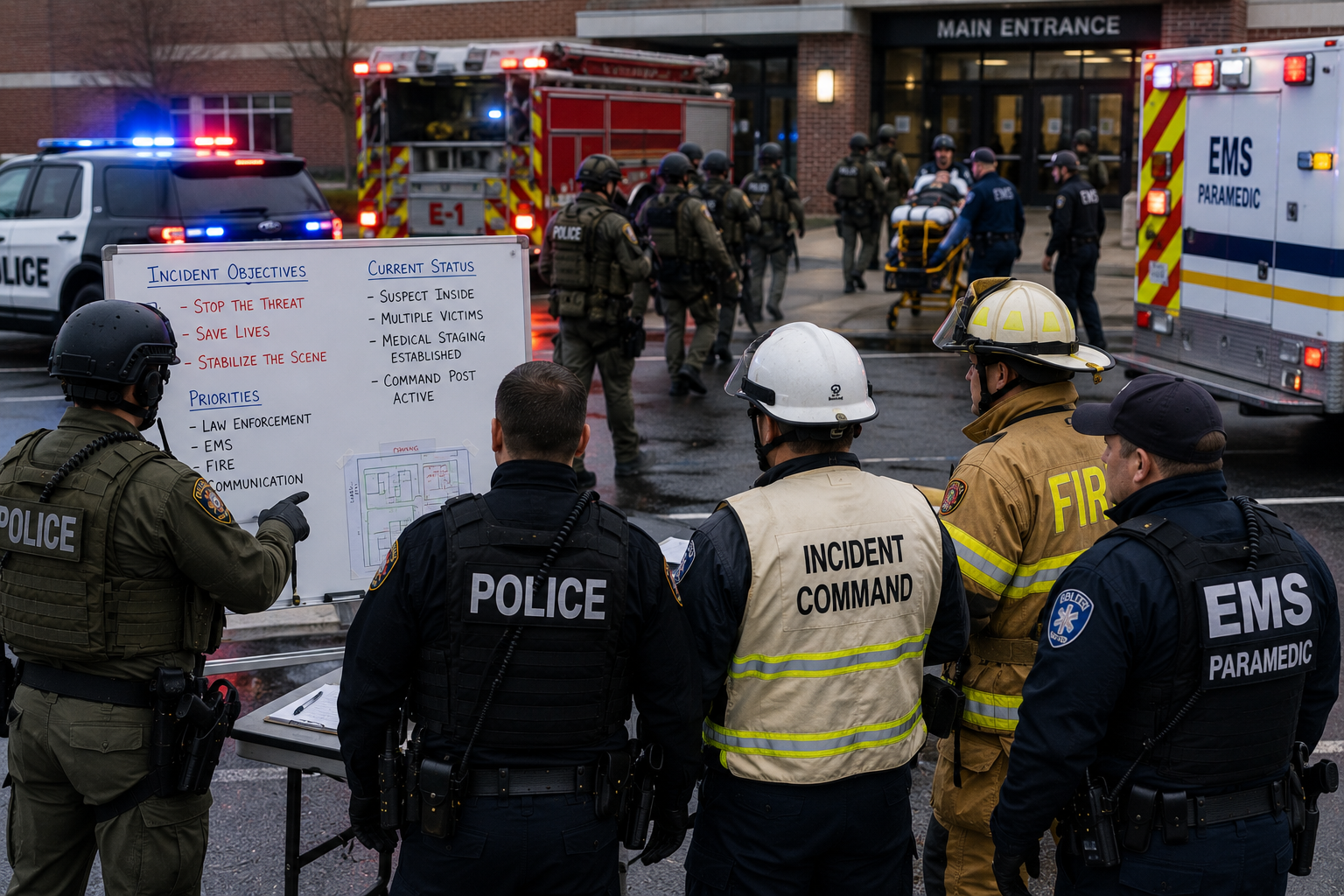
Active shooter incidents expose the limits of traditional response models with unforgiving clarity. These events unfold rapidly, generate extreme uncertainty, and impose simultaneous demands for threat mitigation, medical intervention, command coordination, and public safety management. In this environment, the margin for error is measured in seconds, and the consequences of delay are measured in lives. Historical response frameworks—often linear, discipline-specific, and sequential—struggle to keep pace with this reality. The Chaos–Stabilization–Recovery (CSR) framework emerges in response to this gap, offering a unified, condition-based approach designed to align operational tempo with human physiology and incident dynamics.
The central argument of this analysis is that the anticipated results of implementing the CSR framework in active shooter response are measurably improved survival outcomes, reduced operational delay, and enhanced system efficiency. By unifying response phases, integrating medical intervention throughout the incident lifecycle, and reinforcing coordinated command structures, CSR transforms fragmented action into coherent system performance. This discussion examines the expected outcomes of CSR implementation and explains why these outcomes represent a fundamental advancement in high-threat incident management.
Unifying Chaos, Stabilization, and Recovery Into a Single Operational Continuum
One of the most significant anticipated results of the CSR framework is the elimination of artificial boundaries between response phases. Traditional models often treat threat response, medical care, and recovery as discrete stages assigned to specific agencies. In practice, these stages overlap. Casualties require care during threat mitigation, command structures evolve while operations continue, and recovery considerations emerge before the scene is fully stabilized.
CSR reframes response as a continuous operational continuum defined by conditions rather than checklists. Chaos, Stabilization, and Recovery are not agency-owned phases; they are shared environments that all responders navigate together. This unification produces immediate benefits. Responders no longer wait for formal transitions before acting. Instead, they adjust actions dynamically as conditions change.
The anticipated result is faster decision-making with fewer artificial pauses. Actions that save lives—such as hemorrhage control, airway management, and casualty movement—begin earlier and continue seamlessly as the incident evolves.
Integrated Medical Intervention Across All Phases
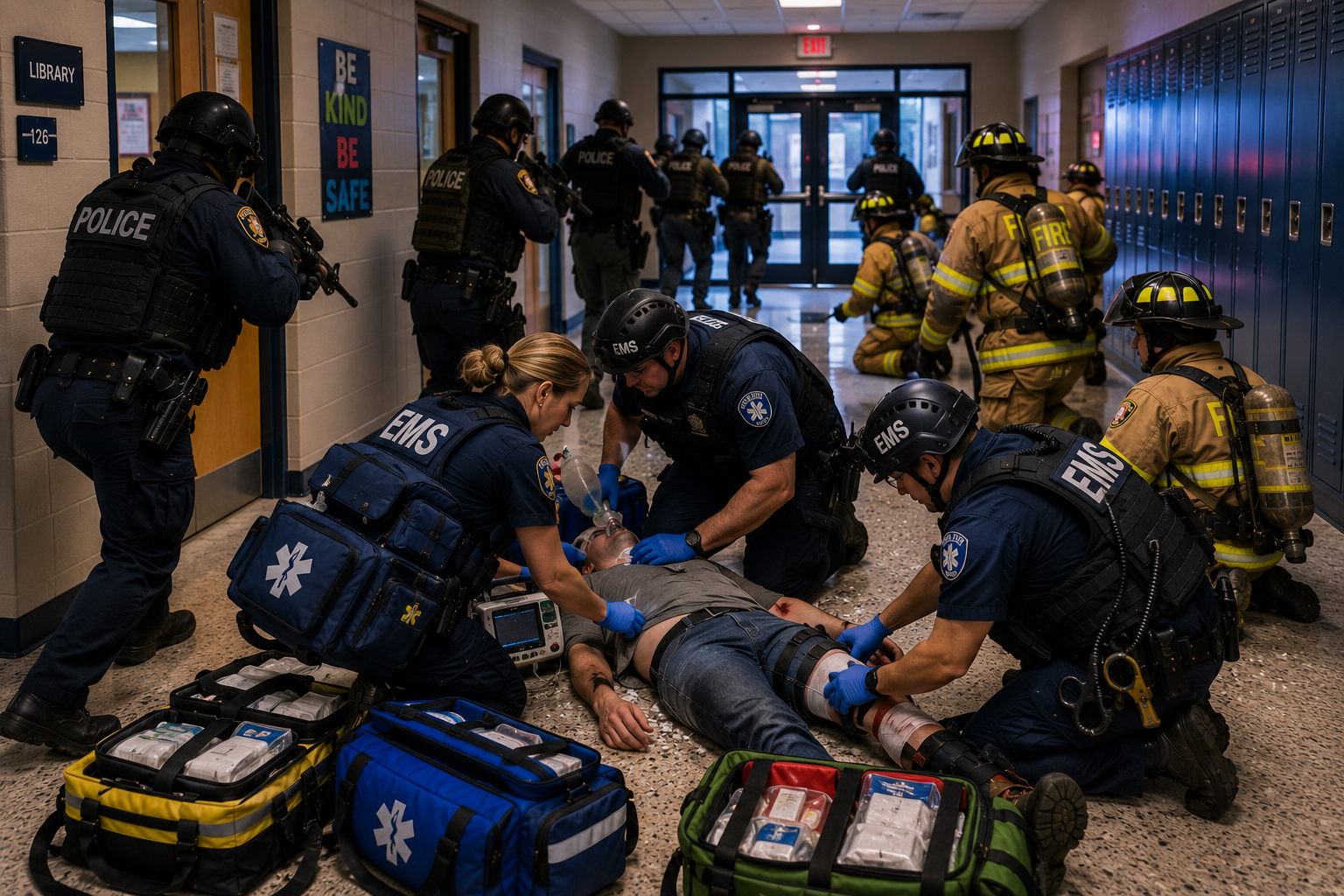
A defining feature of CSR is the deliberate integration of medical intervention across Chaos, Stabilization, and Recovery. Traditional doctrines often delay organized medical response until scenes are declared safe. This delay directly contradicts trauma science, which demonstrates that the majority of preventable deaths occur within minutes of injury.
Under CSR, medical intervention is not treated as a downstream activity. It is embedded into every phase of response. During Chaos, immediate life-saving actions occur under threat-mitigated conditions. During Stabilization, medical operations expand, become more organized, and integrate into coordinated evacuation. During Recovery, ongoing medical and psychological care supports long-term outcomes.
The anticipated result of this integration is reduced treatment delay and improved survival rates. Early hemorrhage control, faster access to casualties, and earlier initiation of definitive care all correlate with improved outcomes. By removing doctrinal barriers to early care, CSR aligns operational behavior with physiological reality.
Coordinated Command Structures and Improved Decision Quality
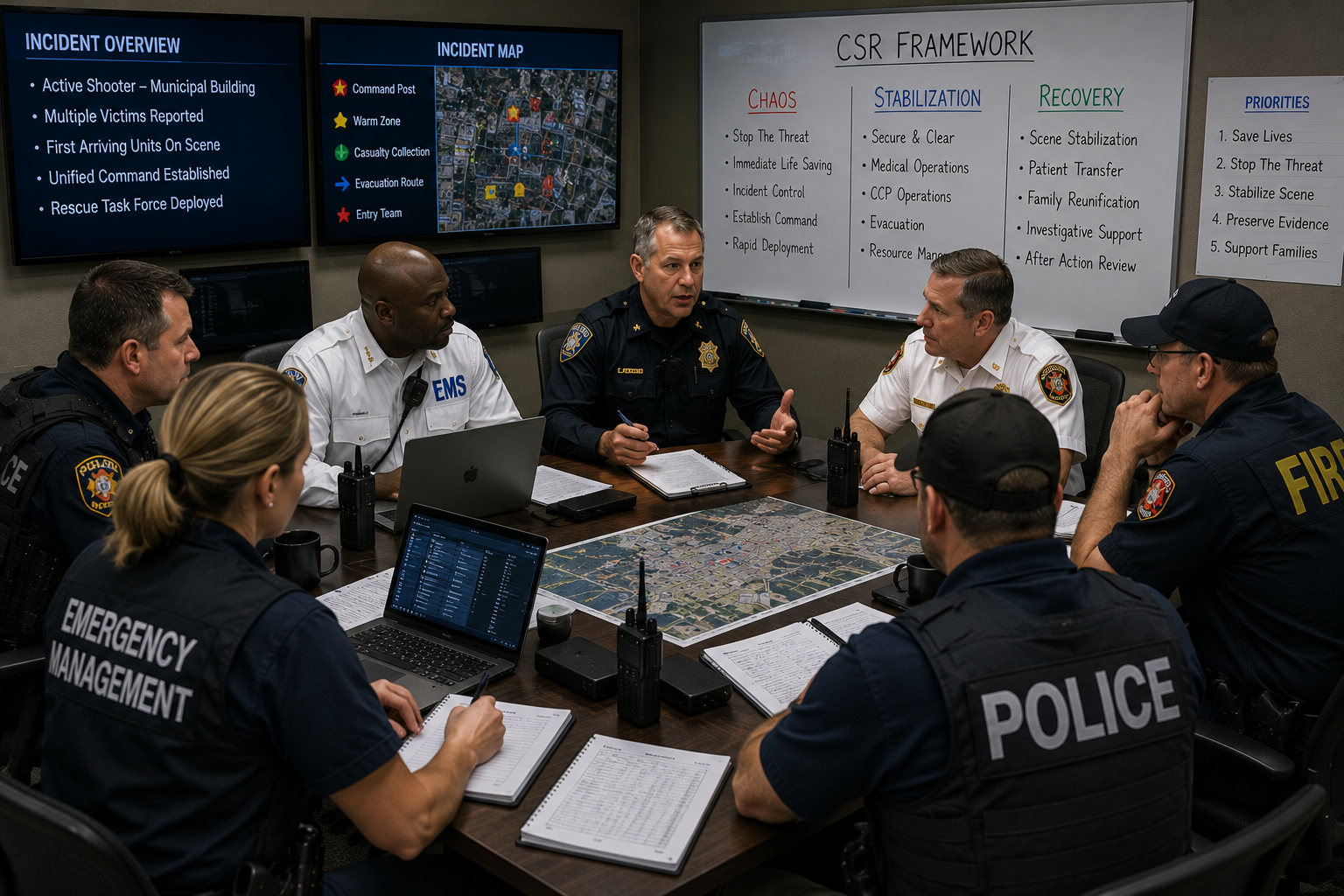
Another anticipated outcome of CSR implementation is enhanced command effectiveness. High-threat incidents overwhelm command structures when agencies operate independently, each optimizing for its own mission without a shared framework. This fragmentation produces conflicting priorities, duplicated efforts, and delayed decisions.
CSR strengthens coordinated command by providing a shared operational model. Command decisions are anchored to phase conditions rather than agency-specific milestones. This shared reference point improves communication, clarifies intent, and accelerates consensus.
As a result, resource allocation becomes more efficient. Personnel, equipment, and access routes are assigned based on evolving conditions rather than rigid plans. The anticipated outcome is command that is proactive rather than reactive—setting tempo instead of chasing it.
Reduction of Operational Confusion and Cognitive Overload
Operational confusion is one of the most persistent threats to effective high-threat response. Confusion arises when agencies operate with different assumptions, terminology, and priorities. Responders may receive accurate information but interpret it differently, leading to hesitation or conflicting actions.
CSR directly addresses this problem by offering a common mental model. When responders understand which phase they are operating in and what conditions define that phase, interpretation becomes more consistent. Language aligns with function. Expectations converge.
The anticipated result is reduced cognitive overload. Responders spend less mental energy reconciling conflicting signals and more energy executing critical tasks. This clarity reduces error rates, improves coordination, and enhances responder safety.
Prevention of Overlap, Conflict, and Redundant Actions
In fragmented systems, overlap and redundancy are common. Multiple agencies may perform the same task while other critical tasks go unattended. Alternatively, agencies may avoid action altogether, assuming another discipline is responsible.
CSR mitigates this risk by clarifying shared responsibility without duplicative effort. During each phase, roles are complementary rather than competitive. Law enforcement actions create space for medical care. Medical operations inform tactical priorities. Command synchronizes rather than arbitrates.
The anticipated outcome is a reduction in wasted effort. Personnel are used more efficiently, coverage gaps shrink, and critical actions occur sooner. This efficiency is particularly valuable during the early minutes of an incident, when staffing is often limited and demand is highest.
Accelerated Threat Mitigation Through System Alignment
Although CSR emphasizes medical integration, it does not diminish the importance of threat mitigation. In fact, the framework is expected to accelerate threat mitigation by reducing friction between agencies. When medical and command elements are aligned with law enforcement objectives, tactical movement proceeds with fewer interruptions and less uncertainty.
Law enforcement benefits from clearer command intent, predictable medical integration, and reduced pressure to delay action due to downstream concerns. The anticipated result is more decisive threat control executed within a system that simultaneously preserves life.
Improved Casualty Care Under High-Pressure Conditions
Casualty care during active shooter incidents is uniquely challenging. Conditions are unstable, access is limited, and patient numbers may exceed immediate resources. CSR addresses these challenges by enabling early care, dynamic triage, and progressive organization as conditions improve.
The anticipated result is improved casualty flow. Casualty Collection Points are established earlier and closer to the point of injury. Triage evolves continuously rather than remaining static. Evacuation begins sooner, reducing time to definitive care.
These improvements collectively enhance survivability, particularly for patients with time-sensitive injuries.
Enhanced Efficiency Through Parallel Operations
Traditional sequential response models force agencies to wait their turn. CSR replaces this with parallel operations guided by shared conditions. Threat mitigation, medical care, evacuation planning, and command coordination occur simultaneously, each advancing as conditions allow.
The anticipated result is compressed timelines. Actions that once occurred minutes apart now occur concurrently. This compression is not chaotic; it is coordinated. Efficiency increases without increasing risk because actions are synchronized rather than stacked.
Improved Safety for Responders and the Public
CSR is anticipated to improve safety not by eliminating risk, but by managing it intelligently. Early integration of medical and command elements reduces uncontrolled movement, clarifies access routes, and limits ad hoc decision-making.
Responders benefit from clearer expectations and better situational awareness. The public benefits from faster care, more orderly evacuation, and earlier stabilization of the incident environment. Recovery operations begin sooner, reducing secondary harm and community disruption.
System-Level Performance Rather Than Individual Excellence
A critical anticipated outcome of CSR adoption is a shift in how success is measured. Rather than focusing on individual agency performance, CSR emphasizes system-level outcomes. Survival rates, time to care, coordination efficiency, and stabilization speed become primary metrics.
This shift encourages collaboration, continuous improvement, and shared accountability. Agencies are incentivized to optimize the system rather than protect silos. Over time, this produces more resilient and adaptable response capabilities.
Long-Term Organizational and Cultural Benefits
Beyond immediate incident outcomes, CSR is expected to generate long-term benefits. Shared frameworks improve joint training effectiveness, reinforce common language, and reduce interagency friction. Organizations become more adaptable, better prepared, and more confident in complex environments.
These cultural shifts strengthen preparedness not only for active shooter incidents, but for a wide range of high-consequence events.
Conclusion
The anticipated results of implementing the CSR framework in active shooter response are clear and compelling. By unifying Chaos, Stabilization, and Recovery into a continuous operational model, integrating medical intervention throughout all phases, and reinforcing coordinated command structures, CSR addresses the most persistent weaknesses in traditional response systems.
The framework reduces treatment delays, minimizes confusion, prevents redundant action, and accelerates both threat mitigation and casualty care. The result is a response that is more efficient, more coordinated, and—most importantly—more life-preserving.
In high-threat environments where seconds determine survival, CSR aligns operational behavior with reality. It does not ask responders to work harder or take unnecessary risks. It asks them to work together under a shared framework that prioritizes life, clarity, and effectiveness.