
Evaluating CSR as a New Direction for Integrated Tactical-Medical Response
Evaluating CSR as a New Direction for Integrated Tactical-Medical Response
Modern active shooter incidents continue to expose a fundamental strain on public safety response systems: the simultaneous demand for rapid threat mitigation and immediate life-saving medical care. These events unfold in compressed timeframes, generate extreme uncertainty, and punish delay. Yet many existing response models still rely on sequential logic—threat first, medicine later—despite mounting evidence that such separation contributes directly to preventable mortality. The consequence is a recurring mismatch between what response systems are designed to do and what high-threat environments actually require.
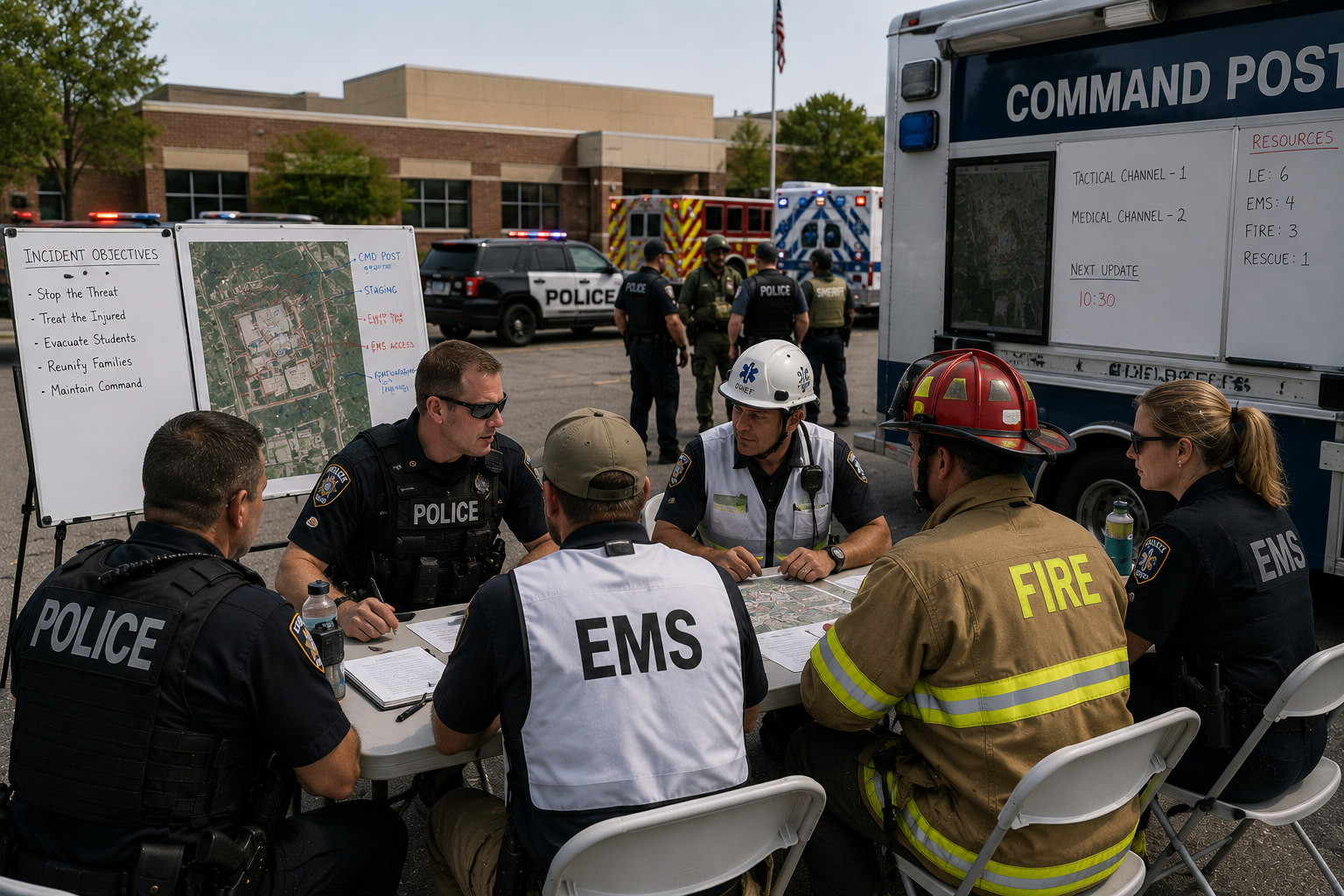
The Chaos–Stabilization–Recovery (CSR) framework has emerged as a proposed corrective to these systemic limitations. Rather than refining individual tactics within existing silos, CSR reorients response around a unified operational system that integrates tactical and medical priorities across all phases of an incident. This analysis evaluates CSR as a new direction for integrated tactical-medical response, examining its conceptual foundations, operational advantages, and inherent limitations. Understanding both its strengths and constraints is essential if CSR is to serve as a durable evolution in response doctrine rather than a temporary corrective.
The Strain on Existing Response Systems
Traditional active shooter response systems were built incrementally, often in reaction to specific historical failures rather than as part of a unified design. Law enforcement doctrine evolved to prioritize rapid entry and threat neutralization. EMS and fire doctrine retained strong emphasis on scene safety and staged deployment. Command structures were layered on top of these functions to manage complexity after initial control was achieved.
While each of these elements evolved independently, they were rarely redesigned as an integrated system. In practice, this fragmentation produces predictable friction. Law enforcement actions may succeed tactically while medical access remains delayed. EMS and fire may possess the capability to intervene but lack doctrinal authority or integration. Command struggles to synchronize actions occurring on different timelines.
High-threat incidents amplify these weaknesses. When threats are mobile, ambiguous, or conclude rapidly, sequential response models fail by design. Medical care that begins only after threat resolution often begins too late. CSR enters this landscape as an attempt to correct system-level misalignment rather than optimize isolated components.
CSR as a Unified Operational Framework
At its core, CSR reframes response around conditions rather than chronology. Chaos, Stabilization, and Recovery are not agency-owned phases, nor are they rigid stages that occur in clean succession. Instead, they represent shared operational environments defined by uncertainty, control, and restoration.
During Chaos, responders operate under extreme uncertainty, incomplete information, and immediate threat. CSR expects decisive action under managed risk, including early life-saving medical intervention when conditions permit. Stabilization emerges as control expands, coordination improves, and operations become more deliberate. Recovery focuses on accountability, investigation, long-term medical and psychological care, and restoration of community safety.
This structure unifies tactical and medical functions by design. Rather than treating medicine as a downstream beneficiary of security, CSR embeds medical considerations throughout all phases. This integration is the framework’s most significant departure from traditional models—and its primary promise.
Supporting Faster Medical Access Without Sacrificing Threat Mitigation
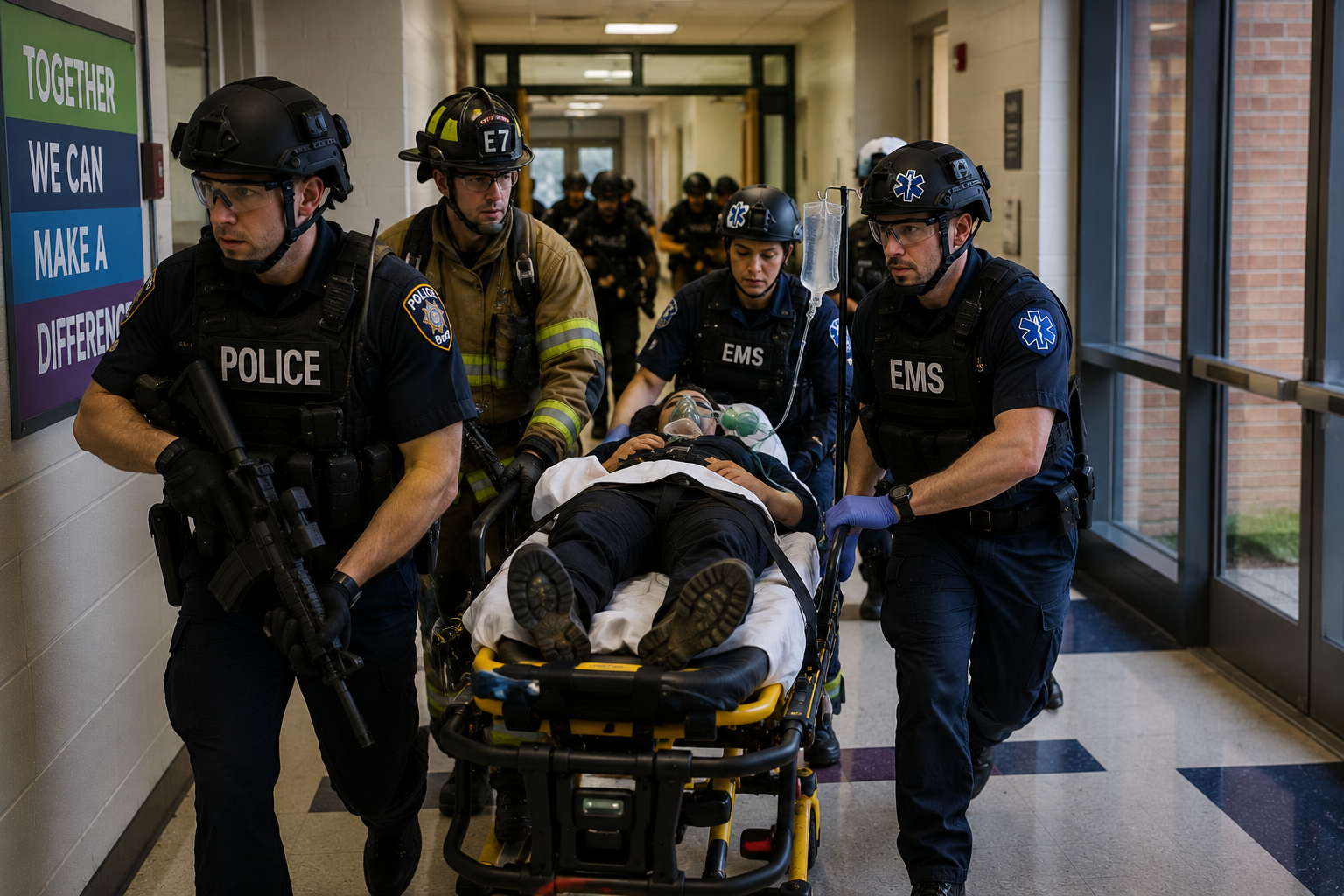
One of CSR’s central strengths is its ability to reconcile two objectives often framed as competing: rapid medical access and continuous threat mitigation. In traditional doctrine, medical care is frequently delayed out of concern that early access will compromise responder safety or tactical momentum. CSR challenges this assumption by formalizing managed risk and coordinated movement.
By integrating medical access into tactical planning, CSR allows responders to capitalize on partial control rather than waiting for total certainty. Law enforcement actions are informed by casualty locations and survivability timelines. Medical teams operate under protection within threat-mitigated zones rather than staging indefinitely.
The anticipated effect is earlier hemorrhage control, faster casualty movement, and reduced preventable death—without halting or undermining tactical operations. Importantly, CSR does not advocate reckless exposure. It replaces passive waiting with deliberate, coordinated action.
Addressing Command and Communication Deficiencies
Repeated after-action reports from high-threat incidents identify command and communication failures as persistent contributors to poor outcomes. Confusion over authority, inconsistent terminology, and competing priorities degrade situational awareness and slow decision-making.
CSR addresses these deficiencies by providing a shared operational reference point. Command decisions are anchored to phase conditions rather than agency milestones. This shared structure improves communication by reducing interpretive variance. When responders understand what Chaos or Stabilization means operationally, coordination becomes more intuitive.
The framework also supports smoother command evolution. Tactical command does not abruptly give way to administrative control; it matures as conditions stabilize. This continuity reduces the leadership gaps that often emerge during prolonged or complex incidents.
Improving Coordination Across Disciplines
Integrated tactical-medical response requires more than proximity; it requires alignment. CSR facilitates this alignment by clarifying how different disciplines contribute simultaneously rather than sequentially. Law enforcement creates access and security. EMS and fire deliver life-saving interventions and extraction. Command synchronizes these actions within a single operational picture.
This coordination reduces duplication and omission. Actions reinforce each other instead of competing for attention. Responders spend less time negotiating boundaries and more time executing purposefully.
From a system perspective, this alignment enhances efficiency. Resources are allocated based on evolving conditions rather than fixed assumptions. The response becomes adaptive rather than reactive.
Evaluating CSR’s Strengths in Practice
Several strengths position CSR as a compelling advancement in integrated response doctrine. First, it aligns operational behavior with trauma science, which emphasizes early intervention. Second, it reflects human performance realities by simplifying decision-making under stress. Third, it offers adaptability across jurisdictions with varying resources.
CSR’s condition-based structure allows small agencies to apply the framework without requiring specialized teams, while larger systems can scale integration across complex operations. Its emphasis on shared understanding supports interoperability without erasing agency identity.
Perhaps most importantly, CSR reframes success metrics. Outcomes such as time to medical access, survivability, and coordination efficiency become central measures of performance rather than secondary considerations.
Recognizing CSR’s Limitations
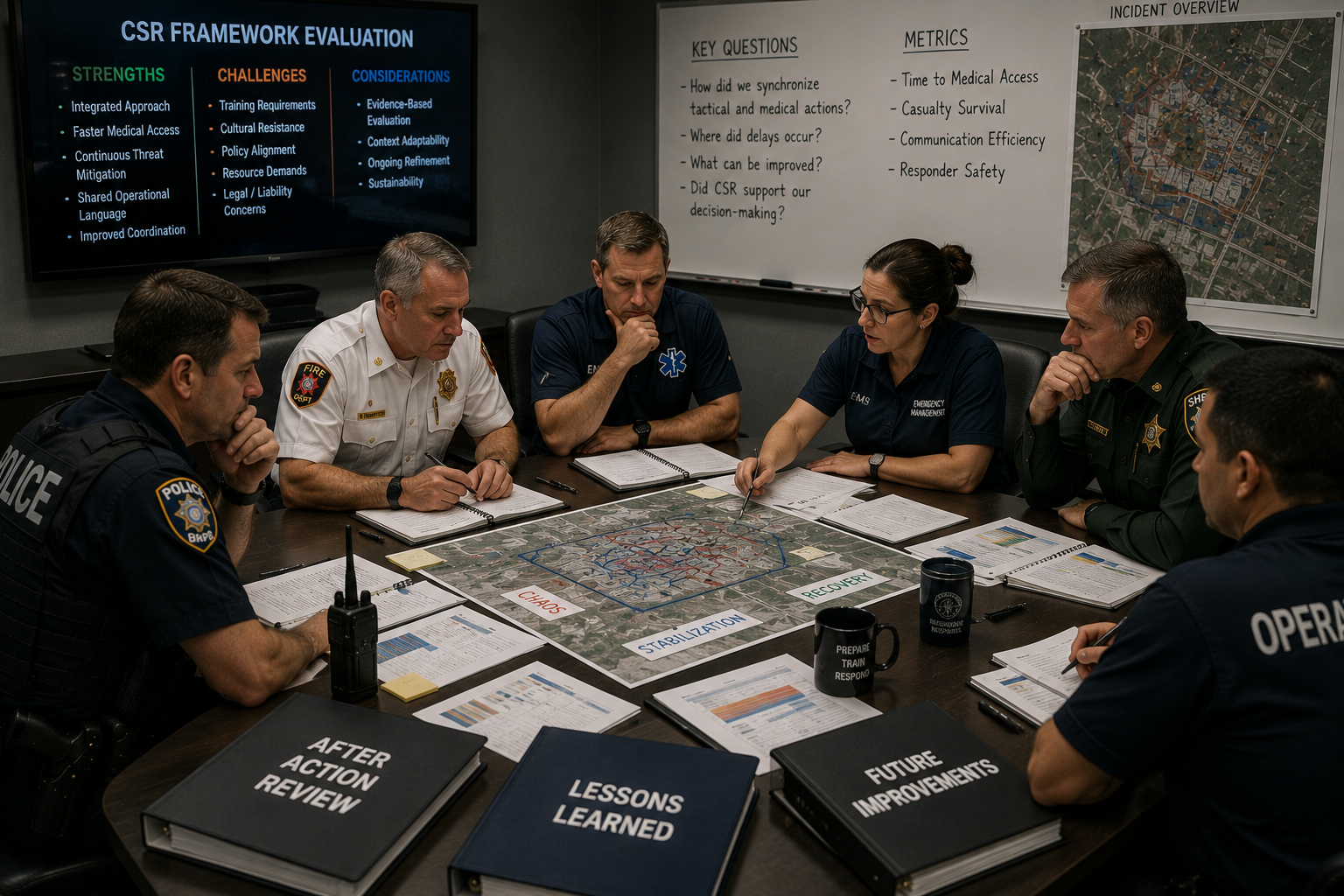
Despite its strengths, CSR is not a universal solution. Its effectiveness depends heavily on implementation. Without joint training, shared terminology, and leadership buy-in, the framework risks becoming another conceptual overlay rather than a functional system.
CSR also challenges entrenched cultural norms. Agencies accustomed to strict role separation or risk-averse doctrine may resist early integration. Legal and liability concerns can further complicate adoption, particularly in jurisdictions where policy lags behind operational reality.
Additionally, CSR does not eliminate ambiguity. High-threat incidents remain inherently unpredictable. The framework provides structure, but it cannot replace judgment. Over-reliance on any model—CSR included—can become problematic if it is treated as prescriptive rather than adaptive.
Recognizing these limitations is essential to prevent misapplication and to guide refinement.
The Importance of Evidence-Based Evaluation
Evaluating CSR requires more than theoretical endorsement. Its value must be assessed through measurable outcomes, training performance, and after-action analysis. Metrics such as casualty survival rates, time to intervention, coordination effectiveness, and responder safety provide meaningful indicators of success.
Evidence-based evaluation also supports iterative improvement. CSR should evolve as new data emerges, incorporating lessons learned rather than becoming static doctrine. This adaptability is critical in an evolving threat landscape.
Importantly, evaluation must consider context. What works in a metropolitan environment may require modification in rural settings. CSR’s flexibility allows for such adaptation, but only if evaluation informs implementation.
Shaping the Future of Integrated Response Doctrine
CSR represents a shift from discipline-centered doctrine to system-centered design. This shift has implications beyond active shooter response. Integrated tactical-medical coordination is relevant to a wide range of high-risk incidents, including complex assaults, terrorist attacks, and mass-casualty events.
As agencies consider CSR’s role in future doctrine, the focus should remain on principles rather than rigid templates. Early integration, managed risk, shared understanding, and continuous coordination are transferable concepts that can strengthen response across scenarios.
The long-term value of CSR lies not in replacing existing expertise, but in organizing it coherently.
Balancing Innovation With Operational Reality
Innovation in public safety must balance ambition with realism. CSR’s promise lies in its alignment with evidence and operational necessity, but its success depends on disciplined application. Training must reflect real conditions. Policy must support managed risk. Leadership must reinforce integration rather than retreat to silos under pressure.
Evaluating CSR honestly—including its shortcomings—ensures that adoption strengthens rather than destabilizes response systems.
Conclusion
Evaluating CSR as a new direction for integrated tactical-medical response reveals both significant promise and critical considerations. Existing response systems struggle to meet the demands of modern high-threat incidents because they are fragmented by design. CSR offers a structured, unified framework that integrates Chaos, Stabilization, and Recovery into a coherent operational system.
By supporting earlier medical access, continuous threat mitigation, and improved command coordination, CSR addresses many deficiencies observed in prior incidents. Its strengths lie in adaptability, evidence alignment, and system-level integration. Its limitations lie in implementation challenges, cultural resistance, and the need for ongoing evaluation.
Understanding both the benefits and drawbacks of CSR is essential for shaping future response doctrine. When applied thoughtfully and evaluated rigorously, CSR represents a meaningful step toward closing the gap between tactical success and medical survivability—advancing public safety response toward a more integrated, life-preserving system.