Improving Collaborative Efforts in High-Threat Incident Response
Improving Collaborative Efforts in High-Threat Incident Response
High-threat incidents do not fail because public safety agencies lack capability; they fail because capability is fragmented. In active shooter events and similarly dynamic emergencies, operational breakdown is rarely the result of insufficient equipment, inadequate training, or lack of resolve. Instead, failure most often stems from poor collaboration—agencies operating adjacent to one another rather than as a single, integrated system. When law enforcement, EMS, fire, and emergency management respond independently, lifesaving opportunities are lost in the gaps between disciplines.
Effective response in high-threat environments depends on collaboration established before the incident begins. Traditional models that rely on agency-specific action followed by later coordination are incompatible with the speed, complexity, and physiological realities of modern threats. Collaboration must therefore be treated as a core operational requirement, not an aspirational goal achieved after the fact. This analysis examines how siloed response models undermine performance, how inconsistent language and independent operations degrade situational awareness, and how the Chaos–Stabilization–Recovery (CSR) framework provides a practical structure for unified, life-saving response.
The Limits of Traditional Siloed Response Models
Public safety response structures evolved during a period when incidents were slower, more predictable, and less complex. Law enforcement focused on security, EMS managed patients, and fire services addressed hazards. Coordination occurred at designated handoff points, often after scenes were secured. For many routine emergencies, this division of labor was sufficient.
High-threat incidents expose the limitations of this approach. Active shooter events compress timelines and expand mission demands simultaneously. Independent action by discipline creates delayed information sharing, redundant efforts, and inefficient resource allocation. No single agency possesses a complete operational picture, and decisions are made with partial awareness. As a result, actions that appear logical within one discipline may undermine system-wide effectiveness.
Independent competence does not translate into collective effectiveness. When agencies act in isolation, the system as a whole slows, even when individual responders perform well.
Communication Failures and the Illusion of Coordination
After-action reviews frequently cite “communication failures” as contributing factors in high-threat incidents. In many cases, radios function properly and messages are transmitted clearly. The breakdown occurs not at transmission, but at interpretation. Agencies use familiar language that carries different meanings across disciplines. Terms such as secure, clear, or safe to enter are decoded through discipline-specific frameworks.
Under stress, responders default to their own definitions, assuming shared understanding where none exists. This creates the illusion of coordination. Everyone believes alignment exists until actions diverge—law enforcement advances while EMS continues to stage, or fire resources hesitate despite reduced threat conditions. These disconnects delay movement, delay care, and prolong chaos.
Language, therefore, is not a cosmetic issue. It is an operational variable that directly affects tempo and safety.
Resource Allocation and the Cost of Fragmentation
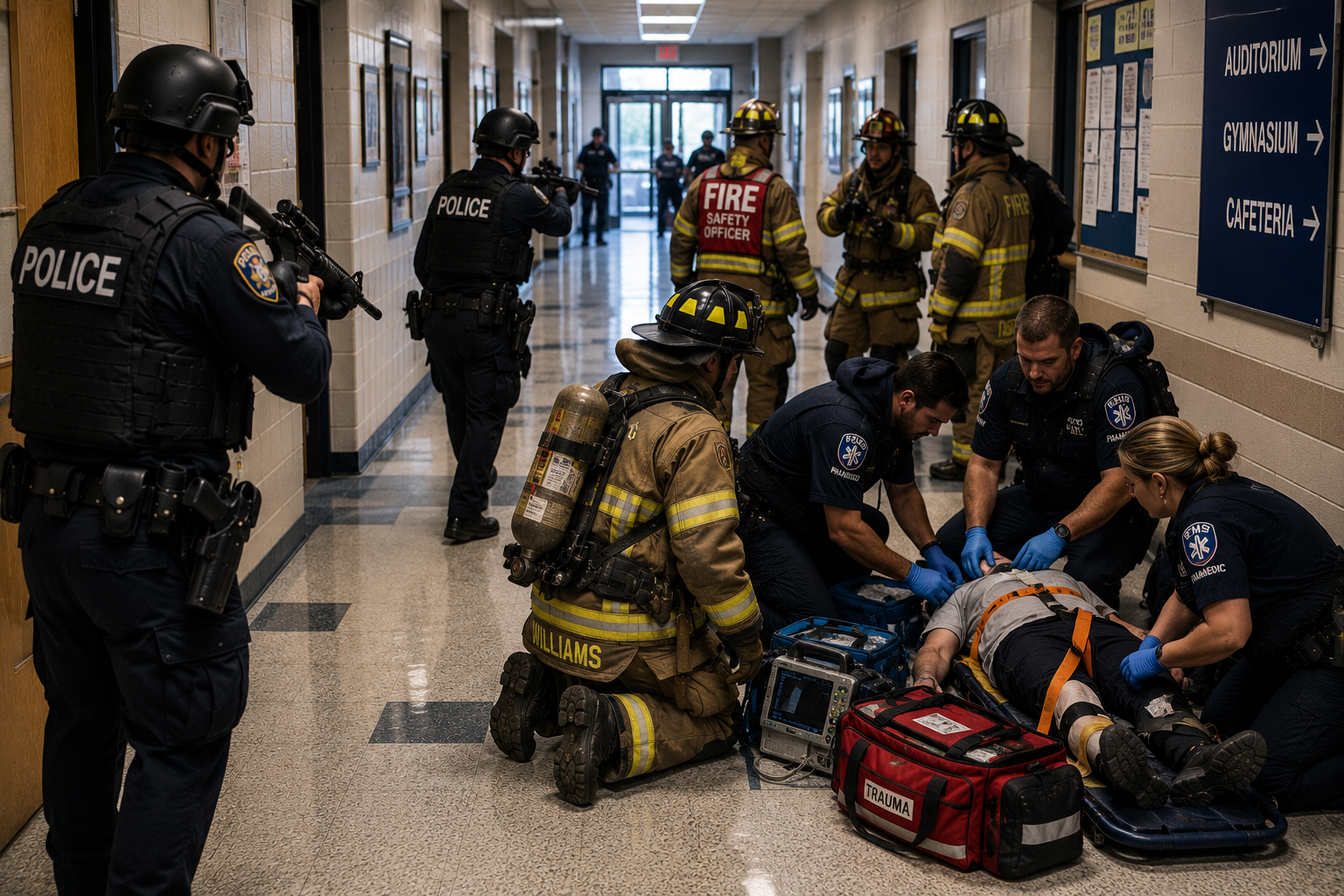
Siloed operations also distort how resources are deployed. Law enforcement may control space without enabling medical access. EMS units may remain staged awaiting clarity that never arrives. Fire resources may be underutilized despite proximity and capability. Each discipline optimizes for its own mission and risk tolerance, but the system becomes inefficient.
Personnel are present but idle. Casualties deteriorate while assets wait. Time—once lost—cannot be recovered. These inefficiencies are not the result of indifference, but of fragmentation. When agencies do not operate from a shared framework, resources cannot be aligned dynamically.
Efficiency in high-threat response does not emerge from accumulating assets; it emerges from integrating them.
Terminology as an Operational Friction Point
Confusing jargon and inconsistent terminology further degrade collaboration. Military-derived language, agency-specific shorthand, and informal phrases often enter response environments without shared definition. When words are familiar but meanings differ, coordination slows.
Misaligned terminology fragments situational awareness, obscures command intent, and increases hesitation. Responders either delay action while seeking clarification or act prematurely based on incorrect assumptions. Both outcomes increase risk.
Clear, shared language is therefore a prerequisite for effective collaboration. Without it, communication remains active but coordination remains elusive.
CSR as a Framework for Integration
The Chaos–Stabilization–Recovery (CSR) framework directly addresses these collaborative gaps by reframing response as a condition-based system rather than a sequence of agency-specific actions. CSR does not assign phases to disciplines; it assigns them to operational realities.
During the Chaos phase, all agencies prioritize immediate life-saving actions under uncertainty. During Stabilization, command structures mature while operations continue. During Recovery, focus shifts to accountability, investigation, and community restoration. Each phase requires integrated effort, not isolated ownership.
By aligning agencies around shared conditions and objectives, CSR provides a common operational lens that improves collaboration before the first decision is made.
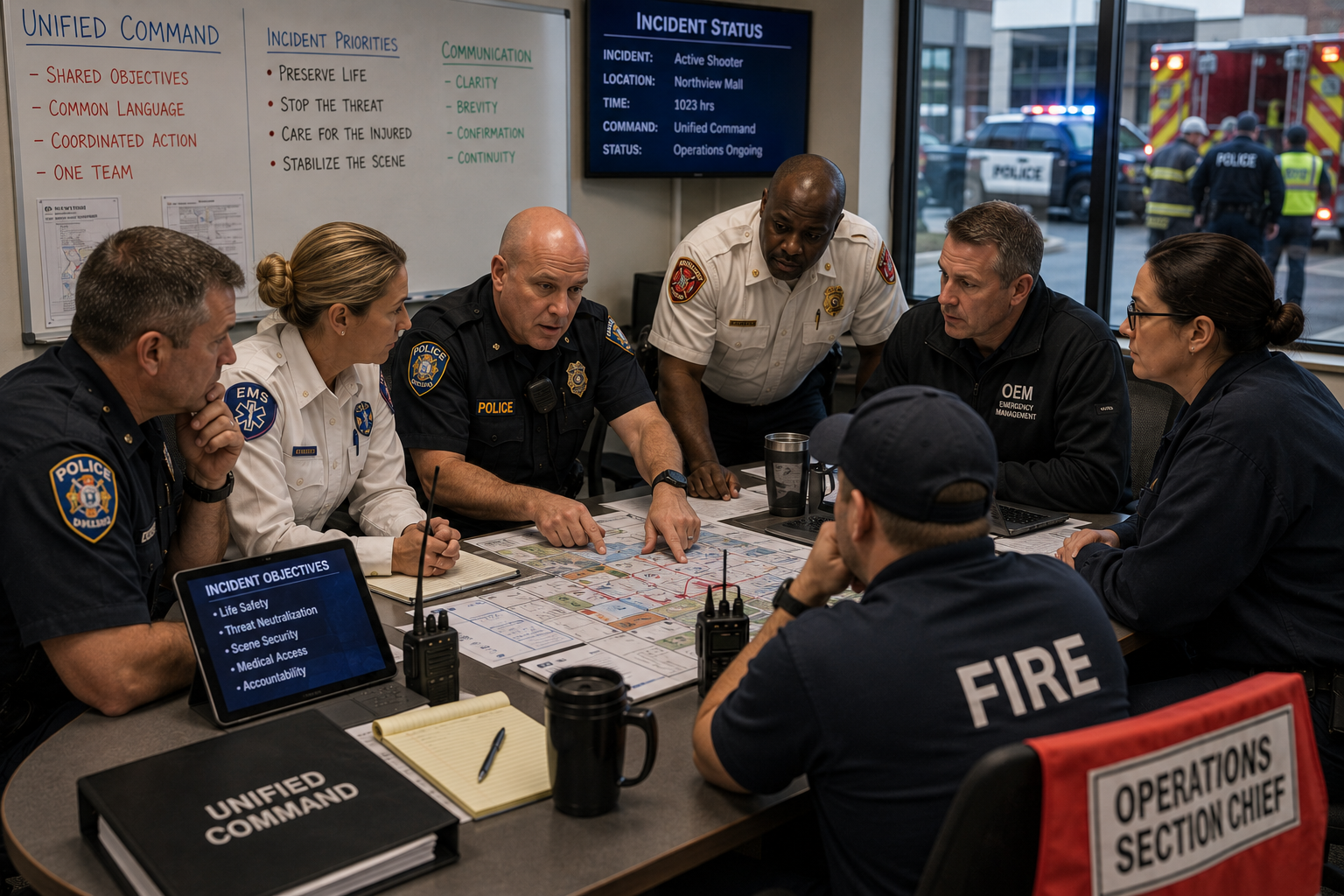
Unified Command as a Coordinating Mechanism
Unified Command is often misunderstood as a bureaucratic structure rather than a functional tool. Its true value lies in shared intent, shared priorities, and shared language. When Unified Command functions properly, agencies plan together, decide together, and adapt together.
CSR strengthens Unified Command by giving it operational purpose beyond administration. Command becomes the synchronizing mechanism that aligns law enforcement movement, medical access, and resource flow in real time. This prevents the reactive posture that emerges when agencies attempt to reconcile independent actions mid-incident.
Joint Training as the Foundation of Interoperability
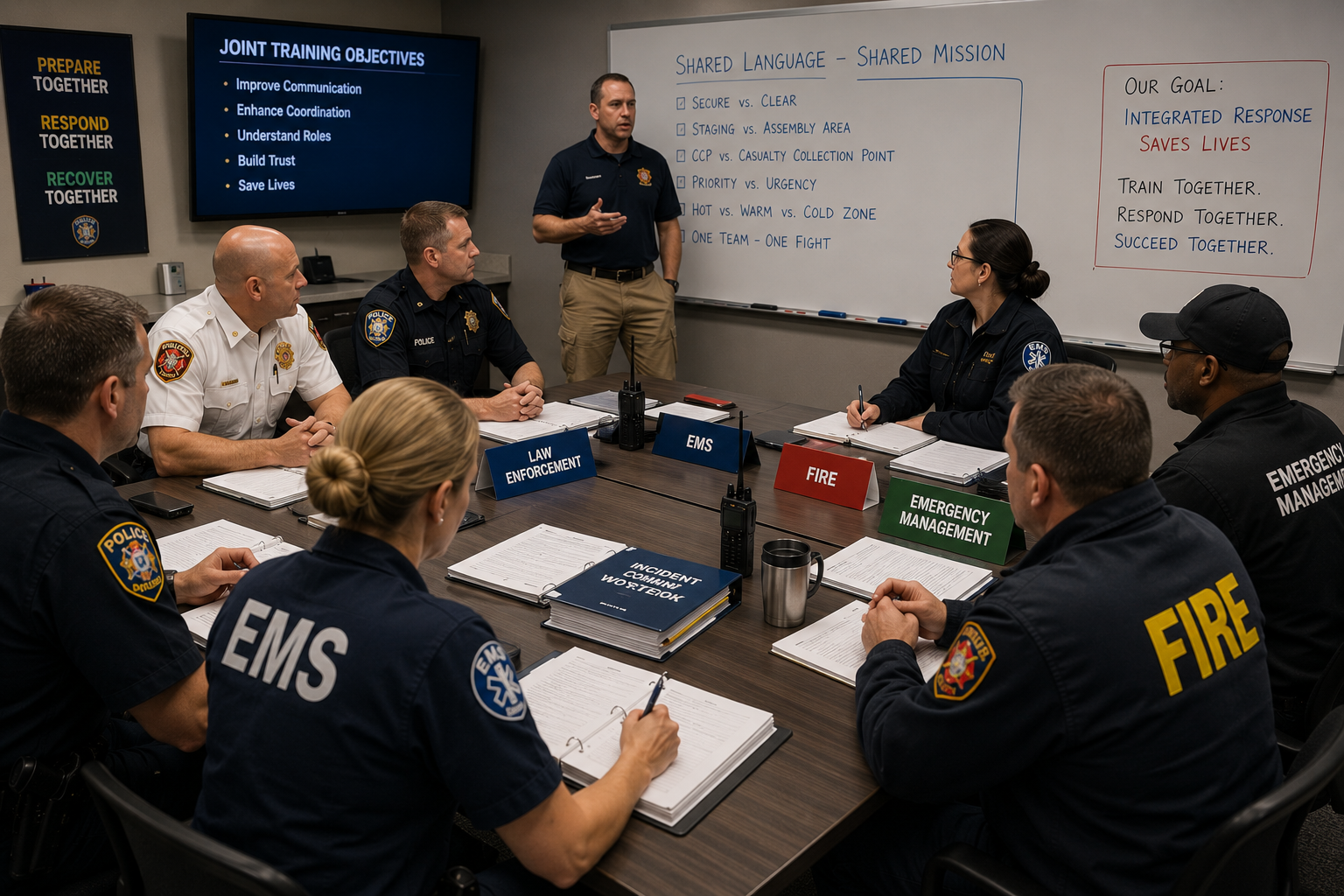
Collaboration cannot be improvised during crisis. It must be trained deliberately. Joint training exposes differences in assumptions, terminology, and priorities before lives depend on alignment. It also builds trust, a critical but often overlooked component of interoperability.
Effective joint training emphasizes scenario-based decision-making, shared operational definitions, parallel tasking, and command-level integration. When agencies train together, they learn not only what other disciplines do, but how and why they do it. This understanding reduces friction and accelerates coordination during real incidents.
Shared Language and Operational Clarity
Shared language is one of the most effective tools for improving collaboration. When agencies agree on definitions, communication becomes concise and actionable. Fewer words are required because meaning is already aligned.
Shared language improves situational awareness, reduces hesitation, and strengthens command cohesion. It transforms communication from information exchange into coordinated action.
Measuring Collaboration Through Outcomes
Collaboration should be measured by outcomes rather than intent. Positive relationships and regular meetings are insufficient indicators of readiness. In high-threat response, collaboration must be evaluated through performance metrics such as time to medical access, speed of CCP establishment, efficiency of resource deployment, and reduction in preventable mortality.
When collaboration improves, these metrics improve. When they stagnate, structural change—not goodwill—is required.
From Parallel Presence to Integrated Action
High-threat incidents demand systems that move together. Parallel presence without integration produces delay. Delay increases harm. Integrated collaboration compresses timelines and improves survivability.
CSR, Unified Command, joint training, and shared language collectively transform response from parallel action into unified execution. This shift is not theoretical; it is operationally observable and outcomes-driven.
Conclusion
Improving collaborative efforts in high-threat incident response requires abandoning siloed models that no longer reflect operational reality. Independent action, inconsistent language, and delayed coordination degrade situational awareness and waste time that victims cannot afford.
The CSR framework provides a practical structure for integration, while Unified Command, joint training, and shared language convert collaboration from aspiration into capability. As collaboration improves, response becomes faster, clearer, and more life-saving.
In high-threat environments, no agency succeeds alone. The true measure of readiness is not how well disciplines operate independently, but how effectively they operate together—under stress, under uncertainty, and in service of preserving life.