
Strengthening Response Systems Through Integrated Medical and Tactical Coordination
Strengthening Response Systems Through Integrated Medical and Tactical Coordination
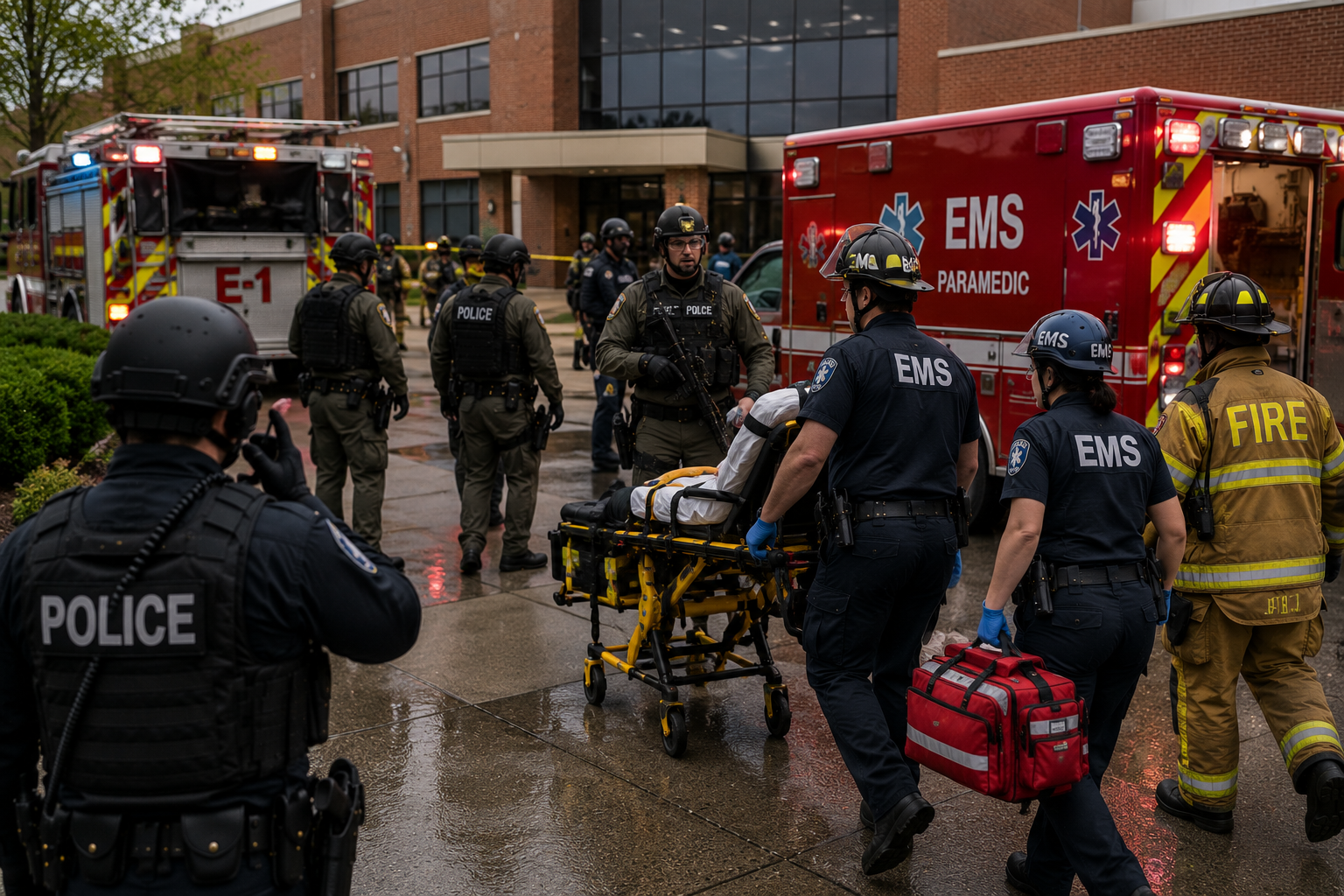
High-threat incidents expose a persistent weakness in traditional emergency response systems: the artificial separation of tactical action and medical care. Active shooter events, complex assaults, and coordinated attacks unfold too quickly and unpredictably for sequential, discipline-isolated models to function as intended. When law enforcement acts first, medical care waits, and command coordination lags behind both, the result is not safety—it is delay. Those delays translate directly into preventable death, responder risk, and operational confusion.
The Chaos–Stabilization–Recovery (CSR) framework addresses this failure by embedding medical and tactical coordination across all phases of response. Rather than treating medicine as a downstream service that begins once certainty is achieved, CSR recognizes medical access as a co-equal operational requirement. The anticipated result is a response system that functions as a single organism—adaptive, coordinated, and focused on preserving life under stress. This analysis examines how integrated medical and tactical coordination strengthens response systems, improves outcomes, and enhances public safety regardless of jurisdictional size or resource level.
The Structural Failure of Separated Response Models
Traditional emergency response doctrine evolved around clear divisions of labor. Law enforcement neutralized threats, fire and EMS staged until scenes were declared safe, and command structures matured after initial control was established. This model assumed time, predictability, and linear progression—assumptions increasingly incompatible with modern high-threat incidents.
In practice, threats rarely remain static. Casualties accumulate rapidly. Decisions must be made with incomplete information. When medical care is structurally separated from tactical action, responders are forced to choose between safety and survivability—a false dilemma created by doctrine rather than reality.
CSR challenges this separation by reframing response as a shared operational environment rather than a sequence of agency-owned tasks. Medical and tactical actions occur in parallel, guided by evolving conditions instead of rigid thresholds. This shift forms the foundation for stronger, more resilient response systems.
Embedding Medical Support Across All Operational Phases
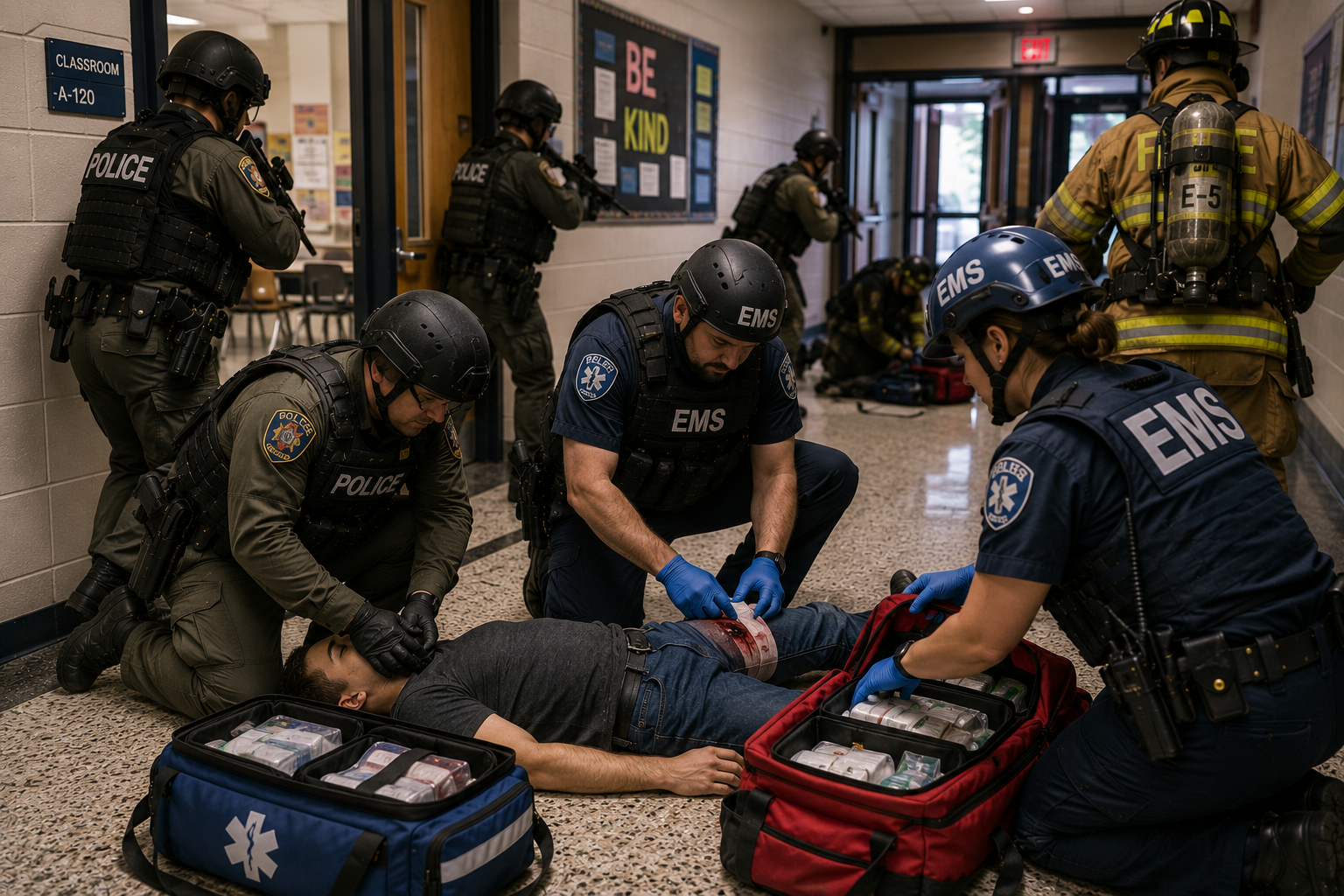
One of the defining strengths of CSR is its deliberate integration of medical support into every phase of response. During Chaos, immediate life-saving actions occur under threat-mitigated conditions. During Stabilization, medical operations expand, organize, and integrate into coordinated evacuation. During Recovery, medical and behavioral health support sustain long-term outcomes.
This integration contrasts sharply with traditional models that delay medical care until full scene security is achieved. Trauma science consistently demonstrates that the leading causes of preventable death—uncontrolled hemorrhage, airway compromise, and tension pneumothorax—are time-dependent. Minutes matter more than certainty.
By embedding medical capability early, CSR aligns operational behavior with physiological reality. The anticipated outcome is earlier intervention, reduced mortality, and fewer irreversible injuries, even when threats remain unresolved.
Earlier Medical Access and Reduced Preventable Deaths
Integrated medical and tactical coordination fundamentally alters the timeline of care. When medical access is planned alongside tactical movement, casualties are reached sooner. Hemorrhage control begins earlier. Airway positioning and rapid extraction occur before deterioration becomes irreversible.
This shift does not require reckless exposure. It relies on managed risk, protective movement, and deliberate coordination with law enforcement. The presence of medical capability within protected hot and warm zones transforms survivability without undermining tactical objectives.
The anticipated result is a measurable reduction in preventable deaths. Integrated systems do not eliminate risk, but they ensure that risk is assumed in service of life rather than in service of procedural comfort.
Coordinated Resource Use Through Tactical-Medical Integration
Separated systems often misuse resources. Medical assets are staged too far away. Law enforcement is forced to manage casualties without adequate equipment. Command elements struggle to prioritize competing requests without a shared operational picture.
CSR resolves this inefficiency by synchronizing resource use across disciplines. Tactical movement creates access corridors for medical teams. Medical priorities inform tactical decisions about space control and clearing order. Command allocates personnel and equipment based on shared objectives rather than agency boundaries.
The anticipated outcome is deliberate, efficient resource utilization. Fewer assets sit idle while others are overwhelmed. Actions reinforce each other rather than compete for attention.
Reducing Fragmentation and Enhancing Mission Clarity
Fragmentation is one of the most dangerous byproducts of high-stress incidents. When agencies operate under different assumptions, confusion replaces coordination. Medical teams wait for clearance that never arrives. Tactical teams assume care is already underway. Command struggles to reconcile conflicting reports.
Integrated medical and tactical coordination reduces fragmentation by establishing common priorities and shared expectations. Responders understand not only their role, but how their actions enable others. This clarity reduces hesitation and prevents duplicated or contradictory efforts.
Mission clarity improves because objectives are aligned around outcomes rather than processes. Success is measured in lives saved, stabilization achieved, and recovery initiated—not merely threats neutralized.
System Performance Across Diverse Jurisdictions
One of CSR’s most powerful advantages is its applicability across jurisdictions with varying resources. Integrated coordination does not require elite teams or specialized equipment; it requires alignment. Small agencies with limited staffing benefit just as much as large metropolitan systems because CSR optimizes what is available.
In resource-limited environments, early integration allows responders to act decisively with minimal assets. In resource-rich environments, it prevents over-segmentation and inefficiency. The anticipated result is consistent system performance regardless of scale, improving equity in public safety outcomes.
Managing Cognitive Load Under Stress
High-threat incidents impose extreme cognitive load. Responders must process information, make decisions, and act under time pressure and uncertainty. Fragmented systems amplify this burden by forcing responders to navigate conflicting priorities and unclear expectations.
Integrated medical and tactical coordination simplifies decision-making. When responders operate under a unified framework, fewer mental resources are spent reconciling differences. Actions become intuitive rather than deliberative.
This reduction in cognitive load improves safety, accuracy, and speed. Errors decrease not because responders are more skilled, but because the system supports human performance rather than working against it.
Enhancing Command Effectiveness Through Integration
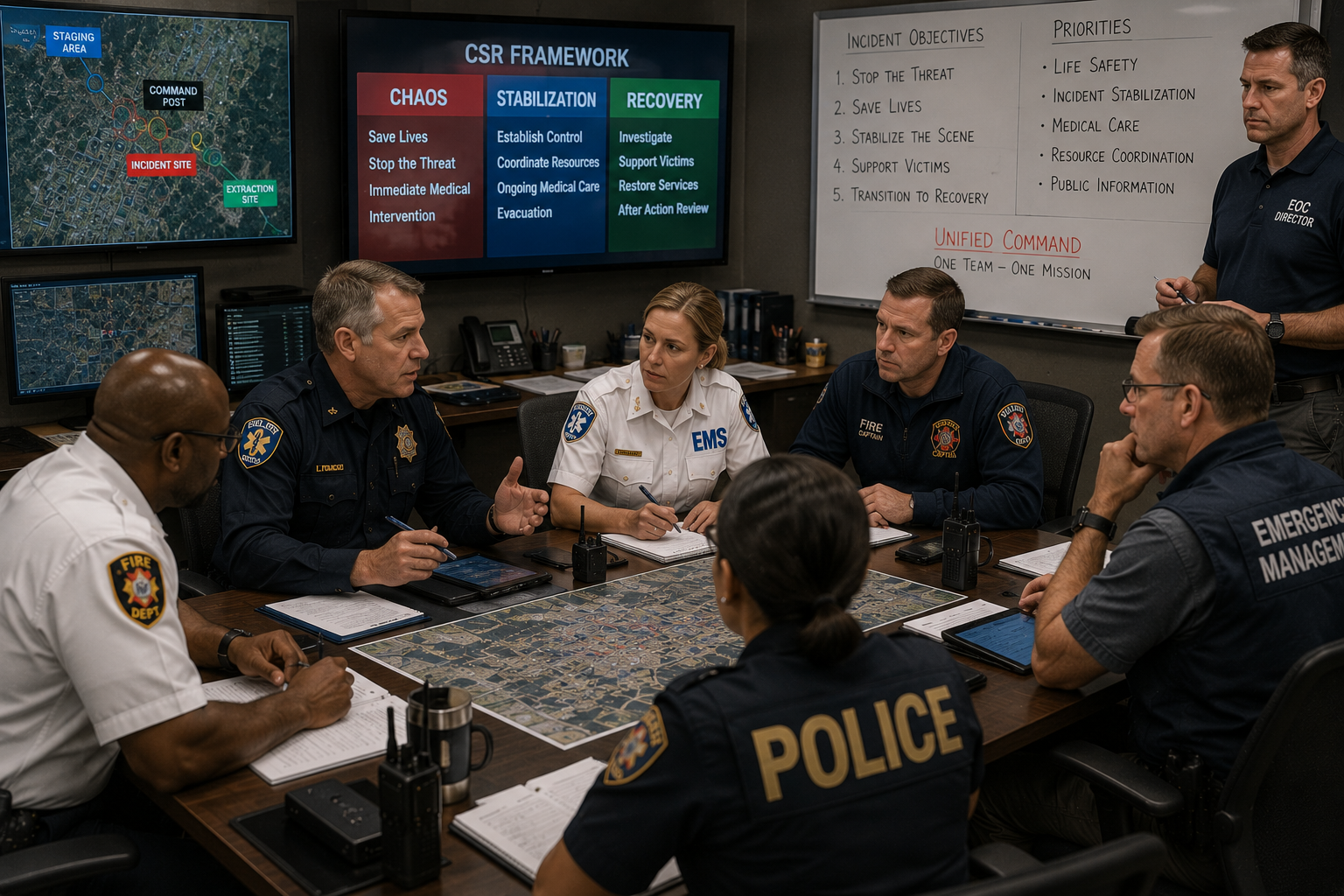
Command structures benefit significantly from integrated operations. When medical and tactical elements are aligned, command decisions are informed by a complete operational picture. Resource allocation becomes proactive rather than reactive.
CSR supports command effectiveness by anchoring decisions to operational conditions rather than agency status. Command transitions occur smoothly as incidents move from Chaos to Stabilization and Recovery. Information flows horizontally as well as vertically, improving situational awareness.
The anticipated outcome is command that sets tempo instead of responding to it—an essential capability in rapidly evolving incidents.
Strengthening Public Safety Outcomes
Integrated medical and tactical coordination ultimately strengthens public safety by ensuring that response systems prioritize life at every stage. Early care reduces mortality. Coordinated action reduces chaos. Efficient recovery supports community resilience.
The public experiences response as purposeful and controlled rather than disjointed and delayed. Trust is reinforced when agencies act cohesively and visibly prioritize victim care.
These outcomes extend beyond individual incidents. Communities served by integrated systems are better prepared, more resilient, and more confident in their emergency services.
Long-Term Organizational Benefits
Adopting integrated coordination through CSR produces long-term benefits beyond immediate response outcomes. Joint training becomes more effective. Interagency relationships improve. Doctrine evolves toward shared responsibility rather than siloed authority.
Organizations become more adaptable, capable of learning from experience and adjusting protocols without dismantling the framework. This adaptability is essential in an evolving threat landscape.
Measuring Success Through System Outcomes
Integrated systems shift how success is measured. Metrics such as time to medical access, casualty survival rates, coordination efficiency, and recovery timelines provide meaningful indicators of performance.
These metrics reinforce accountability and guide continuous improvement. They also discourage superficial compliance in favor of substantive capability.
Conclusion
Strengthening response systems through integrated medical and tactical coordination is not a conceptual preference—it is an operational necessity. The CSR framework provides a practical, evidence-aligned approach to achieving this integration by embedding medical support across all phases of response and aligning tactical action with life-saving priorities.
The anticipated results are clear: earlier intervention, reduced preventable death, improved resource efficiency, decreased fragmentation, and enhanced system performance across agencies and jurisdictions. Most importantly, CSR strengthens public safety by ensuring that tactical success and medical survivability advance together rather than in isolation.
In high-threat environments where seconds define outcomes, integrated coordination transforms response from a collection of well-intentioned actions into a coherent, life-preserving system.