
Communication Failures and Interoperability
Communication Failures and Interoperability
In high-threat incidents, communication is not a supporting function—it is the connective tissue that determines whether individual actions converge into an effective response or fracture into chaos. Tactical success, timely medical intervention, and responder safety all depend on the ability to share accurate information across agencies in real time. When communication fails, coordination collapses, decision-making degrades, and preventable deaths follow. Despite decades of lessons learned, communication and interoperability remain among the most persistent vulnerabilities in active shooter and mass-casualty response.
This analysis examines how communication failures undermine multi-agency operations, why interoperability problems persist despite technological advances, and how inconsistent practices—particularly under stress—erode situational awareness. The central argument is clear: interoperability is not a technology problem alone; it is a doctrine, training, and culture problem. Solutions require more than new radios—they demand unified protocols, shared language, and disciplined practice that holds under pressure.
Why Communication Fails When It Matters Most
Communication systems often appear functional during routine operations. Radios transmit, dispatch centers answer calls, and agencies operate comfortably within their own structures. These conditions mask latent weaknesses that only emerge under stress. High-threat incidents expose those weaknesses immediately.
Stress compresses time, narrows attention, and increases cognitive load. Under these conditions, responders revert to familiar habits, shorthand language, and agency-specific procedures. If interoperability has not been deeply embedded through training and doctrine, it collapses precisely when clarity is most needed.
Communication failure is rarely a single event. It is a cascade: missed transmissions lead to incorrect assumptions, which drive misaligned actions, which then compound confusion across the incident.
The Persistent Problem of Shared Frequencies
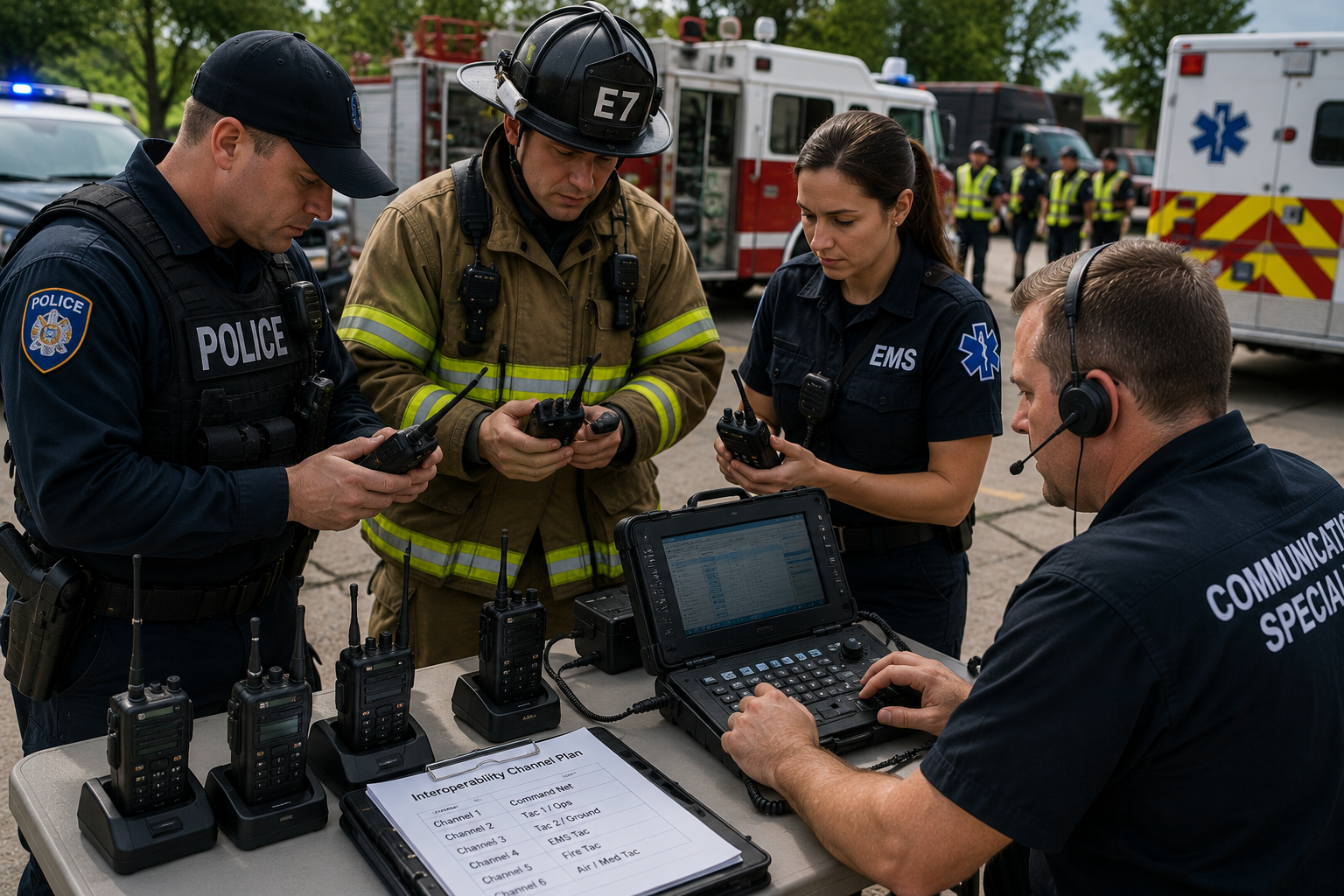
One of the most common interoperability failures is the lack of shared radio channels across law enforcement, fire, EMS, and emergency communications centers (ECCs). Agencies often operate on separate systems, bands, or talk groups, requiring patching or manual switching during incidents.
These workarounds consume time and attention at the worst possible moment. Responders may not know which channel to switch to, whether the channel is monitored, or who is listening. In some cases, agencies assume interoperability exists when it does not, leading to silence rather than coordination.
Even when shared channels are available, they are not always programmed consistently or trained regularly. A shared frequency that exists only on paper does not function operationally. Without routine use, responders hesitate to switch, fearing lost contact with their own command.
Plain Language Breakdown Under Stress
Plain language is widely endorsed as a best practice for interagency communication. Yet during high-stress incidents, responders often abandon it. Agency-specific codes, abbreviations, and jargon reappear—not out of defiance, but out of habit.
This regression creates immediate problems. Terms that are clear within one discipline may be meaningless or misleading to another. A coded status update from law enforcement may be misinterpreted by EMS. A fireground shorthand may confuse dispatchers supporting police operations.
Under stress, listeners also have reduced capacity to decode unfamiliar language. Plain language is not merely about policy compliance; it is about cognitive accessibility. When it disappears, shared understanding disappears with it.
Delayed and Inaccurate Situational Updates
Situational awareness depends on timely, accurate information flowing both upward and outward. In many incidents, this flow breaks down. Updates are delayed, incomplete, or outdated by the time they reach decision-makers.
Several factors contribute to this failure:
Responders are task-saturated and deprioritize updates.
Command hesitates to broadcast unconfirmed information.
Field units assume others already know what they know.
The result is a fragmented picture of the incident. Law enforcement may believe areas are secure when they are not. EMS may stage unnecessarily far from casualties. Fire units may delay entry based on outdated threat information.
In fast-moving incidents, information that is five minutes old may already be wrong. Communication systems that cannot keep pace with incident tempo become liabilities.
ECC–Field Coordination Gaps
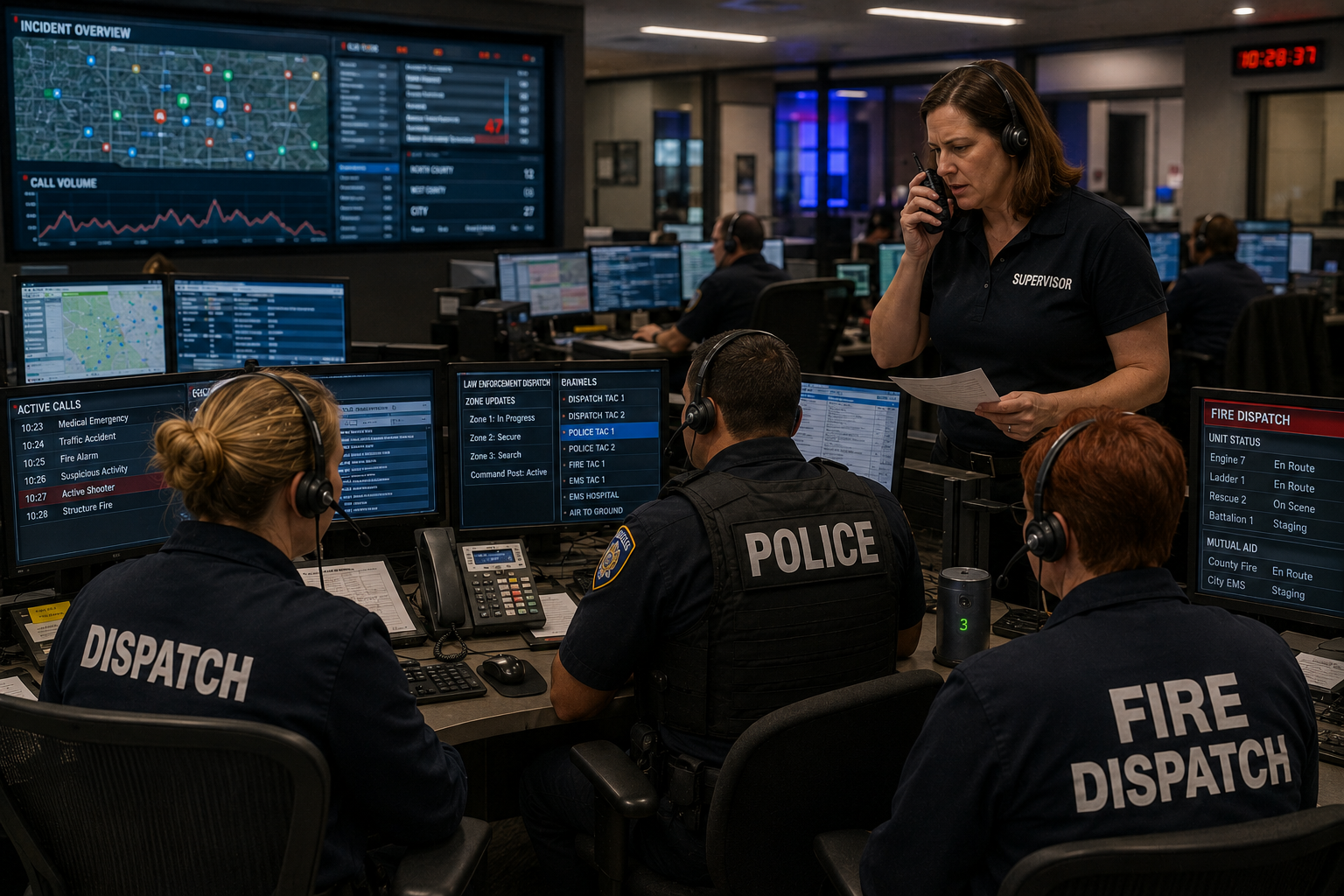
Emergency Communications Centers serve as the hub for information intake, dissemination, and coordination. Yet ECC–field coordination is frequently inconsistent during high-threat events. Dispatchers may receive critical updates that never reach field units, or field observations may not be relayed back to command.
These gaps often stem from unclear roles. In some jurisdictions, dispatch is treated as a relay station rather than an operational partner. In others, dispatch is overwhelmed by call volume and forced to triage information without clear guidance.
When ECCs and field command operate on different mental models of the incident, coordination suffers. Unified response requires ECC integration, not parallel operation.
Technology Is Not the Primary Limiting Factor
It is tempting to frame interoperability as a technology problem. While incompatible systems and aging infrastructure do contribute, they are rarely the primary cause of failure. Many incidents occur in regions with technically interoperable systems that still fail operationally.
The limiting factors are more often:
Lack of standardized communication doctrine.
Infrequent joint training.
Unclear authority over shared channels.
Cultural resistance to cross-agency integration.
Without addressing these issues, new technology simply accelerates existing confusion.
Communication as an Operational Skill
Communication is often treated as an administrative function rather than an operational skill. This framing undervalues its importance and leads to undertraining. Responders practice movement, medical interventions, and command procedures extensively, yet communication is assumed to “just work.”
In reality, effective communication under stress is a learned skill. It requires:
Brevity without ambiguity.
Discipline in message structure.
Awareness of who needs to hear what, and when.
When communication is not trained deliberately, it degrades predictably under pressure.
The Cost of Poor Interoperability
The consequences of communication failure are concrete and measurable. They include:
Delayed medical access to casualties.
Duplicate or conflicting tasking.
Unsafe movement into unsecured areas.
Breakdown of unified command.
These outcomes are not hypothetical. They appear repeatedly in after-action reports following active shooter incidents. In many cases, responders perform their individual tasks competently, yet the system fails because those tasks are not synchronized.
Interoperability failures convert capable agencies into ineffective systems.
Shared Channels as a Baseline Requirement
One of the most effective corrective measures is the establishment and routine use of shared operational channels. These channels must be:
Pre-designated.
Programmed consistently across agencies.
Used regularly during training and routine events.
Shared channels should not be reserved solely for catastrophic incidents. Familiarity is built through repetition. When responders use shared channels only once every few years, confusion is inevitable.
Clear authority over channel management—who assigns it, who monitors it, and who controls traffic—is equally important.
Unified Communication Protocols
Shared channels alone are insufficient without shared protocols. Agencies must agree on:
Message priorities.
Update intervals.
Standardized phrasing for key events (e.g., threat neutralization, casualty access, zone status).
These protocols reduce cognitive load by creating predictable communication patterns. Under stress, predictability is a force multiplier.
Unified protocols also support command decision-making. When updates arrive in a consistent format, leaders can process information faster and act with greater confidence.
Training as the Decisive Factor
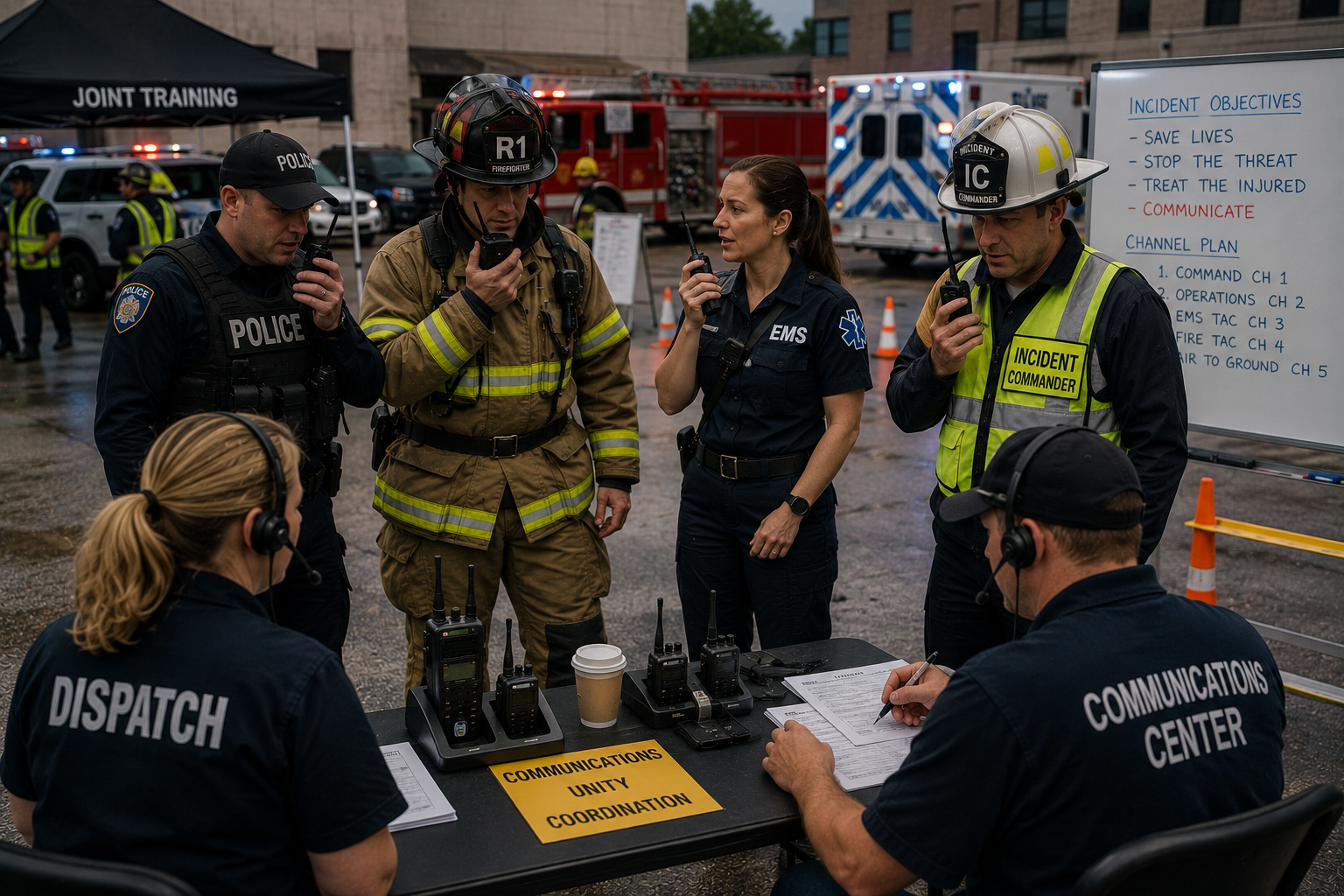
Interoperability improves only when it is trained deliberately and repeatedly. Joint training exercises expose communication barriers that rarely appear in single-agency drills. They reveal differences in language, expectations, and information flow that must be resolved before real incidents occur.
Training should stress communication intentionally—introducing noise, time pressure, and conflicting inputs. Responders must practice maintaining clarity when conditions are worst, not best.
Importantly, training must include ECC personnel. Dispatchers are not observers; they are participants in the response system. Excluding them from exercises guarantees future coordination failures.
Continuous Relevance: Communication Shapes Outcomes
Every phase of a high-threat incident—chaos, stabilization, and recovery—depends on communication. Early updates shape medical access. Mid-incident coordination determines resource flow. Post-incident communication influences accountability and recovery.
Failures at any stage echo throughout the operation. Conversely, strong interoperability enables adaptability. When agencies share information effectively, they can adjust tactics, reposition resources, and mitigate emerging risks.
Communication is not a background process; it is a constant driver of outcome.
Toward Reliable Interoperability
Achieving reliable interoperability requires sustained commitment. Agencies must treat communication as a core operational capability, equal in importance to tactics and medical care. This means:
Investing in shared infrastructure.
Standardizing language and protocols.
Training together under realistic conditions.
Reinforcing expectations through policy and leadership.
Interoperability is not achieved once; it is maintained through use.
Conclusion
Communication failures remain one of the most preventable causes of poor performance in active shooter and mass-casualty response. Shared frequencies without shared doctrine fail. Plain language without reinforcement disappears under stress. ECCs without integration become information bottlenecks rather than force multipliers.
Interoperability succeeds when communication is treated as an operational discipline—trained, standardized, and practiced across agencies. Shared channels, unified protocols, and joint training transform isolated responders into coordinated systems.
In high-threat incidents, what responders know is less important than what they can share. When communication works, coordination follows. When it fails, even the best intentions fragment into chaos.