
Medical Rescue Team (MRT) Deployment Models
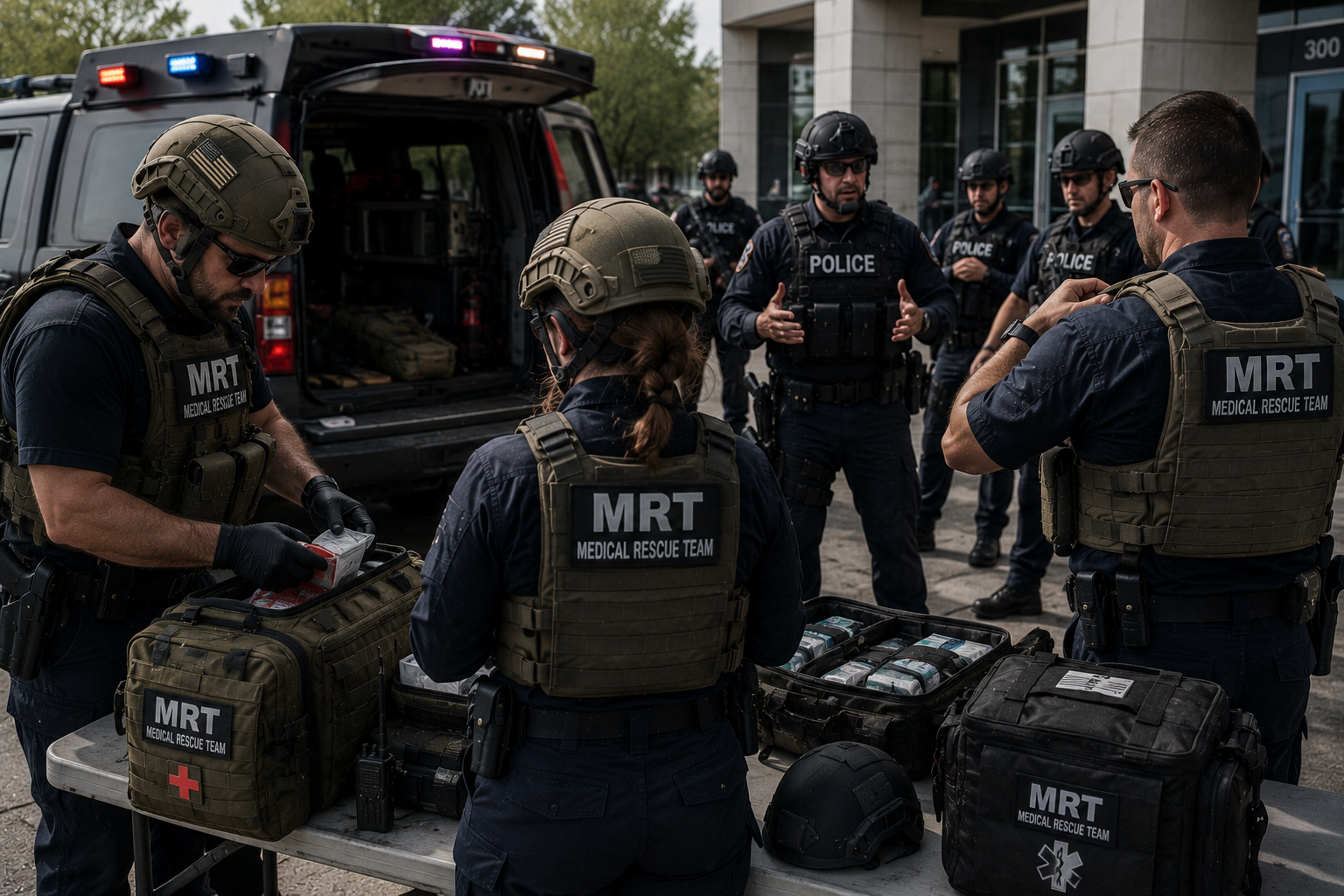
Medical Rescue Team (MRT) Deployment Models
In high-threat incidents, survival is determined long before ambulances arrive or scenes are formally declared secure. The decisive moment occurs at the point of injury, when hemorrhage, airway compromise, and shock begin an irreversible countdown. Medical Rescue Team (MRT) deployment models emerged precisely to address this gap—placing trained medical capability where time matters most, rather than where tradition has historically placed it. MRTs represent a deliberate departure from delayed, perimeter-bound medical response and a recognition that early medical access under protection is not an exception, but a requirement of modern high-threat operations.
This analysis examines MRT deployment models through an operational lens, focusing on early insertion into warm and hot zones, the establishment of hasty Casualty Collection Points (CCPs), alignment with law enforcement movement and protection, and the skill sets and equipment required to survive and operate effectively. By comparing MRTs with Rescue Task Force (RTF) models, this discussion clarifies the distinct role MRTs play in reducing preventable mortality during active shooter and complex assault incidents. The central argument is clear: MRTs operationalize point-of-injury care in environments where delay is lethal and traditional medical staging is inadequate.
Why MRT Deployment Models Exist
MRT deployment models were not developed to replace EMS systems or diminish responder safety. They emerged in response to a recurring operational failure: casualties dying from survivable injuries while medical assets remained staged outside evolving threat environments. After-action reviews repeatedly demonstrated that time-to-care—not lack of transport or hospital capability—was the dominant determinant of outcome.
Traditional models assumed a linear progression: secure the scene, then treat the wounded. MRTs reject this assumption. Instead, they acknowledge that threat mitigation and casualty care must occur in parallel, not sequence. MRT deployment models are therefore designed around immediacy, mobility, and protection rather than certainty and control.
Early Insertion Into Warm and Hot Zones
A defining feature of MRT deployment is early insertion into warm—and when operationally necessary—hot zones. This does not imply reckless exposure or uncontrolled movement. MRT insertion is deliberate, threat-informed, and synchronized with law enforcement operations.
Early insertion allows MRTs to reach casualties during the most survivable window. Hemorrhage control, airway positioning, and rapid assessment can occur minutes earlier than in traditional models. These minutes are often decisive.
Importantly, MRT insertion is not contingent on full scene security. It is contingent on localized threat mitigation, situational awareness, and law enforcement protection. This distinction is critical. MRTs operate in partially secured spaces where risk is managed, not eliminated. Waiting for absolute safety in dynamic environments guarantees delay; MRT models accept managed risk in service of survivability.
Establishing Hasty CCPs in Semi-Secured Areas
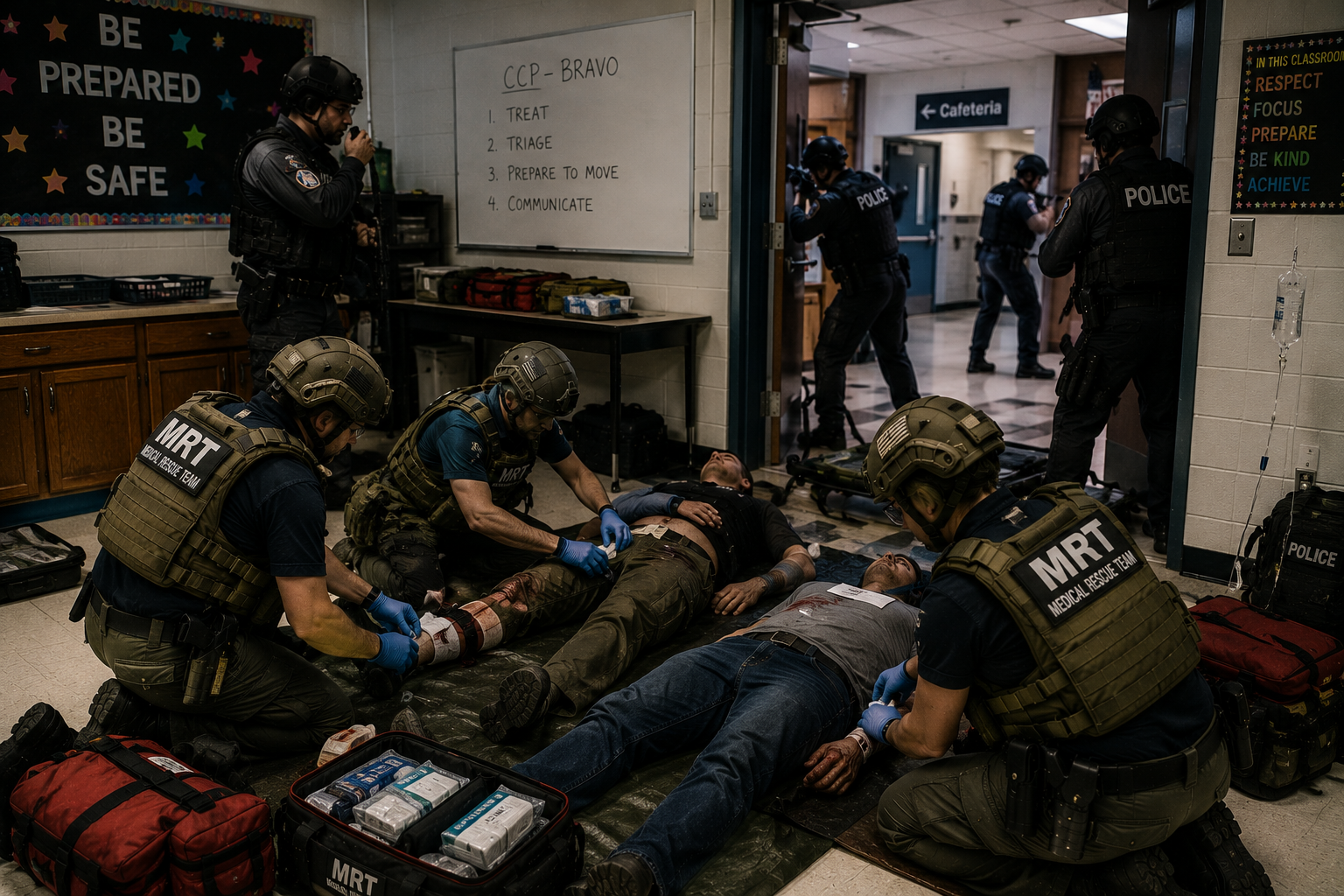
MRT deployment models emphasize the rapid establishment of hasty CCPs inside semi-secured areas. Unlike traditional CCPs positioned well outside threat zones, hasty CCPs prioritize proximity over permanence.
These CCPs are not intended to be comprehensive treatment sites. They are functional waypoints designed to support rapid triage, life-saving interventions, and preparation for movement. Their value lies in reducing distance between injury and care, not in replicating emergency department capabilities.
Hasty CCPs also improve casualty flow. Instead of moving patients long distances untreated, MRTs can stabilize hemorrhage, manage airways, and prioritize evacuation based on real-time assessment. This approach reduces physiological deterioration during movement and improves downstream outcomes.
Alignment With Law Enforcement Movement and Protection
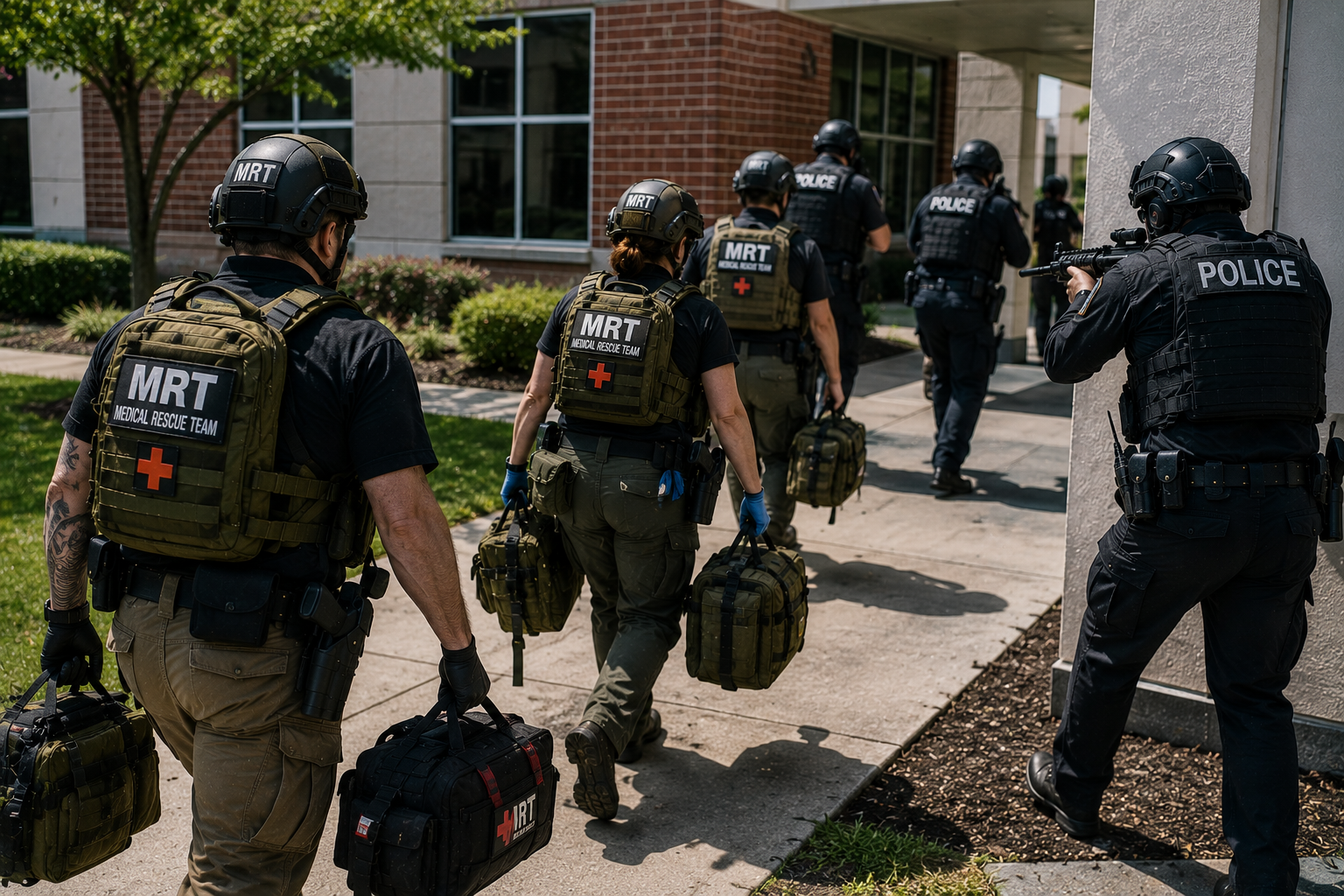
MRT effectiveness depends on alignment with law enforcement movement patterns. MRTs do not operate independently; they move as part of an integrated tactical-medical system.
This alignment includes:
Movement synchronized with entry and clearing teams
Positioning within cleared or controlled corridors
Continuous communication regarding threat status and movement plans
Use of law enforcement protection during casualty access and movement
By aligning with entry teams, MRTs avoid becoming static assets in dynamic environments. They advance as space is secured, maintaining proximity to casualties without outpacing protection. This integration ensures that medical access expands alongside tactical control rather than waiting for it to conclude.
Required Skill Sets for MRT Personnel
MRT deployment models demand skill sets beyond conventional prehospital practice. MRT personnel must be clinically competent and tactically literate. This does not mean they function as law enforcement officers, but that they understand movement, cover, concealment, and threat behavior well enough to operate safely.
Core competencies include:
Rapid hemorrhage control under stress
Airway management with minimal equipment
Casualty movement and drags in confined spaces
Tactical communication and situational awareness
Triage and prioritization in unstable environments
These skills must be trained repeatedly under realistic conditions. MRT performance under stress is shaped by training fidelity, not theoretical knowledge. As with all high-risk operations, responders will default to the lowest level of training they have mastered.
Equipment and Survivability Considerations
MRT equipment must balance capability with mobility. Overloaded kits reduce speed and increase fatigue; under-equipped teams lose effectiveness. MRT loadouts are therefore purpose-built around high-yield interventions.
Essential equipment typically includes:
Multiple tourniquets and hemostatic agents
Pressure dressings and chest seals
Minimal airway adjuncts
Compact casualty movement tools
Individual ballistic protection
Survivability considerations extend beyond equipment. MRT deployment requires clear policies on armor use, positioning, extraction priorities, and medical disengagement criteria. MRTs must know not only how to enter, but when to reposition or withdraw as conditions change.
Comparison With Rescue Task Force (RTF) Models
MRTs and RTFs are often discussed interchangeably, but they are not identical. RTF models typically involve mixed teams of law enforcement and medical personnel operating in warm zones once an area is deemed sufficiently secure. RTFs emphasize collective movement and shared responsibility for security.
MRT models differ in several key ways:
MRTs are often smaller, more mobile, and medically focused
MRTs may deploy earlier, closer to point of injury
MRTs emphasize hasty CCP establishment rather than fixed movement lanes
MRTs integrate directly with entry teams rather than following behind them
RTFs are effective in many contexts, particularly when staffing allows and threat conditions stabilize quickly. MRTs are particularly valuable when speed, access, and adaptability are paramount. The models are complementary, not competing.
Operational Advantages of MRT Deployment
When executed effectively, MRT deployment models provide several operational advantages:
Reduced time-to-intervention for life-threatening injuries
Improved triage accuracy through early assessment
More efficient use of evacuation assets
Enhanced situational awareness for command
Reduced preventable mortality
These advantages emerge not from heroism, but from design. MRTs work because they are built around the realities of high-threat environments rather than idealized assumptions about safety and sequence.
Barriers to MRT Implementation
Despite their benefits, MRT models face barriers similar to those encountered by TECC integration. These include:
Concerns over responder safety and liability
Training resource limitations
Cultural resistance to operating “inside” threat zones
Unclear policy authority for early medical insertion
These barriers are organizational, not evidentiary. The question is no longer whether MRTs save lives; it is whether agencies are willing to adapt doctrine and training to support them.
Relevance to Modern High-Threat Environments
Modern active shooter incidents are fast, chaotic, and often conclude before traditional medical response can mobilize. MRT deployment models are relevant because they match this tempo. They recognize that waiting for structure in chaos is a losing strategy.
As threats evolve toward greater speed and complexity, response models must emphasize flexibility, integration, and early action. MRTs embody these principles in practice.
Implications for Policy, Training, and Command
For MRTs to function effectively, agencies must support them through clear policy, joint training, and command endorsement. MRT deployment cannot be improvised during crisis; it must be planned, exercised, and normalized.
Commanders must understand MRT capabilities and limitations. Law enforcement must trust MRT integration. Medical leadership must prepare personnel for austere, high-risk care. Without this alignment, MRTs become symbolic rather than operational.
Conclusion
Medical Rescue Team deployment models represent a decisive evolution in high-threat medical response. By inserting medical capability early, establishing hasty CCPs near the point of injury, and integrating movement with law enforcement operations, MRTs close the gap between injury and intervention—the gap where preventable deaths occur.
MRTs are not a rejection of safety; they are a recognition that delayed care is itself a lethal risk. Compared with traditional staging models and even RTF constructs, MRTs offer unmatched speed, adaptability, and proximity when seconds matter most.
In environments defined by uncertainty and compressed timelines, MRT deployment is not an advanced option—it is a necessary adaptation. When agencies design response systems around reality rather than tradition, MRTs become not only feasible, but indispensable to saving lives in the most dangerous moments responders face.