
Misinterpretation of Military Terminology
Misinterpretation of Military Terminology: Why Words Without Doctrine Create Operational Risk
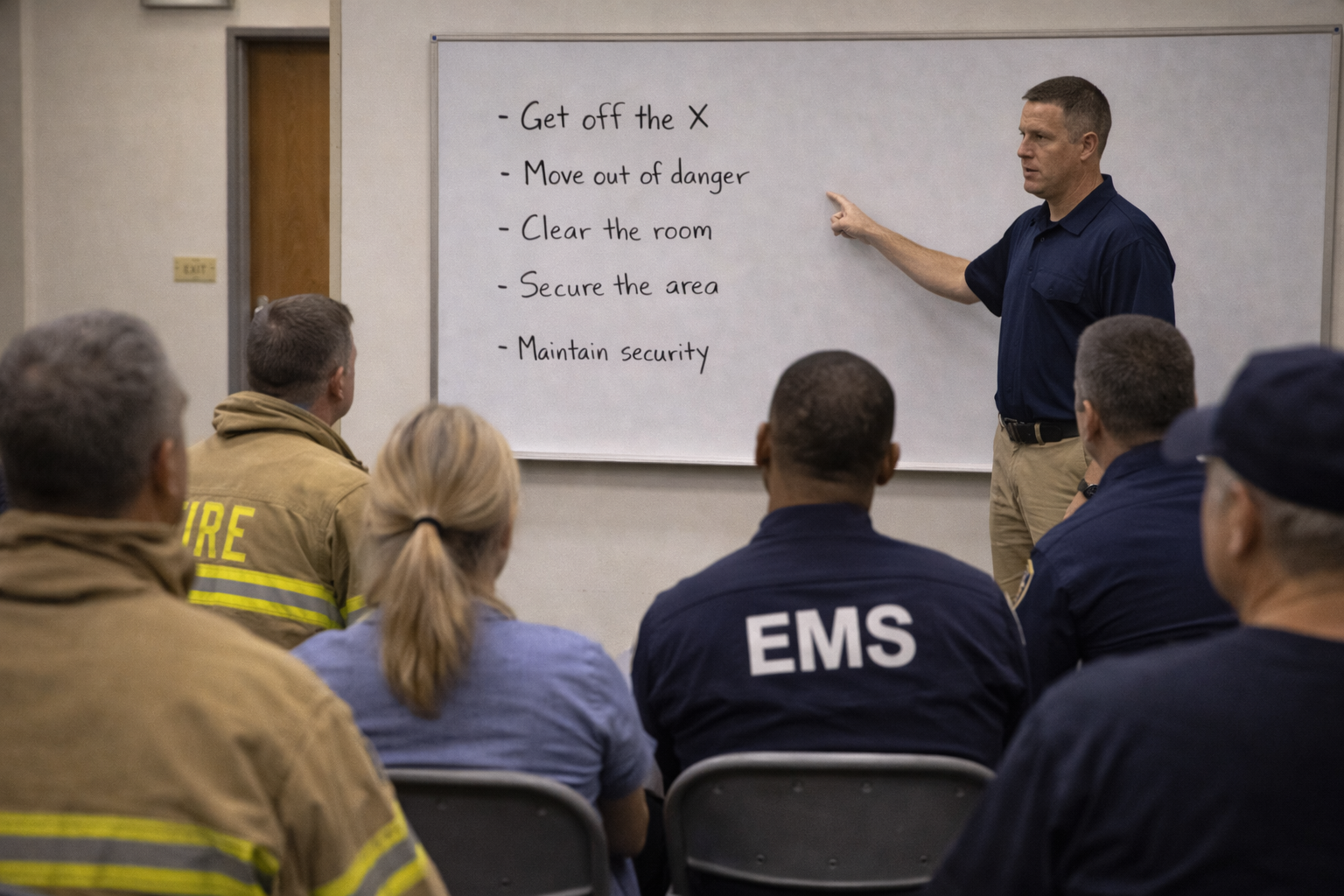
Words shape action. In high-risk environments, terminology does not merely describe reality—it directs behavior under stress. When language is precise and shared, it accelerates coordination. When language is borrowed without context, it creates false confidence, misaligned expectations, and dangerous improvisation. Nowhere is this more evident than in the civilian adoption of military terminology. Phrases like “get off the X,” “clear the room,” and “secure the area” are often repeated with conviction—but stripped of the doctrine, command structures, and assumptions that give them meaning, they become operational liabilities.
The central claim of this analysis is clear: military terminology is inseparable from military doctrine. Transferring words without the frameworks that define their use leads to misinterpretation, not adaptation. Using the science of listener attention—front-loaded relevance (primacy), structured cognitive chunking, progressive emphasis, repetition with variation, and continuous relevance anchoring—this article explains how military language originates, why civilian responders misapply it, and how to prevent terminology-driven failure by restoring context and intent.
Why Terminology Matters More Than It Appears
Front-loading relevance is essential. Under stress, responders default to language-conditioned behaviors. The words used in training become the cues that trigger action in crisis. When those cues are ambiguous or misapplied, performance degrades—often invisibly until consequences appear.
Military terminology evolved to solve specific problems in specific environments. It encodes assumptions about authority, capability, rules of engagement, team composition, and acceptable risk. When those assumptions are absent, the words still sound decisive—but they no longer direct safe or effective action.
This is the core danger: familiar words can conceal unfamiliar obligations.
The Origins of Military Terminology: Language as Doctrine
Military language does not emerge casually. It is forged through repeated exposure to high-risk operations, refined by after-action review, and standardized through doctrine. Each term compresses complex procedures into a few words—but only for those trained within the system.
Consider the origins:
Operational needs: Language evolves to communicate quickly under fire.
Environmental constraints: Terms reflect terrain, threat profiles, and logistics.
Tactical doctrine: Words assume a shared understanding of sequencing and roles.
Command authority: Language presumes lawful orders, compliance, and unity of effort.
In this context, terminology is not shorthand for ideas; it is shorthand for actions governed by doctrine. Remove the doctrine, and the shorthand loses precision.
Repetition with variation underscores the point: military terms are not metaphors; they are procedural triggers.
Mission-Specific Meaning: What the Words Actually Assume
Terms commonly borrowed into civilian response carry implicit assumptions:
“Get off the X” presumes immediate, coordinated movement by a trained element, under fire, with authority to accept risk and maneuver aggressively.
“Clear the room” presumes a team trained in close-quarters tactics, operating under specific rules of engagement, with lethal force authority and mutual support.
“Secure the area” presumes the ability to dominate terrain, control access, detain or neutralize threats, and maintain security over time.
Each term presumes unity of command, shared training, and explicit legal authority. Civilian responders—often operating under fragmented command, mixed disciplines, and restrictive legal frameworks—rarely possess all three simultaneously.
Misinterpretation begins when the term is repeated without acknowledging these prerequisites.
The Civilian Context Gap: When Assumptions Don’t Transfer
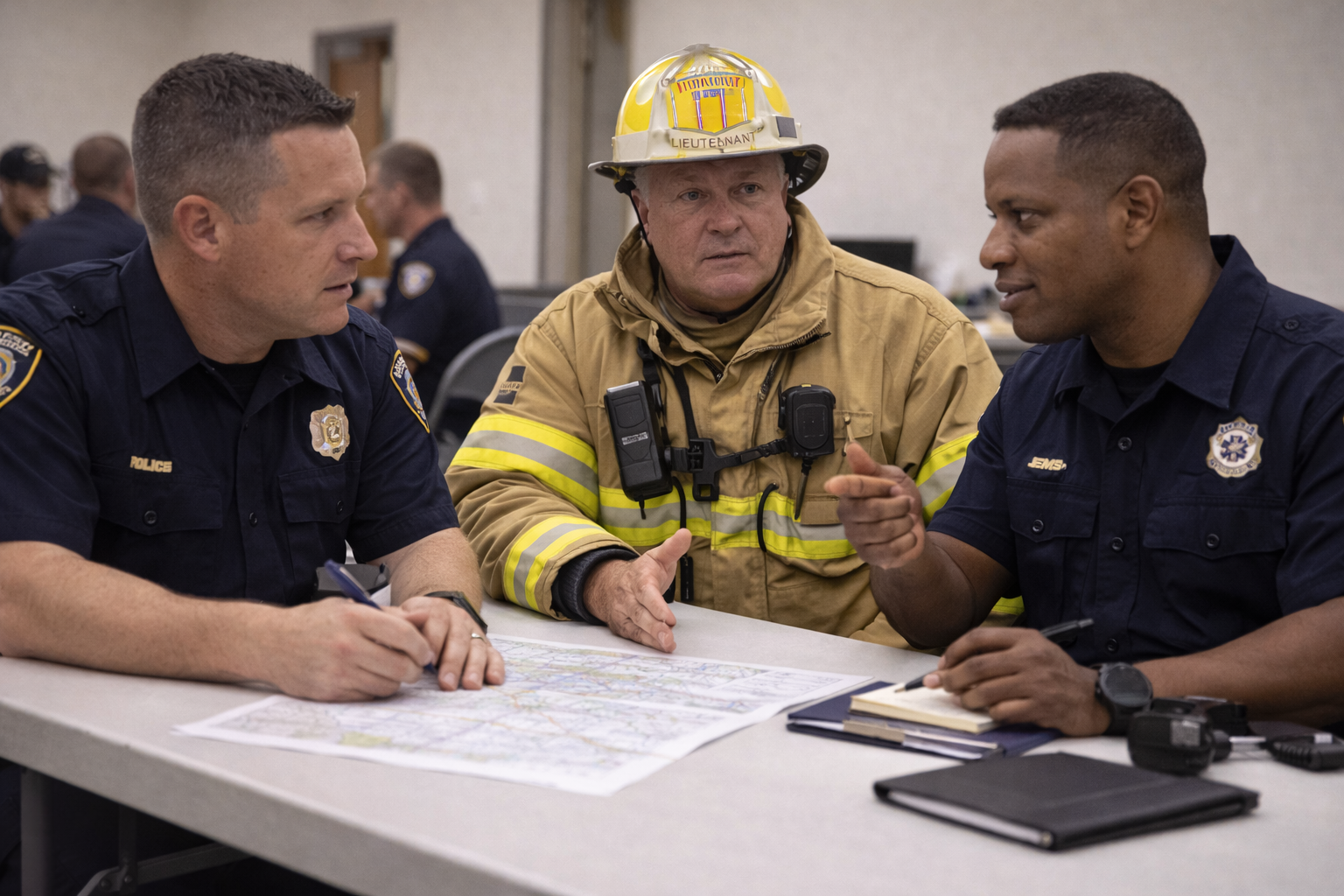
Civilian emergency response operates under fundamentally different constraints:
Diverse command structures (ICS/Unified Command rather than military hierarchy)
Mixed teams with variable training depth and mission scope
Legal and policy limitations on movement, force, and detention
Public accountability that shapes acceptable risk
When military terms are imported without translation, responders may assume they are acting decisively while actually violating policy, exceeding training, or creating unsafe conditions.
This gap is not a failure of motivation; it is a failure of contextual alignment. Words are used as if they carry universal meaning when, in reality, their meaning is conditional.
Cognitive Anchoring and the Illusion of Competence
Listener attention science explains why this problem persists. Cognitive anchoring occurs when familiar terms create a sense of understanding that exceeds actual capability. The language feels right; the action feels justified.
Under stress, responders fall to their lowest mastered level of training. If training has normalized military terms without civilian-specific doctrine, responders may default to actions they cannot safely or legally complete.
Repetition with variation reinforces the risk: hearing a term repeatedly increases confidence—even when comprehension remains shallow. The result is an illusion of competence driven by language.
When Words Replace Planning
One of the most damaging effects of misused terminology is that words begin to substitute for planning. Saying “secure the area” can prematurely end discussion about how, by whom, with what authority, and for how long.
In military doctrine, those questions are already answered. In civilian operations, they are not—and must be answered explicitly. When terminology short-circuits that conversation, gaps go unaddressed.
Progressive emphasis clarifies the danger: terminology without doctrine accelerates decisions without improving decisions.
Case Patterns: Language-Driven Failure Modes
Across after-action analyses, recurring patterns emerge when military terminology is misapplied:
Premature declarations of safety based on “secured” language
Overextension of personnel attempting actions implied by terms they cannot support
Interagency friction when different disciplines interpret the same term differently
Legal exposure when actions exceed training or authority
These failures are rarely attributed to language—but language is often the silent driver.
Repetition With Variation: Same Words, Different Meanings
A critical insight is that the same term can mean different things in different systems. In military use, “clear” may mean neutralized or controlled. In civilian fire or EMS use, “clear” may mean visually inspected. Without explicit definition, coordination fails.
Effective operations therefore require terminology discipline—defining terms operationally within the civilian context. This does not mean abandoning strong language; it means rebuilding meaning.
Restoring Meaning: Translating, Not Transplanting
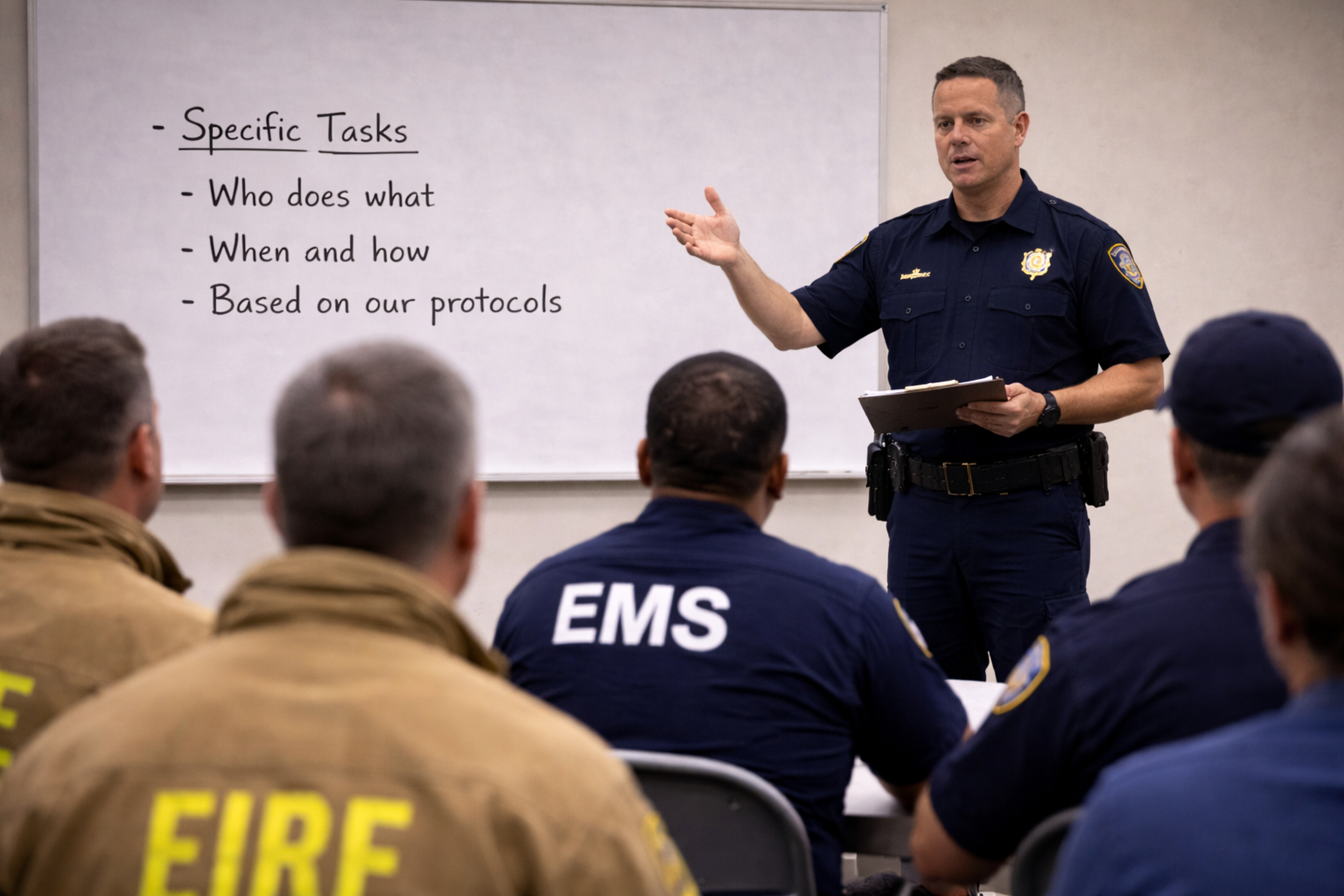
The solution is not to ban military terminology, but to translate it. Translation preserves intent while adapting execution to civilian realities.
Effective translation includes:
Explicit definitions tied to civilian authority and capability
Task-based language that describes actions rather than slogans
Training scenarios that demonstrate correct application and limits
Policy alignment that clarifies who can do what, when, and why
For example, replacing “secure the area” with “establish controlled access points with law enforcement oversight and continuous reassessment” restores precision.
Continuous relevance anchoring keeps attention on outcomes: clarity prevents harm.
Training Implications: Teaching Language as a Skill
Terminology must be trained as deliberately as tactics. This includes:
Explaining origins and assumptions behind commonly used terms
Demonstrating civilian-equivalent actions and constraints
Practicing interagency communication with shared definitions
Correcting misuse during exercises, not after incidents
Repetition with variation ensures responders learn not just what to say, but what the words require.
Leadership’s Role: Modeling Precision Over Machismo
Leaders shape language culture. When leaders use military terms casually or performatively, misuse spreads. When leaders insist on precision and context, discipline follows.
Effective leaders:
Model clear, task-oriented language
Correct ambiguous terminology in planning and briefings
Reinforce that strength comes from clarity, not borrowed bravado
This leadership posture aligns language with responsibility.
Progressive Emphasis: Words Drive Behavior
Across doctrine, cognition, and training, the same truth recurs: words drive behavior. Behavior drives outcomes. Therefore, language is an operational variable, not a stylistic choice.
Misinterpretation of military terminology is not a semantic problem—it is a safety problem. Correcting it improves coordination, reduces risk, and aligns actions with authority and capability.
Conclusion
Military terminology originates from specific operational needs, environments, and doctrines. When civilian responders adopt these terms without the frameworks that give them meaning, misinterpretation follows. Words become placeholders for actions that teams cannot safely, legally, or effectively perform.
By restoring context, translating intent, and training language as a skill, civilian agencies can reclaim clarity without sacrificing decisiveness. Precision in language produces precision in action.
In high-risk operations, what we say shapes what we do. Ensuring that words carry their intended meaning is not academic—it is operationally essential.