Officer Down Rescue and Rapid Extraction Techniques
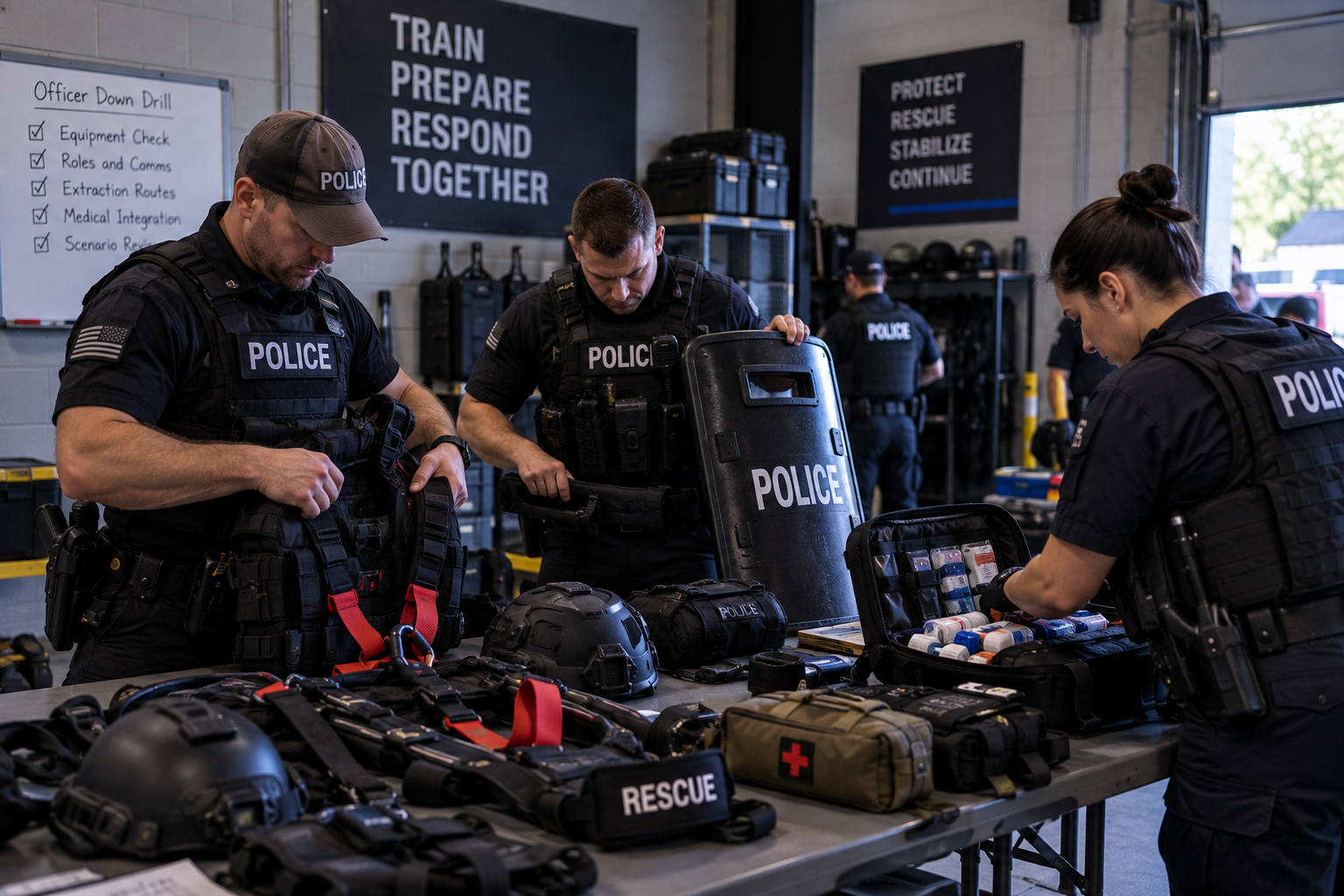
Officer Down Rescue and Rapid Extraction Techniques
When an officer goes down during an active shooter or high-threat incident, the event shifts instantly. Tactical priorities compress, emotional intensity spikes, and the margin for error narrows to seconds. Officers are often the first to engage the threat and, consequently, among the first casualties. What happens in the moments immediately following an officer down event frequently determines not only that officer’s survival, but the tempo, cohesion, and effectiveness of the entire response.
This reality demands clarity: officer down rescue is not an ancillary task—it is a core operational function that must be anticipated, trained, and executed under threat. Rapid extraction is not about heroics or improvisation; it is about disciplined movement, protected mobility, and seamless integration of tactical and medical actions. Agencies that treat officer rescue as an assumed skill rather than a trained capability expose responders to preventable death and operational collapse.
Officers as High-Risk Early Casualties
Active shooter incidents place law enforcement officers in uniquely vulnerable positions. Early responders move toward gunfire with limited information, uncertain layouts, and evolving threat dynamics. Unlike later-arriving units, they often operate without established perimeters, protection elements, or medical support.
Historical analysis consistently shows that officers are disproportionately represented among early casualties. These injuries frequently occur during initial contact, movement through unsecured corridors, or attempts to protect civilians. Once an officer is wounded, the tactical environment becomes more complex: teammates must balance threat mitigation, casualty care, and self-preservation simultaneously.
Recognizing officers as high-risk casualties is not pessimistic—it is operationally honest. Planning for officer down events before they occur is a prerequisite for survivability.
The Imperative of Immediate, Protected Extraction
Time is the dominant variable in officer down survival. Uncontrolled hemorrhage, airway compromise, and shock progress rapidly, particularly under stress. Waiting for scene security or external medical access is rarely compatible with survival timelines.
Extraction must therefore occur under threat, using protected mobility rather than static care. The objective is not definitive treatment at the point of injury, but rapid movement to a location where stabilization can occur with greater protection and resources.
Protected extraction acknowledges managed risk. Officers are not abandoning the threat; they are executing a life-preserving maneuver that sustains force integrity and operational momentum.
Protected Mobility: Movement With Purpose
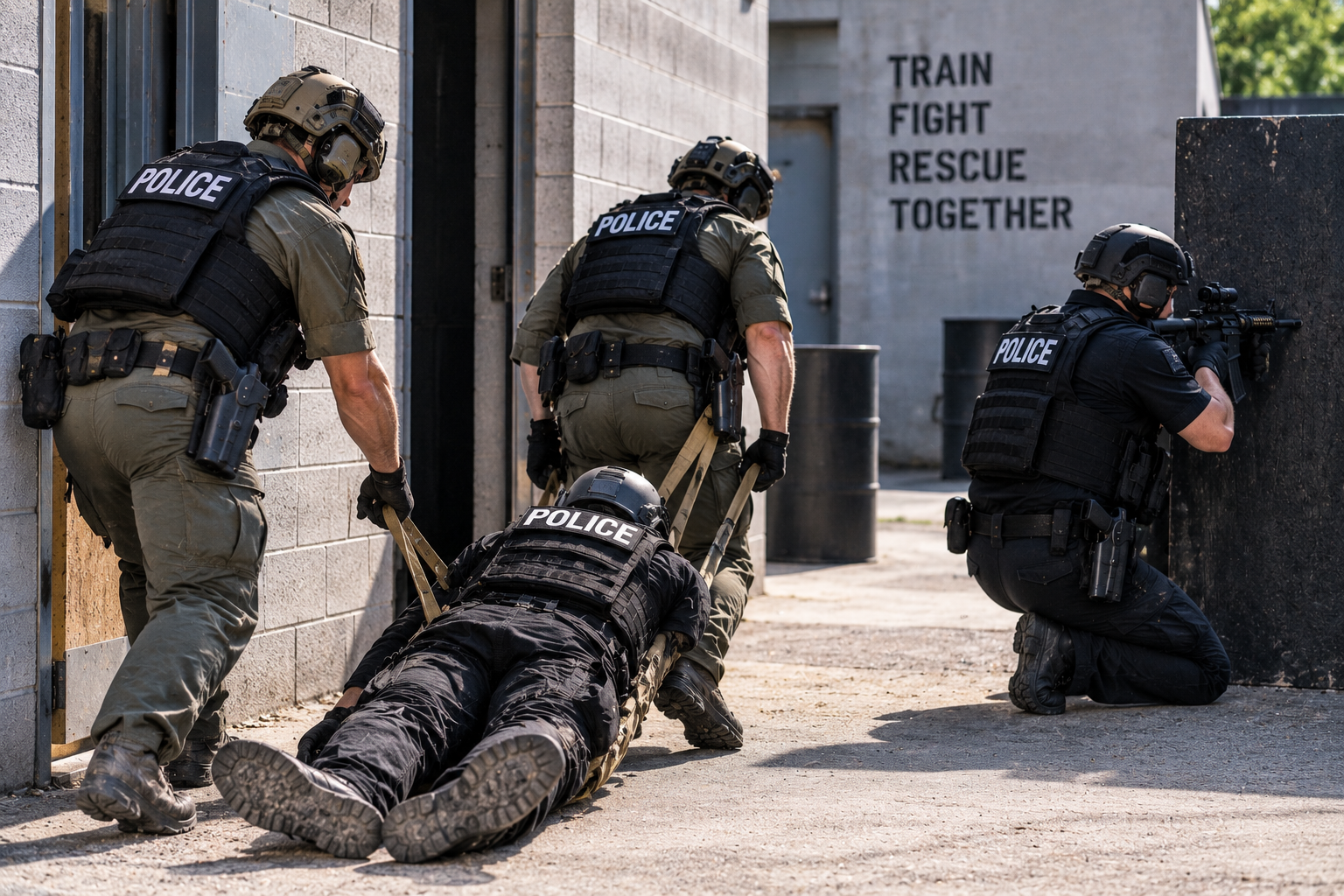
Protected mobility is the foundation of effective officer down rescue. It combines cover, concealment, suppression, and movement into a coordinated action that minimizes exposure while enabling extraction.
Key principles include:
Movement to cover, not comfort: extraction routes prioritize ballistic protection over convenience.
Short, deliberate bounds: moving casualties incrementally reduces exposure time.
Security-first positioning: cover officers orient outward, not inward, during movement.
Momentum maintenance: pauses are minimized to prevent fixation and secondary targeting.
Without protected mobility doctrine, rescues devolve into chaotic rushes that multiply casualties rather than prevent them.
Integration of RTF and MRT Elements
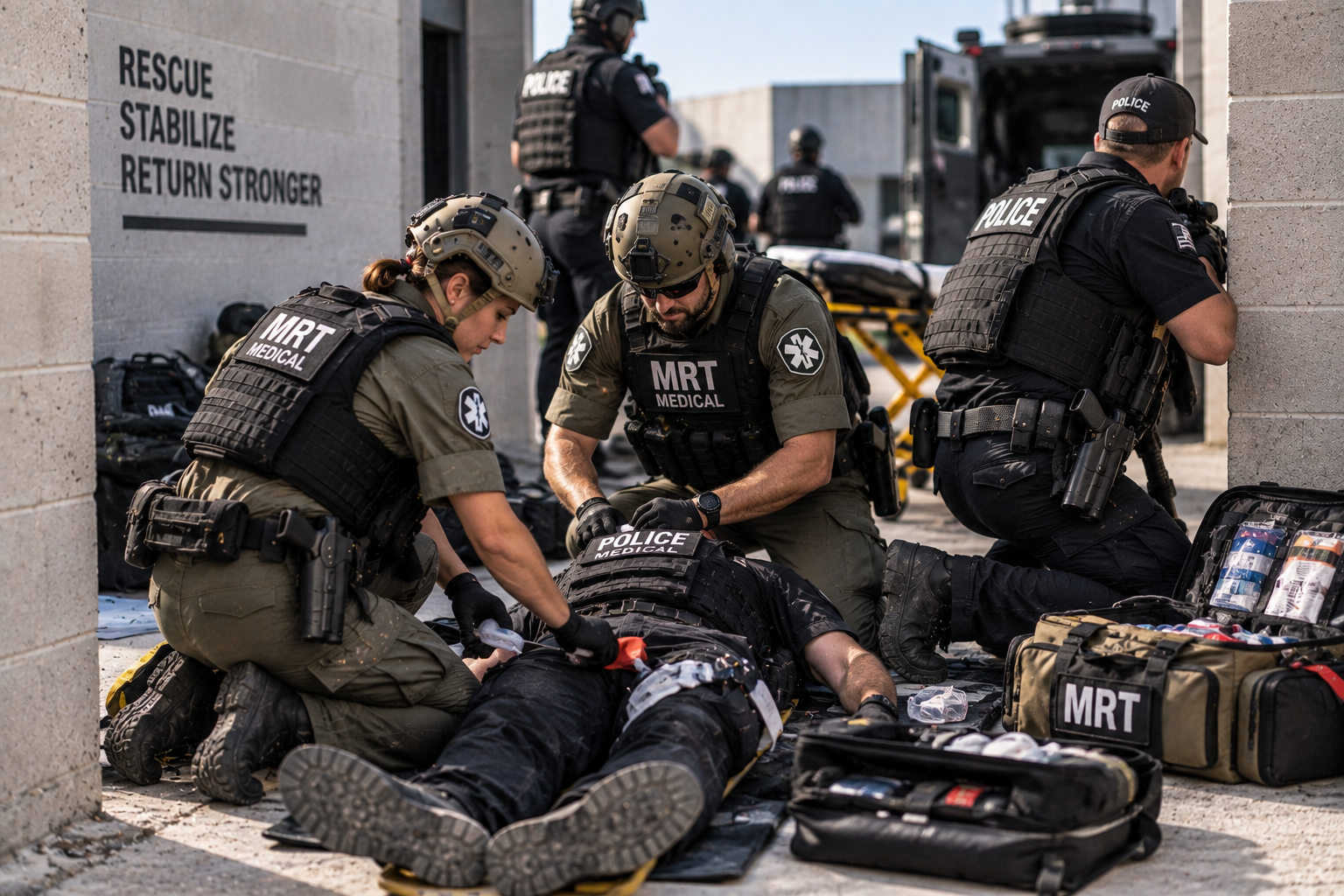
While immediate extraction is often initiated by law enforcement, survivability improves significantly when Rescue Task Force (RTF) or Medical Rescue Team (MRT) elements are integrated early. These teams provide rapid medical stabilization without requiring full scene security.
RTFs and MRTs bring focused capability:
Hemorrhage control and airway interventions.
Casualty packaging for movement.
Medical decision-making aligned with extraction priorities.
Their role is not to replace officer action, but to collapse the gap between injury and intervention. When medical elements train alongside law enforcement, transitions during officer down events become fluid rather than disruptive.
Shields, Drags, and Mechanical Advantage
Equipment does not replace training, but appropriate tools significantly enhance extraction effectiveness. Ballistic shields, when used correctly, provide mobile cover during approach and movement. Their value lies not in invulnerability, but in reducing exposure long enough to gain control of the casualty.
Drag techniques—such as shoulder drags, vest drags, and improvised harnesses—allow rapid movement with minimal lifting. These techniques preserve rescuer posture, reduce fatigue, and maintain weapon orientation.
Mechanical advantage matters. Officers attempting to lift or carry under fire often sacrifice speed and awareness. Drags and low-profile movement maintain survivability for both casualty and rescuer.
Coordinated Movement Under Fire
Officer down rescue is a team event, even when initiated by a single officer. Effective extractions rely on role clarity:
One element provides security and suppression.
One element controls the casualty.
One element manages movement and direction.
These roles may overlap in small teams, but they must be conceptually understood. Without coordination, rescuers cluster around the casualty, creating target density and degrading situational awareness.
Training reinforces these patterns so they emerge automatically under stress. In their absence, well-intentioned responders often create additional risk.
Medical Priorities During Extraction
Medical intervention during extraction is necessarily limited. The goal is not comprehensive treatment, but life-saving interruption of preventable death mechanisms. Tourniquet application, airway positioning, and rapid reassessment occur during movement or immediately upon reaching cover.
RTF and MRT personnel excel in this space because they are trained to work within tactical constraints. They understand when to intervene and when to move. This judgment is critical; over-treatment delays extraction and increases exposure.
Extraction and care are not sequential—they are concurrent, balanced continuously as conditions change.
The Psychological Dimension of Officer Down Events
Officer down incidents exert intense psychological pressure on responders. Emotional responses—fear, anger, urgency—can overwhelm training if not addressed beforehand. These reactions are human, but unmanaged emotion degrades performance.
Training that incorporates realistic officer down scenarios conditions responders to operate despite emotional stress. Familiarity reduces panic; repetition builds confidence. When responders know what to do, they are less likely to freeze or rush blindly.
Ignoring the psychological dimension does not make it disappear—it ensures it will surface uncontrollably during real events.
Training as the Decisive Variable
No extraction technique succeeds without training. Agencies that assume officers will “figure it out” under fire gamble with lives. Effective training incorporates:
Movement under simulated threat.
Low-light and confined-space extractions.
Integration with medical teams.
Decision-making under time pressure.
Importantly, training must be recurrent. Skills decay quickly, particularly those rarely used. Annual exposure is insufficient; officer down drills must be reinforced regularly to remain accessible under stress.
Training transforms extraction from a desperate act into a practiced response.
Common Failure Modes and Their Consequences
After-action reviews consistently identify predictable failures:
Delayed movement while awaiting permission or equipment.
Clustering around casualties without security.
Attempting to treat extensively before moving.
Loss of command and communication during extraction.
These failures are not moral shortcomings; they are training gaps. Each reflects an absence of shared doctrine or practiced coordination. Correcting them requires institutional commitment, not individual heroism.
Officer Down Rescue as Force Preservation
Beyond individual survival, officer down rescue preserves operational capability. Leaving an officer exposed or inaccessible drains morale, distracts units, and fractures command focus. Rapid extraction restores cohesion and allows the mission to continue.
Force preservation is not separate from public safety—it enables it. A response system that cannot rescue its own personnel cannot reliably protect civilians.
Relevance Across Incident Types
While most often associated with active shooter events, officer down extraction principles apply to ambushes, terrorist attacks, barricaded suspects, and even large-scale disasters with secondary threats. Any environment where responders operate under risk demands the ability to move casualties deliberately and safely.
The techniques are scalable, adaptable, and universally relevant.
Toward a Doctrine of Rescue Under Threat
Agencies that succeed in officer down events treat rescue as doctrine, not improvisation. This doctrine:
Accepts managed risk as necessary.
Integrates medical and tactical functions.
Emphasizes movement over stasis.
Is reinforced through policy and training.
Leadership plays a critical role by endorsing realistic training and resisting the illusion of safety through delay.
Conclusion
Officer down rescue and rapid extraction are among the most consequential actions in high-threat response. Officers are frequent early casualties, and survival depends on immediate, protected movement rather than delayed care. Effective extraction requires coordination, equipment, medical integration, and—above all—training.
RTF and MRT elements enhance survivability by compressing time-to-intervention, while shields, drags, and disciplined movement reduce exposure. Training transforms chaos into action and fear into function.
In high-threat environments, rescue is not an interruption of the mission—it is a continuation of it. Agencies that prepare for officer down events preserve lives, sustain operations, and uphold the trust placed in them by their communities.