Coordinated, Multi-Objective Operations in High-Threat Incidents
Coordinated, Multi-Objective Operations in High-Threat Incidents
High-threat incidents do not unfold in sequence—they unfold in parallel. The defining operational failure in many active shooter and complex attack responses is not a lack of courage, equipment, or intent, but the persistence of linear thinking in a non-linear environment. When security, medical care, and command functions are treated as consecutive steps rather than concurrent imperatives, response systems fall behind the incident tempo. The result is delayed care, fragmented coordination, and preventable loss of life.
The central argument of this analysis is that modern high-threat response demands coordinated, multi-objective operations executed simultaneously across mission domains. Threat control, space security, medical access, and command integration must advance together, not wait on one another. Applying the science of listener attention—front-loaded relevance (primacy), structured cognitive chunking, progressive emphasis, repetition with variation, and continuous relevance anchoring—this article explains why parallel operations are essential, how they function operationally, and how they dramatically improve survivability when executed effectively.
Why Parallel Operations Are No Longer Optional
Front-loading relevance is critical because the cost of delay is measured in physiology, not procedure. In high-threat incidents, the majority of preventable deaths occur within minutes due to uncontrolled hemorrhage, airway compromise, and traumatic shock. Yet traditional response models often delay medical access until security objectives are fully resolved. This mismatch between incident tempo and response sequencing is the core problem multi-objective operations are designed to solve.
Parallel operations recognize a simple truth: the incident will not wait for agencies to finish one task before beginning another. Response systems that insist on linear progression surrender time they cannot recover. Coordinated, multi-objective operations reclaim that time by allowing life-saving actions to begin as soon as space is created—often while the threat response is still unfolding.
Understanding the Multi-Objective Environment
High-threat incidents impose multiple, competing demands simultaneously. Law enforcement must locate, disrupt, or contain the threat. Medical responders must reach casualties before survivable injuries become fatal. Command elements must synthesize incomplete information, allocate resources, and manage risk across agencies. These demands are interdependent, not independent.
A multi-objective environment therefore requires a shift in mental framing. Instead of asking, “What comes next?” responders must ask, “What can begin now?” This reframing aligns operations with reality: as soon as law enforcement secures space—even temporarily—medical action becomes viable. As command gains partial clarity, coordination can begin without waiting for certainty.
Repetition with variation reinforces the concept: partial control enables partial care, and partial care saves lives.
Law Enforcement’s Dual Role—Threat Engagement and Space Creation
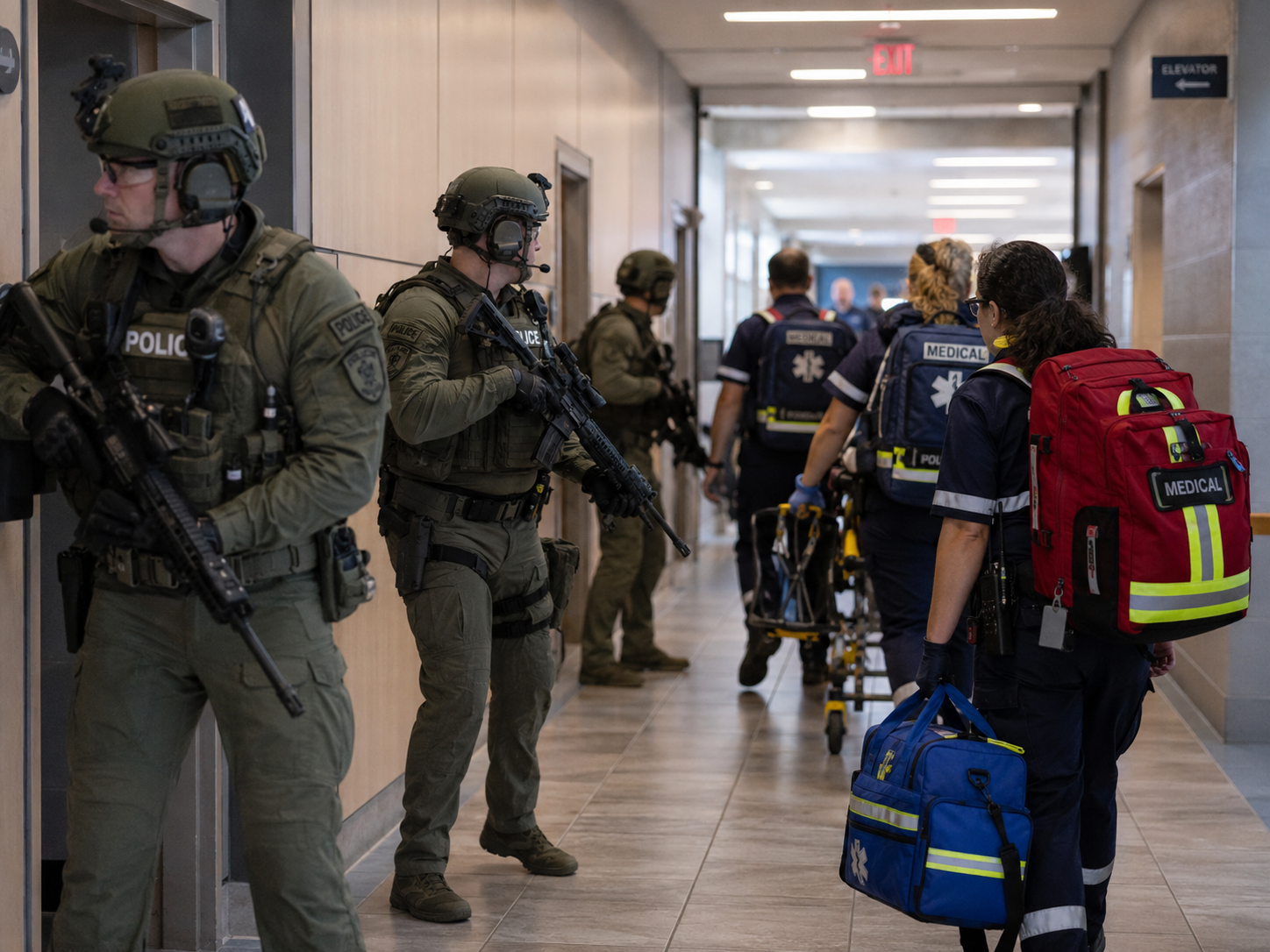
In multi-objective operations, law enforcement’s role extends beyond threat engagement. As officers move, clear, and contain, they also create protected space—corridors, rooms, or sectors where medical operations can initiate. This dual role does not dilute tactical focus; it enhances mission effectiveness.
Securing space for care involves:
Identifying areas with reduced threat probability
Establishing temporary control sufficient for rapid treatment
Communicating access windows to command and medical partners
This approach reframes clearing not as an end in itself, but as a means to unlock survivability. When officers understand that their movement directly enables medical intervention, tactical decisions naturally account for casualty access alongside threat suppression.
Early CCP Establishment as a Force Multiplier
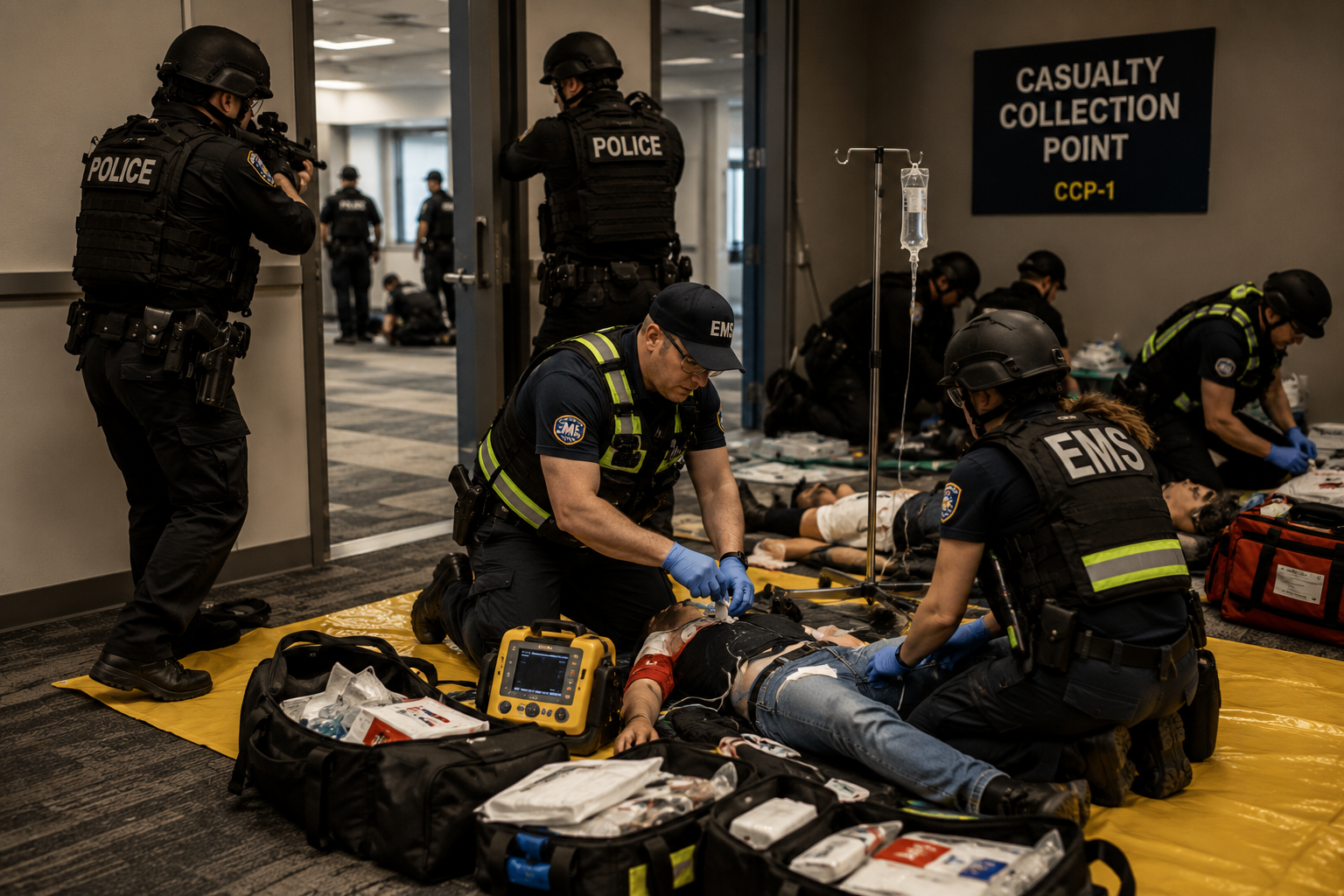
One of the most powerful outcomes of coordinated operations is early Casualty Collection Point (CCP) establishment. When CCPs are positioned as soon as space allows—rather than after full scene security—time-to-care collapses. Hemorrhage control, airway positioning, and rapid triage can begin while the incident is still active.
Importantly, early CCP establishment does not require full medical posture. Initial CCPs may be austere, mobile, and limited in scope. Their value lies in immediacy. Even minimal intervention at the point of injury dramatically improves outcomes compared to delayed evacuation.
Continuous relevance anchoring keeps attention on the outcome: a CCP that exists early saves more lives than a fully equipped CCP that exists late.
Parallel Personnel Utilization Across Disciplines
To prevent delays, personnel across law enforcement, EMS, fire, and emergency management must operate in parallel, not in sequence. This requires abandoning the assumption that one discipline must “finish” before another can begin. Instead, tasks are distributed based on capability and proximity, not organizational boundaries.
Examples of parallel tasking include:
Law enforcement continuing containment while escorting medical access
Fire personnel assisting with extraction while EMS treats
Command allocating resources dynamically as conditions evolve
Parallel utilization increases efficiency without increasing risk, provided coordination is clear. It recognizes that waiting for perfection is more dangerous than acting under managed uncertainty.
Tactical Flexibility in a Fluid Environment
Multi-objective operations demand tactical flexibility. Threat conditions shift, casualty numbers change, and access routes evolve. Rigid plans fracture under these pressures. Flexible operations, by contrast, adapt continuously while maintaining alignment with core objectives.
Tactical flexibility includes:
Adjusting CCP locations as space expands or contracts
Reprioritizing casualties based on dynamic triage
Modifying movement patterns to preserve access corridors
Progressive emphasis highlights the advantage: flexibility preserves momentum when conditions change, preventing operational paralysis and maintaining care continuity.
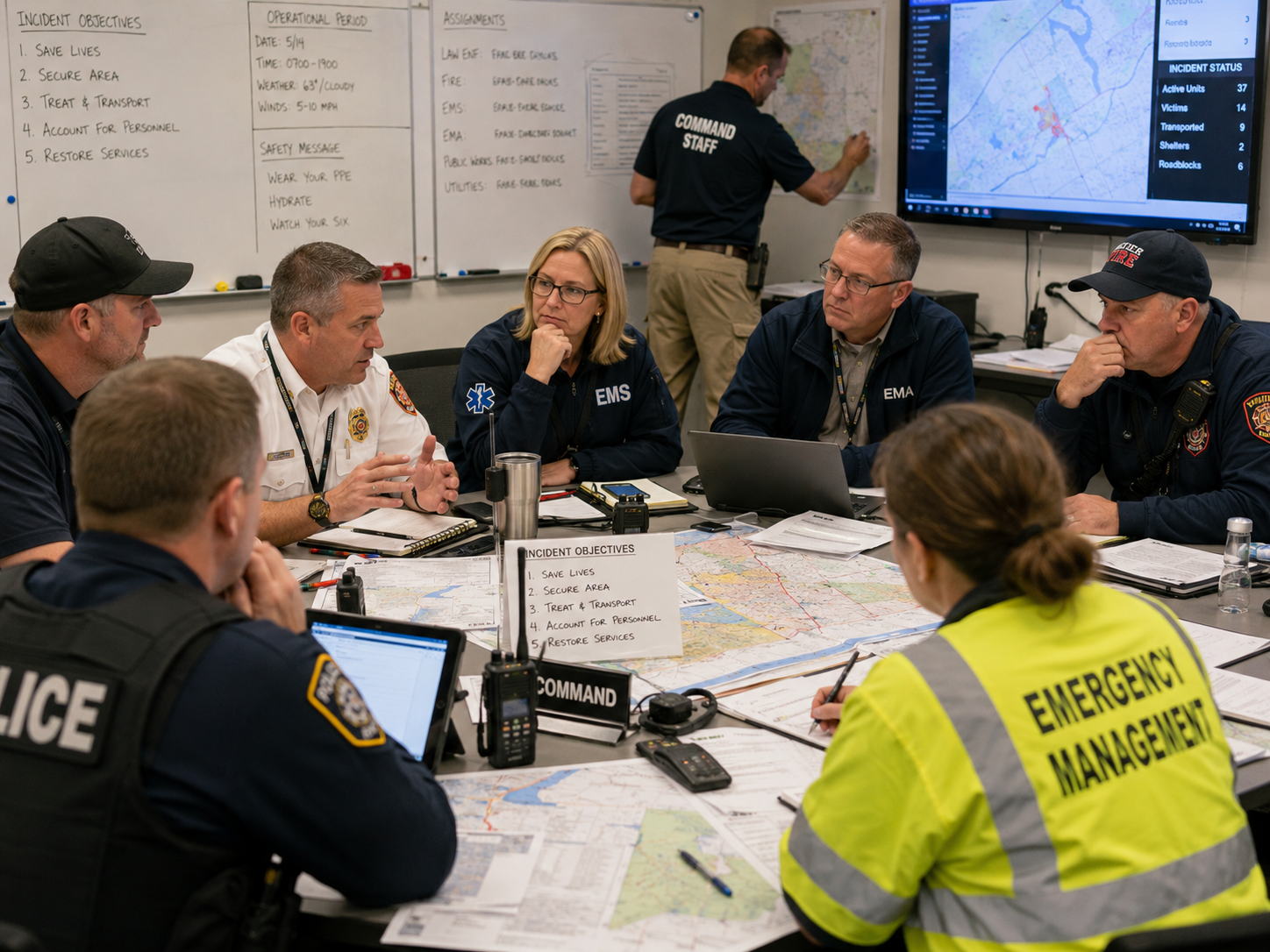
Command as the Synchronization Mechanism
Parallel operations require deliberate synchronization. The Incident Command Post (ICP) is not merely an administrative hub; it is the integration engine that aligns security, medical, and logistical actions. Command’s role is to see across disciplines, identify emerging opportunities for care, and authorize action before delays become fatal.
Effective command in multi-objective operations:
Communicates intent clearly and early
Prioritizes life safety alongside threat control
Adjusts objectives as new information emerges
By reinforcing shared priorities, command ensures that parallel actions converge toward stabilization rather than diverge into chaos.
Managing Interdependence Without Interference
Parallel operations introduce interdependence: actions in one domain affect outcomes in another. The goal is not independence, but interference-free interdependence. This requires disciplined communication, shared terminology, and mutual understanding of constraints.
When executed well, interdependence produces synergy:
Security actions shorten medical timelines
Medical progress informs tactical priorities
Command decisions balance risk across domains
Repetition with variation reinforces the lesson: coordination amplifies effectiveness; isolation multiplies delay.
Survivability as the Primary Performance Metric
Traditional evaluations often measure success by threat resolution alone. Multi-objective operations shift the metric to survivability. How quickly was care initiated? How many casualties received early hemorrhage control? How efficiently were patients moved toward definitive care?
By centering survivability, agencies align tactics with purpose. Decisions are judged not by tradition or optics, but by outcomes that matter to victims, responders, and communities.
Training for Parallel Execution Under Stress
Training must reflect the realities of multi-objective operations. Linear drills reinforce linear thinking. Scenario-based exercises that force parallel tasking build the cognitive flexibility required under stress. Responders learn to balance priorities, communicate across disciplines, and adapt without hesitation.
Effective training emphasizes:
Early medical access under partial security
Dynamic CCP establishment
Command decision-making under uncertainty
This prepares responders to fall to the right level of training when chaos erupts.
Progressive Emphasis: From Sequential Models to Integrated Action
As the analysis progresses, a clear progression emerges. Sequential models delay care. Parallel models compress time. Compressed time saves lives. The logic is cumulative and unavoidable. Coordinated, multi-objective operations are not a theoretical ideal; they are an operational necessity dictated by incident tempo and human physiology.
Continuous Relevance Anchoring: Stabilization Through Integration
The ultimate objective of high-threat response is stabilization—of the scene, the casualties, and the community. Integration accelerates this process. When security, medicine, and command advance together, chaos shortens, uncertainty diminishes, and recovery begins sooner.
Conclusion
High-threat incidents demand coordinated, multi-objective operations executed in parallel across security, medical, and command domains. Linear response models cannot keep pace with modern incident dynamics or physiological realities. By enabling law enforcement to create space for care, establishing CCPs early, utilizing personnel in parallel, and synchronizing actions through command, agencies dramatically improve survivability.
The science of listener attention reinforces what operations confirm: what begins early matters most, what happens together matters more, and what remains relevant saves lives. Coordinated, multi-objective operations do not complicate response—they align it with reality.