
Unified Command in Rapidly Evolving Incidents
Unified Command in Rapidly Evolving Incidents
In rapidly evolving high-threat incidents, outcomes are shaped less by the number of responding agencies than by how quickly those agencies align their decisions, priorities, and actions. Active shooter events compress time, fragment information, and overwhelm linear command structures. In these conditions, Unified Command is not an administrative preference—it is an operational necessity. When Unified Command is delayed, response efforts fracture along disciplinary lines, situational awareness degrades, and lifesaving opportunities are lost. When Unified Command forms early and functions effectively, disparate capabilities converge into a coherent, adaptive system capable of managing chaos.
This analysis examines the role of Unified Command in rapidly evolving incidents, with particular attention to early fragmentation, barriers to coordination, and the limitations of traditional Incident Command System (ICS) constructs under extreme stress. The central argument is that Unified Command must be established deliberately and early—even with incomplete information—because integrated decision-making is the only mechanism capable of synchronizing tactical action, medical intervention, and resource management in modern active shooter response.
Early Fragmentation as the Default Condition
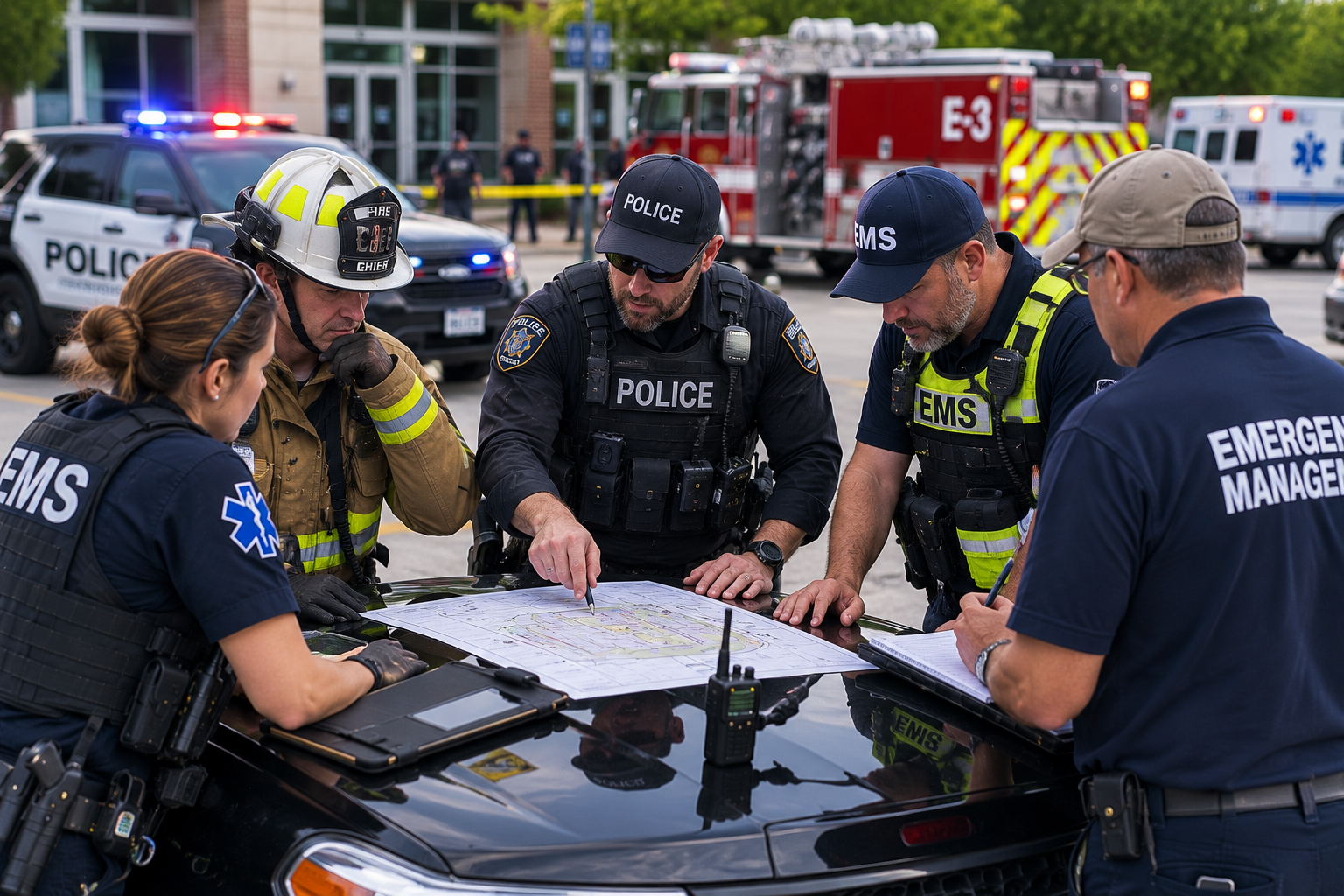
Most high-threat incidents begin in fragmentation. Law enforcement, fire, EMS, and emergency management arrive independently, often from different directions, with different information and priorities. Initial actions are necessarily discipline-specific: law enforcement moves toward the threat, fire and EMS stage for safety, and emergency management begins notification and coordination functions.
This fragmentation is not a failure; it is a predictable starting condition. The failure occurs when fragmentation persists beyond the initial moments of response. Without rapid convergence into Unified Command, agencies continue to operate in parallel rather than in concert. Decisions are made independently, priorities diverge, and critical actions—such as medical access, evacuation routing, and perimeter control—become misaligned.
In rapidly evolving incidents, fragmentation is inevitable; disunity is optional.
Why Unified Command Must Form Early
Traditional interpretations of ICS often emphasize establishing command once situational clarity improves. In active shooter incidents, waiting for clarity is a losing strategy. The environment stabilizes only after decisive, coordinated action—not before it.
Unified Command must form early, even when information is incomplete and conditions remain fluid. Early Unified Command does not require perfect intelligence or fully staffed command posts. It requires agreement on shared objectives, recognition of mutual authority, and a commitment to integrated decision-making.
When Unified Command forms early, agencies can align on life safety priorities, define operational boundaries dynamically, and anticipate downstream needs. When it forms late, command becomes reactive—chasing problems rather than shaping outcomes.
Operating Under Extreme Stress and Cognitive Load
High-threat incidents impose extraordinary cognitive demands on responders and commanders alike. Stress, time pressure, sensory overload, and uncertainty degrade individual decision-making. Under these conditions, reliance on isolated judgment increases error risk.
Unified Command mitigates this effect by distributing cognitive load across disciplines. Law enforcement contributes threat intelligence, EMS contributes medical prioritization, fire contributes hazard mitigation and rescue expertise, and emergency management contributes resource coordination. Together, these perspectives create a more complete operational picture than any single agency could generate alone.
This integration is not bureaucratic—it is neurological. Shared decision-making improves performance when individual cognition is taxed.
Barriers to Rapid Unified Command Formation
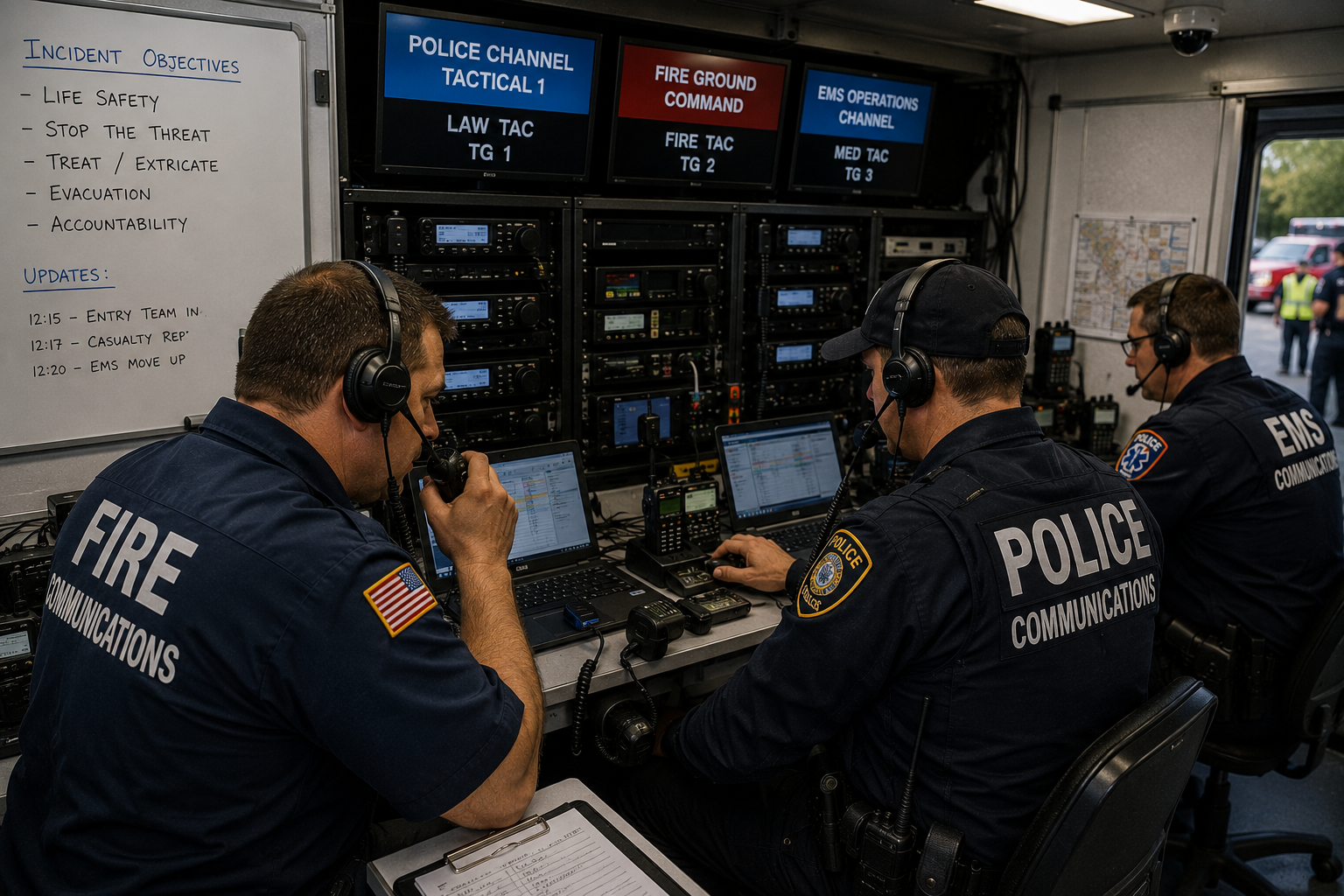
Despite its importance, Unified Command formation is frequently delayed by predictable barriers. Communications is among the most common. Incompatible radio systems, overloaded channels, and unclear communication protocols impede early coordination. Geography further complicates matters, as agencies may arrive at different locations and establish separate command nodes.
Incomplete or conflicting intelligence is another barrier. Early reports are often inaccurate, leading agencies to hesitate before committing to joint decisions. Ironically, this hesitation increases confusion rather than resolving it.
Cultural barriers also play a role. Agencies accustomed to operating independently may resist shared authority, particularly under stress. Without prior joint training and trust, Unified Command can feel artificial rather than functional.
These barriers are not incidental; they are structural. Overcoming them requires preparation long before incidents occur.
ICS in Dynamic and Chaotic Scenes
The Incident Command System provides a valuable framework for organizing response, but it was not designed for instantaneous convergence in chaotic, adversarial environments. ICS assumes progressive expansion, clear operational periods, and defined transitions—all of which may be absent in the early minutes of an active shooter incident.
This mismatch creates friction. Commanders may delay formal ICS implementation, perceiving it as too slow or cumbersome. Alternatively, they may implement ICS rigidly, constraining adaptability.
Unified Command in high-threat incidents requires flexible application of ICS principles, not rote adherence. Structure must support action, not delay it. Early Unified Command may be informal, mobile, and rapidly evolving—yet still effective if shared authority and objectives are established.
The Cost of Delayed Integration
When Unified Command is delayed, consequences cascade quickly. Law enforcement may clear areas without medical coordination, leaving casualties untreated. EMS may stage without understanding threat progression, prolonging delays. Fire may be unaware of tactical movements, increasing risk during rescue or suppression operations.
These disconnects produce redundant actions, conflicting priorities, and unsafe conditions. Most critically, they delay medical intervention—the factor most closely tied to survivability in high-threat incidents.
Delayed integration is not merely inefficient; it is dangerous.
Integrated Decision-Making as a Force Multiplier
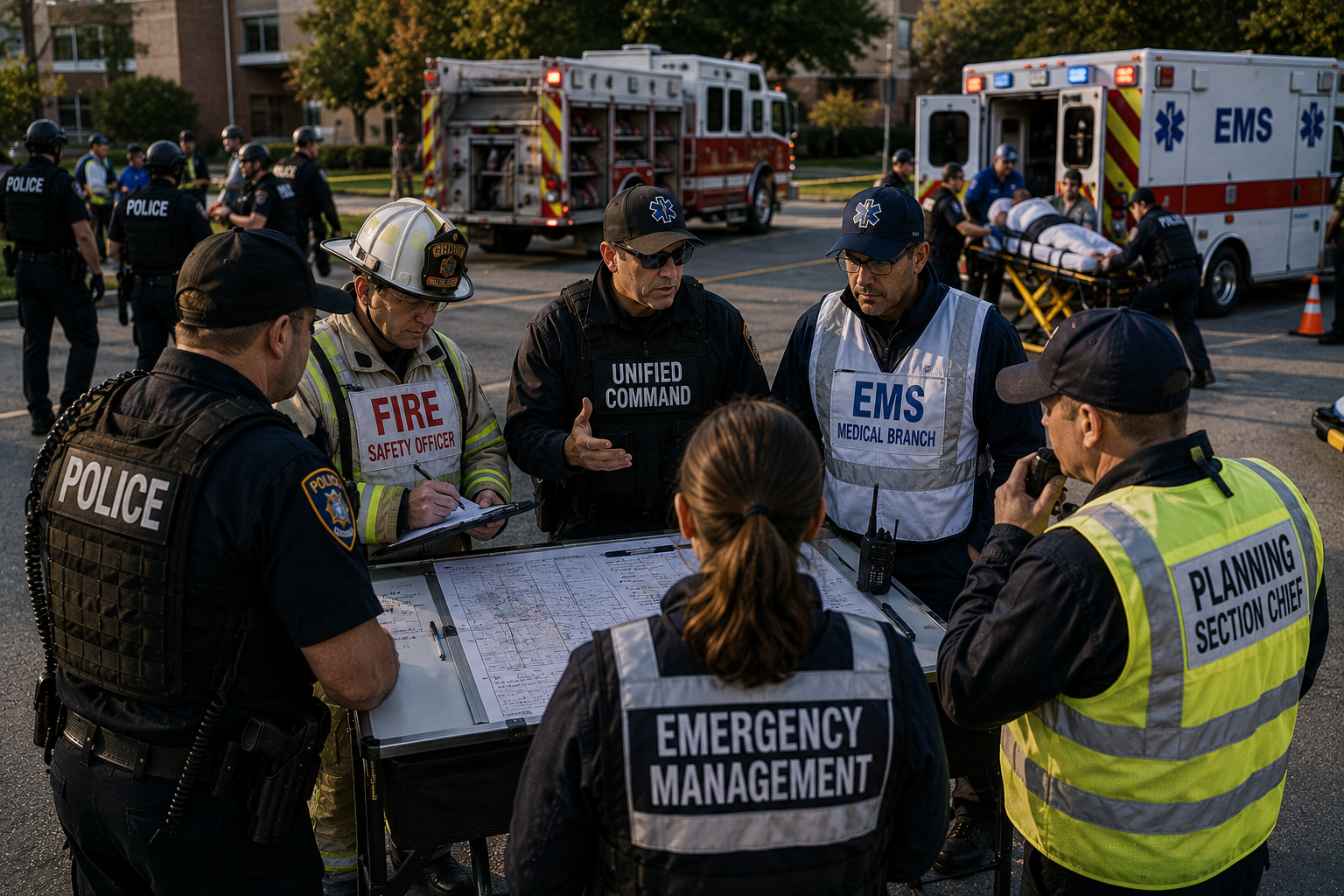
The operational value of Unified Command lies in integrated decision-making. When agencies plan and act together, decisions are informed by multiple domains simultaneously. Entry routes consider casualty access. Perimeter placement accounts for evacuation corridors. Resource requests align with actual operational needs rather than assumptions.
Integrated decision-making accelerates tempo rather than slowing it. Contrary to common belief, coordination does not delay action; misalignment does. Unified Command enables agencies to act faster because they act with shared intent.
This effect compounds over time. Early integration produces downstream efficiency, reducing confusion, duplication, and reactive correction.
Managing Uncertainty Through Collaboration
Active shooter incidents are defined by uncertainty. Threat location, offender status, casualty numbers, and hazard conditions shift rapidly. No single agency can resolve this uncertainty alone.
Unified Command provides a mechanism for managing uncertainty collectively. Information is shared, assumptions are challenged, and decisions are adjusted as new data emerges. This iterative process supports adaptability without paralysis.
Importantly, Unified Command does not eliminate uncertainty; it contains it, preventing uncertainty from fragmenting operations.
Unified Command and Medical Integration
One of the most significant benefits of early Unified Command is improved medical integration. When EMS and medical leadership are present in command decisions from the outset, casualty care is prioritized alongside threat management.
This integration enables early authorization for medical movement into warm zones, coordinated establishment of CCPs, and efficient use of transport assets. Medical timelines inform tactical decisions, aligning operations with survivability windows.
Without Unified Command, medical considerations are often reactive. With it, they become operational drivers.
Training and Doctrine as Preconditions
Effective Unified Command in rapidly evolving incidents does not emerge spontaneously. It must be built through joint training, shared doctrine, and repeated practice under stress. Agencies that have never trained together cannot expect seamless integration during crisis.
Doctrine must explicitly support early Unified Command formation, clarify authority relationships, and define expectations for shared decision-making. Training must simulate ambiguity, incomplete intelligence, and compressed timelines—reflecting real conditions rather than idealized scenarios.
Preparation determines performance when stress peaks.
Relevance to Modern Threat Environments
Modern high-threat incidents unfold faster and with greater complexity than the events that shaped early ICS doctrine. Multi-site attacks, hybrid hazards, and rapid casualty generation demand coordination from the first moments of response.
Unified Command is uniquely suited to meet this demand—if implemented early and flexibly. In environments where time is scarce and stakes are high, integration is not an administrative task; it is a lifesaving function.
Conclusion
Unified Command is the linchpin of effective response in rapidly evolving incidents. Early fragmentation among law enforcement, fire, EMS, and emergency management is inevitable—but prolonged fragmentation is not. When Unified Command forms early, agencies align priorities, share intelligence, and synchronize action under extreme stress.
Barriers such as communication challenges, geography, and incomplete intelligence complicate this process, but they do not negate its necessity. ICS must be applied flexibly to support rapid integration rather than impede it. The operational benefits of Unified Command—improved tempo, reduced confusion, and earlier medical access—directly translate into lives saved.
In modern active shooter response, Unified Command is not a final step once order is restored. It is the mechanism by which order is created.