
Building Unified and High-Performing Response Teams Through Shared Doctrine
Building Unified and High-Performing Response Teams Through Shared Doctrine
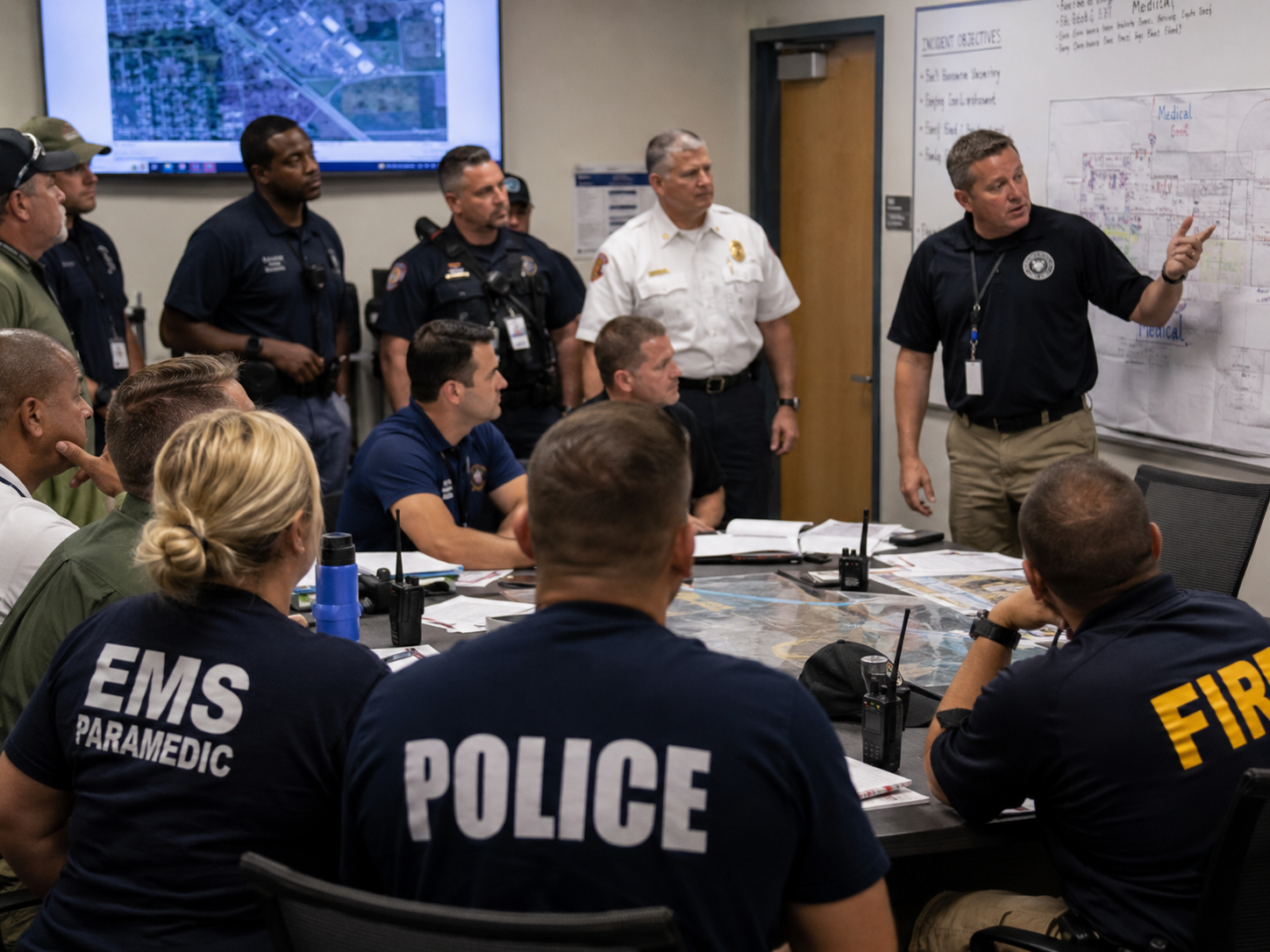
High-threat incidents do not test whether individual agencies are competent; they test whether multiple competent agencies can function as a single system. Active shooter events, complex coordinated attacks, and rapidly evolving mass-casualty incidents demand speed, precision, and adaptability under extreme stress. In these environments, breakdowns rarely occur because responders lack courage, equipment, or technical skill. Instead, failures most often arise from misalignment—differences in doctrine, terminology, and expectations that prevent agencies from acting in concert when seconds matter most.
The central premise of this analysis is that shared doctrine is the foundation of unified, high-performing response teams. Doctrine shapes how responders interpret information, prioritize actions, and coordinate with one another under pressure. When law enforcement, EMS, fire services, and emergency management operate from different doctrinal assumptions, even well-intentioned actions can conflict. Conversely, when agencies share doctrine and common operational language, coordination becomes fluid, parallel operations accelerate, and mission effectiveness improves measurably. This discussion examines how shared doctrine reduces miscommunication, enables synchronized action, and builds response teams capable of performing reliably in high-threat environments.
Why Shared Doctrine Matters in High-Threat Response
High-threat incidents compress time and expand complexity simultaneously. Responders must make rapid decisions with incomplete information while balancing multiple objectives: threat control, casualty care, scene management, and command coordination. In these moments, responders do not consciously analyze doctrine; they default to it. Doctrine becomes the mental shortcut that guides action when cognitive bandwidth is limited.
When doctrine differs across agencies, these defaults collide. Law enforcement may interpret a tactical milestone as authorization to advance, while EMS interprets the same condition as insufficient for entry. Fire services may assume hazards remain unmanaged while command believes mitigation has occurred. These disconnects are not the result of incompetence, but of doctrinal divergence.
Shared doctrine aligns these defaults. It ensures that when a term is spoken, a condition is declared, or an objective is set, all agencies interpret its meaning consistently. This alignment reduces hesitation, prevents duplication of effort, and accelerates life-saving action.
Doctrine as a Cognitive and Operational Framework
Doctrine is often misunderstood as a collection of policies or manuals. In practice, doctrine functions as a cognitive framework—a shared understanding of how problems are approached, how risk is managed, and how success is defined. In high-threat environments, doctrine determines what responders perceive as acceptable action and what they perceive as premature or unsafe.
A unified doctrine establishes:
Common assumptions about risk tolerance and managed exposure
Shared priorities regarding life safety, threat mitigation, and stabilization
Agreed-upon decision thresholds for movement, access, and care
When these assumptions are aligned, agencies can execute parallel tasks without constant clarification. When they are not, command must continually reconcile competing interpretations, slowing the response and increasing the likelihood of error.
The Role of Common Operational Terminology
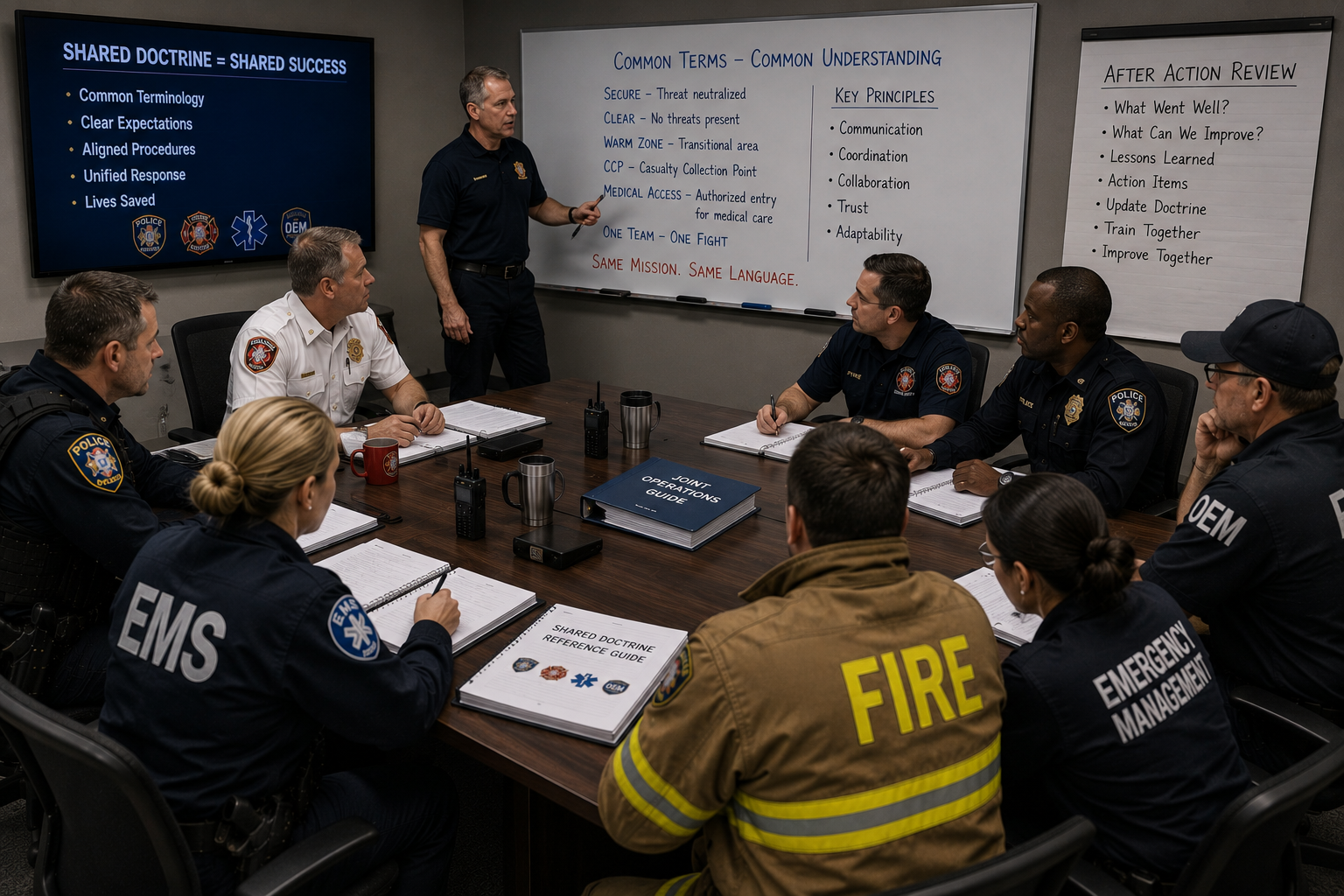
Language is the most visible expression of doctrine. Terms such as secure, clear, warm zone, CCP, or medical access carry operational meaning only when they are grounded in shared definitions. Without common terminology, communication becomes descriptive rather than directive, forcing responders to infer intent under stress.
Shared terminology enables:
Rapid transmission of intent without lengthy explanation
Predictable action across disciplines
Reduced radio traffic and clarification requests
In fast-paced operations, clarity is speed. When agencies speak a common operational language, fewer words are required to achieve coordinated movement. This efficiency is not merely convenient; it directly affects survivability by shortening the time to medical intervention and scene stabilization.
Reducing Miscommunication and Preventable Errors
Miscommunication is a frequent finding in after-action reviews of high-threat incidents. However, the root cause is often not poor communication skills, but inconsistent doctrinal interpretation. Agencies may hear the same message but act differently because their internal frameworks differ.
Shared doctrine reduces these errors by standardizing how information is interpreted. When objectives, conditions, and phases are defined consistently, responders can anticipate one another’s actions. This predictability reduces friction and prevents operational errors such as:
Delayed medical entry due to overly conservative assumptions
Premature movement into unsecured areas
Redundant tasking that wastes limited personnel
By eliminating ambiguity at the doctrinal level, agencies reduce the need for corrective communication during the incident itself.
Enabling Parallel Operations Through Doctrinal Alignment
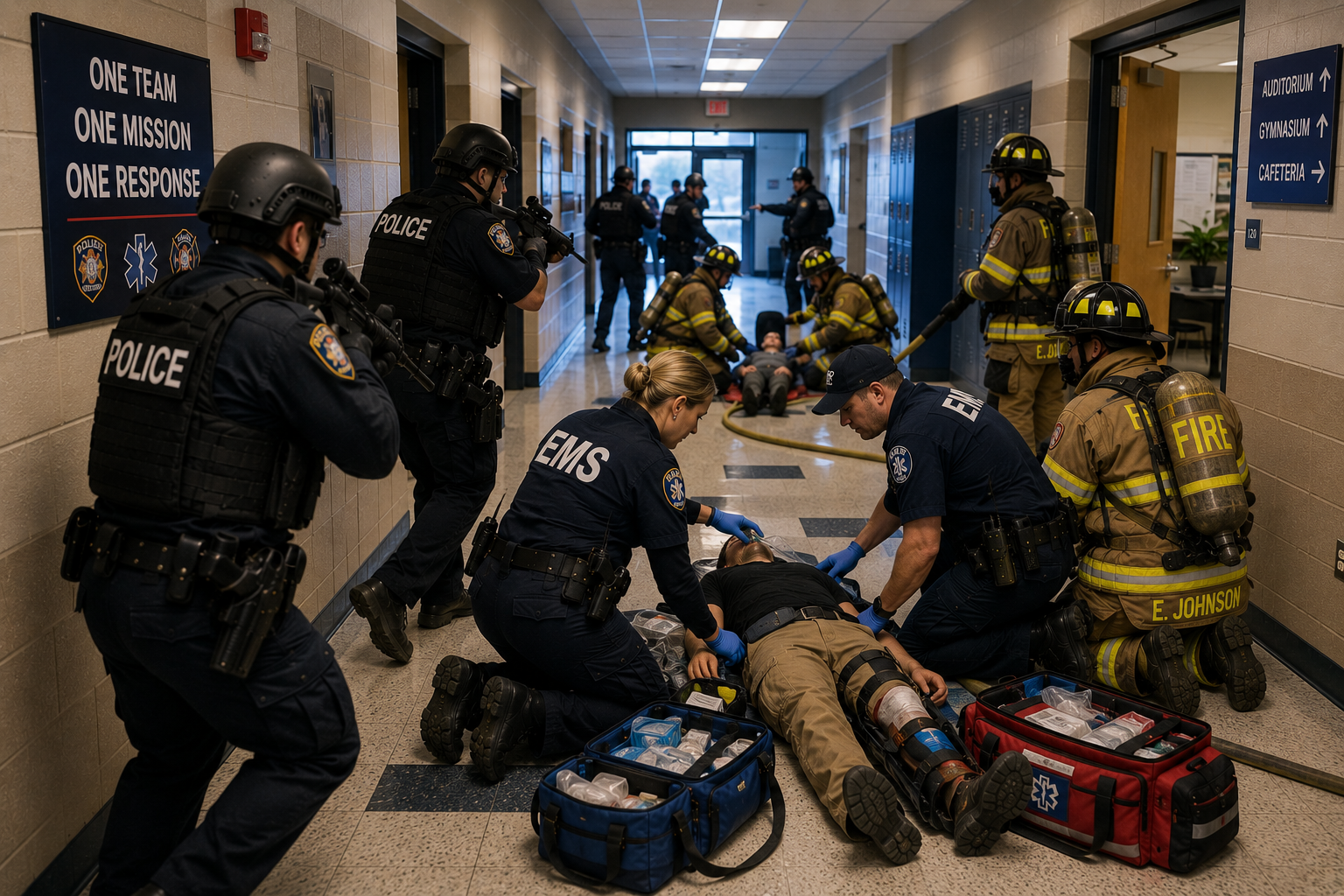
Modern high-threat response requires parallel execution. Threat management, casualty care, evacuation planning, and command coordination must occur simultaneously rather than sequentially. Parallel operations are only possible when agencies trust that others are operating under the same expectations and constraints.
Shared doctrine enables this trust. Law enforcement can create space for care knowing EMS understands the conditions under which entry is appropriate. EMS can initiate treatment confident that fire and law enforcement actions will support, rather than conflict with, medical priorities. Command can authorize movement without micromanaging details.
This alignment allows agencies to work in parallel without interference, dramatically improving operational tempo and outcomes.
Cross-Agency Alignment and Task Synchronization
High-performing response teams are distinguished not by rigid control, but by synchronization. Each discipline executes its role independently while remaining aligned with shared objectives. This synchronization depends on common doctrine that defines roles, boundaries, and interfaces between agencies.
Cross-agency alignment ensures that:
Law enforcement actions deliberately enable medical access
Fire services integrate hazard mitigation with evacuation needs
EMS operations align with tactical movement and security posture
When doctrine is shared, these interactions become intuitive rather than negotiated. Teams move fluidly, adjusting to changing conditions without losing coherence.
Agility and Adaptability Under Shared Expectations
High-threat environments are inherently unpredictable. Threat locations change, casualty numbers fluctuate, and access routes evolve. Teams operating under unified doctrine are more agile because they share expectations about how to adapt.
Agility emerges when responders understand not only what to do, but why they are doing it. Shared doctrine provides that context. It allows teams to adjust tactics while remaining aligned with overarching objectives such as life preservation and stabilization. This adaptability reduces paralysis when conditions deviate from plans.
Teams without shared doctrine may hesitate, waiting for explicit direction. Teams with shared doctrine adjust proactively, maintaining momentum despite uncertainty.
Shared Doctrine as a Trust-Building Mechanism
Trust is essential for high-performance teams, especially in environments that require managed risk. Shared doctrine builds trust by making actions predictable. When responders know how others will interpret conditions and directives, they are more willing to act decisively.
This trust reduces overly conservative behavior driven by uncertainty. Responders are less likely to delay action out of fear that others will not support them. Instead, they operate with confidence that their actions align with system-wide expectations.
Over time, this trust compounds, producing teams that function cohesively even under extreme pressure.
Training as the Vehicle for Doctrinal Integration
Shared doctrine cannot exist solely on paper. It must be trained, exercised, and reinforced. Joint training provides the environment in which doctrine is tested against reality and refined through experience. It also reveals gaps between written policy and operational behavior.
Effective training for doctrinal alignment emphasizes:
Scenario-based exercises that require cross-agency decision-making
Reinforcement of shared terminology and definitions
Evaluation focused on system performance rather than individual actions
Through repetition, doctrine becomes internalized. Responders no longer need to consciously recall procedures; they act instinctively within a shared framework.
Measuring Performance Through System Outcomes
The effectiveness of shared doctrine should be evaluated through outcomes rather than intent. Metrics such as time to medical access, speed of CCP establishment, efficiency of evacuation, and reduction in preventable mortality provide tangible indicators of alignment.
When doctrine is truly shared, these metrics improve consistently across incidents and exercises. When doctrine remains fragmented, performance varies widely depending on personalities and circumstances.
Outcome-based evaluation reinforces the importance of doctrinal alignment as an operational necessity rather than an administrative preference.
Sustaining Doctrine Across Agencies and Time
Doctrine must evolve as threats, tactics, and capabilities change. Sustaining shared doctrine requires ongoing collaboration, periodic review, and leadership commitment. Agencies must resist the tendency to drift back into discipline-specific language and assumptions.
Leadership plays a critical role by modeling shared terminology, reinforcing unified expectations, and prioritizing joint training. When leaders speak the same language and reference the same doctrine, alignment cascades through the organization.
From Coexistence to Cohesion
Many agencies coexist effectively during routine operations, but high-threat incidents demand more than coexistence—they demand cohesion. Cohesion arises when shared doctrine binds diverse disciplines into a single operational system.
This cohesion transforms response from a collection of parallel efforts into a synchronized operation. Actions become complementary rather than competitive, and outcomes improve accordingly.
Conclusion
Building unified and high-performing response teams begins with shared doctrine and common operational terminology. In high-threat environments, doctrine shapes perception, guides action, and determines whether agencies can operate as a cohesive system under stress. Unified doctrine reduces miscommunication, enables parallel operations, and strengthens trust across disciplines.
When law enforcement, EMS, and fire services align their expectations, language, and procedures, response becomes more agile, efficient, and effective. Preventable errors decrease, survivability improves, and stabilization occurs more rapidly.
In modern high-threat response, success is not defined by how well individual agencies perform in isolation, but by how effectively they perform together. Shared doctrine is the mechanism that turns coordination into cohesion—and cohesion into lives saved.